A multisensory exhibition at Chisenhale Gallery reveals how systems of care are entangled within state, corporate and military infrastructure
Much recent art about the politics of care has focused on its soft aspect: nonhierarchical solidarity, community and a gendered entanglement of femininity, ecology and nurture. Racheal Crowther’s new work offers a refreshingly sinister turn towards a vertical logic: turning a forensic gaze towards existing top-down infrastructures of care in which nurture, protection and social cohesion become entangled with technologies of discipline, surveillance and behavioural control.
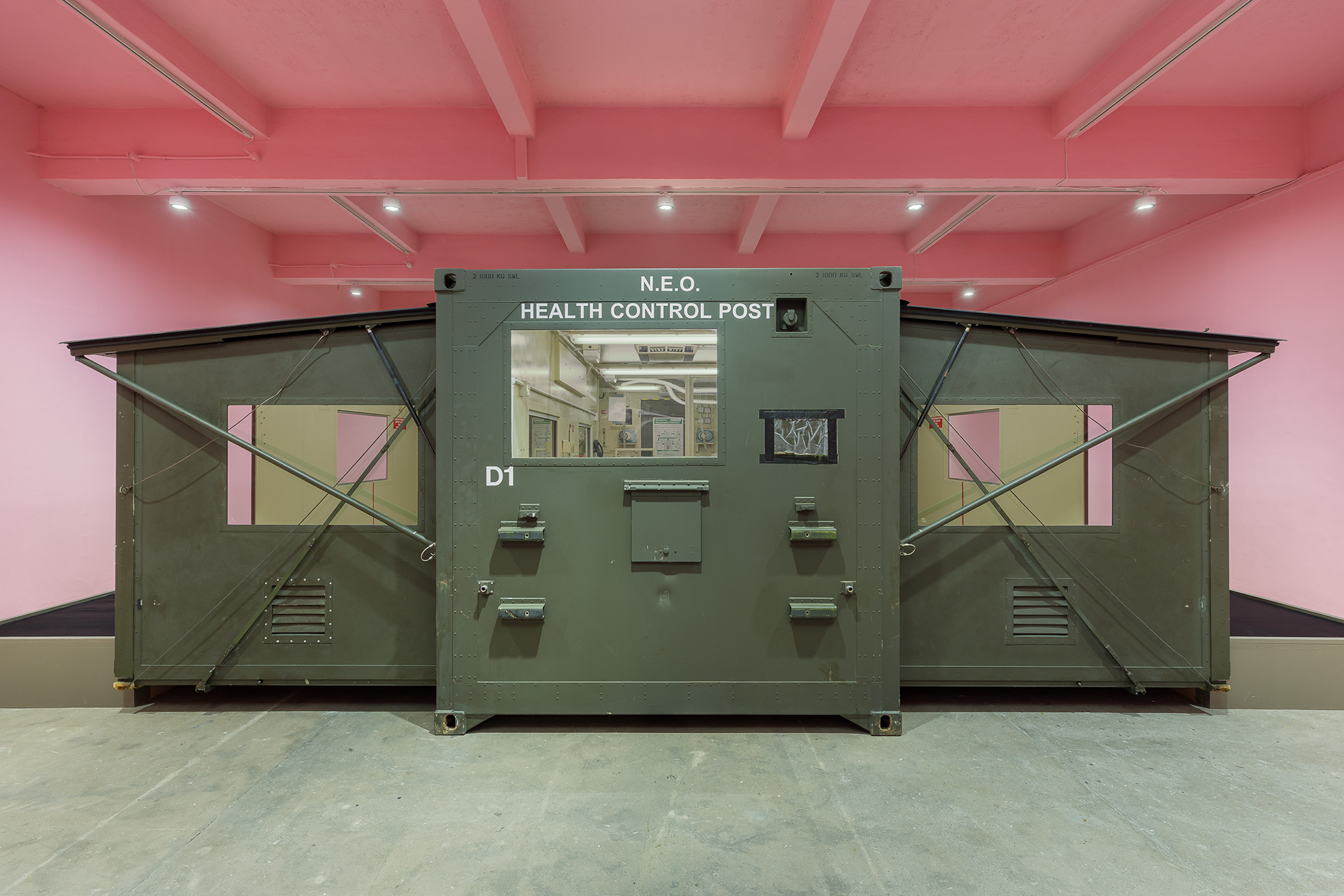
Borrowing its title from a 1990s pheromone perfume that promised instant trust and social bonding in a bottle, Liquid Trust reconfigures the gallery as a multisensory disciplinary apparatus. Bubblegum-pink walls under clinical overhead light; windows boarded over; an ominous khaki-green structure at the centre: three interconnected metal containers, their windowless facade with a heavy-duty latch door stencilled with a sequence of cryptic serial numbers in white and the words ‘Health Control Post’ the sole immediate clue to its origins.
The jarring atmosphere is thickened by a sickly sweet smell: a collaboration with a perfumier, the gallery text tells us, HS Code 04022911 (all works 2026) diffuses through hidden dispensers, its title the customs code for sweetened infant milk powder, whose history Crowther traces from dairy byproduct to military ration to near-invisible industrial additive. The scent includes hexadecanal – found on newborn scalps, shown to suppress aggression in men while amplifying it in women – alongside compounds tied to oxytocin, a hormone linked to lactation, also used in military-funded research into engineering social bonding between soldiers. The ‘Baker-Miller Pink’ covering the walls (once used to paint the walls of US correctional facilities on the basis of later-debunked claims that it suppressed aggression in detainees) hints at an institutional conviction that behaviour can be ‘hacked’ through design. Intimacy and nurture are co-opted by military and commercial industries as tools of behavioural control. All of this context, disclosed only in accompanying materials, shadows a concentrated visceral encounter that quickly generates fantasies of escape.
The towering presence of NSN 5411-99-219- 4744, occupying almost half of the gallery space, intensified this atmosphere. This readymade mobile health unit previously used by the British military was listed at a Ministry of Defence surplus auction as a ‘health control post.’ It evokes refugee detention centres or COVID-19 containment units – ‘protective’ architectures that serve to concentrate power in the name of the greater good.
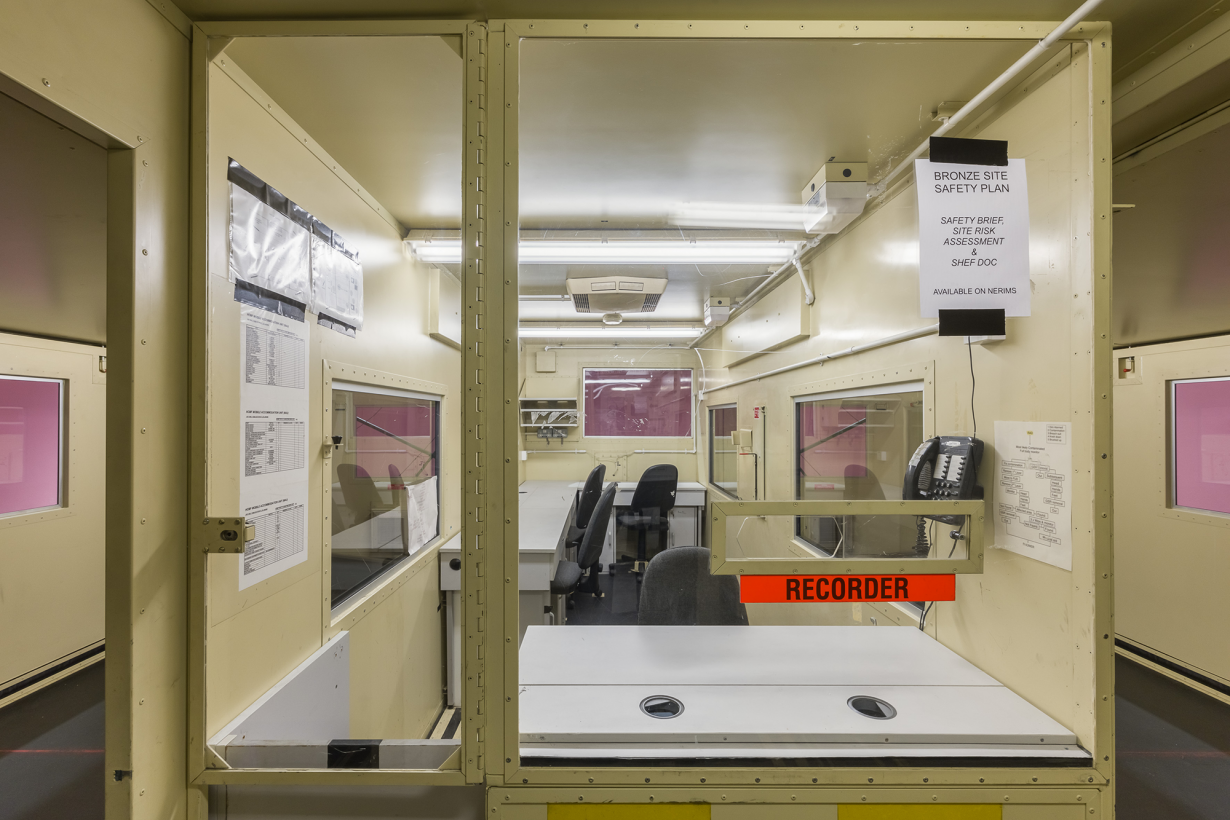
Visitors pass through the structure’s two wings, encountering use-faded cabinet labels, procedural instructions and warnings – while its central monitoring booth remains sealed off but visible through glass. Circulating this opaque bureaucratic nucleus, we’re cast as the monitored body; the nature and criteria of its Kafkaesque authority remain opaque. But since Liquid Trust works through the language of the readymade, the critical stakes lie in tracing its elements through the infrastructures through which they circulate, and to consider their position within the economic and political structures of the gallery. The military unit’s acquisition is part of this politics: purchased through a contractor engaged by the MOD to dispose of surplus assets and return the proceeds to its military activities – the same ones Liquid Trust holds up for scrutiny – the artwork’s own position within that circuit remains, pointedly, unresolved.
Pivoting away from artworld discourses about care, Liquid Trust redirects attention towards the state, corporate and military infrastructures that implicate systems of care. At a moment when political authority – the traditional guarantor of care under the social contract – is increasingly entangled with tech giants, corporate power and the military-industrial complex, Crowther’s paranoid atmosphere captures a broader collective anxiety about whose interests systems of care ultimately serve, whether they still operate for the greater good and who gets to define their terms.
Racheal Crowther, Liquid Trust is on view at the Chisenhale, London through 14 June
Read next Notes on the Gallery as Military Hangar