Can painting achieve new forms of fluidity once it subjects free association to self-imposed restrictions?
Amy Sillman has been heralded as a feminist painter, her typically gestural, intuitive and unruly brushstrokes interpreted as traces of fraught intimacy, aborted memory and bodies adrift with violent eroticism. However, it is evident that a certain interpretive tendency attaches to Sillman and her women painter peers such as Laura Owens, Jacqueline Humphries and R.H. Quaytman, who have, alongside new developments in feminist and queer cultural theories, risen to prominence since the early 1990s with largescale works that meticulously think through the circulation and production of postmodern images and repressed histories.
Art historians and curators tend to frame these painters in clichés, presupposing that they take conceptual and formal cues from the unconscious, for instance, or that they delight in the spontaneous eruption of affect or are attuned to the vitality of matter. While these claims hold some truth, as seen in Sillman’s earlier paintings that figure tragicomic sexual encounters, mythological scenography and abject confrontations with mortality, recent developments in Sillman’s three-decade practice, characterised by the artist’s nonhierarchical attitude towards materials, artistic movements and references, depart from a set of demanding questions irreducible to such theoretical frameworks: can painting achieve other forms of fluidity once it subjects free association to self-imposed restrictions? Can precision and control coexist with care and affection for more democratic modes of viewing and making sense? Can authorship exist in both singular and plural forms?
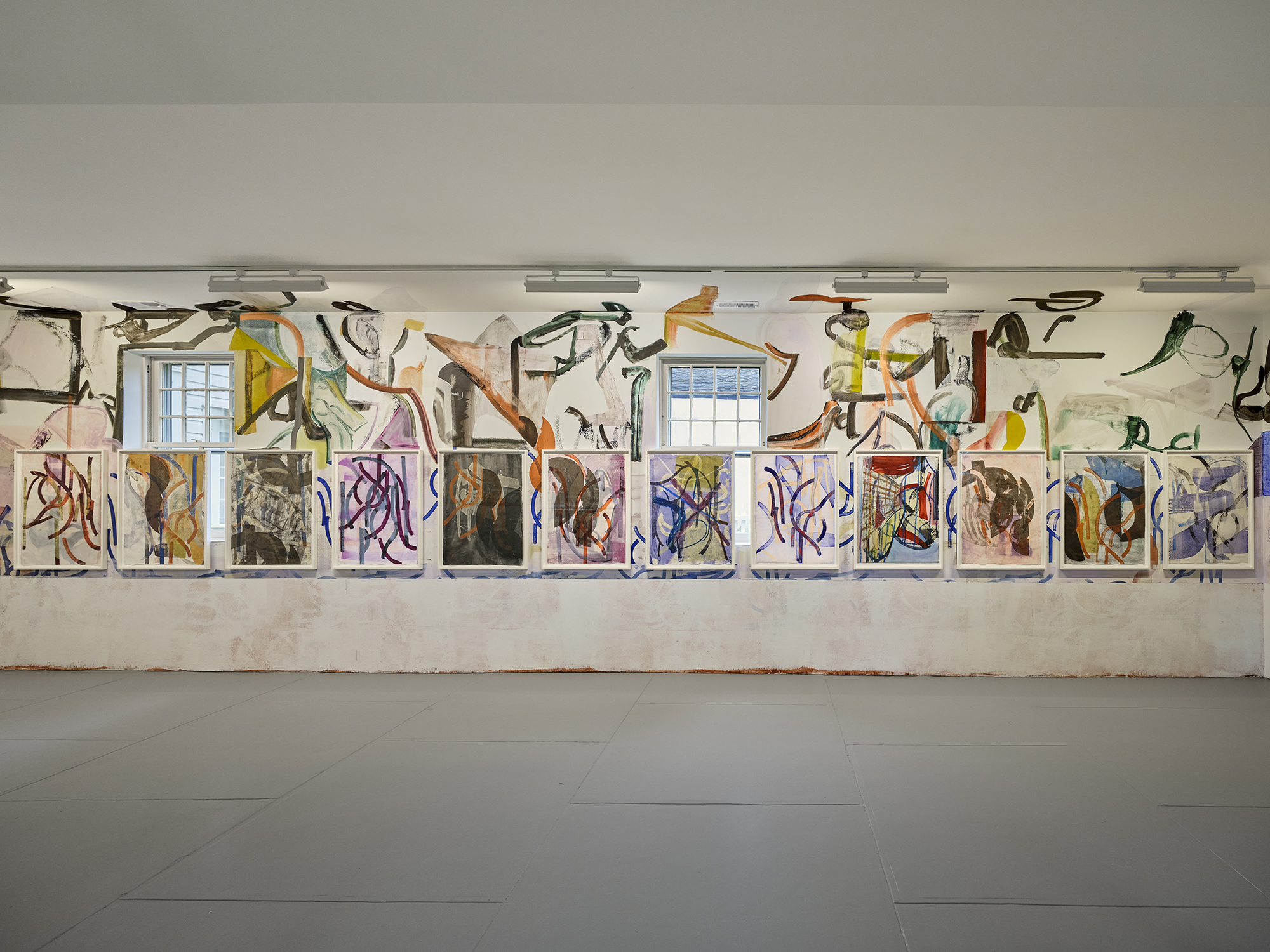
Alternate Side (Permutations #1–32) is conceived as one site-specific installation, consisting of a series of 32 framed and untitled monotypes, hung on gallery walls that are themselves host to improvised painting and screenprinting. The monotypes, which offer an interplay between image and asemic writing, deploy a small pool of forms, ranging from vertical, slightly zigzagging lines of various lengths and thickness to ovals of different sizes. In one, lines of burgundy and storm-cloud grey wiggle against a light pink backdrop. Another is filled with whirling bands of Persian blue and black. Sillman couples and decouples these shapes against hazy colour fields and seems to revel in her own mark-making processes, laying bare traces of production.
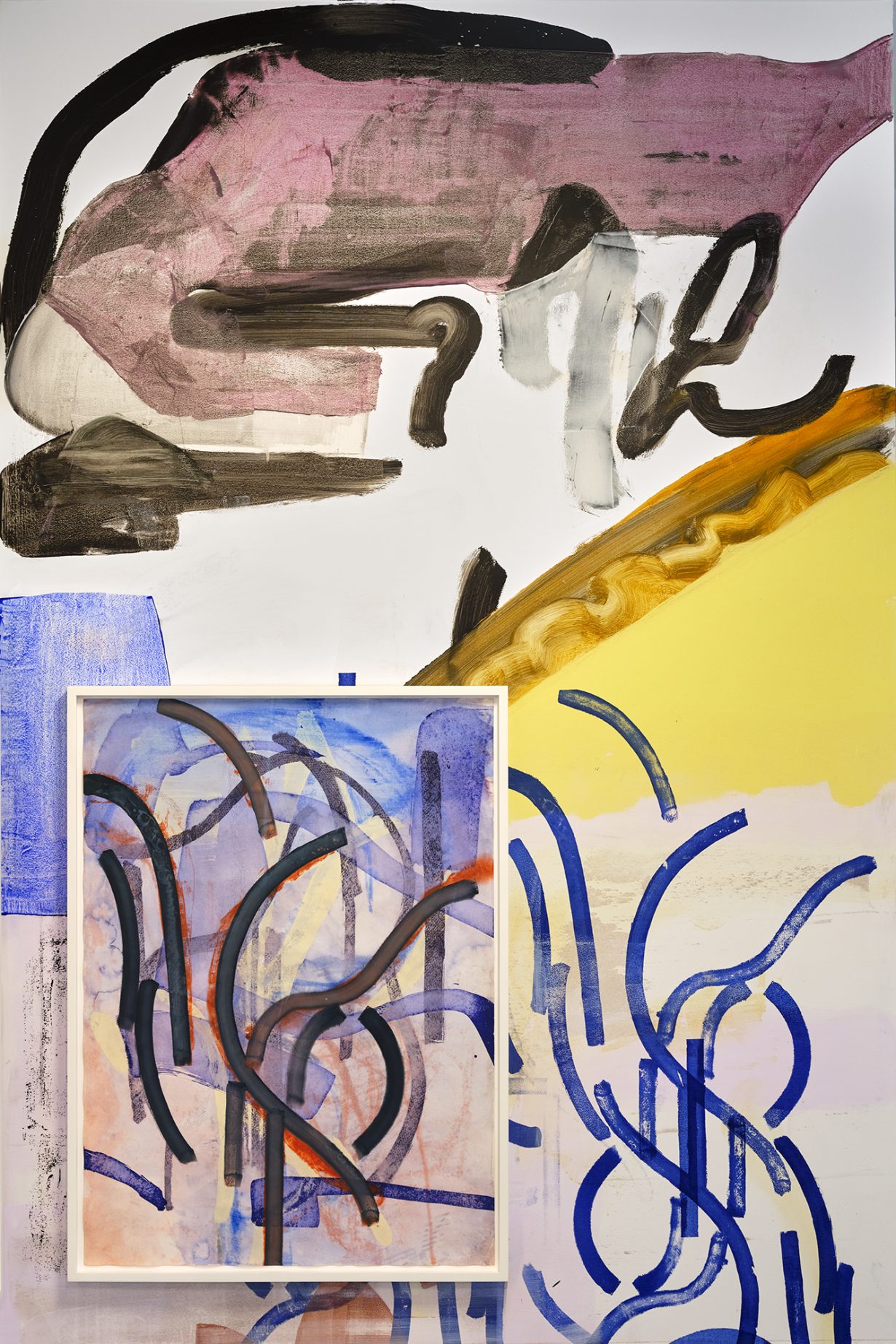
Printmaking can be unpredictable. These monotypes – produced during Sillman’s residency at Two Palms, an organisation that supports the production of artists’ prints and multiples – are irreproducible, full of chance and accident. Their surfaces, with the artist’s investments and gestures scraped, reworked and repeated but never erased, allow for a multitude of traces to coexist. The multiplicity of scales and shapes is most prominent in the black-and-white screenprints on the north wall. These monochrome prints, with their shallow depth of field, recall a ruined facade but ultimately point to their own making, demonstrating Sillman’s careful play with density, volume, definition and flatness, and how such play turns the painterly logic of time back on itself.
Around them, the painted and screenprinted walls appear at first as a ground of sketches, or a site of construction, that reveals the building blocks of the artist’s monotypes. Alternate Side continues Sillman’s problematising of painting as an autonomous object and closed field of operation. The south walls beam with quasi-Fauvist vibrancy, thanks to the artist’s frenzied application of unconventional materials – like turmeric – using sponges and squeegees. The resulting shapes splinter and fuse; vaguely figurative but ultimately disturbed by Sillman’s avoidance of direction and depth, they retreat into opacity and illegibility. The north walls see spatters, pulls and pours of ink that flow and wander into subdued lines of flight, loosely corresponding with the screenprints installed on them, which harbour more condensed forms and gestures.
Sillman resists the ontological and epistemological purity of painting, yet she ultimately isn’t interested in easy ambiguity or ambivalence. Instead she rejoices in her environments and her influences, at every turn complicating these with an intentionally devised and imposed grammar and rules. Sillman sets up binary oppositions only to collapse the two in one operation of immanence and unpredictable order, one that measures the inexact borders between language and perception, cause and effect.
Alternate Side (Permutations #1–32) at Dia Bridgehampton, through 25 May
From the October 2025 issue of ArtReview – get your copy.
Read next The many ways of R.H. Quaytman