Hardy’s humanoid Beings blend vitality and disintegration, dynamism and destruction
The forlorn spirit of Anne Hardy’s Interloper – a suite of floor-based installations and assemblage sculptures, spread across two adjoining galleries at Visual – feels well-matched to my late-winter state of mind and body. The British artist’s rough-wrought amalgams of cast, found and crafted objects comprise much that looks bent out of shape or barely held together. Most of the sculptures, whether resting on muddy foundations or otherwise accessorised with earthy detritus, present as twisted or partial humanoid entities. Some of the materials they are made up of – rusted wire, crushed tin cans – accentuate age and deterioration, wear-and-tear. Two of the pieces sit on low cuboid plinths shaped from compacted topsoil: brittle, crumbling supports, their flaked, pitted surfaces a mosaic of multiplying cracks. They are envisaged, so their titles declare, as life-size ‘Beings’, each one identified with a different attribute or association. Some, like Being (Contortionist) (2025–26) and Being (Interloper) (2026) stretch or kneel, as if performing yoga poses or prayer rituals – perhaps striving, against the odds, to improve or centre the self.
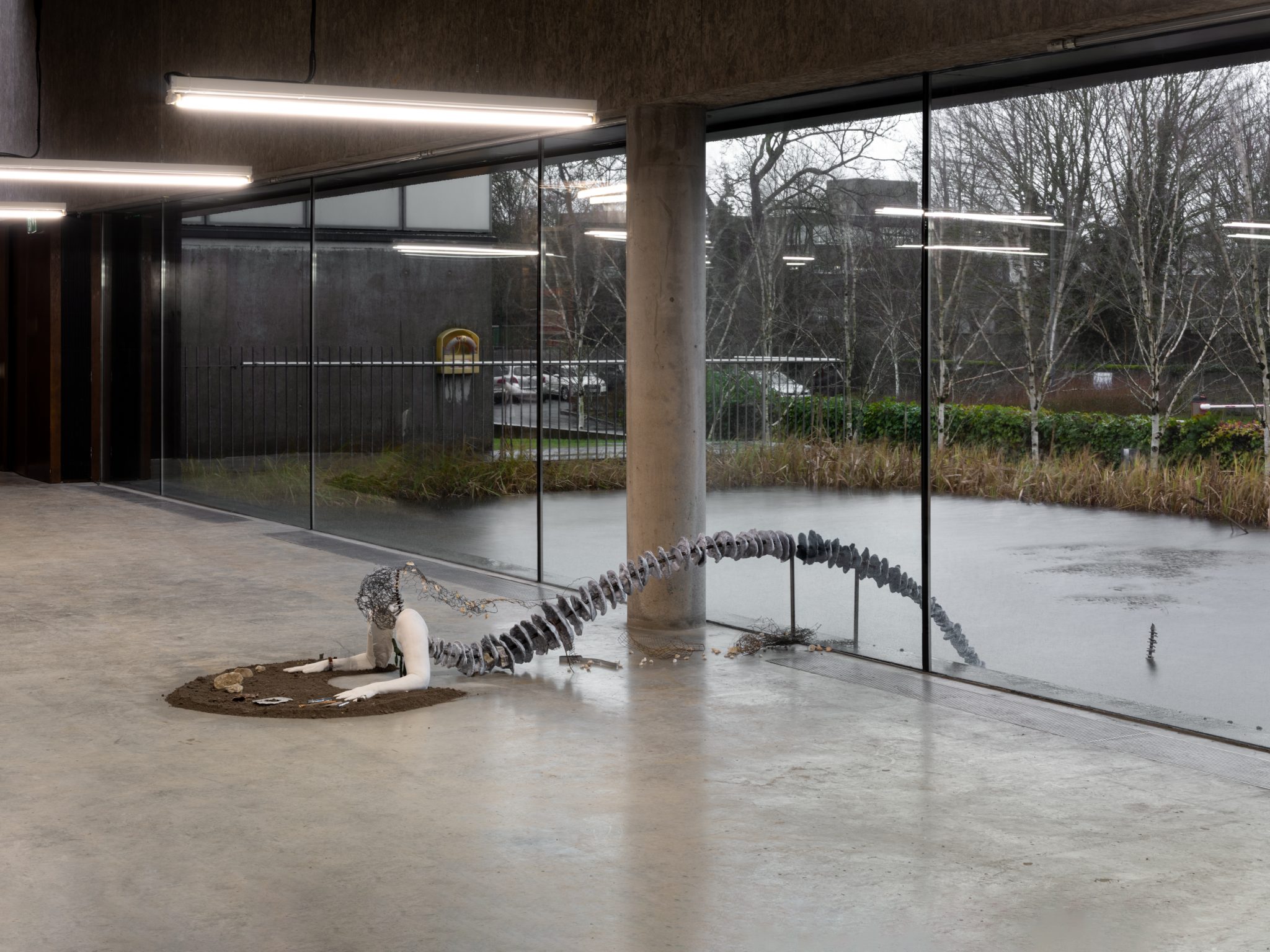
Other forms lean towards other fantasies. In Being (Immaterial) (2023–24) the legs and extended hand of a resting body adopt a peaceful, meditative position, yet instead of a torso and head, Hardy adds a gnarly bundle of rusted wire. Being (Chimera) (2026) imagines a version of the titular human-animal hybrid: in Greek mythology a ‘she-goat’ with a serpent’s tail; here a monstrous, pewter-cast snake-skeleton, augmented and personalised with casts of the artist’s arms low-planking on a crescent of soil. In all cases, whether not-quite-whole or not-quite-human, these wayward portrayals of living presence share a fundamental absence: they lack an inner core. Hardy costumes her welded-steel bone structures and Jesmonite castings of hands, arms and high-heeled footwear with her own hand-me-down clothes, adorning the figures with an assortment of collected bric-a-brac (seashells, discarded ring-pulls, antique jewellery); as such, she attends sensitively to how they pose and appear. But look close: these human avatars are merely hollow, faceless outlines, each one a straining, dressed-up void.
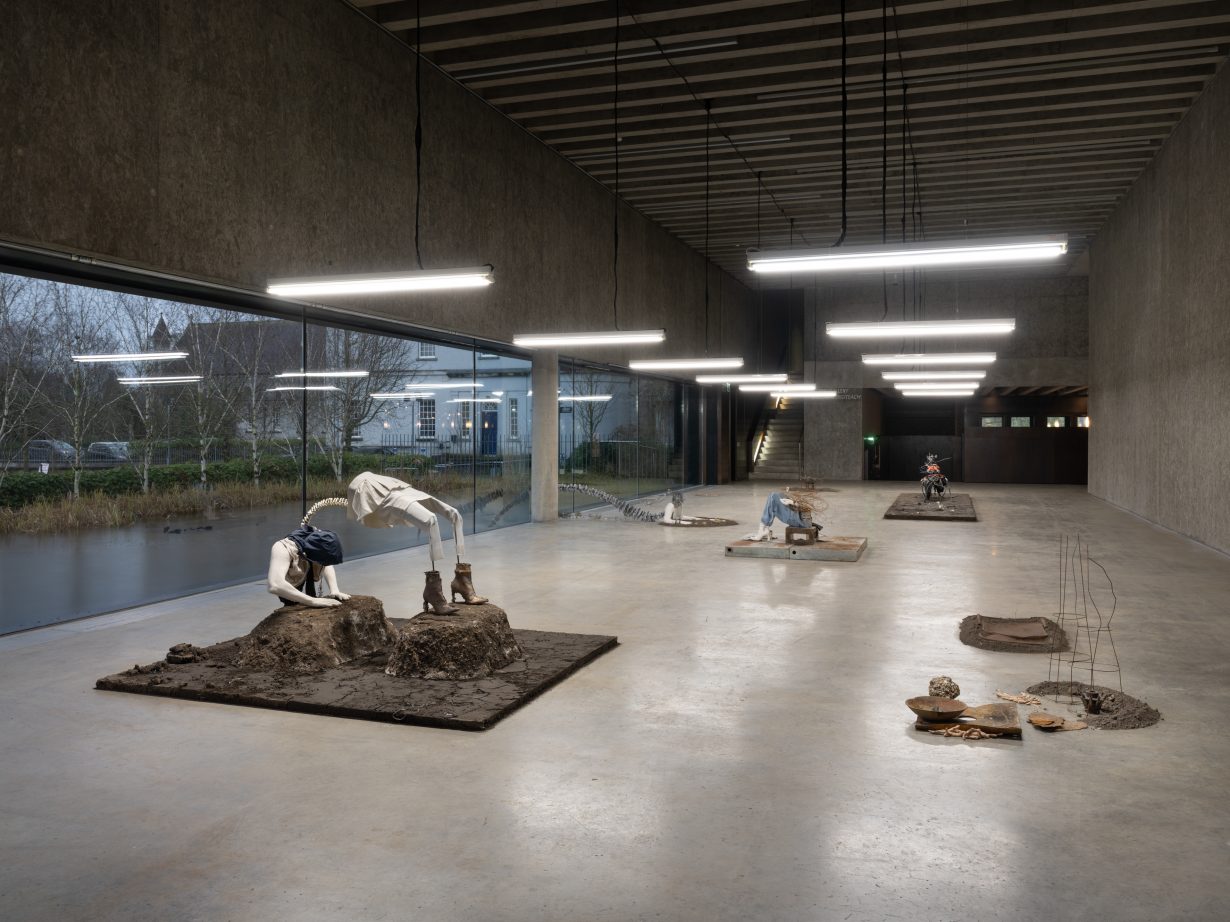
Hardy’s Beings might be read as ghoulish ravesties of ‘wellbeing’ culture – collectively a bleak tableau vivant satire on personal improvement. A degree of self-admonishing might be implied: there appears to be, after all, a fair amount of the artist’s outer being – her body, her clothes – in these oblique evocations of arduous self-care. (Notably, many wellness adherents recommend ‘soil rituals’ as effective means of grounding mind and body.) Yet Hardy’s art remains too studiously messy to be summarised in such a tidy thematic way. Both in her prior mode as a painstaking maker of uncanny photographic fictions (largescale images of staged interior scenes: abandoned spaces suggestive of private parties, occult activities, underground bunkers) and through her subsequent shift towards elaborate three-dimensional installation, her work has centred on the production of rigorously detailed enigmas: puzzle-box narratives, compressed into single still images, or dispersed as multipart sculptural scenarios.
In Interloper the commitment to mystery remains strong, maintaining a vigorous push and pull of clashing effects. Best, on that front, is Being (Slipstream) (2024–26): a reaching, cyborgian rocket-woman, soaring above a thick block of sculpted earth. Arms extended – modelled, once again, from Hardy’s own – with a motorcycle helmet for a head, the upper body appears to power forward. Below the neck, however, in place of human anatomy, the airborne figure is a wild tangle of wires, cables and inner tubes. Like much that we encounter here, the slipstream ‘being’ is a figure of beautifully grotesque Ballardian contradiction: a vision of vitality plus disintegration, dynamism and destruction.
Interloper is on view at Visual, Carlow, through 10 May
From the March 2026 issue of ArtReview – get your copy.