Explore the 2025 Power 100 list in full
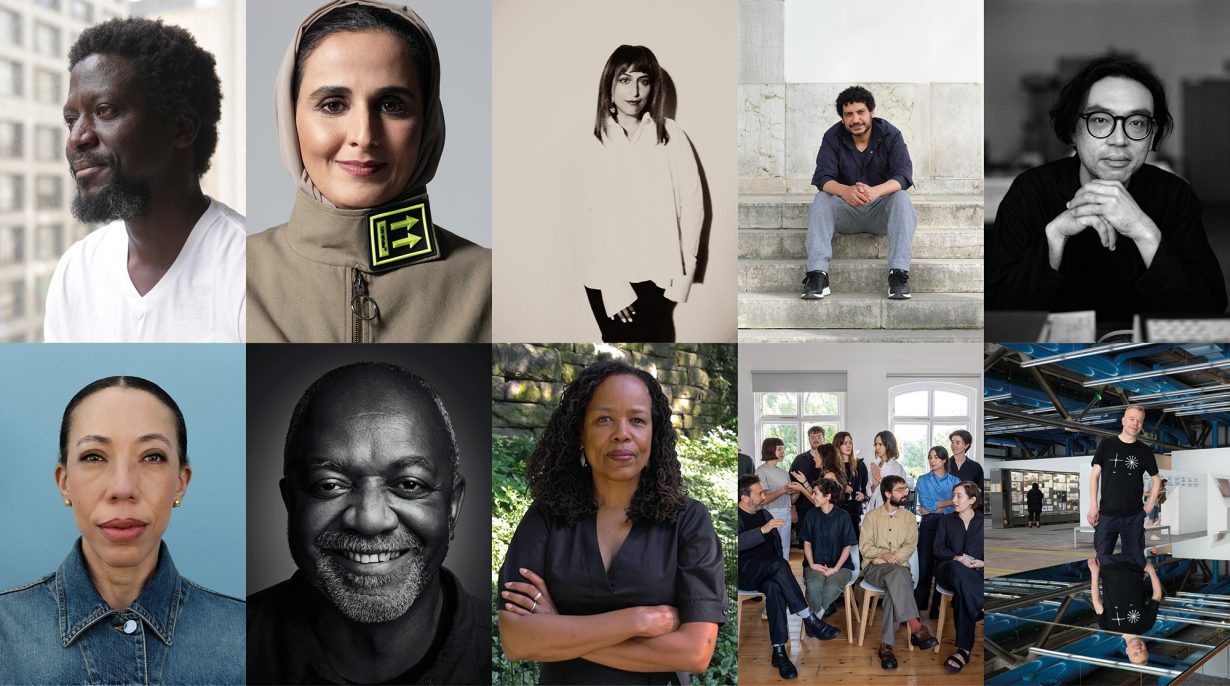
The artist Ibrahim Mahama heads ArtReview’s Power 100, its 24th annual ranking of the people who have shaped art over the past year.
The Ghanaian artist came to prominence over the past decade with large installations, often using jute sacks and remnant textiles – such as leftover cloth from Ghana’s cocoa industry – stitched together by teams to form giant quilts that he has then draped over buildings. Mahama is the first person from the African continent to occupy the top spot on the Power 100, his place on the list a result of his role as both an artist and as a creator of infrastructures that assist other artists in realising their visions.
Mahama’s work addresses issues of labour, extraction and exploitation. He makes use of his position in a global artworld to reflect back on those issues practically, creating educational and art institutions while also establishing collaborative partnerships. For the past few years, Mahama has been directing his blue-chip-gallery sales profits into a series of institutions in his hometown of Tamale: the Red Clay Studio, the Savannah Centre for Contemporary Art (SCCA) and Nkrumah Volini, which host residencies, student projects, children’s workshops and exhibitions. As older models of museums and galleries struggle, the potential for new forms of support for and sharing of art are key issues for the present and near future. Mahama is emblematic of the way in which many artists today are taking control of the means of production as well as the means of distribution.
This year’s top ten is in part defined by artists who, like Mahama, are creating their own infrastructure, reflecting a desire to bring artmaking closer to artworld-making. Egyptian Wael Shawky is ‘curating’ an art fair, Singaporean artist Ho Tzu Nyen is curating a biennale. Elsewhere on the list others have founded residency programmes (Mark Bradford, Yinka Shonibare, Tracey Emin), or built their own art centres and schools (Wolfgang Tillmans, Theaster Gates, Marina Abramović, Emily Jacir, Dalton Paula, RAQS Media Collective), or are creating new ecosystems though biennials and festivals (Sammy Baloji, Bose Krishnamachari). This is alongside groups like Forensic Architecture, blaxTARLINES and Cercle d’Art des Travailleurs de Plantation Congolaise who are reinventing how their work should be distributed and who their audiences should be. Many of these individuals or groups operate in locations and contexts outside of traditional centres of commercial, governmental and philanthropic resources.
The increasing presence of the Gulf States near the top of this list (Sheikha Al-Mayassa bint Hamad bin Khalifa Al-Thani, Sheikha Hoor Al Qasimi, Badr bin Abdullah Al Saud) reflects another form of institution building, with the enormous resources they are pouring into arts and culture both shifting the emphasis of their carbon-centric economies and recognising the arts as a means of burnishing a national brand. With culture wars and austerity raging in old art-power centres such as the US, Germany and the UK, the Gulf is increasingly becoming a platform from which artists and curators can expand their work.
This shift is also a recognition that museums and galleries are in a moment of flux. In many traditional art centres, museums are at a stalemate of funding and programming, there is alarm about the closure of so many familiar mid-level galleries and many of the blue-chip megagallerists are reporting dramatic falls in profits of (up to almost 90 percent in some regions according to newspaper reports). The past 12 months have seen many art patrons (such as Miuccia Prada, Bernard Arnault, François Pinault and Han Nefkens) cut out the former middlemen to instead provide funds directly to artists through their own private institutions or production funds. The galleries that remain on ArtReview’s list (and there are certainly fewer of them than in the past) do more than simply sell art, with David Zwirner’s publishing endeavours; Emmanuel Perrotin’s pop and fashion crossovers; and Hauser & Wirth, Prateek Raja & Priyanka Raja of Experimenter and Liza Essers of Goodman embracing pedagogy.
The list as a whole speaks to our current moment, confronting issues of censorship and subjugation: artists, curators and thinkers who deal with representation and technology, while asking what art can do in a world that’s increasingly defined by conflict.
The Power 100 is compiled by a panel of around 30 individuals from across the globe, and from all parts of the artworld, who propose those people who have shaped the art that has emerged in their locality over the past year. The criteria for inclusion are that each person on the Power 100 has had an influence on the art being made and shown now; that they have been active in the last 12 months; and that their presence stretches beyond a local scene (while many act locally, the influence of that local action can reverberate internationally). What emerges is a means of capturing an artworld that is not purely an economic system, or an aesthetic one, but a complex social system. Through this list, ArtReview gives a portrait of the network of relationships that shaped the art of 2025.
First published in 2002, ArtReview’s Power 100 is the most established and widely circulated annual ranking of influence in the contemporary artworld. Sheikha Hoor Al Qasimi topped the list in 2024; Nan Goldin in 2023; Ruangrupa in 2022; and ERC-721, representing NFTs, in 2021. Founded in 1949, ArtReview is one of the world’s leading international contemporary art platforms, dedicated to expanding contemporary art’s audience and reach, and to tracing the ways it interacts with culture in general. Aimed at both a specialist and a general audience, the flagship magazine and its sister publications, ArtReview Asia (launched in 2013) and a quarterly Chinese edition of ArtReview (launched in 2022), feature a mixture of criticism, reviews, commentary and analysis alongside commissioned artist projects, guides and special supplements. A Japanese-language edition was launched online in 2025.