Presenting González as a global and contemporarily relevant artist, this exhibition returns a painful image of our world
Colombian artist Beatriz González (1932–2026) referred to her work as ‘bad painting’. Her current retrospective at the Barbican, the first in the UK, is however testament to a six-decade career committed to the medium and its force as a form of political commentary.
González’s work is at times satirical and at others mournful. Her archival style reimagines popular images through bi-dimensional silhouettes painted in saturated colours, allegorising Colombia’s colonial legacies and agitated recent history while spelling out what art can say about violence without reproducing it (be it through voyeurism or propaganda). That’s not to suggest that art itself escapes her critical gaze: establishing a direct dialogue with the better-known exemplars of the European canon, from Leonardo’s Mona Lisa to Manet’s The Luncheon on the Grass and Vermeer’s The Lacemaker, she coarsely interrogates the ways in which art history has been a vehicle for cultural imperialism.
Meanwhile, her attention to the readymade image and its circulation between Europe and Latin America has been linked with an expression of international Pop art less focused on a critique of consumerism than on the societal effects of political violence and the pernicious legacies of colonialism. The context of her early practice is a period of accelerated industrial development following a ten-year civil war known as La Violencia (1948–58), and as economic and cultural reform accelerated during the relative peace of the 1960s, González became a chronicler of a highly stratified society buying into the promise of modernisation. During these early days of her work, González combined her self-proclaimed ‘provincial’ attention to local issues, objects and images with a Borgesian cosmopolitanism in dialogue with Velázquez, Da Vinci, Millet, Picasso, Warhol and Botero, alongside other, often anonymous makers of votive images, postcards (of Queen Elizabeth II, among others) and portraits of political leaders. Paradoxically, this promiscuity of sources marks the cultural specificity of González’s creations, given how European culture travels to Latin America through bad quality images and art history manuals that often flatten historical time and both geographic and cultural difference.

A section of González’s extensive archive of newspaper clippings, postcards and photocopies that served as sources for her paintings is discretely included in the exhibition. Looking at those alongside her own creations lays bare the fact that her ‘reproductions’ are far from direct: they flatten the figure, rely on an expressive (rather than documentary) colour palette and often combine scenes from different events, generating ‘unacademic’ paintings that can be perceived as either playful or damning allegorical sketches. González was proudly outspoken about her poor performance in an art market attuned to more ‘neutral’ styles, in particular to geometric abstraction, which was widely perceived in the 1960s and 1970s in Latin America as international, ‘exportable’ art. Due to her interest in mass media and the sentimentalism of the tabloid press, she became, by contrast, associated with cursilería (imperfectly translated as kitsch), which taste-making Colombian-Argentine critic Marta Traba praised as an autonomous cultural expression and a bitingly humorous take on Colombian society.
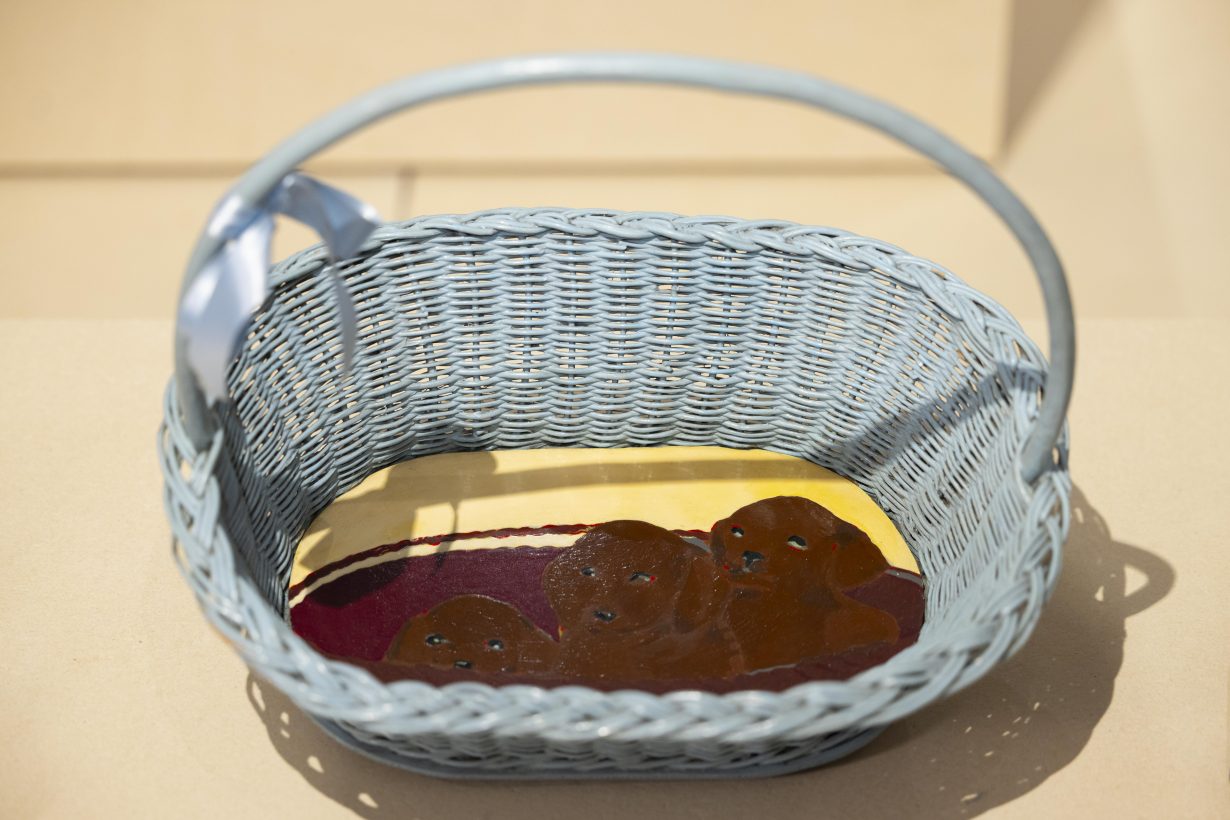
As well as her paintings and serigraphic drawings (often conceived to be cheaply reproduced and fly-posted), the exhibition displays a wide array of González’s intervened found objects, including several now-renowned works of painted furniture, such as The Last Table (1970), a faux-wood dining table overpainted with a reinterpretation of Da Vinci’s The Last Supper (1495–98), and I Was Born in Florence and I Was Twenty-Six When My Portrait Was Painted (Sentence Uttered in Low and Soft Voice) (1974), a coat rack featuring a brightly coloured Mona Lisa in lieu of a mirror. Lacemaker in Situ (1973) is a small, yellow-painted wicker basket, likely found in one of Colombia’s craft markets, to which González added an underlid depicting, in commercial enamel, a lacemaker leaning towards her worktable. The object belongs to González’s early series of paintings and sculptural assemblages based on Vermeer’s The Lacemaker (c. 1669–70), which catapulted her to fame at the age of thirty-one when they were shown at the Museo de Arte Moderno de Bogotá. The small, freestanding basket invites the viewer to lean forward to decipher precisely what kind of synthesis between ‘local’ colour and high art defines González’s hybrid aesthetic: the viewer must look carefully and decipher the spatial and corporeal codes of the everyday, just as González did in her own creations. (Regretfully, the gallery’s alarm beeps nervously when one does, a sign of how removed from the everyday González’s art has become as a consequence of her own success.)

As the show unfolds chronologically from the Barbican’s upper to lower galleries, we’re confronted with an exhaustive consideration of González’s art, which enhances the prior iteration of the exhibition at the Pinacoteca de São Paulo (2025) with loans by major international collections, mostly from the United States. The result is not just the first display of a number of works in the UK, but also a memorial gathering of artworks now spread worldwide. A rare sighting in the exhibition is, for instance, the three renderings of The Sisga Suicides (all from 1965) hung side by side in one of the upper galleries. Each is a slightly different version of González’s now iconic appropriation of a photograph she had found in the tabloid press depicting a young couple before their double suicide. The original news piece describes their death as an attempt to cleanse the woman’s reputation after their romantic encounter, a gender imbalanced account of their death based on the suicide note left by gardener Antonio María Martínez Bonza. One of the values of this comprehensive yet slightly solemn exhibition is therefore the opportunity to reappraise González’s oeuvre as a totality at a time marked by her recent death on 9 January this year.
During the mid-1980s, González’s work shifted from a broad commentary on the life and circulation of high art and popular images to an exploration of the ways in which painting can become a means to awaken a society anesthetised by the daily gore of political and drug-related violence. González found herself ‘unable to laugh’ after the seizure by the M-19 guerilla group of Colombia’s Palace of Justice – which led to hundreds of casualties when the army raided the building. Once justice had been literally ‘taken hostage’, González’s art began to bear witness to the human suffering resulting both from guerrilla-led narco-violence and government-supported paramilitary groups. The visual archive thus turns toward press photographs of corpses being recuperated from mass graves, widowed women crying in despair, eviscerated bodies and many more instances of unspeakable grief. In her attempt to represent the unrepresentable, she universalises a depth of feeling as an act of empathy and protest.

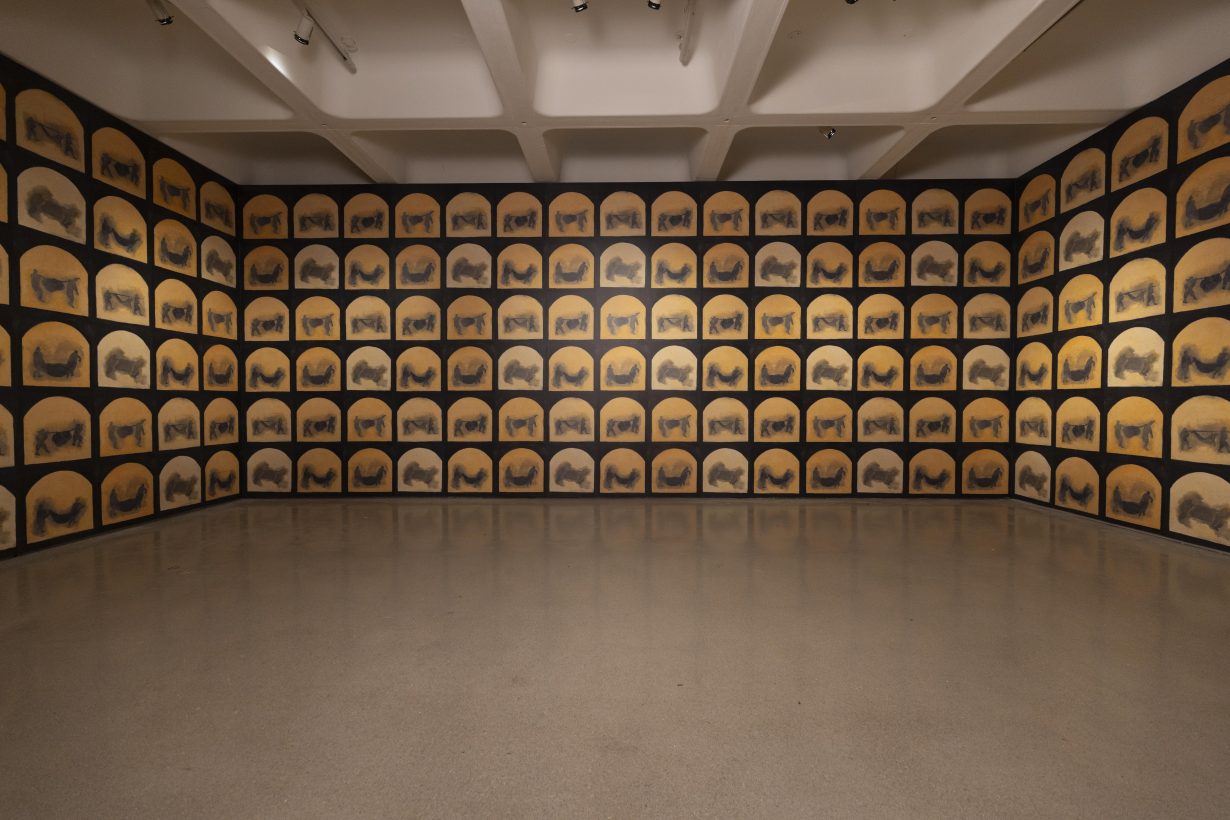
The exhibition appositely closes with a small iteration of González’s site-specific installation Anonymous Auras (2007–09). Prompted by the news that Bogotá’s government was intending to demolish the Block B building of the city’s Central Cemetery – six neoclassical structures where victims of political conflict in Colombia had been buried and then rehoused due to the building’s deterioration – González took the initiative, with fellow artist Doris Salcedo, to save the building and turn it into a site of mourning. She sealed each of the 8,956 niches and printed on their exterior surface silhouettes of men and women carrying cadavers, drawn by González on the basis of real photographs of cargueros transporting bodies found in mass graves. The last room of the exhibition reproduces this vast mausoleum in small scale. The repetitive silhouettes are affixed as wallpaper; the room is otherwise empty. A sense of void and quietness allows for the weight of loss to take expression. However, rather than leaving the viewer paralysed, González’s repetitive invocation of the shadows of the dead and those brave enough to reclaim their bodies becomes an affirmation of life and of memory over a machinery of destruction deeply embedded in capital accumulation and cultural extraction. Since it is clear that this machinery continues to hold sway over the loss of innocent lives, González’s non-conformist understanding of the politics of art haunts the departing viewer.
This is an important show of a Latin American artist deserving of much greater recognition in the UK and a unique opportunity to see a body of work that, being based on reproductions, defies reproduction, due to the large scale, bold colours and unorthodox shapes of many of González’s creations. Presenting González as a global and contemporarily relevant artist, the exhibition returns a painful image of our world today, as unstoppable violence takes a new palette.
Beatriz González is at Barbican Art Gallery, London, through 10 May
Read next The Interview: Beatriz González