KAWRUH: Land of Rooted Practices explores different modes of sensemaking but doesn’t offer many fresh openings
In Faisal Kamadobat’s installation Piwulang Suwargi (2025), human and nonhuman life intertwine in lavishly illustrated visions that combine Islamic and Javanese mythologies. The work comprises panels akin to large standing pages of an illuminated manuscript. One image depicts a gigantic human heart sprouting leaves, on which tiny humans are standing. Another shows three sages meditating in front of a stone, around which sinuous shoots and fronds extend. These mystical scenes are illustrations based on the teachings and experiences of a Sundanese traditional leader called Ki Girang Tampian.
This work is a fitting entry point to this edition of the Biennale Jogja, which adopts the theme of kawruh, a Javanese word meaning the deep, lived knowledge that comes from experience, habit and ritual – the sort of knowledge contained in, say, a traditional farmer’s almanac, which includes ecological patterns and religious rites. Exploring alternative epistemologies and belief systems, the biennale aims to decentre Western frameworks (human-centric, scientistic, extractivist) and explore other ways of engaging with the world. The biennale’s format also aims to challenge more output-focused exhibition models by unfolding in two phases: the first part being process-driven and located in a small village outside Yogyakarta called Boro Hamlet. Invited artists immersed themselves in local practices, resulting in a small showcase of works that coincide with the village’s traditional harvest festival. The second phase is a more conventional biennale presentation featuring the work of about 60 artists, spread out around 11 venues. This review focuses on the latter phase – an uneven, fitfully realised experience characterised by haphazard organisation and occasional moments of brilliance.
The exploration of peripheries plays out in venues with viewing conditions of varying degrees of difficulty. A major venue is the Purnama Store, a second-floor unit slated to house a supermarket but still under construction, so that the staircase has no railings and clouds of dust rise up when you tread on the unfinished cement floor. In this gritty environment, you encounter a playful vision of multispecies, multibeing coexistence in Yuta Niwa’s painting Non-dual Mandala of the Banquet Table (2025), which blends Japanese and Javanese belief systems. A mountain at the top, with a moon and sun on either side, represents the sacred realm. The composition then flows down into the secular world, where there is a busy tableau of anthropomorphised animals feasting lustily. The lived experiences of marginalised communities are explored in Posak Jodian’s videowork Misafafahiyan – Teman dari Jauh (2025), bringing together three Indonesian transgender performers and Hao Hao, an Amis transgender performer from Taiwan. In confessional scenes and song-and-dance segments, they share their experiences surviving on the streets and setting up an organisation to help other transfolk.
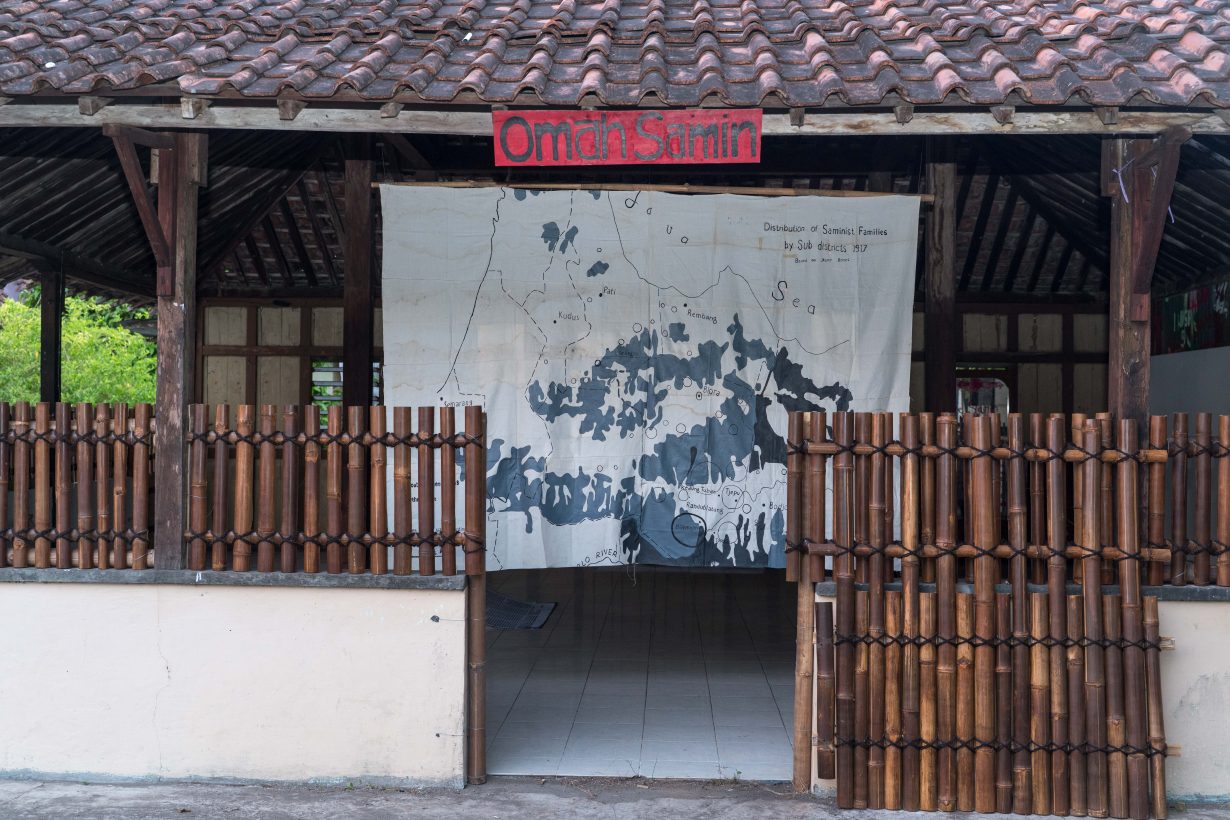
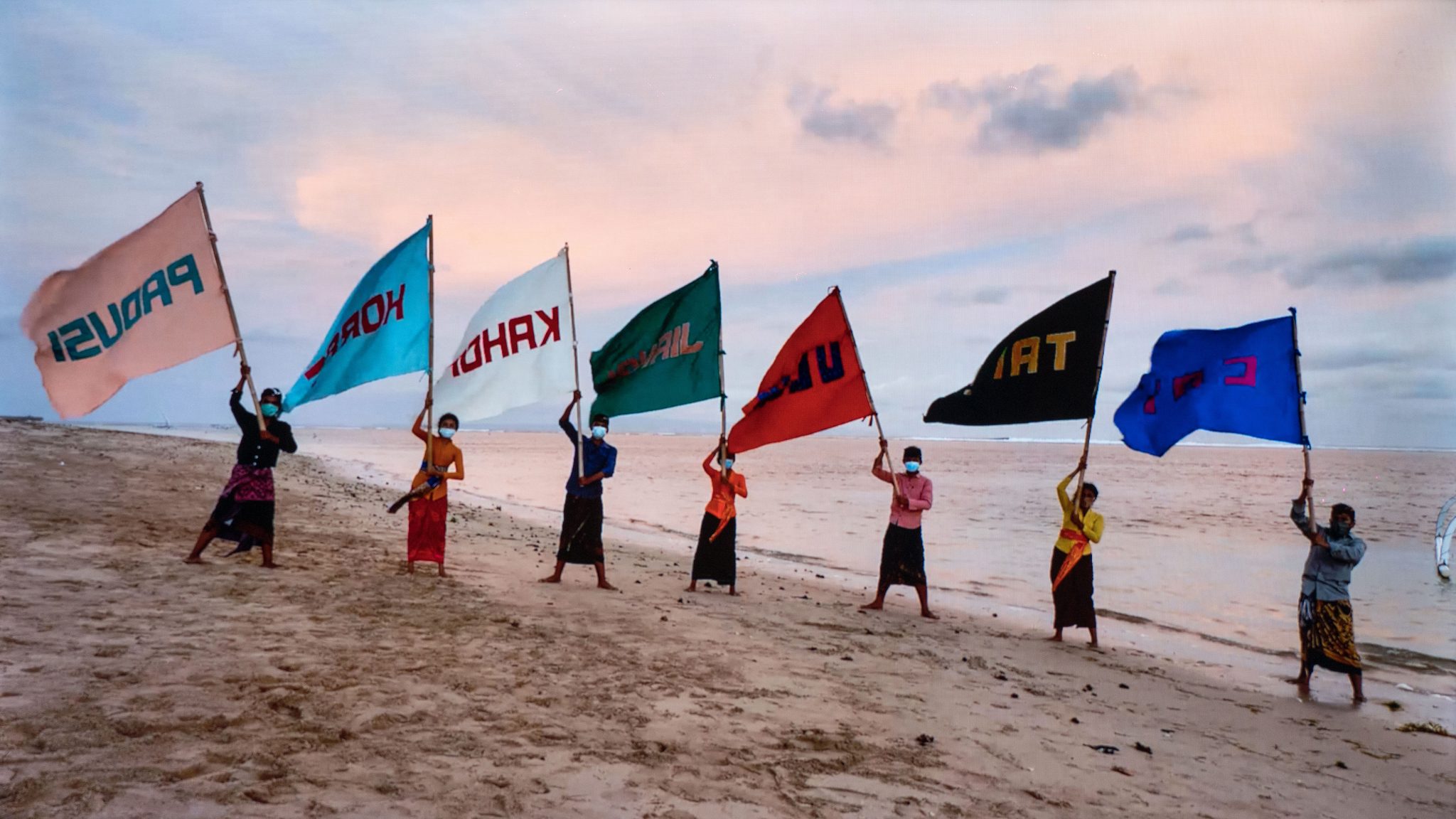
Overall, though, despite moments of insight and illumination, the biennale feels tired. Given the global decolonial turn in challenging Eurocentric paradigms (systemic thinking, instrumental rationality, etc), the concept of kawruh is not exactly radical. Instead, it sits dutifully within well-worn, mainstream curatorial currents exploring different modes of sensemaking (embodied knowledge, Indigenous cosmologies and so on), but doesn’t offer many fresh openings. Arahmaiani’s longrunning Flag Project (2006–) gets a conscientious local iteration with KWT Sawit, a local female farmers’ group whose performanceincorporates flags inscribed with Javanese words such as bejo (fortunate), adem ayem (peaceful) and rahayu (well-being). Some research-heavy projects exploring ‘worthy’ topics struggle to be engaging experiences. Kolektif Arungkala’s installation Omah Samin (2025) centres on the Samin tribe, an Indigenous group known for its resistance to Dutch colonial forces. More like a reading corner than an artwork, it is filled with newspaper reports blown up to poster size, scans of academic articles placed around a table, as well as a large map showing the geographical distribution of the Samin population.
Logistically, too, the exhibition seems overtaxed. During the opening week, some videos are not turned on and several venues are closed. Some may consider this part of the shabby, anti-spectacle charm of modestly budgeted biennials, but the question remains: for whom is this event relevant? During my three days there, public visitorship is limited and there is little knowledge of the exhibition in the city. Most of the visitors are art professionals from abroad. As such, the biennale runs the risk of being an exoticised ‘hardship’ tour for seasoned art-travellers rather than a significant event for local residents. Which is a shame, because Biennale Jogja has a venerable history and unique position in Southeast Asia since its launch in 1988. Committed to collaborating with different countries around the equatorial region, it became one of the first regional biennales to focus on South–South exchanges. Its new conceptual cycle, defined by the vague-sounding ‘working framework’ of ‘translocality and transhistoricity’ – don’t all biennales draw connections between different spaces and times? – seems to be struggling to offer new perspectives.
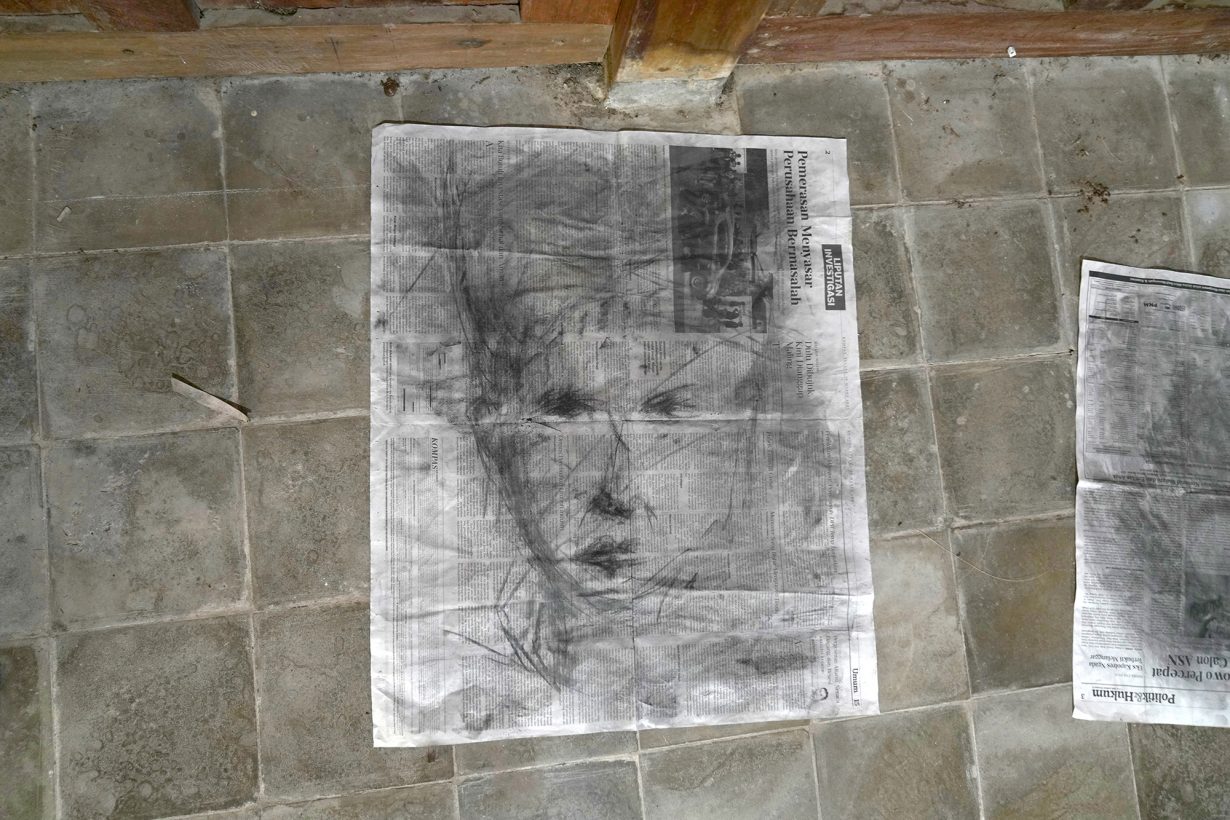
Counterintuitively, this edition of the biennale also feels strangely ahistorical and apolitical. Often, its focus on larger epistemic shifts overshadows ongoing and specific injustices. Some of the artworks here urge deeper changes in how we order and understand the world, while tackling local exigencies and material realities, opening up a richer seam of meaning. A highlight is Imal Malabar’s ghostly installation Menggali Cerita Lewat Garis (2025), comprising charcoal drawings of people mounted or scattered around a room at the Bibis Monument. An important venue in Indonesia’s struggle for independence against the Dutch, one room in the building is purportedly a spiritually charged place where presidential hopefuls came to meditate to gain power. Malabar’s hasty, smudged sketches have an automatic and grotesque quality – as if they bloomed like fungus out of walls in a damp room. The faces include known ones, such as General Sudirman, national anticolonial hero and the first commander of the Indonesian National Armed Force, as well as other unidentified persons. Malabar’s artist bio states he is part of the Alliance of Independent Journalists in Gorontalo, advocating for press freedom and protection from intimidation; these mysterious faces could also be interpreted as those of victims of such violence and disappearance. Politically engaged and exuding a dark occult energy, the work gathers politics, black magic, histories of struggle and subjugation, and the teeming presences of unknown beings. It taps into different realms without losing sight of this flawed and familiar one.
Biennale Jogja 18: KAWRUH: Land of Rooted Practices, Yogyakarta 19–24 September (Part I), 5 October – 20 November (Part II)
From the Spring 2026 issue of ArtReview Asia – get your copy.