Daddy Issues, on view at Copenhagen’s Gammel Strand, steers between personal demons and a more universal angst over flawed father figures
In the feature-length film Daddy (1973), writer/codirector Niki de Saint Phalle narrates: “Once upon a time, there was a girl who dreamt she lived in a castle. Do you remember, Daddy, how much I loved you? You made my life into a fairytale.” What follows is a twisted account of a father and daughter, loosely inspired by the artist’s own childhood trauma. Who doesn’t have daddy issues, right? Daddy’s searing parody of sexploitation movies is one of the more impactful moments in Daddy Issues, which steers between personal demons and a more universal angst over flawed father figures. With works spanning antiquity to the present day, it addresses a supposed lack of paternal representation in visual art, while attempting to tackle the ‘daddies’ of art history. Amelie von Wulffen’s wryly titled painting I Think We Did a Great Job (2024) transforms Francisco de Goya, Odilon Redon and Eugène Delacroix into a microphone-clasping boy band. Meanwhile, a plaster cast of a slightly farcical stone phallus from 400–200 BCE evokes the ultimate machismo of ancient artistry. But this tussle with patriarchs as custodians of history, society and culture dilutes the vulnerability that is the show’s emotional throughline.
Home videos are rich material for Kim Richard Adler Mejdahl and Robert Carter’s intimate perspectives on life with alcoholic fathers (Moire, 2025, and Notes on Dad, 2020), just as Adam Christensen’s Under Hypnose (2020) exposes the experience of his parents’ divorce through footage of his childhood home and heard conversations between the artist, his mother and his sister. Most disturbing is Markus Öhrn’s specially commissioned Kattilakoski (2026), inspired by the summerhouse ruled over by the artist’s tyrannical grandfather. Öhrn projects stills of the house and surrounding landscape, and clips of naked performers in masks onto a reimagined wooden porch, accompanied by a version of the 1972 movie Deliverance’s soundtrack on banjo. Even without knowing the connection to the cult horror classic, Öhrn’s juxtaposition of the performers and nature is unsettling in its weirdness.
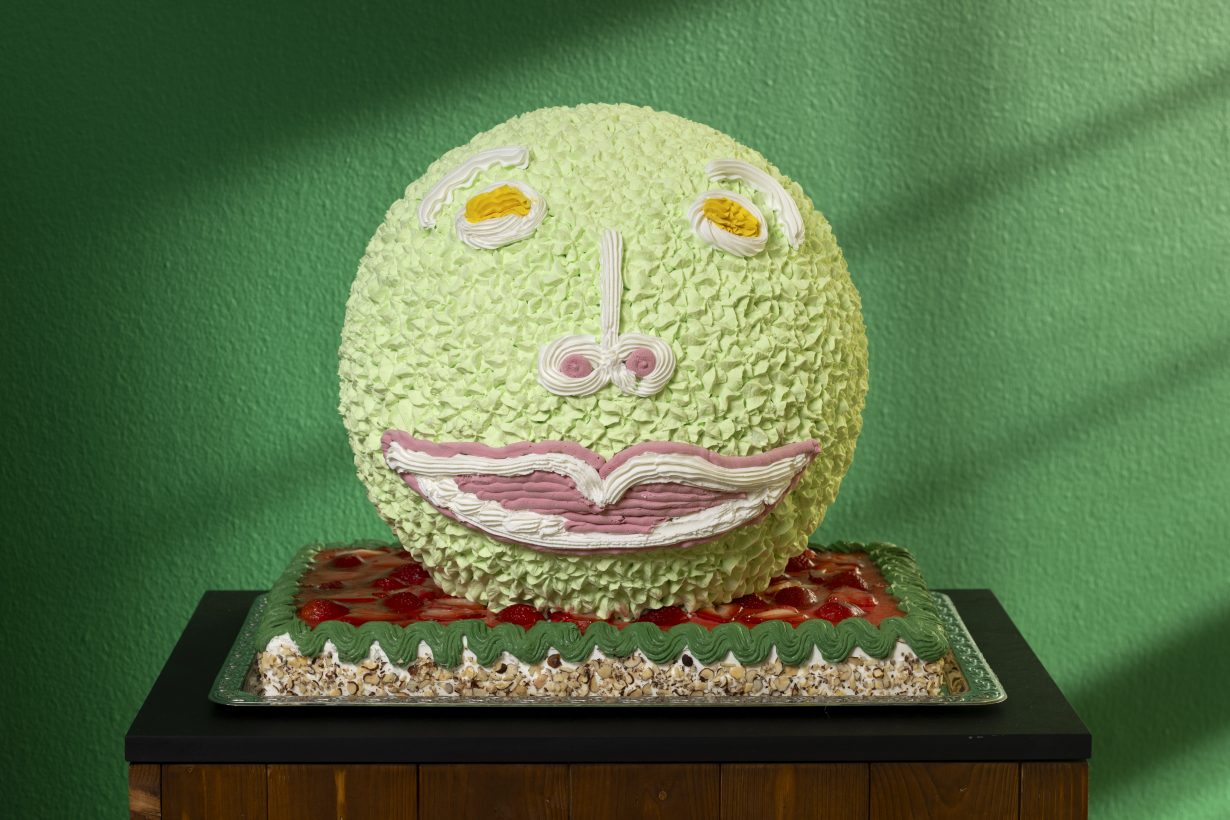
Elsewhere, Tracey Emin’s 1996 film Emin & Emin is filled with yearning, showing the artist and her father on a Cypriot beach but never in the same frame. Beth Collar’s sculpture in brittle unfired clay, of her father clasping his stomach, shatters patriarchal infallibility (Dad with a tummy upset, 2017). A playful, though absurd, stroke of curatorial innovation groups artists comparing fatherhood to dinosaurs, including Alexander Tovborg’s papier-mâché version of a dinosaur drawing by his father (Pietá, 2026), alongside an Asger Jorn painting that imagines his young son as a dinosaur (Den grønne Ole, 1950–53).
Sometimes, though, the artists have much less in common. Selma Selman’s four enthralling paintings on pieces of metal – bathtubs, car hoods and pipes – which quietly cite her family’s business of selling scrap, picture Shakespeare’s Ophelia as the artist’s alter ego (Ophelia’s Awakening, all 2024). In one, Selman’s cheeks blaze and blood drips from her nose, her skin tinged green as if she’s been rotting in water. The exhibition guide informs us that Selman freed herself from a traditional Romani marriage by paying her family the money they would have made from the sales of her art. Meanwhile, Anna Munk’s gossamer images – an oil still life (Stilleben [The Silver Goblet], 2025) and an oil-and-eyeshadow painting of the recent Copenhagen Old Stock Exchange fire (Smoke Study [The Dragon Spire Burning], 2026) – feature no fathers but supposedly tackle traditionally male genres, like nature morte and history painting. Such collisions between personal tales of paternal strife and the overarching patriarchy muddy the already hazy (and vast) waters of fatherhood. Daddy Issues, though ambitious in scope, might have benefitted from a more crystalline direction: one tied to the ideal, and delusion, of the fairytale happy family.
Daddy Issues is on view at Gammel Strand, Copenhagen, through 3 May
Read next The Lesser-Known Robert Rauschenberg