Dóra Maurer, whose conceptual work spanned printmaking, film, photography and collage, has died.
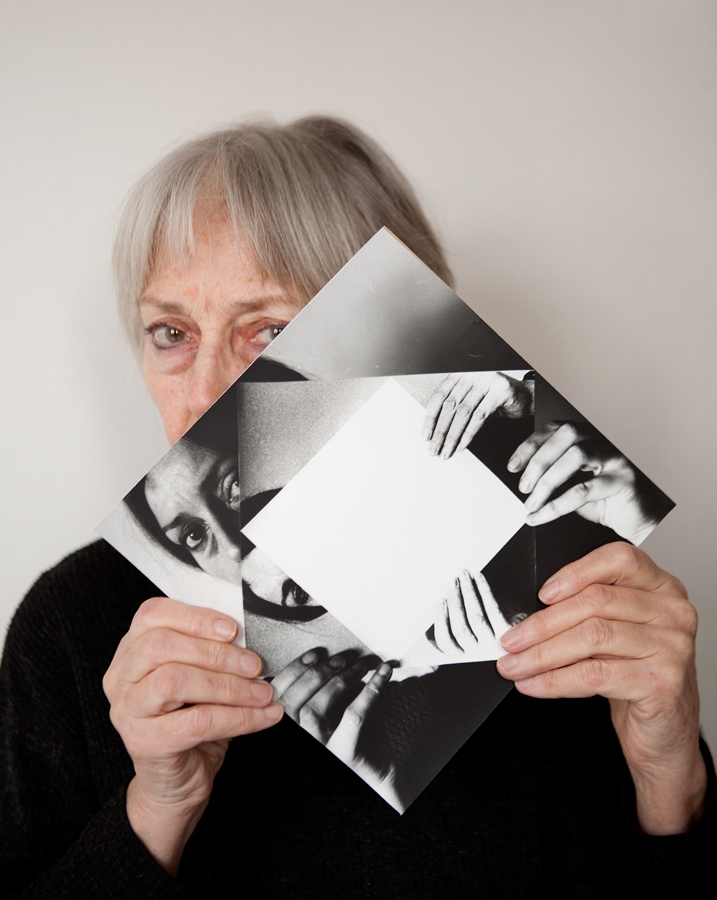
A star in her native Hungary from the 1970s onwards, Maurer received greater international attention after her turn in the 2011 Istanbul Biennale. There, curators Jens Hoffman and Adriano Pedrosa included a selection of her 1979 Seven Rotations works, silver print photographic self-portraits that begin with the corner of her face poking out from behind a square of white card and continues with her holding the previous portrait in the series rotated 45 degrees, culminating in a dizzying spiral of hands and peeking eyes.
‘Since a few years ago,’ she told ArtReview in 2012, ‘everybody has been interested in my work from the 1970s. Everybody wants to talk about these works and to see them. The administration involved in this disturbs me in my current work.’
Just as popular was What Can One Do with a Paving Stone? (1971), featuring four rows of three images showing the artist variously tying and untying, dragging, caressing, wrapping and unwrapping the titular stone. ‘A paving stone is the material of fights – street fighting and so on – and what can you do with a paving stone? Here I made some examples of what I can do with the paving stone. It is ambivalent. You can consider it is as political.’
Later works included a series of shaped canvases, combined sculpturally, often with a trompe-l’œil effect, which she titled Overlappings.
Maurer trained as a graphic artist and, until the late 1960s, worked mainly in printmaking before expanding across media. She was a long time professor at the Hungarian Academy of Fine Arts in Budapest and a curator and member of the Open Structures Art Society, which staged exhibitions at Budapest’s Vasarely Museum. In 2019 she had a solo show at Tate Modern, London.
Read next Mark Rappolt meets Dóra Maurer