“I want to do my work as well as I can and get out as fast as possible”
ArtReview sent a questionnaire to artists and curators exhibiting in and curating the various national pavilions of the 2026 Venice Biennale, the responses to which will be published daily in the leadup to and during the Venice Biennale, which runs from 9 May through 22 November.
Alwar Balasubramaniam (Bala), Sumakshi Singh, Ranjani Shettar, Asim Waqif and Skarma Sonam Tashi are representing India; the pavilion is in the Arsenale.
ArtReview Tell ArtReview what you plan to exhibit in Venice. What has influenced or inspired you?
Skarma Sonam Tashi I will present an installation titled Echoes of Home. The work draws inspiration from the traditional architecture of Ladakh, where I come from. Ladakhi homes are built with local materials such as stone, mud, wood and earth, reflecting a deep understanding of climate, landscape and sustainability. In my installation, I recreate fragments of these architectural forms using recycled cardboard, papier-mâché made from discarded books and notebooks, and clay. These materials carry memories of everyday life and knowledge while also speaking about fragility and transformation.
Sumakshi Singh Though I have lived across many states and countries, my idea of home remains tethered to ‘33 Link Road’: a house built by my refugee grandparents in Delhi in 1952. Now demolished, it was a site of annual gatherings, stories, weddings and sleepovers; a room at the back where my mother was born, and a room at the front where my grandfather died.
When cities modernise, what is often lost is not only buildings, but the histories held within them. As an homage to the afternoons spent in this home, knitting and embroidering with my grandmother, I recreated the architectural details of the house using thread, turning the solid architectural facades into spectral webs of memory. Viewers will walk through life-sized architectural fragments and experience them as apparition rather than structure. Every nut, bolt, hinge and brick becomes a porous skin, challenging the solidity of both the form and idea of ‘home’.
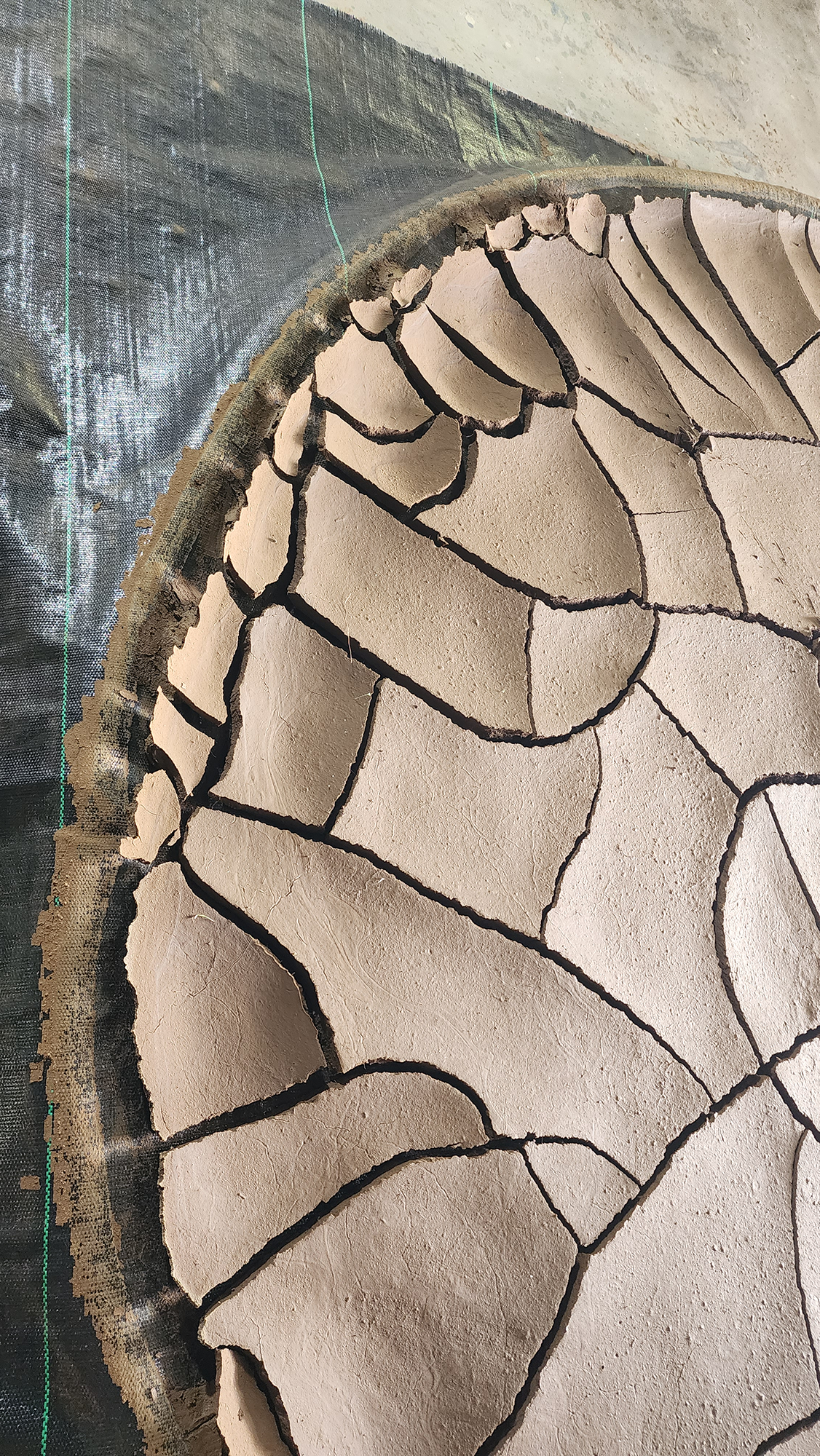
Alwar Balasubramaniam The work I have created continues my long-term exploration of nature and its processes. It comes from observing how earth, water and air interact over time, and how simple shifts, like moisture drying or dust settling, can slowly bring a form into being. It is the physical result of the bonding and separation of earth and water. These forms emerge from the cracks created as water evaporates from the soil. The way the land drifts, segments or becomes isolated serves as a symbol for our own fragmentation – the act of distancing ourselves from the whole or from one another.
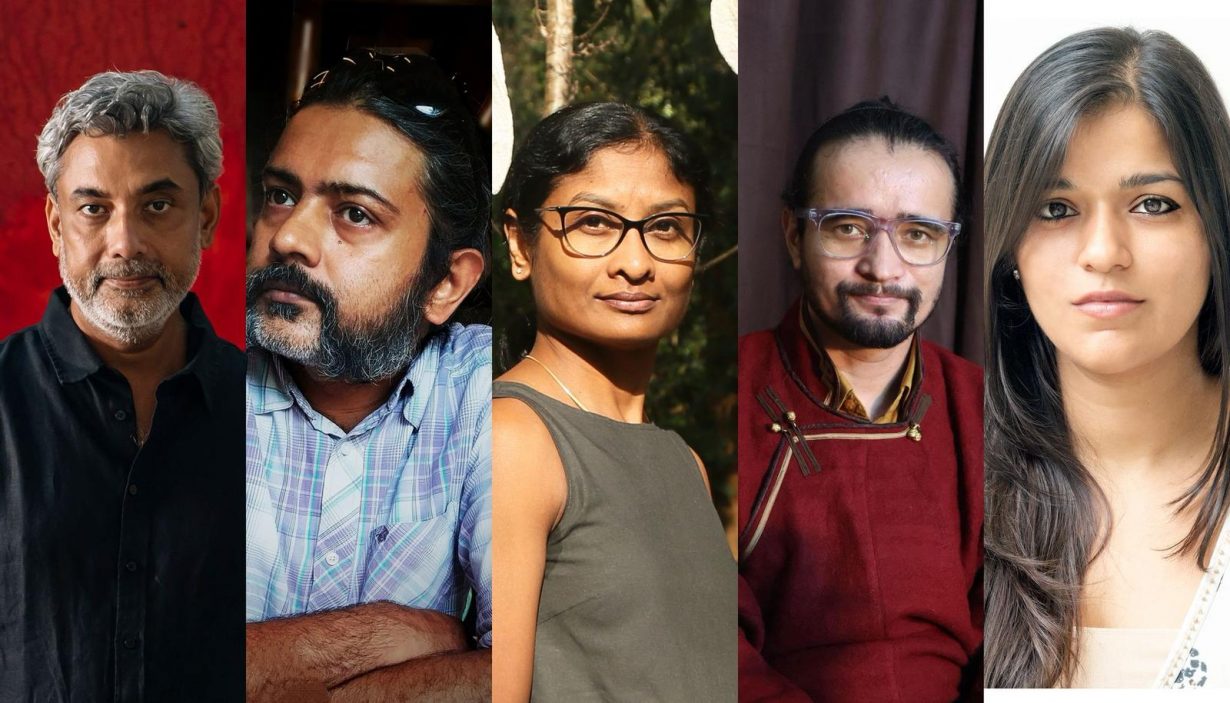
Rajani Shettar The work develops from my ongoing engagement with natural materials and the ways they change over time. I’m interested in how form, texture and space come together through process, and how gradual transformation shapes what the work becomes. While the work does not represent nature directly, it is informed by the flora that I encounter in my immediate environment.
In the installation, multiple elements are suspended and placed in relation to one another, creating a kind of choreography. The forms are developed in response to the space they inhabit and to the shifting effects of light and shadow across their surfaces. The final composition is resolved in space through a process of improvisation and adjustment, before arriving at a cohesive whole and a sense of visual harmony.
Asim Waqif I have been working with bamboo on and off for almost 30 years. When I was an architecture student, it was a cheap and versatile material to play with. I have worked from plantation and harvesting to artisanal craft and architecture, and this project is informed by all these experiences.
AR In what ways (if at all) does your work relate to the theme of the Biennale exhibition, In Minor Keys?
SST My work resonates with the theme In Minor Keys through its quiet and reflective approach. The installation focuses on subtle gestures: textures of earth, fragile materials and forms that resemble distant mountain homes. These small, understated elements invite viewers to slow down and observe carefully. By recreating the forms of Ladakhi homes through fragile materials, the work highlights the quiet resilience of traditional practices and the delicate balance between people, memory and environment. In this way, the installation speaks through minor, almost whispering gestures.
SS The minor keys in music are associated with a slight sense of melancholy, a longing, a haunting beauty that persists despite loss. They are not about the major or the dominant narrative but rather the fragmentary, the fugitive.
I resonate strongly with this. I am making a house that cannot be inhabited, its surfaces provide no shelter or support. It is a home that no longer lives in walls or addresses. It becomes something held in memory, an essence that transcends the shape it once inhabited.
AB A minor key suggests quiet attention. It asks us to look and listen closely. The cracking of earth happens gradually and without spectacle, yet it holds profound and intense transformation, caused by the most subtle of shifts in moisture and temperature.
RS I am drawn to subtle shifts of balance and to changing ecosystems, which have long informed both my work and my way of life. I have consciously chosen to live away from large cities. In that sense, I feel like I have been singing in ‘minor keys’ all along.
AW For me, work and life are in constant flux. The structure I am building occupies a threshold, mediating between older knowledge systems and present-day regulations, between artisanal labour and design authorship. The quiet disappearance of vernacular construction is one minor key within a larger narrative of development.
AR Why is the Venice Biennale still important, if at all?
SST The Venice Biennale remains important because it allows artworks shaped by local experiences to be seen within a global context. For many artists, it is also an opportunity to engage with audiences who may never have encountered their cultural or environmental realities before. The India pavilion has five artists because India is multicultural and geographically diverse, which one single artist could not represent. In my case, presenting work inspired by Ladakh in Venice opens a conversation between two places shaped by fragile environments: high mountains and a lagoon.
SS The Venice Biennale for me is like a pulse, returning every two years, that you can place your finger on to feel what’s really happening rather than rely on what’s being declared. One sees voices that are layered, contradictory, unfinished. Not just the dominant narratives that one hears in public discourse, but the quieter, unresolved undercurrents that move beneath them. In that way, each edition becomes a kind of diagnosis of where we are collectively.
AB The Biennale gathers artists into a shared space, each bringing a distinct history and material language. The value lies in this proximity and exchange.
RS Venice embraces the contemporary without losing sight of history and memory. Its editions over the years expose our shifting values, sensibilities and priorities. In this way, it’s an important record.
AW I feel like the Venice Biennale is an exploitative institution. It takes advantage of its name and marketing to coerce exhibition-making. I am astonished that artists in the main exhibition are given no production budget, let alone any artist fee. This creates a situation where only commercially viable art is feasible, and I feel that this is a very poor criterion for what purports to be the biggest art exhibition in the world. There seems to be an unspoken attitude that artists should be grateful that they have been selected for the Venice Biennale and should bend over backwards to produce their own artworks. I’d rather the Biennale tell artists that they have been selected for the biggest art exhibition in the world and help them produce their most ambitious project yet. I saw a graffiti in Venice:
‘L’arte è morta e Venezia è una tomba’
Art is dead and Venice is a tomb
AR What role does a national pavilion play at a time of increasing confrontational nationalisms? Is it about expressing difference or commonality?
SS The art chosen for the India Pavilion emerges from a specific context. The materials – textile, bamboo, clay – carry the weight of particular histories and practices. There are references to labour, to land, to vernacular building traditions and to flora that belong to the subcontinent. These works are grounded in place.
When work travels beyond its point of origin, it becomes interesting. As people from different contexts encounter it, meanings shift, translations falter and new readings emerge. Yet more than the differences, I am fascinated by the common ground. Your question reminds me of an incident:
I was living in France in 2008 when I created Mapping the Memory Mandala, an artwork that mapped out my grandparents’ living room at 33 Link Road in Delhi. Made with chalk pastel over various surfaces, the work started to blur and eventually erase as the viewers walked through it. One day, a visitor from the south of France walked into the installation and, without knowing anything about the work, said, “This reminds me of my childhood home.” I was surprised. I couldn’t imagine how his home in Provence could resemble my grandparents’ living room in Delhi, so I asked him why. He said, “Because everything feels slightly smaller than it should be.” He explained that it reminded him of returning to this home as an adult and discovering how small everything was compared to how large it had seemed as a child.
This is one of the things that I love about the creative process. Decisions that often emerge intuitively can later resonate with others in ways that the rational mind might never have anticipated. I cannot claim that art is universal, but it is brilliant at building bridges and creating connections that can bypass difference. In this context, I feel that the role of a national pavilion is not simply to express difference or assert commonality, but to explore the space between them. It can acknowledge specific cultural experiences while also pointing to shared human concerns.
AB A national pavilion can appreciate its origin without becoming confined by it. Every work grows from a specific context of language, climate and history, but the deeper, universal questions within art transcend borders.
RS My work is shaped by the location and influence of its creation, in rural Karnataka. However, it can be accessed and considered by all sorts of different people in a vast multitude of ways. It is a product of its origins but also a way of bringing our commonality to the surface.
AW Art has often been used as soft power to promote specific ideologies, and national pavilions in Venice are perhaps the pinnacle of such endeavour.
AR Who, for you, is the most important artist (in any discipline) that your country has produced?
SST India has produced many influential artists across different disciplines, so it is difficult to choose only one. I have great respect for Ram V. Sutar, one of India’s most renowned sculptors. I am also deeply inspired by the pioneer of modern sculpture Ramkinkar Baij, whose works I studied during my MFA. Seeing sculptures like Santhal Family (1938) and Sujata (1935) had a lasting impact on me. I am also inspired by contemporary artists, including my fellow India Pavilion participants, whose experiences and practices continue to teach and inspire me.
AB I am a great admirer of the art at Mahabalipuram and at the Ellora caves. These artworks have spoken across thousands of years. They were created by artists whose names we may not know, but whose works we continue to experience and appreciate.
RS Nasreen Mohamedi and no doubt about it.
AW In boutique studios across the world, bamboo is being hailed as a wonder-material in terms of sustainability. However, little economic or creative opportunities seem to trickle down to the artisans that work with the material. The creative roles have been usurped by the designer, while the fabricator is expected to merely follow instructions. My focus is with the artisans.
AR What is something you want people to know about your nation that they might not know already?
SS India is a constellation of languages, memories, migrations and contradictions. A platform like the Venice Biennale offers nations the opportunity to resist simplification. It allows us to move beyond familiar stereotypes of India. I think something honest emerges in that space. When identity is not performed or neatly defined but allowed to remain plural and unresolved. In a world increasingly obsessed with defining and boxing identity, such platforms can instead open it up, acknowledging the complexity of what it means to be human and to be Indian. I would love it if the viewers left with a sense of that.
AB India is often defined by its scale and energy. However, there is also a stillness that shapes daily life in many places. In rural areas, time follows the rhythm of seasons and sunlight. This quieter dimension is essential to fully understanding the country.
RS I want people to know how closely ecology is bound up with the domestic and ideas of home.
AW Many of the ideas now promoted as sustainable innovations, such as closed loop systems and reliance on local renewable resources, were integral to preindustrial societies. Traditional knowledge in India evolved through generations of trial and error, responding closely to climate and ecology. What is less visible is how quickly these systems are being eroded by regulation and market forces.
AR Given that you are exhibiting in a national pavilion, is there something that distinguishes the art of that nation from that of others? That makes it particular? Are there specific contexts that it responds to? Or do you think that art is a universal language that goes beyond social, political or geographic boundaries?
SST Rather than a single defining quality, what distinguishes Indian art for me is its ability to hold many perspectives at once. This is reflected in the diversity of the five pavilion artists. Our works vary in materials, ideas and approaches, yet together they reflect the diversity of the country.
AB Art begins within a particular context, but the impulse to document and reflect that context belongs to all people.
RS We no longer live in a world where cultures are pure or divided by geography. Influences move in multiple directions.
In my work, forms drawn from nature – especially flora – are not tied to a single place but come from a shared environment that we all experience in different ways.
Within the context of the Biennale, where works from many different countries are shown alongside one another, these connections become more visible. Contemporary art can have a universal language, one that connects people across these differences.
AW India is a place where established tradition and accelerated modernity constantly meet each other. However, questions of adaptability, durability and memory are not confined to one geography. So, while the materials may be specific, the concerns are global.
AR What, other than art, are you looking forward to seeing – or doing – while you are in Venice?
SST As someone who comes from a mountainous region where people have learned to live in balance with nature, I am curious to observe how Venice has adapted to its own landscape over centuries. I look forward to walking through the narrow streets and canals and understanding how architecture and environment interact there. I am also interested in the everyday life of the city: its quiet corners, local markets and people. For me, exploring the city slowly and attentively can be as inspiring as visiting the exhibitions.
AB The nature and environment there are so different from where I am and that keeps me curious about everything around me. I am always amazed by how beautifully life works in a place without bikes, cars or metros as the main means of transport. Also, I look forward to interacting and reflecting with other artists in Venice.
RS I am looking forward to catching some live classical concerts while I am there. I also enjoy exploring a new city on foot, it’s the best way to feel the pulse of a place and a community.
AW I look at Venice as a very hostile environment. I have heard from others how difficult it is to get anything done there, especially in the last few weeks before the Biennale opens. I am afraid it will not be an ideal setting to make a site-specific installation. I hope my team and I will survive this ordeal without too much loss. I want to do my work as well as I can and get out as fast as possible.
AR Could you give us a brief overview of your average working day while creating your presentation in Venice?
SST I only had one month to complete the project, so the process was intense. I invited three artist friends from Ladakh – Urgyan, Jamyang and Samphel – to assist me with this work. Initially we worked mostly during the daytime, but as the deadline approached we continued late into the night. One of us would cook while the others kept working, so the studio also felt like a shared home.
My process is very hands-on: cutting, preparing and shaping papier-mâché from recycled paper. Each layer needs time to dry, so patience is essential. I often felt stressed, but my assistants stayed calm and reminded me that the work would be completed. I am deeply grateful to them for helping bring the installation to life.
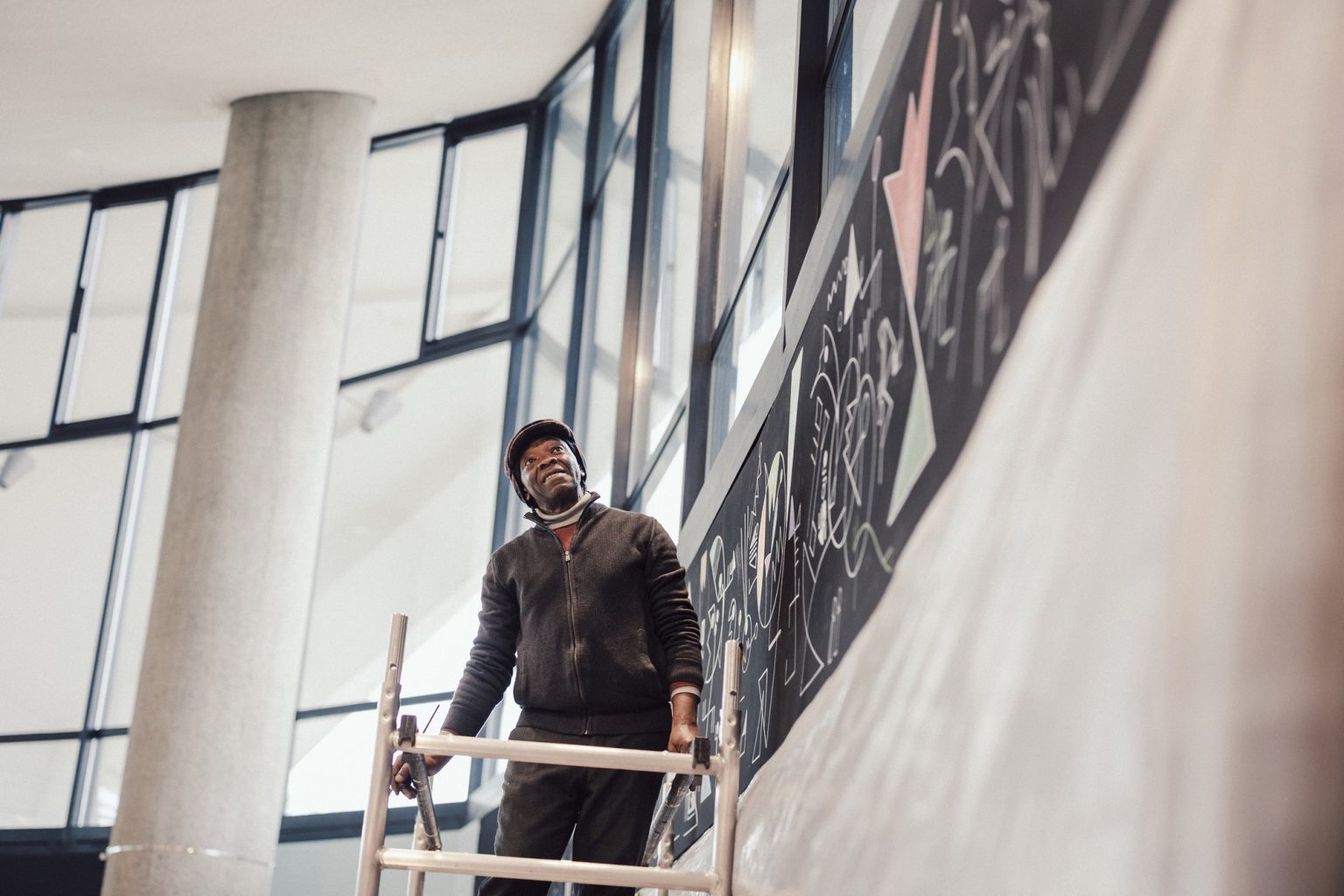
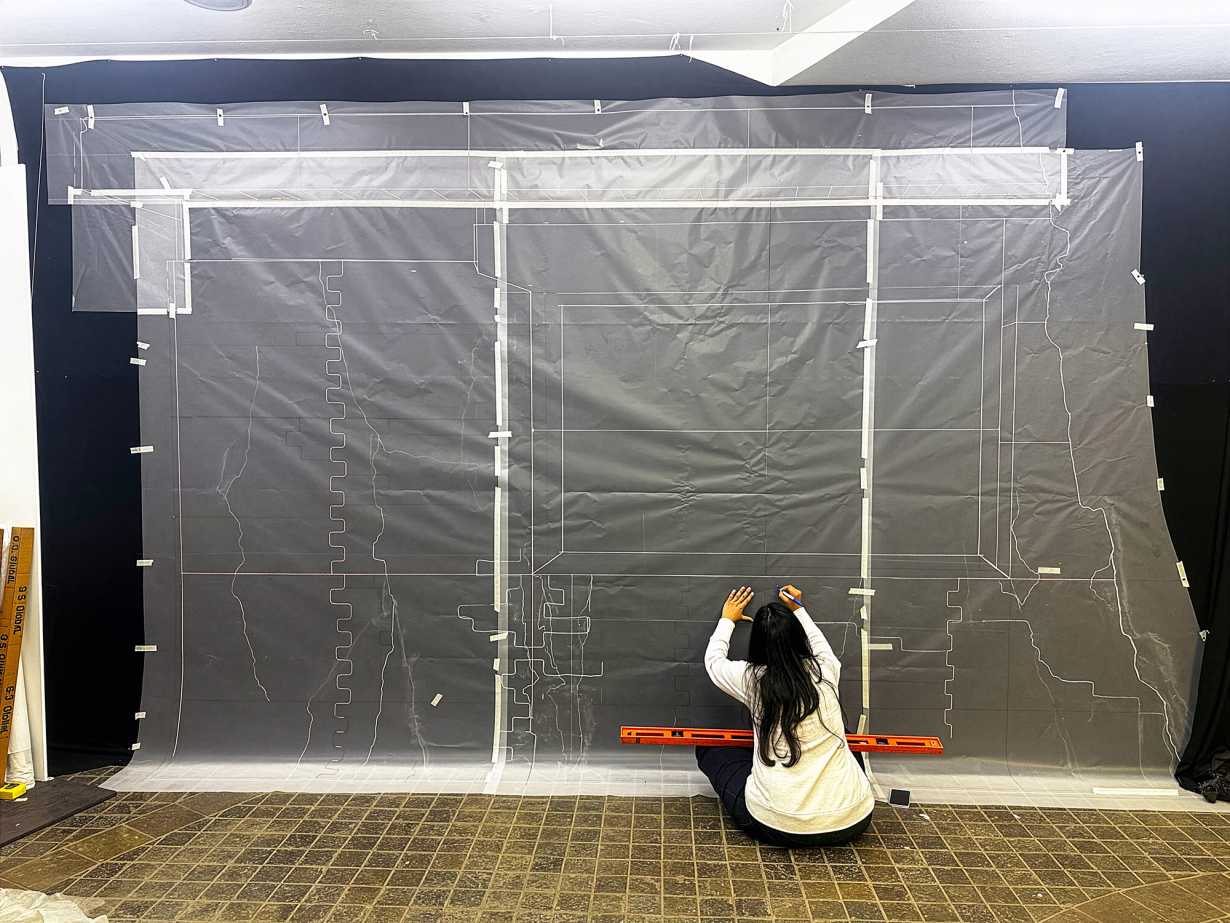
SS It has been months of intense work, including many 14-hour days, quite a few of them spent on top of a ladder. The process has been physically, emotionally and mentally rigorous. Each day involves moving constantly between different kinds of making: drawing life-sized images that will later become embroidery, working on digital sketches, building physical models, preparing full-scale drawings for the welders, working with thread, soaking and dissolving large, heavy textiles, and slowly assembling the installation.
The day rarely follows a single rhythm. It moves between the conceptual and the physical, the studio table and the scaffold. In the end it becomes a kind of choreography of drawing, adjusting, stitching and installing, repeated over and over until the work finds its form.
AB Usually I begin the day with a plan, but often the day itself dictates how it unfolds. It includes working in the studio, eating lovely food, and of course a long walk.
RS It was a solid block of time. There were no Sundays and no social events. Normally, I prefer waking up with the sun and going to bed early. But this process was a complete exception. There were many all-nighters and many days with less than five hours of sleep. It became an immersive experience. For the past few months, the sole focus has been on creating the work. It could not have happened otherwise.
AW I will be installing onsite in the Arsenale with a team of artisans from India. We plan to work for 15 days from 9am to 7pm with two-hour midday breaks. Two teams will work simultaneously with fluid collaboration and improvisation.
AR Can art really change the world?
SST Art may not change the world in an immediate or direct way, but it can change how people see and understand it. In my practice, I try to bring attention to fragile landscapes and traditional knowledge from Ladakh. If someone who sees the work begins to reflect on sustainability, community or the meaning of home, that small shift in awareness already matters.
SS From my personal experience, I feel that art has a remarkable capacity to transform consciousness in both the person making and encountering it. In the act of viewing, a work of art can slow us down, shift our perspective, or allow us to feel connected to someone else’s experience. These shifts in perception are powerful, because the way we perceive life shapes how we think and act.
While the analytical brain tends to move linearly and separate things into categories, the creative brain – activated through making or viewing – senses connections between things. It allows us to be more authentic, less bound by inherited models of how to think or who we imagine ourselves to be.
AB Art can influence how we understand our place in the world. This shift in perception can lead to greater awareness, which can make us act with more care.
RS Art is often an expression of the potential of humanity – how far we can push ourselves both in creating and experiencing. Artistry, creation and communal experience are as old as humanity itself, so humanity was and will always be continually shaped by these things.
AW Art mimics what’s happening and is itself what’s happening in the world. I think it neither changes nor maintains.
The 61st Venice Biennale runs 9 May through 22 November 2026