From analogue and digital collage to her towering radiola sound system, Viana’s work is anchored in the hybrid character of Brazilian culture
I grew up with a story lodged somewhere between folklore and threat. As a result, whenever my family drove from Belém – the Amazonian port city in which I was born – to São Luís, the island capital of Maranhão, a tightness gathered in my chest as we approached our destination. My father’s family lived there, and the journey was long: 11 hours by road in a Fiat Uno with no air conditioning, my brother and I pinning T-shirts to the rear windows to shield ourselves from the searing heat while the adults took turns at the wheel. At the end of the drive came the ferry. São Luís sits in the Bay of São Marcos, known locally as the island of love and reggae, and the crossing always felt like an initiation. I had absorbed the story my cousins passed around: beneath the city slept a colossal serpent, its body split into seven parts. Six had already recombined; when the last fragment found its place, the creature would rise, drown the island and take everyone with it. My parents reassured me that it was a tale to scare children, but the image endured: catastrophic, strangely plausible, like geological fate.
When I tell this story to the artist Gê Viana, who grew up and still lives in the area, she laughs. “There’s no way to detach yourself from that,” she says. “We learn it at school. It’s been told for centuries. The serpent matters in the [West African] Kingdom of Dahomey, and Maranhão was founded by Dahomeans. It matters to Catholicism, too. Everything here is syncretic. Our calendar has a feast day for some saint or entity almost every month.” Viana has her own Afro-diasporic roots, in a region rich in quilombos – the autonomous communities established by formerly enslaved Africans – as well as tracing heritage to the Anapuru Muypurá people. Her answer folds mythology into history with the ease of someone used to moving between cosmologies. And that breathing history anchors one of the most compelling works in the most recent Bienal de São Paulo: A colheita de Dan (The Harvest of Dan, 2025). The work takes the form of a monumental radiola – a stacked wall of loudspeakers, subwoofers and amplifiers painted in black, white and red, interspersed with panels of photomontage depicting Black people dancing in reggae parties, historical images of congás (highly ornamented shrines from the Afro-Indigenous religion Umbanda, with images of Catholic saints, orishas, candles and flowers) and plants with healing powers, whether spiritual or physical.

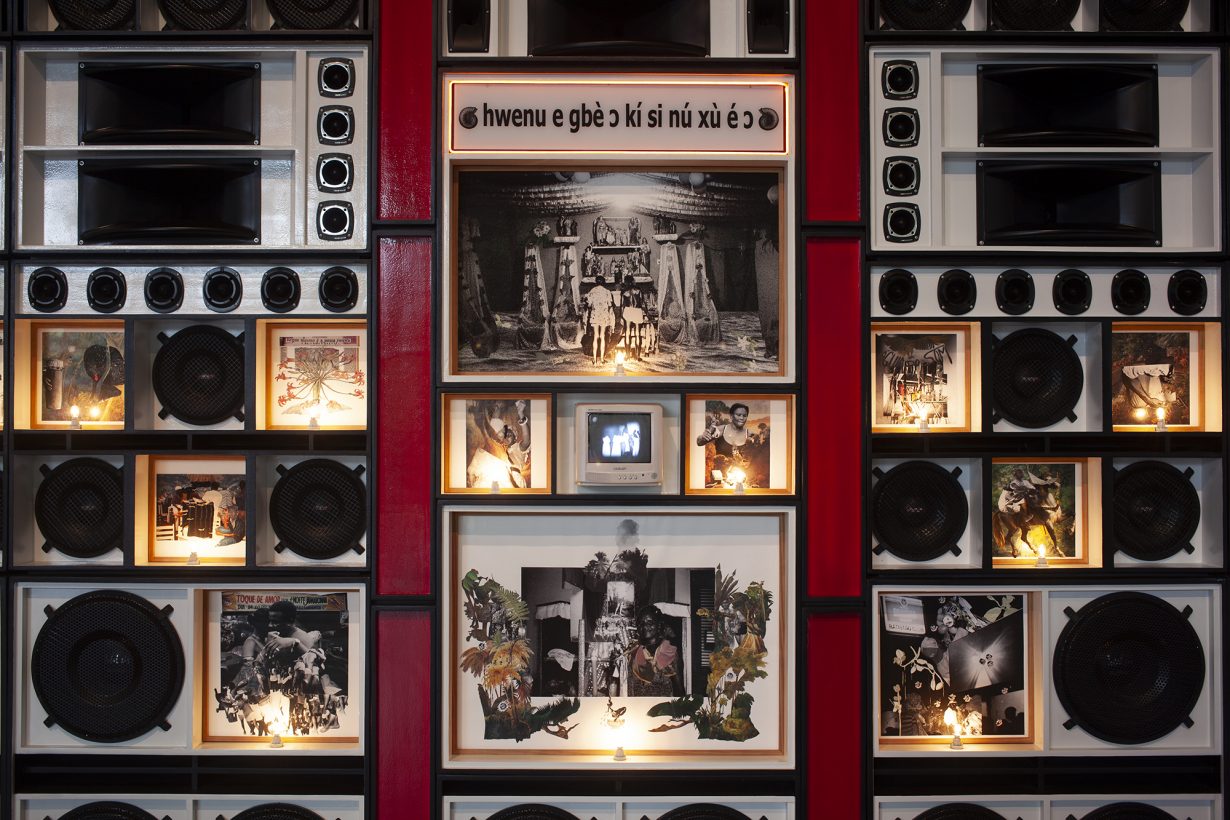
A colheita de Dan reads at once as a sound system and as an architectural totem or altar reimagined through vernacular engineering. The structure plays Brazilian reggae and songs rooted in Maranhão’s quilombos on loop. Across the state, such sound systems power street parties, beach gatherings and fêtes. The lineage of these parties can also be traced to Jamaica: São Luís was always an Atlantic port open to the Caribbean routes, and reggae came through sailors’ imported LPs and radio waves – Maranhão felt more connected to Kingston than São Paulo or Rio, where in the 1970s samba and bossa nova were still more prevalent. These cultural dynamics map the afterlives of the African diaspora, of an ambivalence to national borders and rhizomatic vectors of influence. Viana’s version condenses that circuitry into a hypnotic installation. She told me she was startled to see people kissing in front of it after the show had opened. Later, she understood: the work was functioning: among the photocollages included in the work, the installation incorporates a sign declaring ‘hwenu e gbè ɔ kí si nú xù é ɔ’, which, translated from Dahomean, means ‘when the sound kisses the sea’. Reggae, and everything it carries, generates its own field of intimacy.
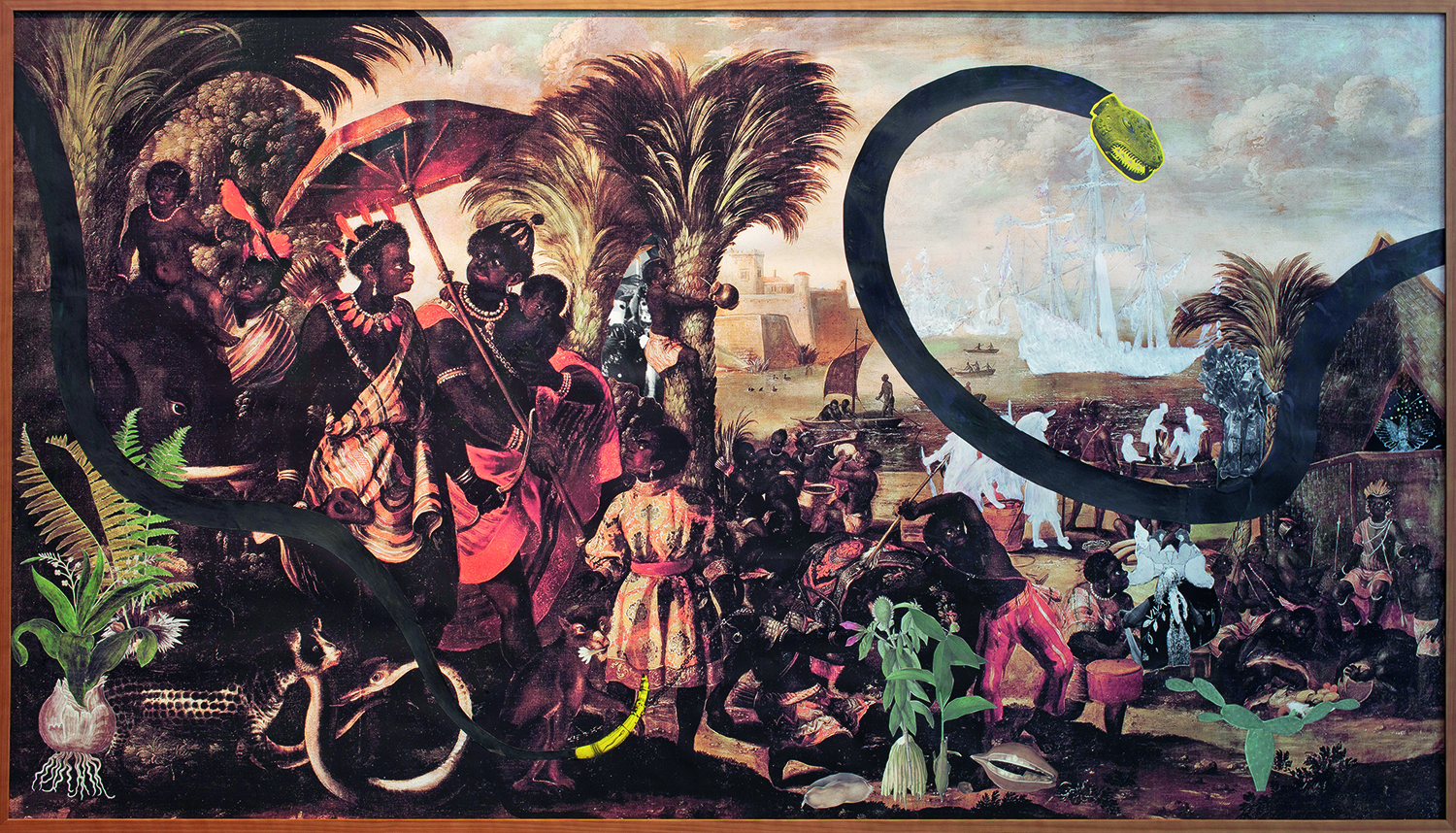
Viana reads the mythic serpent beneath São Luís as the titular Dan, a vodun spirit with historical roots in West and Central Africa, often figured as a rainbow snake. Through Dan, she foregrounds the Afro-diasporic constitution of Maranhão and the centrality of Tambor de Mina, the region’s syncretic religion, within both social life and her own thinking. Transporting the radiola, built by specialist workers in rural Maranhão and brought some 3,000 kilometres to São Paulo, feels like she created an outpost of the state within Brazil’s financial capital. The gesture claims mobility as inheritance. It gathers what has been planted for generations.
“Here, there’s a tradition of planting something for a saint,” she explained. “For Saint Benedict, you plant to feed his mouth, his belly, his eyes. So when I speak about harvest, there’s the material side – rice, cassava leaves – and there’s the spiritual side. You harvest what is left behind. You harvest what was planted for the saints. You harvest musically.” Tambor de Mina crystallises the hybrid character of Brazilian culture, blending African and Indigenous principles through lengthy initiations and drum-centred rites that induce trance. Viana recognises the same somatic shift at reggae parties. “When you start dancing, you melt,” she said. “You enter another state.”
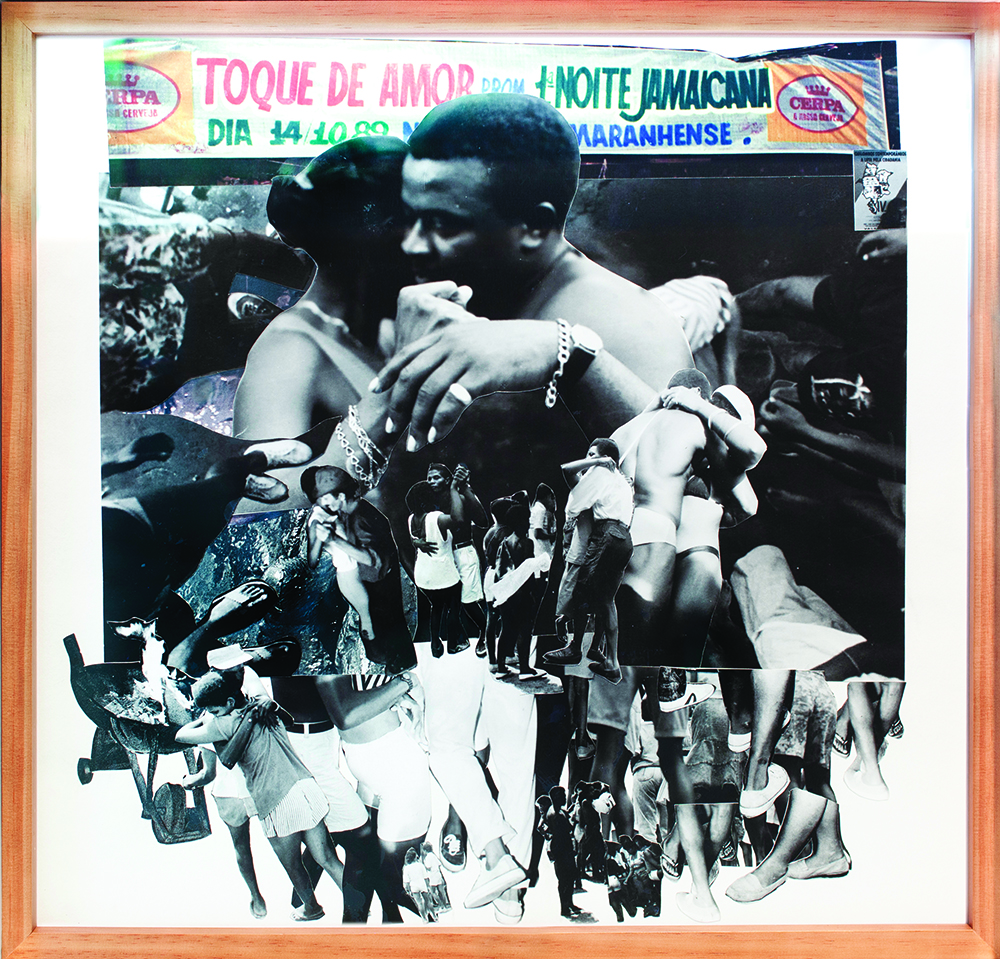
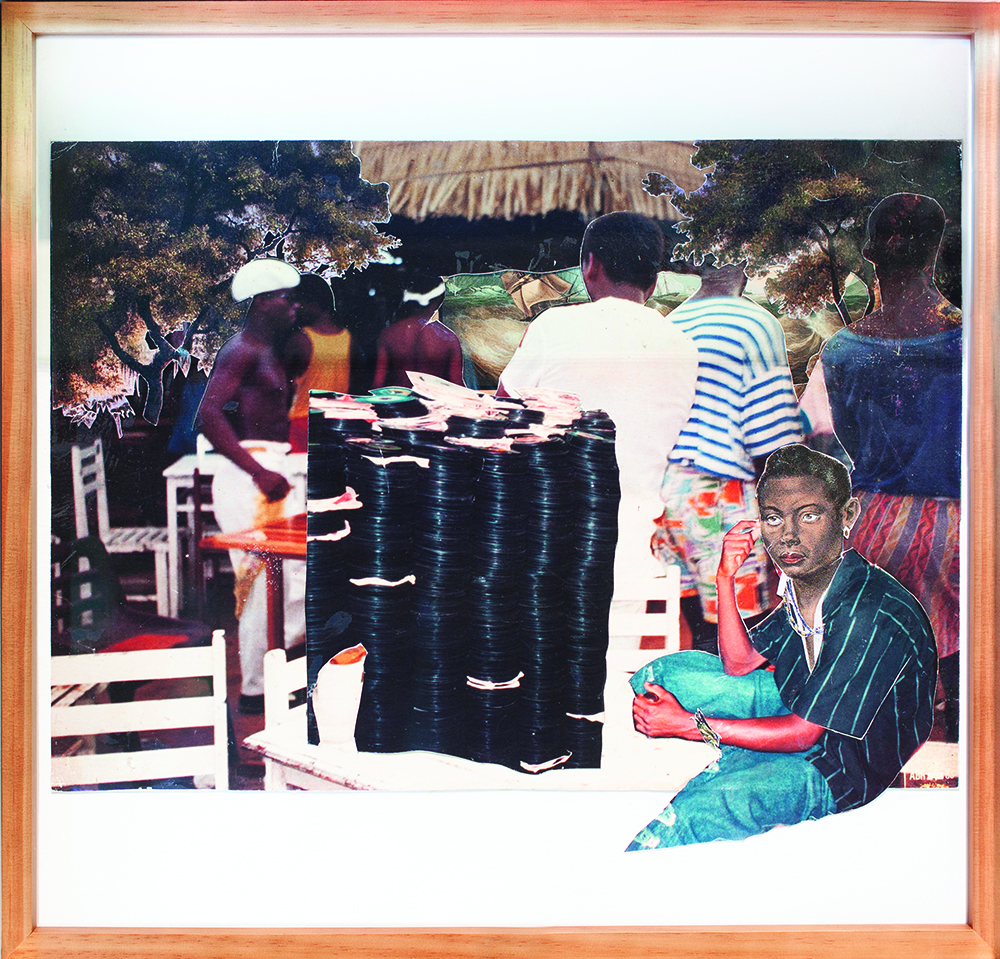
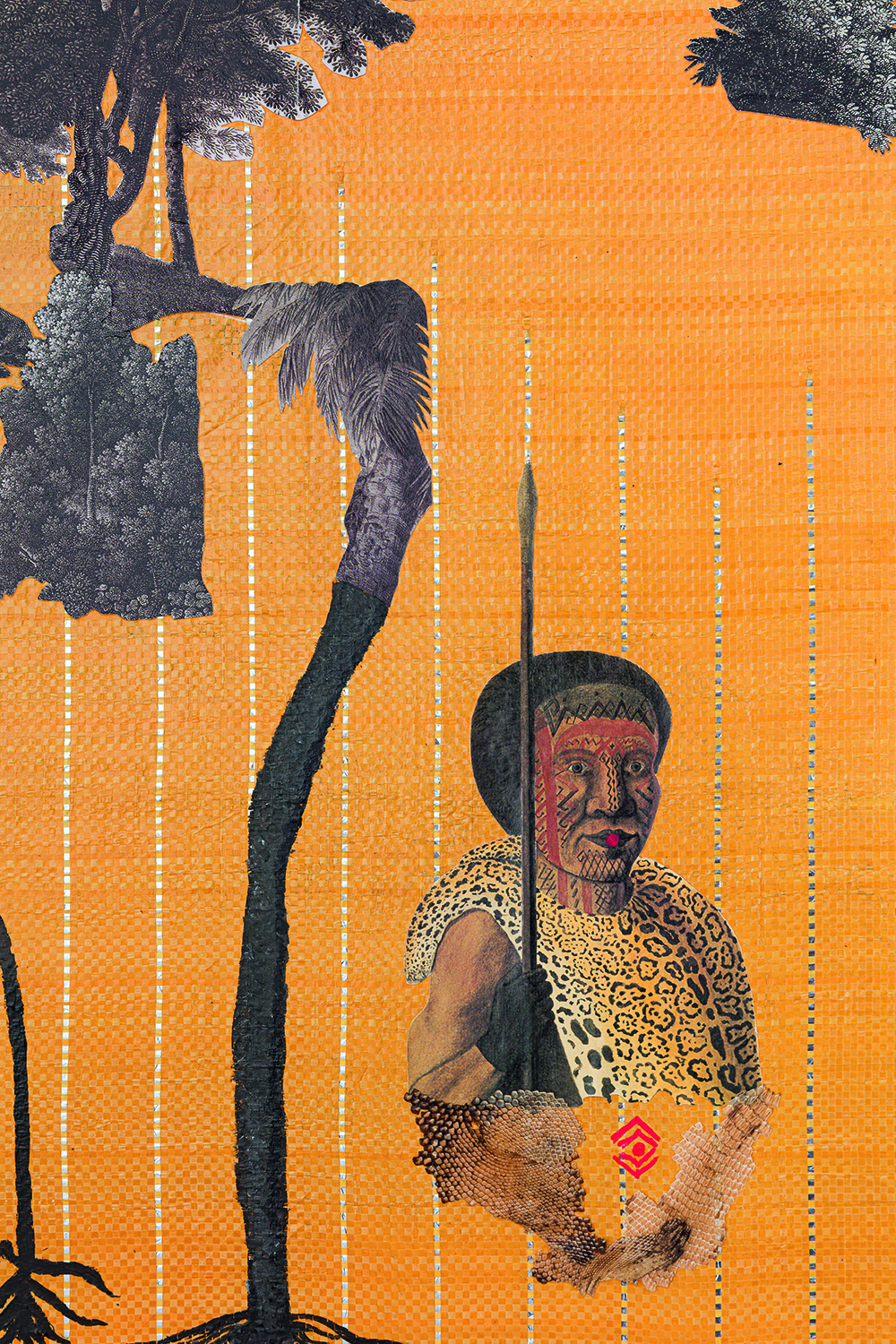
Before the radiola, collage anchored her artmaking. Her works engineer abrasive encounters between images collated from official archives, and those that address historiographic erasures and record other forms of cultural memory – festivals, food, devotion, gesture. Some works are handcrafted: photographs, cutouts of tropical flora and stereotypical images of Indigenous people are placed alongside painted motifs on raffia canvas, edged with feathers, as in Histórias do Anu III (Histories of the Ani III, 2024–25), from the series Couro laminado (Laminated Skin). Others are digital, produced in Photoshop, in which she interlaces images drawn from European colonial photographers (and white southern Brazilians) with her extensive archive documenting everyday life in Maranhão. In A colheita de Dan, alongside the speakers, she presented 26 new traditional collages based on photographs from the 1938 Missão de Pesquisas Folclóricas (Mission of Folkloric Research), an expedition organised by the Paulistano modernist writer Mário de Andrade. Andrade, author of the rhapsodic 1928 novel Macunaíma, sought to catalogue Brazilian popular culture during a period of rapid industrialisation. The project produced a vast visual record while also filtering Indigenous and Afro-Brazilian life through an extractive, stereotyped lens. Viana overlays her own images of everyday life in Black communities in the inlands of Maranhão onto these photographs, fracturing their authority. Figures multiply, perspectives clash, timelines collapse, while the archive becomes porous, contested.
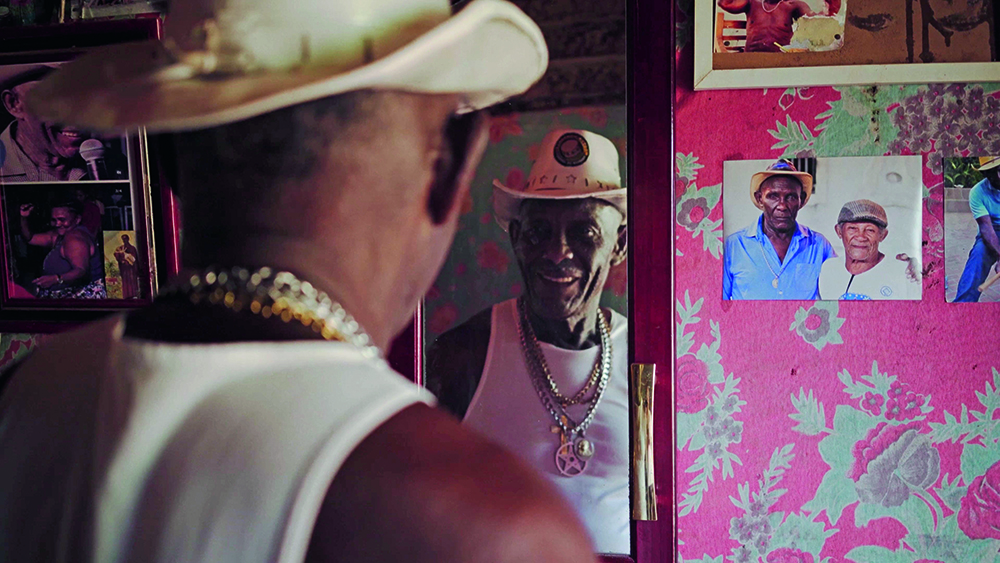
At Pinacoteca de São Paulo, she is showing Radiola de Promessa (Radiola of Promise, 2025), a 13-minute film with the tone of a documentary. The camera follows the labour that sustains the radiola: musicians, electricians, carpenters, dancers, cooks. A woman arranges hand-moulded tapioca cakes on banana leaves before sliding them into a wood-fired clay oven. Mestre Vanderlei, a musician, recounts decades spent stretching cowhide over drums, composing and teaching songs. Interviewees recognise relatives who appear in older footage shot between 1975 and 2002, part of the artist’s carefully assembled archive. Skirts trimmed with lace spin before towering speaker stacks, kicking up dust. Men hoist cabinets, coil cables and test coloured fluorescent tubes. Everything is built collectively and with devotion. The radiola that travelled to the São Paulo Biennial was made this way. Viana films with immaculate framing and colour, attentive to ambient textures: the glow of red bulbs at dusk, the chalky earth, the saturated fabrics. The result condenses the interior of Maranhão into a vivid capsule, sensuous and unguarded, leaving the viewer spellbound.
During our conversation Viana hesitates only once, when I ask about the most beautiful moment she experienced at a reggae party. She laughs: “That’s way too hard.” Eventually, she offers a scene: travelling with her partner Kaká, she spotted people dismantling a small, dazzling radiola. They asked where it would play next. Two hours away, the following day. At noon, they drove there, knowing no one, simply to photograph it – Viana holds a careful photographic archive of radiolas. “The heat was ferocious, and they offered us a beer and some fish broth. As we were leaving, Freedom Musical arrived, a huge sound system that exists here in São Luís. It’s red, yellow and black, insanely beautiful. And for me, it was magnificent to see the small sound system being dismantled while, next to it, the gigantic Freedom was being installed. It looked like a filmset,” she recalls.
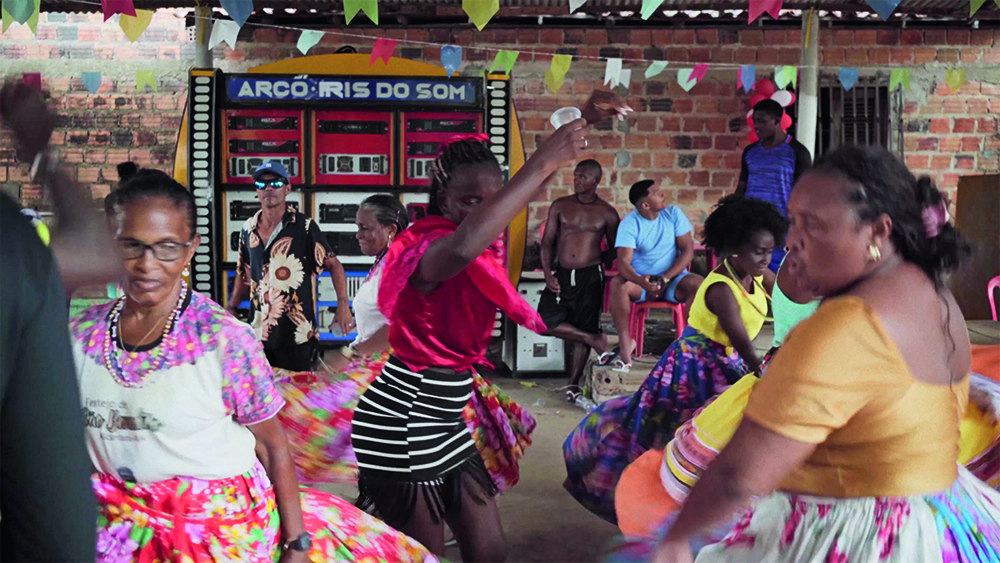
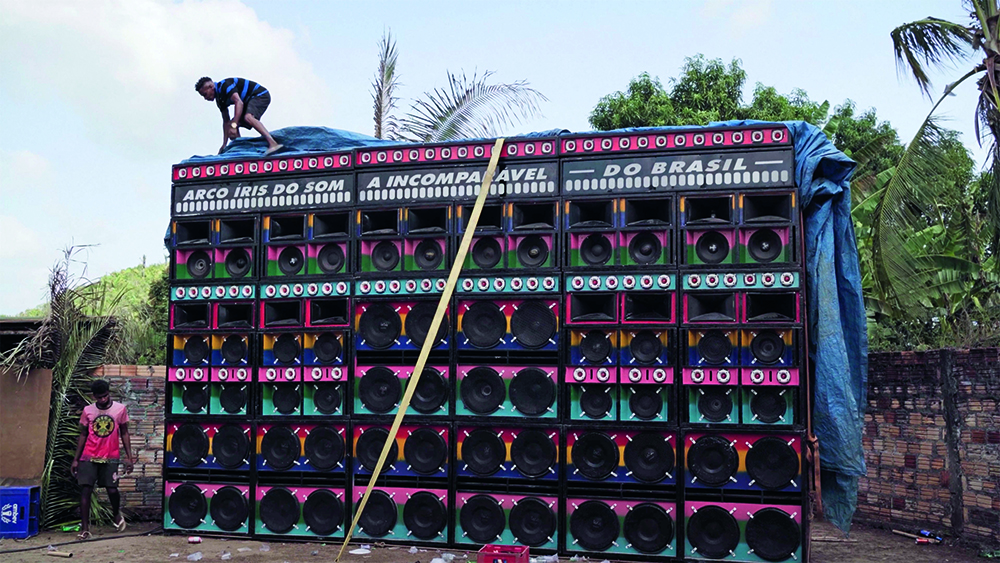
Radiolas are not merely the material convergence of musicality, faith, celebration and dance; they create occasions and carve out intervals in time that grant something people of Afro-diasporic roots in Brazil are routinely denied due to the racist legacy of slavery: leisure. “The work reasserts the presence of these spaces of rest and gathering, where Black and peripheral communities can go on the weekend and simply enjoy reggae on the beach, unburdened. I like to imagine the moment when the sound kisses the sea, when it spills beyond the speakers and takes hold of the bodies around it, manifesting in people who are celebrating calmly, who walk towards the water to meet, to talk, to make their offerings. Many of these sounds – songs, chants, oral histories – crossed the ocean to arrive here from Africa, and many were lost along the way. All I know for certain is this: we did not go searching for this sound. It was the sound that reached us.”
From the March 2026 issue of ArtReview – get your copy.
Watch next Viana’s Radiola de Promessa (2025), streaming now in ArtReview’s Art Lovers Movie Club