Michael Clark’s Satie Studs, performed by Jules Cunningham, revels in the precision of movement
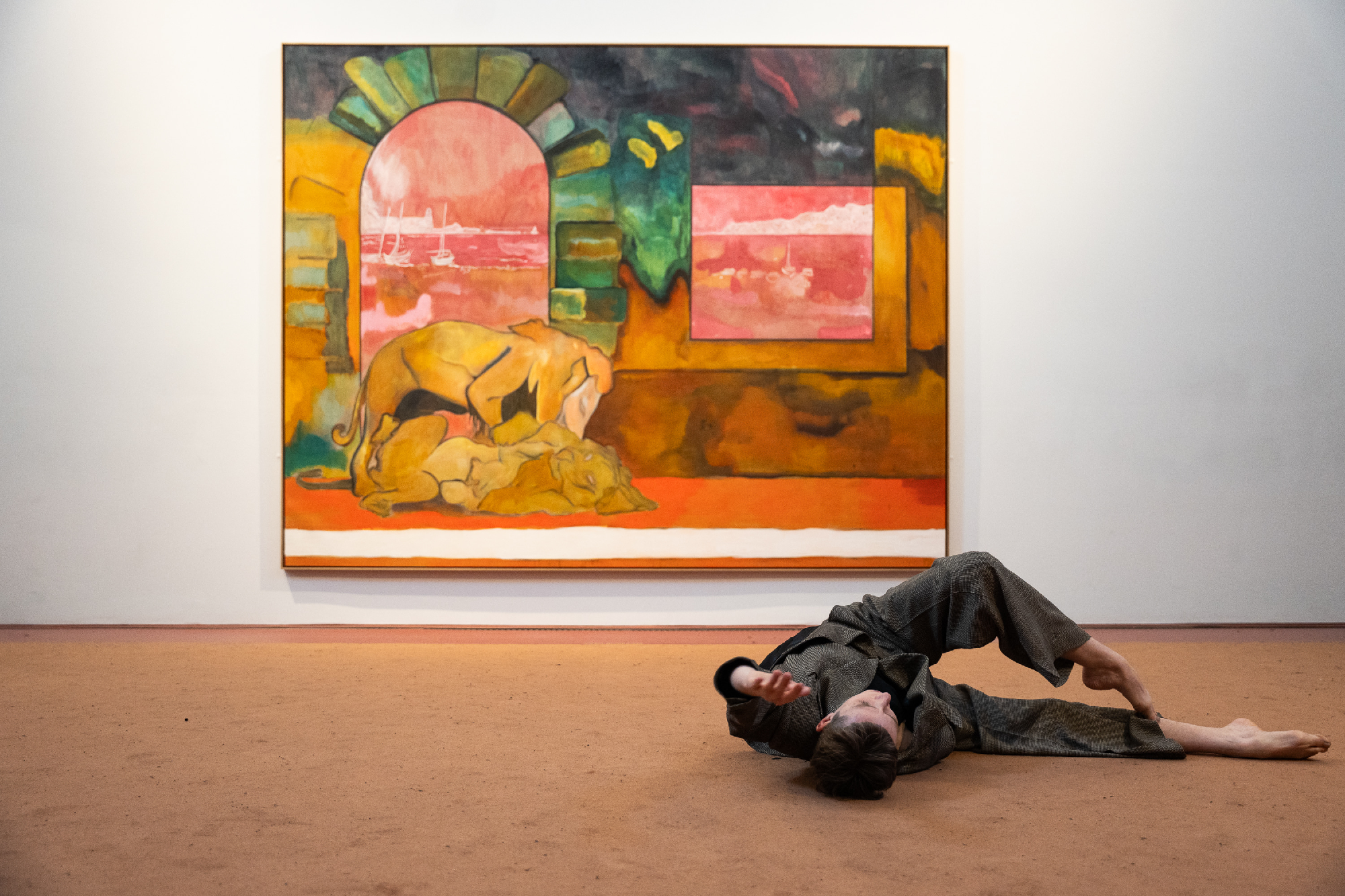
It starts somewhere between ballet and yoga. Jules Cunningham, barefoot in a grey-brown suit tightly cinched at the waist, holds each pose for a moment and then glides into the next. The poses often test extremes of flexibility and balance, sometimes resembling parts of yoga’s sun salutation sequence or echoing its warrior poses. Choreographed to the first of Erik Satie’s Quatre Préludes (1929), the short solo dance might risk becoming turgid beside the slow, solemn piano. Instead, the delicate precision that starts Satie Studs projects a fascination with movement, like a human puzzle meticulously exploring all possible solutions.
The live event programme of Peter Doig’s Serpentine exhibition House of Music – which explored cross-artform exchanges by inviting artists, collectors and musicians (including Max Richter and Brian Eno) to guest DJ – in its final week turned to dance. The 2003 choreography revived here feels controlled and minimalistic. For many, it’s likely not immediately obvious that this is the work of Michael Clark. The performance’s initial besuited restraint is a far cry from the iconic Scottish choreographer’s punk-influenced creations – from dancers cosplaying citrus fruits (I Am Curious, Orange, 1988) or, as I heard one visitor fondly recollect, dancers ‘with their arses out’ (referencing Clark’s 1984 BBC-broadcast performance to The Fall’s Lay of the Land). In Satie Studs, it’s as if Clark takes the key poses of a ballet and deletes any fluff between them, distilling the motion.
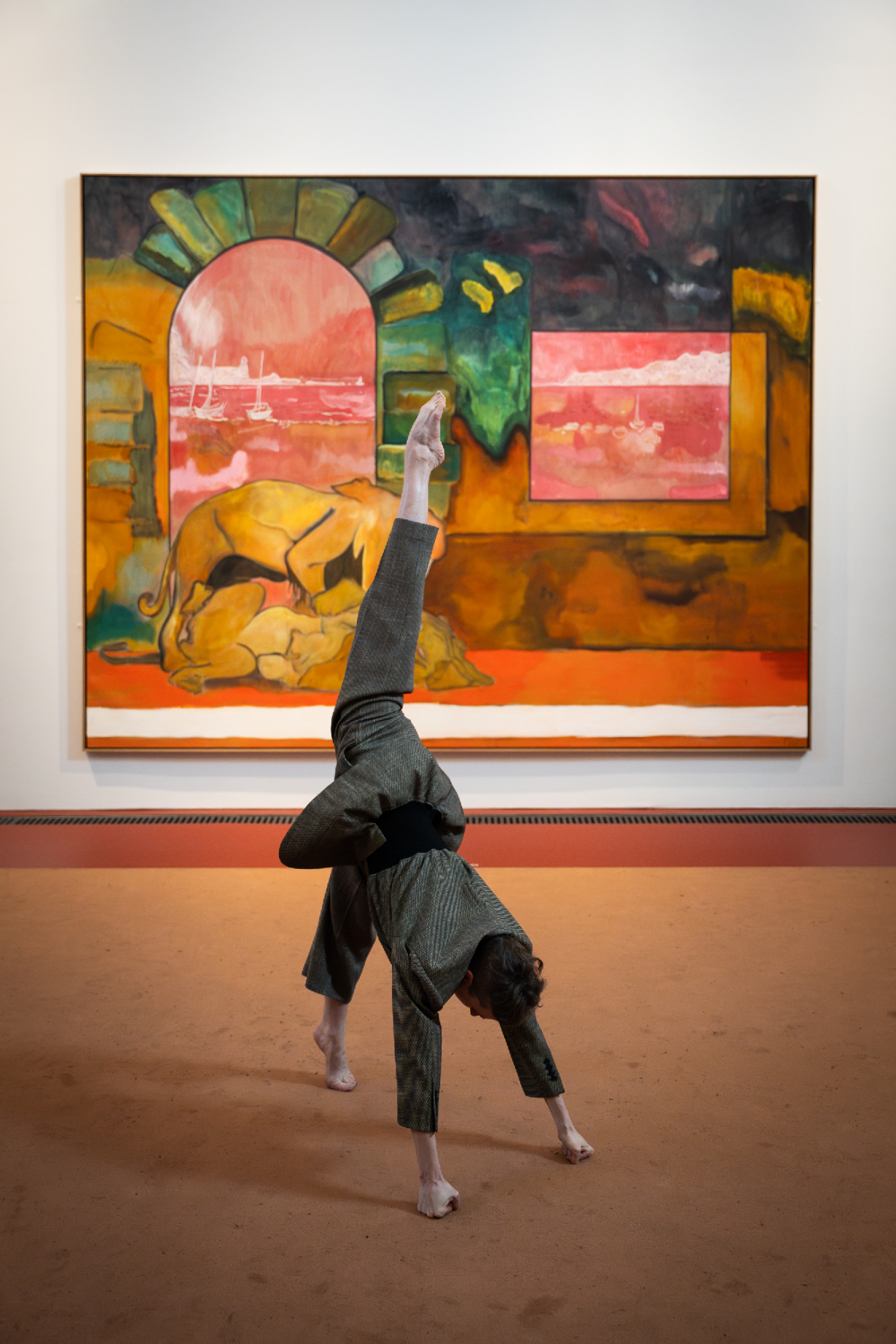
Collapsing to the tan brown carpet as the piano intensifies, Cunningham lies down and hits the music’s accents with precise kicks and rolls. Later, traversing the space via graceful balletic spins, Cunningham makes for a rare sighting of more classical continuous stepping movements, as if to highlight that tradition is always within reach but not always desirable. Cunningham stops in a one-legged, birdlike pose so close to the audience that some of us flinch. The DJ’s towering sound system at the centre of Doig’s exhibition stretches the length of the performance space, speakers impressive enough to be an altar for cult worship – but the music doesn’t dominate the movement. It’s intimate: we hear Cunningham’s joints creak with exertion, and heavier breathing develops into the dance’s own subtle internal rhythm.
Nearing the music’s resolution, the momentum builds into a series of spins that test the limits of control but never break them. If any fears about the piece’s hesitancy or self-restraint arose early on, they’re dispelled in its last seconds. After the piano stops, Cunningham continues relentlessly spinning towards the exit as the dance powers – self-propelled – into the silence. If any moment evokes the spirit of punk, it’s that feisty, near-frenzied spinning in silence. The dance seems to soar, launched into something far beyond the constraints of sound.
In the surrounding paintings, Doig’s figures are often faceless phantoms, part-present or part-erased; one of the performance’s direct neighbours, Rain in the Port of Spain (White Oak) (2015), features a watery, evanescing man and a lion with a ghost duplicate. By contrast, it doesn’t seem accidental that Clark selected a dance that emphasises controlled, concrete movements. There’s nothing ghostly about them. Among Doig’s evasive, part-real scenes, Cunningham’s performance feels reassuring, a lifeline to something grounded and certain. Though Doig’s exploration of art–music overlap gets people through the doors, it often feels incidental to the paintings themselves. But in Clark’s choreography, the exhibition finds a neat solution to bring the aural and visual together via movement: Satie Studs reminds us how precise a tool movement can be, how music remains in the air, unheard and unfelt, without the body.
Michael Clark and Jules Cunningham, Satie Studs was at Serpentine Galleries, London, 2, 4, 6 February 2026
From the March 2026 issue of ArtReview – get your copy.