Fullerton’s portraits question what it means to be represented, by whom and to what end
For over two decades, Glasgow-based painter Michael Fullerton has brought an analytic, conspiratorial edge to the most conservative of artforms: traditional portraiture. Inhabiting an eighteenth-century style indebted to Thomas Gainsborough, Fullerton’s portraits underscore their subjects’ relation to structures of power, from the director general of UNESCO to an extradited hacker, the governor of a Glasgow prison to a man wrongly imprisoned for the Birmingham pub bombings.
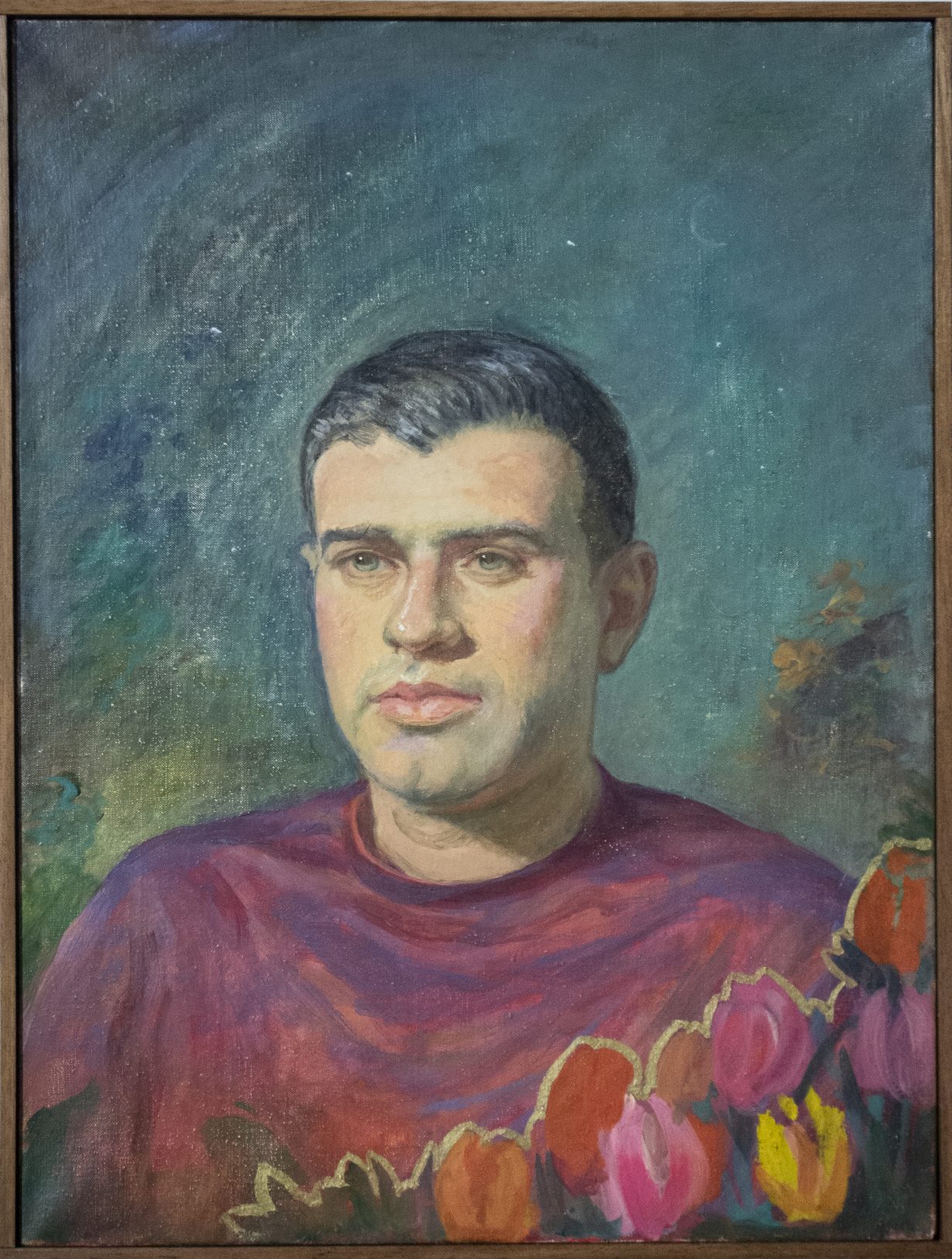
In 2023 Fullerton spent time as a member of live-in staff at the Hilltop Hotel in Carlisle, then under contract to house people seeking asylum. The first section of this two-part exhibition centres on 11 portraits of male refugees who lived alongside Fullerton at the hotel. Painted in oils, the men are depicted from the chest up in front of muddy, vaguely Romantic landscapes, or in one case smokestacks and factories pinched from L.S. Lowry. The sitters’ distant expressions are carefully rendered in warm colours: dashes of pink suggesting flushed cheeks, streaks of red in tired, watery eyes.
Fullerton often works from life, and some of the older works in the exhibition’s second half are complemented by captions recalling time spent with former subjects, such as a trip to New Zealand to visit the controversial entrepreneur Kim Dotcom for Ultramarine (2014). In the Hilltop Hotel series, however, Fullerton is cautious not to overstate the proximity of artist and sitter despite their shared accommodation. Information about the men is restricted to names and places of origin. One moving exception is the portrait of Joma Ahmadi (Afghanistan), Asylum Seeker, Hilltop Hotel, Carlisle (2025), which is accompanied by a slab of stone with a half-finished carving. A wall text explains that Ahmadi, a professional stone-carver, approached Fullerton to collaborate on a sign for a gardening charity he volunteered with, but the project was abandoned when Ahmadi unexpectedly stopped coming to the charity’s sessions. The portrait is luscious, a spray of gold-fringed tulips arranged against the deep reds and purples of Ahmadi’s sweatshirt, yet his detached look suggests his mind is elsewhere.
Some portraits express more familiarity than others. In Ayeman Al Rasheed (Syria) (2025), the sitter looks relaxed, a hand raised to his face as he stares through wire-rimmed glasses. His name in Arabic is painted in gold characters at the bottom corner of the canvas. On an adjacent wall, Christian Asylum Seeker, Name Unknown (2025) depicts a man in a black T-shirt and a thick silver chain. His face is delicately realised, but the roughly painted grey background gestures towards an emptiness. While these portraits, suffused with care and attention, act to correct the dehumanising rhetoric asylum seekers often suffer, Fullerton’s acceptance of absence and interruption questions the limits of representation, taking seriously the risk and responsibility involved when capturing another person’s image.
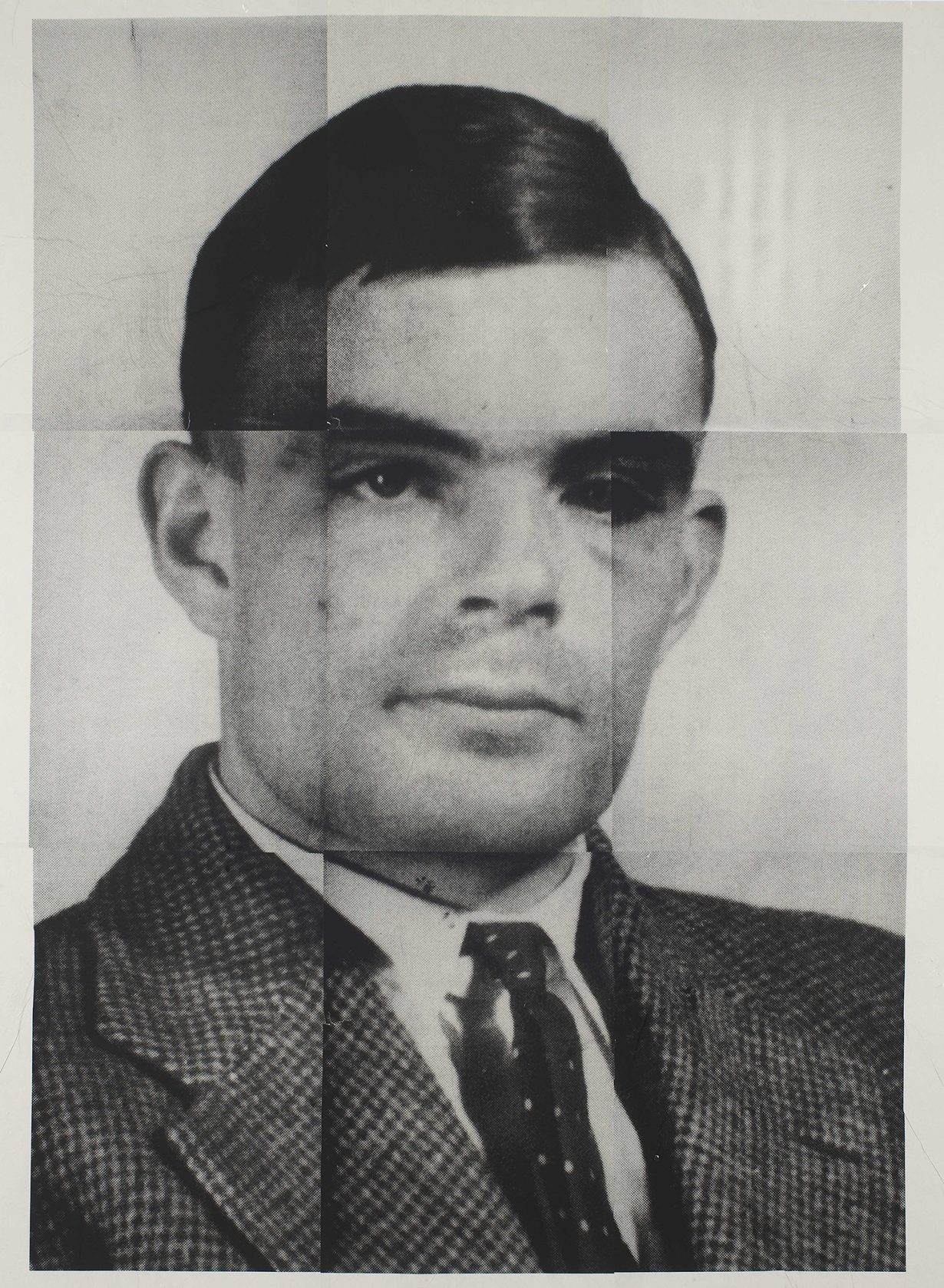
The second part of the exhibition is dedicated to Fullerton’s screenprints, selected from over 20 years of work. Printed on newsprint in black or gold inks, many of them are pasted directly onto the gallery walls. Repurposed images reference alternative music, golden-era Hollywood, advertising and activism. A recurring print of Alan Turing (Using Polish Technology, Turing Devised a More Sophisticated Machine to Crack ENIGMA, 2010) recalls the recent use of his image on banknotes by the state that persecuted his homosexuality and drove him to suicide. Included as part of the Hilltop Hotel section, the screenprint George Islay MacNeill Roberston, Baron Robertson of Port Ellen (2025) depicts the former secretary of state for defence, Fullerton’s childhood MP, splashed with streaks of gold and rotated on his side. Fullerton’s work ensnares the local within the global, constantly questioning what it means to be represented, by whom and to what end.
Michael Fullerton is on view at City Art Centre, Edinburgh, through 12 April
From the March 2026 issue of ArtReview – get your copy.
Read next Black Portraiture: ‘Looking At’ Or ‘Seeing Through’?