We are living in a culture that treats sex – with all its latent violences – as a virtual object instead of an embodied experience
This past December, a small audience gathered closely around four actors in a tiny loft near Union Square to watch New York-based artist Georgica Pettus’s Seconds Minutes Hours (2025), a stream-of-consciousness play set during the morning after a one-night stand. Stella Jiler, playing Molly (B) – for ‘Body’ – lay silent and undressed in a rumpled bed beside Jack Irv, playing Gabe (B). Kayhl Cooper, playing Gabe (M) – for ‘Mind’ – and Pettus herself, playing Molly (M), roamed the metre or so of space between the bed and the spectators, who became privy to a charming, awkward, step-by-step negotiation of sexual consent, articulated in duelling monologues.
“I could go again,” Gabe said as Gabe (B) gazed at Molly (B). For a minute or so, Gabe (M) rattled off how his body should signal this intent – “I should maybe be a little, like, not presumptuous. […] I’m not a dog. […] GET A MOVE ON MAN” – before opting simply to pet Molly’s arm. He ‘trac[ed] it from fingers to shoulder, […] refraining from going anywhere further’, following the stage directions as they appear in Pettus’s book 3 Plays (2025). Molly, confused by Gabe’s actions, told herself just to “smile nicely” and “let him do the talking”. In the ensuing silence, Gabe worried that he was acting like a pervert, then convinced himself that his touch was soothing. Spoiler: the characters became distracted, and the mood fizzled. They spent the remainder of the hour daydreaming about work, exes and family, and ultimately came to similar conclusions – separately, privately – about the fleetingness of intimacy and the joys of being present in the moment.
For a work that seemed intent on portraying sex fairly and responsibly in a post-#MeToo milieu, what Seconds Minutes Hours perhaps more accurately depicted was the experience of being ‘very online’, even if the set around the bed suggested otherwise: minimalist and lo-tech, it featured two vintage-looking chairs, an old-fashioned table and an analogue clock. There was even, notably, a tussle when Molly’s body started rummaging for her phone, and her mind blocked her path: “Where’s my phone?” Jiler agonised. “I need it. I want it. I want it. I’m gonna go get it NO no I’m not. No. I. Am. Not. I’m gonna enjoy this moment.” But if anything, those sad little lines paradoxically betrayed the play’s ‘very online’-ness. That and how it managed to strip an erotic scenario not only of desire and frustration but also of its power relations made Seconds Minutes Hours an apt encapsulation of our shallow, tech-addled and sexually stupefied times.
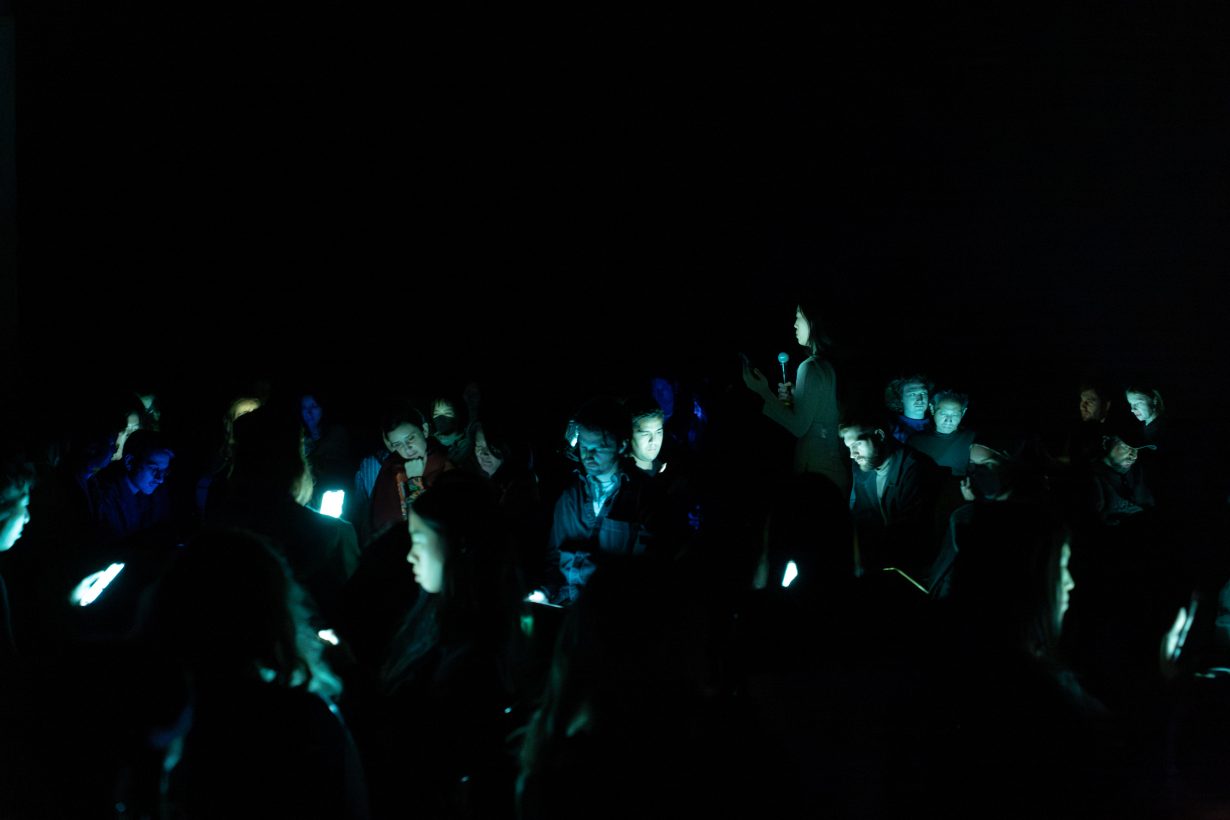
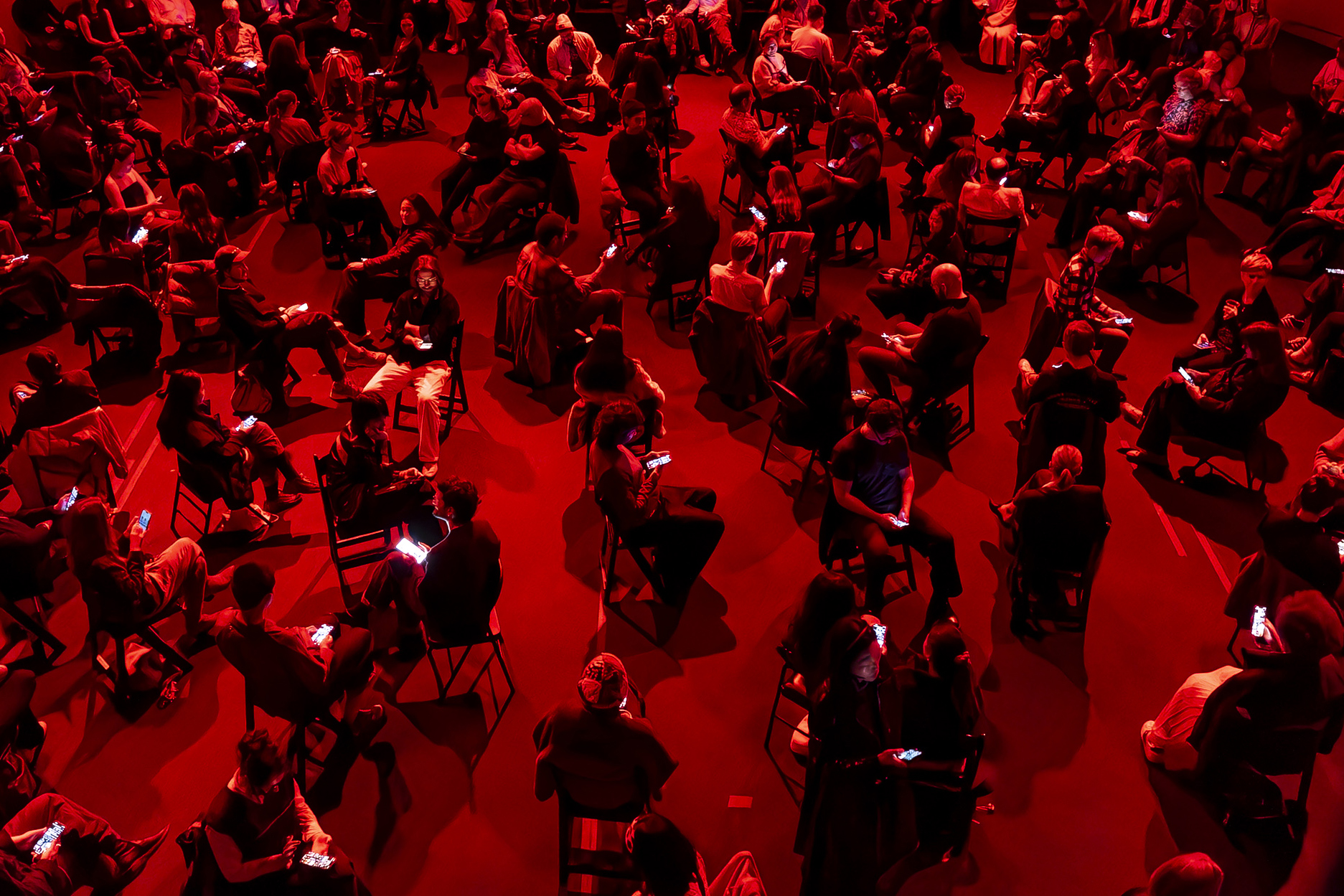
It reminded me of a programme I’d attended in Red Hook in September, Mindy Seu’s A Sexual History of the Internet (2025), a maximalist made-for-social-media spectacle that guided audiences through the dreary, misogynistic underbelly of cyberspace by way of a lecture unfolding across some 200 rapidly advancing Instagram stories. For her part, Seu enacted a cross between a schoolmarm and a data dominatrix, weaving authoritatively between the seats in Pioneer Works’ spacious exhibition hall. Her lecture comprised a history of events in which consent was foreclosed. Permission was never obtained, for instance, from the model Lena Forsén, whose image in a 1972 issue of Playboy was ripped to make the first JPEG. Today’s internet, Seu argues, likewise reduces our uploaded images and biometric data into quasi-pornographic fodder for strangers’ consumption: “Different parts of my body are scattered across apps and devices,” she incanted. “YouTube has my voice. TSA has my eyes. Health app logs my heartbeat. You’ll find my face, my limbs, on the app you’re viewing now.”
At the heart of Seu’s performance were her personal testimonies – the formative memories of an artist born in 1991, “the same year that VNS Matrix coined ‘cyberfeminism’” and “the World Wide Web was released”. She first encountered porn on her family computer, “a blue iMac G3”, and her subsequent professional career as a designer and technologist was met with sexual harassment from so-called icons in the field of computer science. But these episodes were conveyed as if through an outraged For You Page, in a sensory wash of intersecting oppression that flattened human experiences, Seu’s included, into undifferentiated data.
In comparison with that, Pettus’s production felt capacious if, by the same token, conspicuously aloof. Where A Sexual History of the Internet compressed five decades of injustice and resistance into screen-size capsules, Seconds Minutes Hours expanded time with verbosity and digression. Where A Sexual History skulked in the substrate of id-sponsored wish-fulfilment and unchecked power, Seconds played it safe, floating by on half-formed introspections that never quite reached the level of candidness. Both are symptoms of a culture that treats sex – with all its latent violences – as a virtual object instead of an embodied experience.
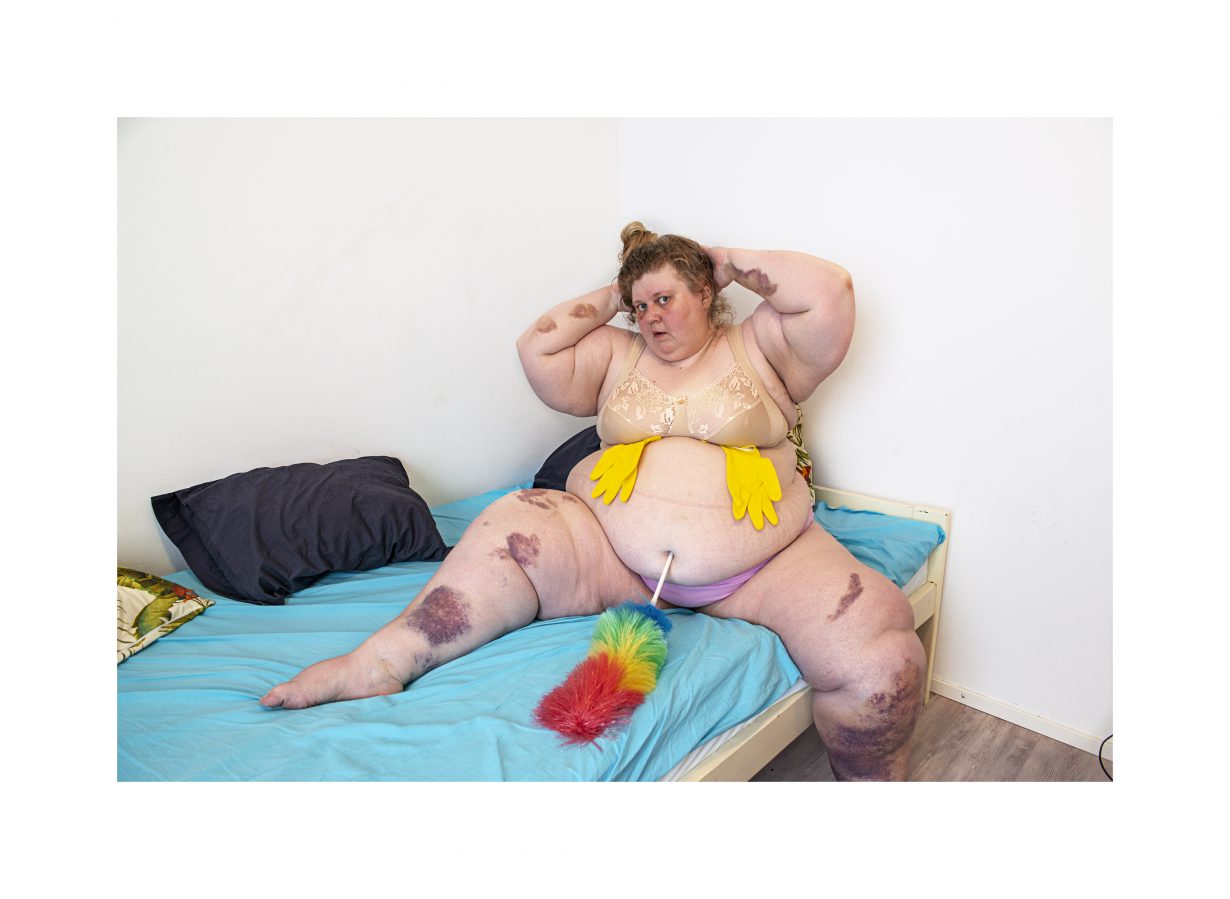
I recall the work of Finnish self-portraitist Iiu Susiraja and her early photo series Dalmatian (2019). Made during a year that was, in hindsight, an interlude between the opening salvos of #MeToo and the COVID-induced digital acceleration that was to come, Dalmatian was a group of full-body portraits in which Susiraja appears either naked or partially unclothed inside her middle-class home in Turku, the typical setting for her photographs. In that series, however, she adopts distinct, pinup-style poses to document a host of grisly purple bruises on her corpulent arms, legs, face and buttocks, while absurd props – a plastic toy horse wedged between her thighs, a rainbow feather-duster protruding from her navel – short-circuit her oblique testimony. In each photo, Susiraja’s deadpan eyes, one of which is blackened, stare into the camera. She had declined, during a Q&A at MoMA PS1, where the series was included in her 2023 survey, A style called a dead fish, to comment on the cause of the bruises, and so, in lieu of an unspooling inner monologue or the facts and figures that constitute history, the only authority on the matter was her self-fashioned chronicle. Tinged as it is with the kind of knowing irony that the harrowing information shared during the #MeToo movement, largely via the internet, baked into subsequent cultural representations of desire and intimacy, the evidence – of personal injury, of sexual agency – inscribed on her body and in her palimpsestic gaze remains today as explicit as it is irreducible.