These colourful paintings of dancing figures reject hierarchy in favour of collective being
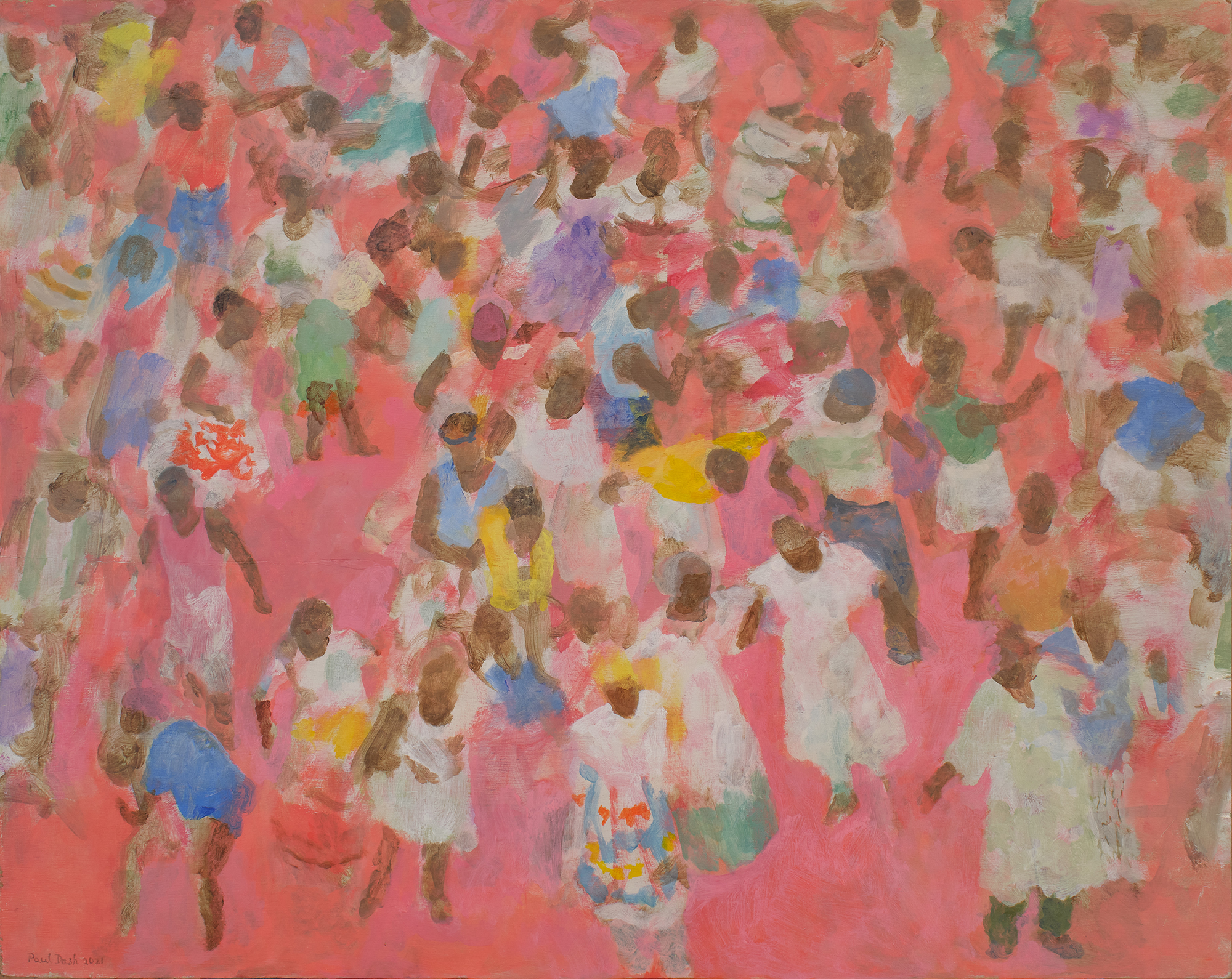
The death of pictorial ego is Paul Dash’s métier, though you might not see this at first. At first glance, the paintings included in Dancing in the Street present as celebratory crowd scenes: dense gatherings of brown bodies caught mid-motion, seen from an aerial vantage. A single structuring condition animates Dash’s work throughout: carnival, operating as aesthetic, even metaphysical, theme. A member of the Caribbean Artists Movement – a pivotal London-based collective of the 1960s and 70s – Dash has spent over six decades painting carnival, an inexhaustible artistic wellspring.
Dash was born in Barbados and came to Oxford when he was eleven, and since Barbados did not then have a carnival tradition, this is a heritage he imbibed after arriving in the UK as a young person. Dash is more of a synthesiser than an ethnographer. Far from simply painting joy and revelry, Dash jettisoned the visual grammar of hierarchy – the perspective, costume, spatial privilege and focal distance, the far-off vistas enclosing the scene and situating bodies within it – that structures the Western crowd-painting tradition, from Pieter Bruegel to Georges Seurat, Diego Rivera and others. Where philosopher Mikhail Bakhtin’s carnivalesque proposed a temporary suspension of order, Dash proposes permanent replacement. It is less a stylistic contrast than an ontological one: what a painting tells us the world is. For Bruegel, the world is individuals arranged by class and role. For Dash, it is bodies together without rank, collective.
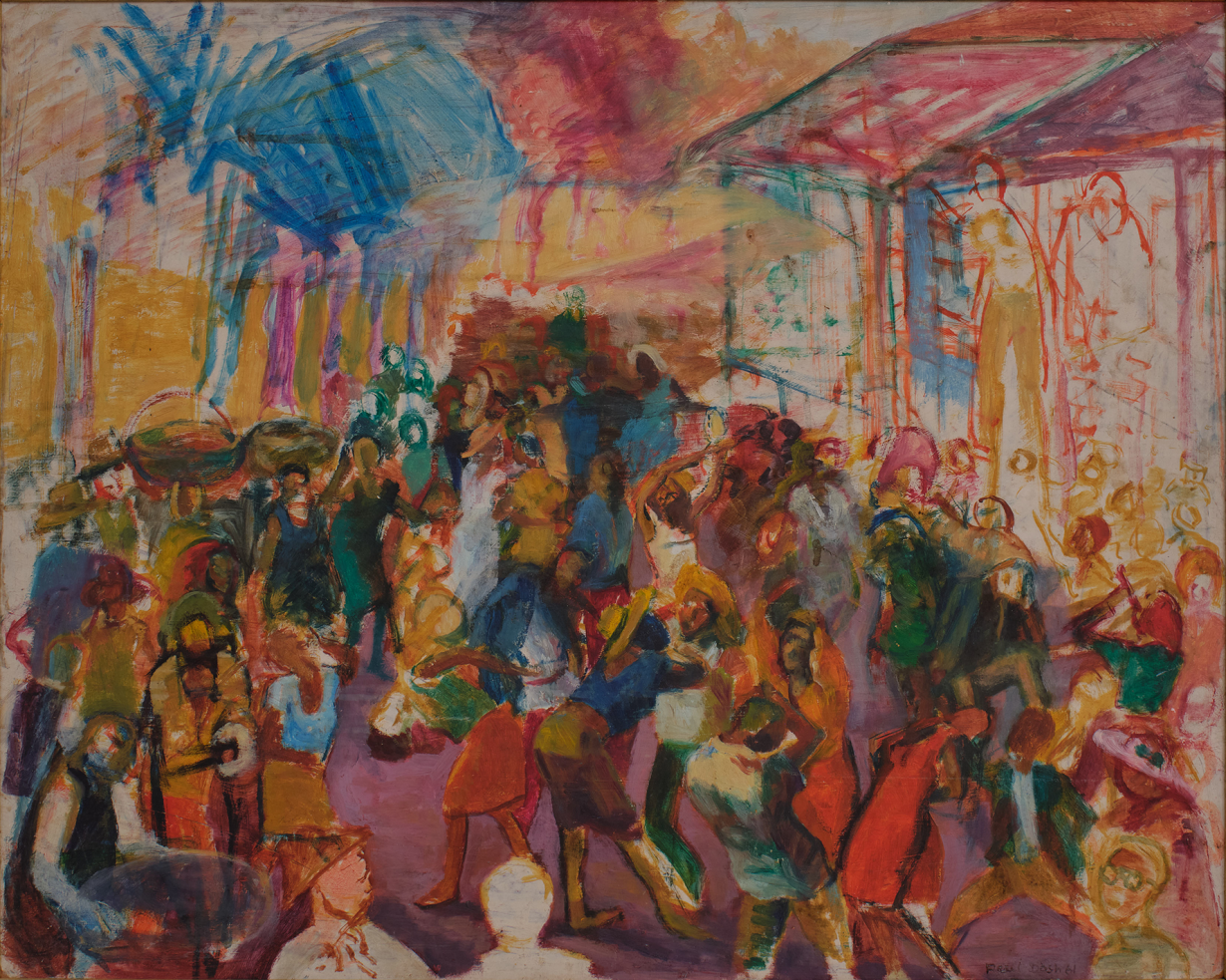
The exhibition’s eponymous title and earliest work, Dancing in the Street (1961), painted when Dash was fifteen, operates as landscape first – leafy trees flanking the left, a house on the right, a road receding to a solitary tree establishing a focal point in the distance – before it operates as crowd painting. You notice all these things before the foreground, the revellers: splotchy, loosely brushed. A woman in white raises arms skyward, another bends low in ecstatic gesture, a policeman looks on as does a spectral figure. No two gestures repeat, yet the figures remain subordinate to the landscape that frames them. One of the largest works, Want Fi Goh Rave (2025), contains some 120 figures. Sixty-four years separate these paintings, yet the formal proposition remains consistent. The configuration of bodies is asymmetrical, appearing as one great jumble at first. But look closely and one can trace out waves – much like a party train that people make when they dance. They break, but resume. Several parties break out within one main party, each with their own rhythm, creating a visual dazzle or polyphony, created by body placement and colour action: the yellow ground holds the plane while synchronised strokes of pinks, blues, greens pulse on the figures themselves.
Here, Dash’s radical proposition clarifies. Figures exist together, offering neither narrative nor symbolism, instead inviting a celebration of collective being. No two figures are identical, yet no figure is depicted as a portrait or psychological type. Freedom Come (2021) presents a compelling complication: several foreground figures wear long white flowing robes that signal ritual or religious affiliation. In Trinidad, white signals Afro-diasporic spiritual traditions, while in Barbados, church procession or respectability. What appears here is not memory reinhabited but studied adoption by Dash as painter, working across Caribbean visual language rather than a single local tradition. Crucially, the white-robed figures in Freedom Come neither command space nor organise the crowd. Hierarchy is momentarily invoked only to remain incomplete. Carnival is rendered not as a temporary release, but as a permanent state, one that Dash sought at fifteen, found and never let go.
Dancing in the Street at Felix & Spear, London, through 8 March
Read next Who Doesn’t Have Daddy Issues?