Is there risk in transforming migration into mythology, Sharmilla Ganesan wonders – turning memory into something to be preserved indefinitely?
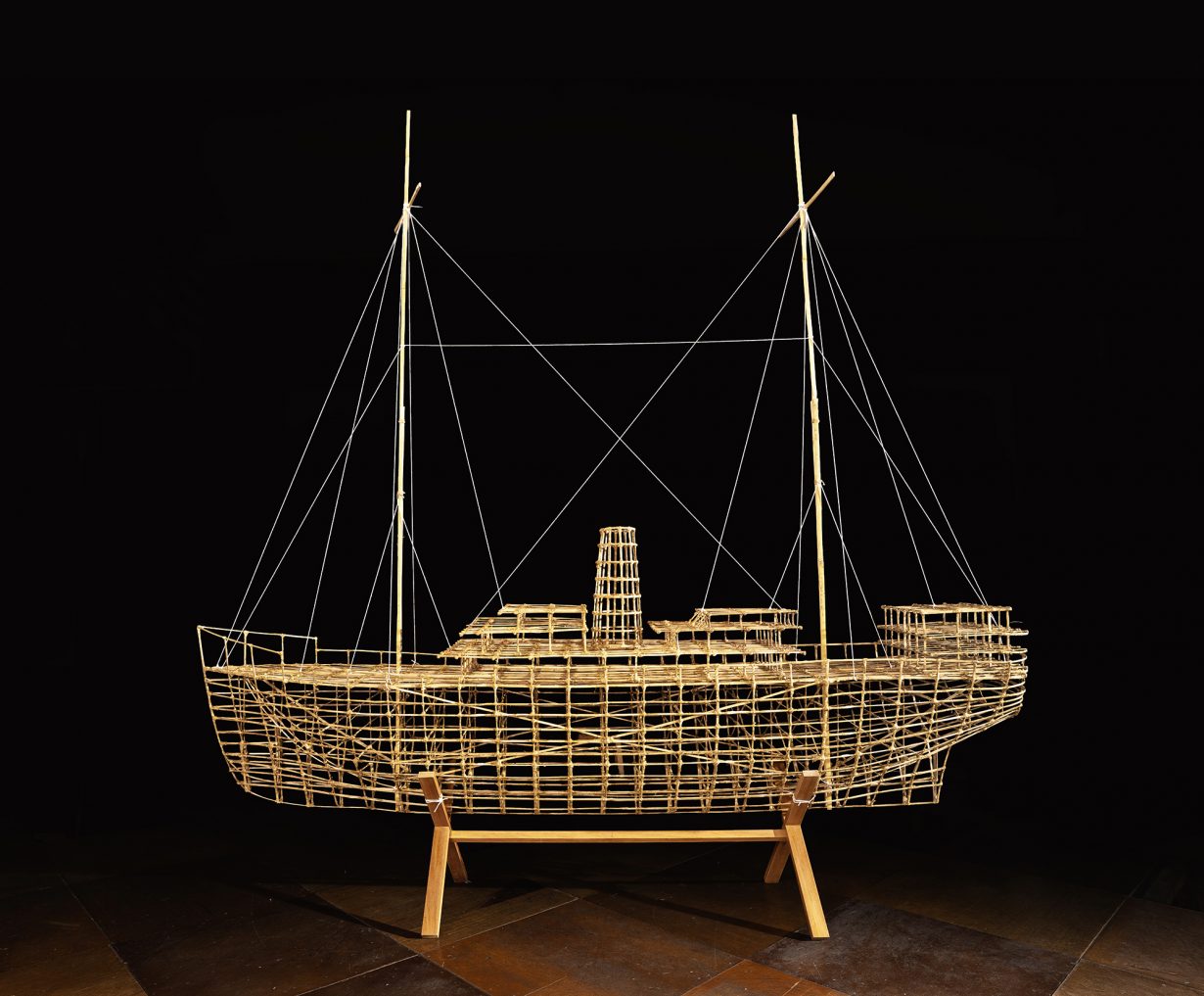
A two-metre-long bamboo model of a twin-masted steamship (SS Rajula, 2026) rests on a wooden stand in front of two screens looping black-and-white videos of the ocean. The sound of movement through water fills the space. Paintings in shades of ochre, clay and black hang on walls to either side of the model, aligned in a manner reminiscent of the way that portholes puncture a ship’s hull.
Despite the videos, for an exhibition centred on the theme of journeys, it is all remarkably still. It feels, in fact, like facing an altar.
Which is apt given the history of the actual ship that inspired these works: the S.S. Rajula, which transported tens of thousands of Indian migrants between India and Malaysia from 1926 to 1973. Running fortnightly between Madras, Nagapattinam, Penang, Port Klang and Singapore, the ship played a pivotal role in the lives of these migrants, allowing not just their migration to new shores, but also journeys back and forth.
Rajinder Singh has voyaged on it, his father did the same in 1957, as did his grandfather in 1927. But the Rajula is a shared refrain within the family histories of many Malaysian Indians, taking on almost a totemic quality – a symbol of a past home and the means by which they left. It is this reverence that seems to linger in Singh’s Saffron Crossings. The Malaysian-born, London-based artist has long been excavating his family’s migration history from Punjab to Malaysia in his works. With this exhibition, he seems not just to be exploring memories of that journey, but also crafting them into both a personal and a collective mythology.
For his richly patterned paintings, Singh draws on the centuries-old Phulkari textile tradition from Punjab. Traditionally these were made by women, embroidered slowly over time in anticipation of major celebrations like weddings, and often treasured as heirlooms. By employing this style of geometric, repetitive motifs, Singh’s paintings take on a further ceremonial quality.
The imagery they contain, however, is so varied as to defy easy categorisation. Some paintings seem like festival scenes, with gods, sacred animals and umbrellas in procession. Others resemble cave paintings, with forms that suggest mysterious plants and fauna, or mythological figures. And in others, there are trains and Ferris wheels, all of it densely packed together as if multiple different stories were unfolding at once. In this they recall passengers packed tightly onboard a vessel: chaotic but arranged in neat rows. A hodge-podge of memories, which have now, like the patterns, become heirlooms.
Amid those busy Phulkari canvases, Singh places textured, monochromatic paintings of deep red or black, evoking the feel of both soil and sea through their opaque, tactile surfaces. Between two paintings (and one floor up from the model ship) is in an evolving work titled Passenger Manifest (2026): 63 wooden beads (the total comes from the arithmetic of a 7 × 9 grid for embroidery and the fact that the artist is in his 63rd year) occupy a grid on the wall, notionally representing positions within a vessel. Each Tuesday during the run of the exhibition, one bead is removed. The wall label declares: ‘The position remains. The passenger has departed.’
There is a risk in transforming migration into mythology, of turning memory into something to be preserved indefinitely. The very qualities that make these works resonate so deeply – the sense of ritual, the evocation of heirlooms – also seem to keep the exhibition removed from the present. The Rajula becomes a relic.
This is where the stillness begins to feel complicated. The ship that once carried people between countries is here permanently fixed in place. The paintings are full of movement, but all fixed into a pattern. Lived experiences have become objects of contemplation.
This is particularly striking in comparison to Singh’s previous solo show, Saffron Surrender (2024), which examined migration through the lens of violences inflicted on the Sikh body by colonialism. The paintings were roiling and restless, and insisted on confronting the present with the uncomfortable past. In contrast, Saffron Crossings presents migration as something to be contemplated, preserved and passed down.
Perhaps this is the tension at the heart of Saffron Crossings. There is something genuinely powerful about seeing a community’s fragile histories carefully gathered and made tangible. But migration is not simply an inheritance; it is a lived reality that continues to be shaped by changing borders, economic conditions and the desire – or necessity – to make a life elsewhere. Here the present remains largely beyond the frame.
Rajinder Singh: Saffron Crossings at Wei-Ling Gallery, Kuala Lumpur, through 26 September
From the Autumn 2026 issue of ArtReview Asia – get your copy.
Read next The Human Story of Maritime Capitalism