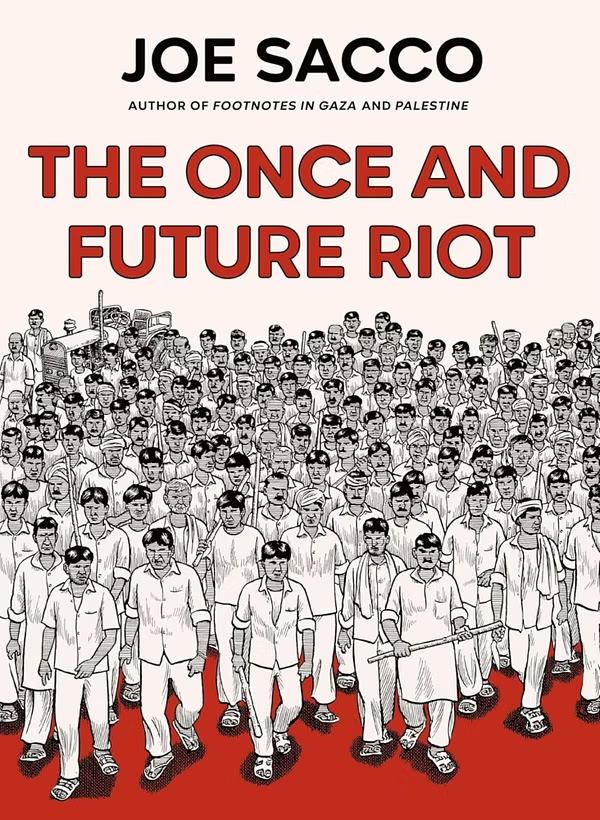
‘A democracy that arouses violence may one day be overwhelmed by it,’ graphic journalist Joe Sacco warns in his latest docu-comic. Delving into the 2013 riots in the Muzaffarnagar area of Uttar Pradesh in India, in which a fatal street scuffle led to wider clashes between Muslim and Hindu communities and to over 60 deaths, The Once and Future Riot isn’t so much a history of a single catastrophic event as it is a portrait of how people justify hatred and rationalise cruelty.
Sacco interviews people on all sides of the conflict Ð politicians, mayors, lawyers, swamis, villagers and refugees Ð to piece together a timeline of events, creating a dense tale of the personal perspectives that underwrite the headlines. What is first portrayed as religious tension soon becomes apparent as a knot of conflicts between landowner and labourer, male and female power, and rural and urban populations. A riot is never just a riot, Sacco sets out, but only the latest expression of wider issues, jumping all-too-briefly back to the Partition of India and Pakistan in 1947 and to the 1992 violence that erupted after the destruction of the Babri Masjid mosque, before returning to his visit in 2014 to piece together disparate accounts and find, as he puts it, ‘some semblance of reality’.
Why a comic to portray ‘reality’? Sacco’s drawings are executed in clear, thick black lines, his characters just shy of caricature; the artist often makes sure to include himself in the page, in the foreground with pen in hand. But the medium is appropriately kaleidoscopic, each page a tightly packed collage of text and image that allows for a multifaceted perspective. The accounts from his (mostly male) sources diverge, sometimes overlap: one mayor insists nothing even happened, while others attest to that same person leading a mob. What emerges is a depiction of inequality and sectarianism, but also corruption, misinformation, willing ignorance and a will towards violence on both an individual and state level.
The opening scene, of a car racing through dense traffic, becomes the metaphorical vehicle for the whole story: speeding through a complex issue in a single rushed visit, a quick spin through Partition’s deadly legacies and the more recent rise of Hindutva nationalism. Here, there is less intimate scene-setting than in some of Sacco’s previous works, more a drive-by. But as the title suggests, this isn’t actually about one riot, or even one place, but statement of the reasons why this will happen again.
The Once and Future Riot by Joe Sacco. Jonathan Cape, £20 (hardcover)