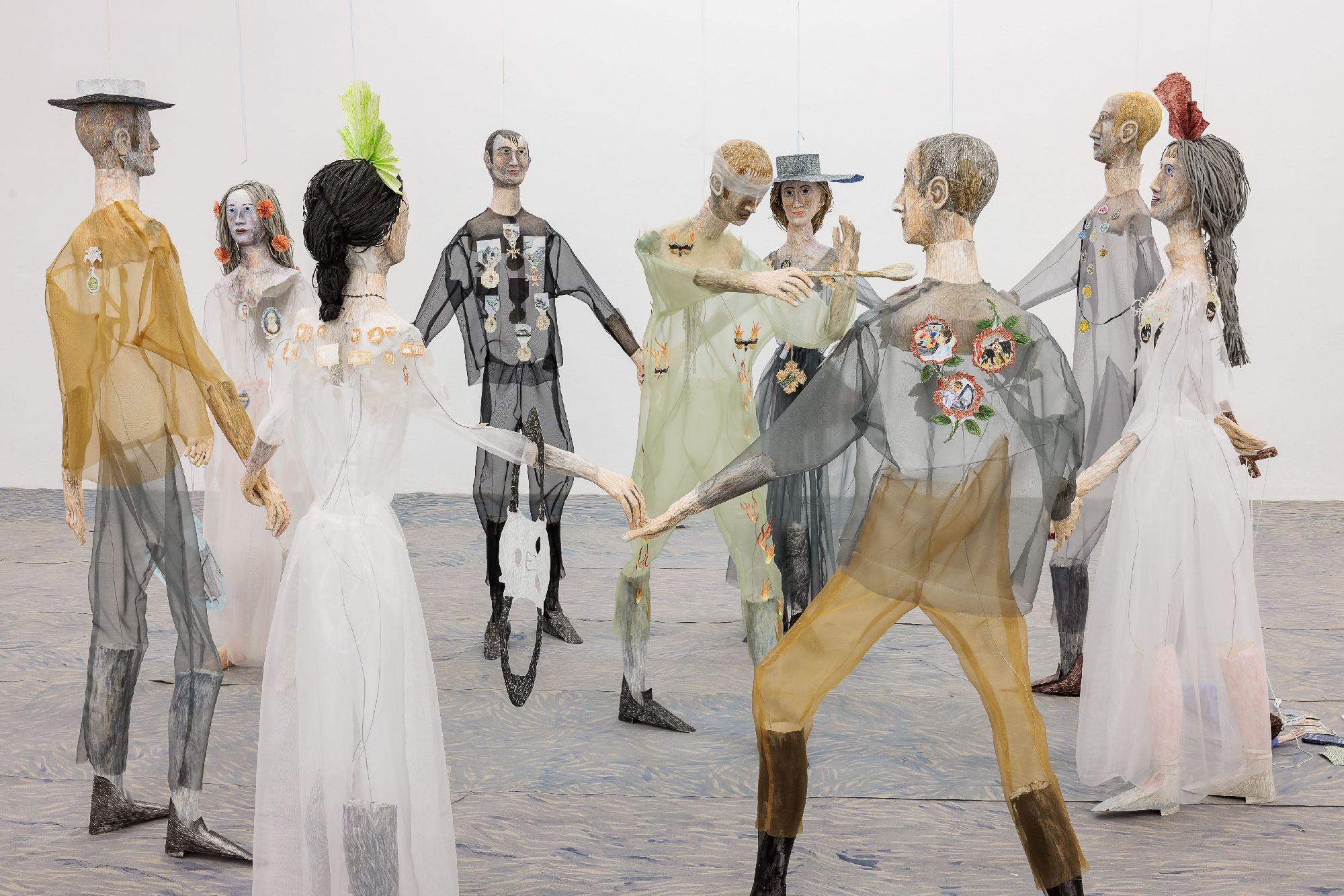
Considering Agnes Scherer’s Three Wicked Games at Salzburger Kunstverein, Olga Hohmann wonders who gets to be part of the inner circle
‘A human only plays when they are, in the full sense of the word, a human being, and they are only fully a human being when they play.’
–– Friedrich Schiller, On the Aesthetic Education of Man (1795)
Again and again, I catch sight of the two groups of figures from the doorway. They look tall and form a constellation, so self-contained, so absorbed in themselves and in one another, that I feel reluctant to disturb them. One group forms a closed circle; the other leaves it open. I am not sure I feel invited to join any of them.
I spontaneously think of my behavioural therapist, who discharged me after only a few sessions but left me with an intriguing piece of trivia: the so-called Zeigarnik effect. A drawn circle remains in memory when it has not been completed. An open circle haunts us in a way a closed circle does not. This theory, which refers to a concrete experimental setup in which patients literally had to draw circles on a piece of paper, can, of course, function as a metaphor for uncompleted tasks or finding closure in a social constellation. Yet my friend A. once said: “Strangely, I become nervous when the circle is closed, not when it is open.”
Open or closed, the circles behind the doorway haunt me, just like the empty-yet-animated gazes of the larger-than-life puppets – humanoid sculptures – that form them.
The sculptures seem almost to float in their fragility, while remaining stable, certain of themselves and of one another but aloof at the same time. They are made of paper and semitransparent fabric, which gives them a ghostlike quality, like a mirage in the desert, threatening to disappear if you come too close. Though of course they do not need to be observed to exist. Again and again I consider stepping among them, and again and again I abandon the thought. ‘The inner circle,’ I think. I have never liked exclusivity, yet it remains a determining force within the field that I navigate professionally. It constitutes relationality by introducing us to a concept of affiliation and distinction. ‘Where do I belong? Where – and with whom – do I stand? Against whom?’ Inclusion and exclusion seem to be not only aesthetic but political values within the artworld. The circle becomes a powerful figure. It is charged with the fantasy that there exists a group into which one might one day be admitted. This fantasy is structured as a game of desire that can never be fulfilled. What sustains desire is not admission itself but the expectation of admission – an endless game of ‘edging’.
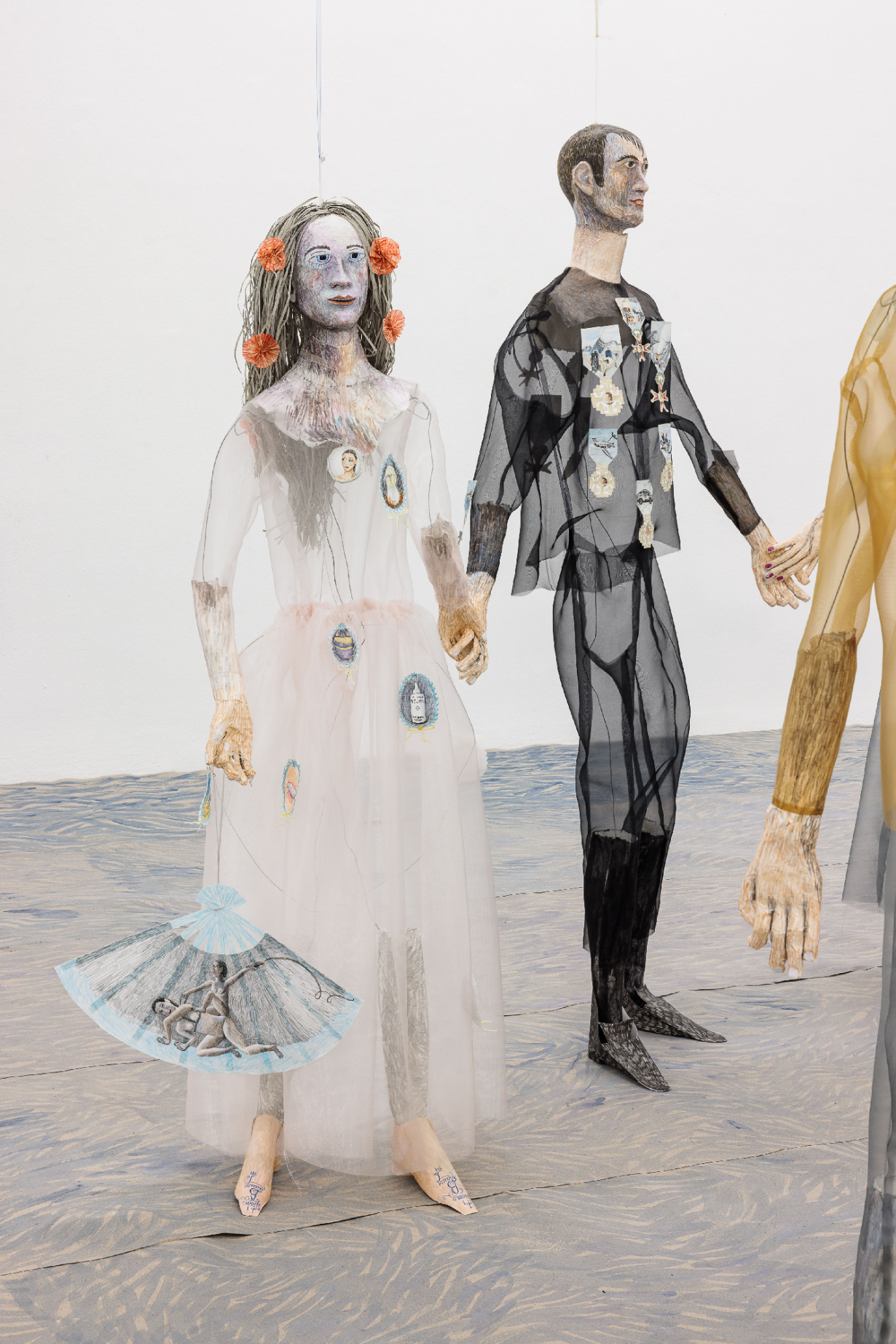
In Agnes Scherer’s exhibition Three Wicked Games at the Salzburger Kunstverein, the floor on which the figures seem to float is covered with paper depicting the surface of water. On the one hand you might recognise this as the type of setup used to protect a floor during a renovation; on the other you might feel like Jesus. Moreover, the painted floor in combination with the protagonists (whose features are drawn on) turn the whole room into one big painting. A painting that you are allowed to enter. You become part of the work, through your somatic presence alone. In doing so, you inevitably participate in the ‘wicked game’ of belonging and exclusion – whether you wish to or not. Coming closer to the figures, you are able to read the elaborately drawn signs they carry on their clothes, referring to expensive skin-care brands, for example; the viewer feels pleased to be able to detect and read these signifiers, understanding the mockery as an insider joke. Both the figures and we, the viewers, are thus trapped in the game of distinction.
Yet the circle evokes more than social hierarchy. It also suggests ritual, séance and childhood play. It recalls those games in which children stand in a circle while an unseen figure moves around them. “Dreh dich nicht um” (Don’t turn around), they chant, warning one another. The circle becomes a space of suspense, complicity and latent threat.
Friedrich Schiller understood that every game contains a seriousness of its own. A game consists not only of rules but of the collective decision to treat those rules as meaningful, binding. We know they are invented, yet we follow them as if they are laws. Refusing the rules means refusing the other players. The game only functions because everyone agrees to believe in its rules. It is an early form of social contract.
Games model social life because they teach us how relations are negotiated, constructed and maintained. A game is never ‘just’ a game – it is always a mirror of society. And as experience shows, one becomes a social outsider if one does not know the rules or does not take them seriously. ‘Not allowed to play’ is a social punishment.
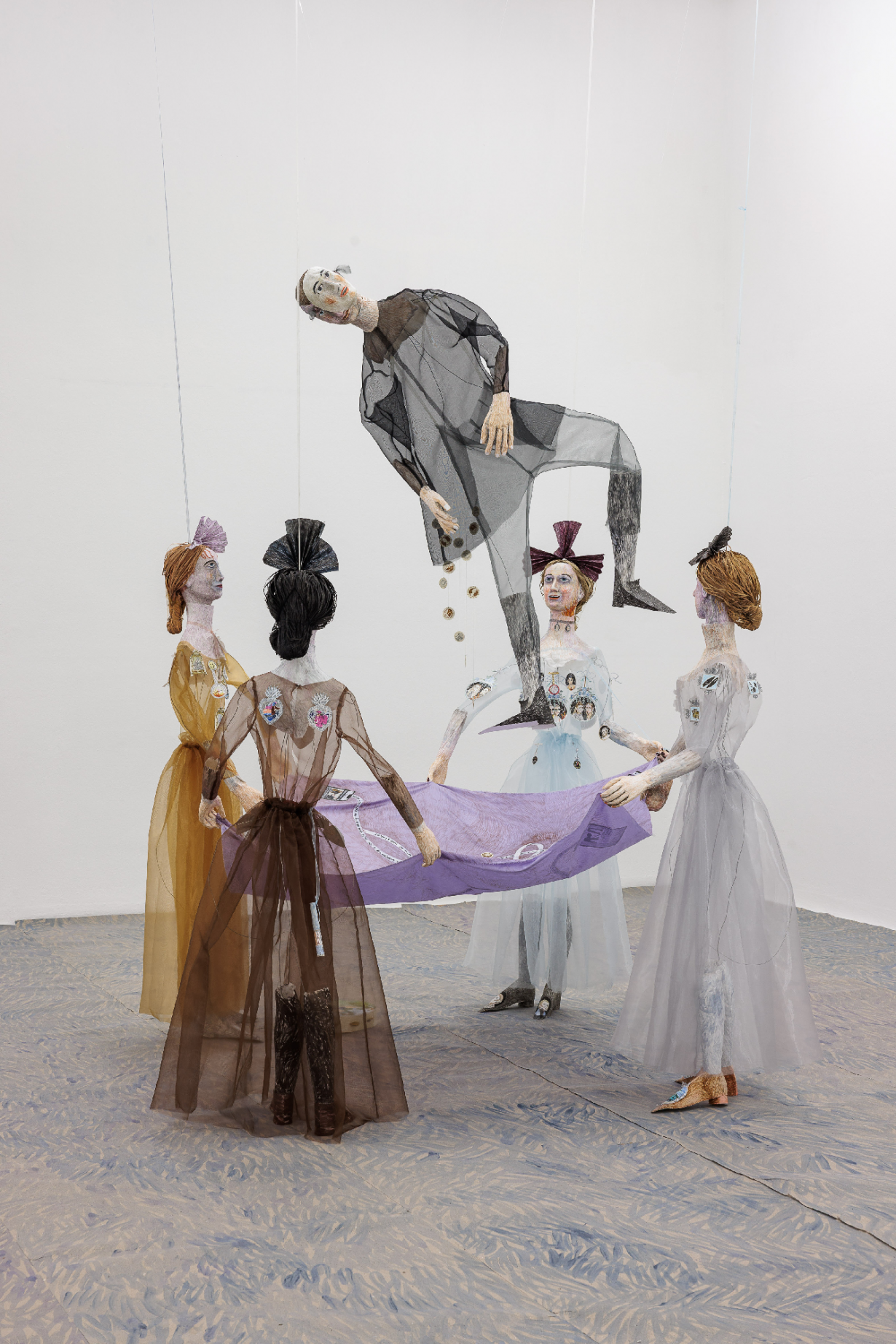
These issues are already present in the works that are named as references in the text that accompanies the exhibition: Francisco Goya’s paintings Blind Man’s Bluff (1789) and The Straw Manikin (1791). The former features a group of well-dressed courtly characters dancing in a circle while a blindfolded youth in the middle tries to touch them with a spoon. The latter features four young women who each hold one corner of a sheet of cloth, which they use to toss and catch the titular straw doll. Both are commissions that the painter developed at the Spanish Court. When I encounter these references, I hesitate. I feel as though I have seen the motifs of the paintings before, albeit in a very different form.
Eventually I recall a trip to Madrid where I unexpectedly encountered a complete set of Goya’s etching series The Follies (1815–23). The series depicts people absorbed in games and rituals. But unlike in Goya’s earlier works, which often feature members of the bourgeoisie or courtly elite, here we see figures that belong to the marginalised, the abandoned and the excluded. They may be society’s outcasts, but they appear to be playing the very same games played at court in Blind Man’s Bluff.
Unlike the elegant participants of Blind Man’s Bluff, the figures of The Follies appear unruly, autonomous, as if the same game operates a more radical mode of existence beyond the boundaries of social convention: the aristocrats appear controlled and distant, as representatives of their class; the figures in The Follies emerge as individuals, as protagonists. They seem animated by genuine pleasure: you instinctively want to join them, rather than the aristocrats.
This becomes especially revealing in relation to Blind Man’s Bluff. The painting can be read as an allegory of how the aristocrats move ‘blindly’ through society, fulfilling and performing the roles assigned to them. The game thus becomes more than a scene of leisure; it functions as a metaphor for the mechanisms of social conformity and obedience.
The distinction between those with agency and those without it is useful when thinking about Scherer’s installation. Her figures oscillate between personhood and puppethood. They are human enough to invite identification yet artificial enough to remain unsettling. Their circles – open or closed – are neither fully welcoming nor entirely forbidding.
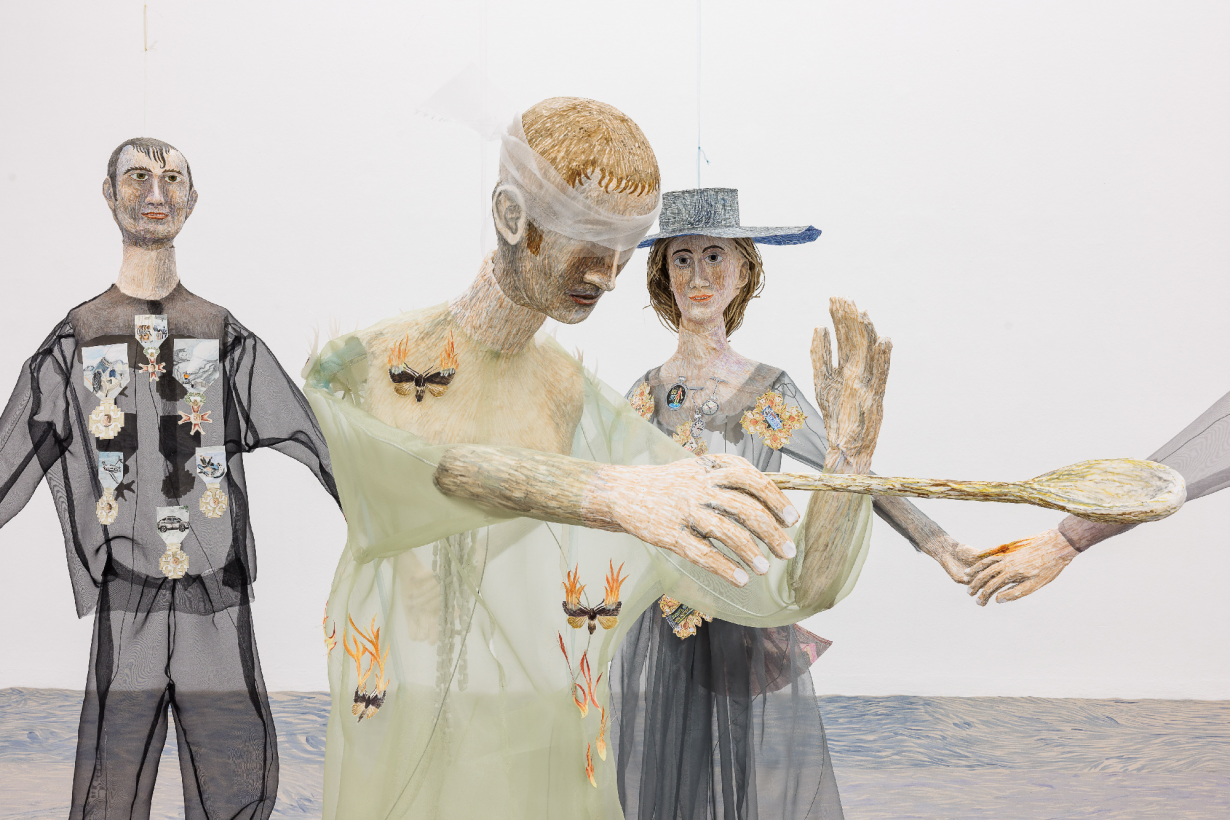
Standing on the paper-covered floor of the Salzburger Kunstverein I begin to wonder: who is the straw manikin and who is the blindfolded player today? Who is blind, and to what? Are we all playing blind man’s bluff? And above all: who gains entry into the ‘inner circle’, and who does not? Who wishes to enter which circle here?
The question of blindness leads naturally to Freud’s concept of the uncanny, which concerns itself with the invisible aspects of a seemingly transparent social reality. The uncanny (das Unheimliche) emerges when something is both familiar (heimelig) and strange, foreign, secret (heimlich) at the same time. Scherer’s figures produce precisely this effect.
These uncanny figures do not need my attention. The circle would continue to exist without me. The game would be played in my absence. I am not invited anyway.
And so I remain standing in the doorway. The figures continue their silent game. What lingers is not the certainty of belonging but the persistence of the desire to belong.
And with it, a final question: at what point does the (serious) game finally end?
Olga Hohmann is a writer and performer from Berlin, who is using text both a form of art and as a medium to discuss and accompany art.