How the artist explores real-world suffering through mediated artifice
There’s an elysian quality to the gardens surrounding the Shiga Museum of Art. The air is crisp, the brook clear, the trees bare yet resplendent in the winter sun. This is a kind of Eden one dreams of; it is not the version that artist Sasaoka Yuriko offers inside the museum.
Sasaoka Yuriko’s Paradise Dungeon opens with a grimace. In the two-second looped video Untitled (2011), a marionette with crudely spliced body parts, including the artist’s digitally superimposed head, is jerked around by strings in front of a green screen. Sasaoka’s avatar makes a face as her knee is pulled upward, her hand twisted in an involuntary wave. Trained in painting, Sasaoka made her first foray into video art with this work in the wake of the 2011 Tōhoku earthquake and tsunami. Watching the tragedy unfold on television, the artist was struck by the unreality of the images; to her, they seemed like repeated scenes of destruction from a movie or videogame. This work is an apt place to start, as it encapsulates many of the themes and aesthetic choices that have come to define Sasaoka’s oeuvre: the exploration of real-world suffering through mediated artifice, the exaggerated and discordant style and lots of bizarre puppets.
The exhibition proceeds in a roughly chronological order, with works that revolve around consumption and death. Bodybuilding in the Water (2012–13) follows the battle within an aquarium between two buff man-puppets over the affections of a lady-puppet clad in a frilly pink dress (the artist provides comical superimposed facial expressions for all three characters). Much to the damsel’s distress, the men engage in an underwater boxing match as distorted voices intone in the background, “Oh, love. Here we go now. The one and only way is given from above.” Eventually, the loser is lifted out of the tank and gobbled up by a giant Furby-esque owl. Human–animal conflict continues in Anima (2013–14), where a Sasaoka double is seen wresting a live fish out of a tank, dramatically losing an arm in the process. Two manga-style marionettes lament her injury, then eviscerate and cook the fish while declaring in Japanese, “I judge” – a play on the homophonous word for ‘gut’. The dish is served to a chef puppet, who criticises its lack of “ingenuity” but concedes that it is oishii (delicious).
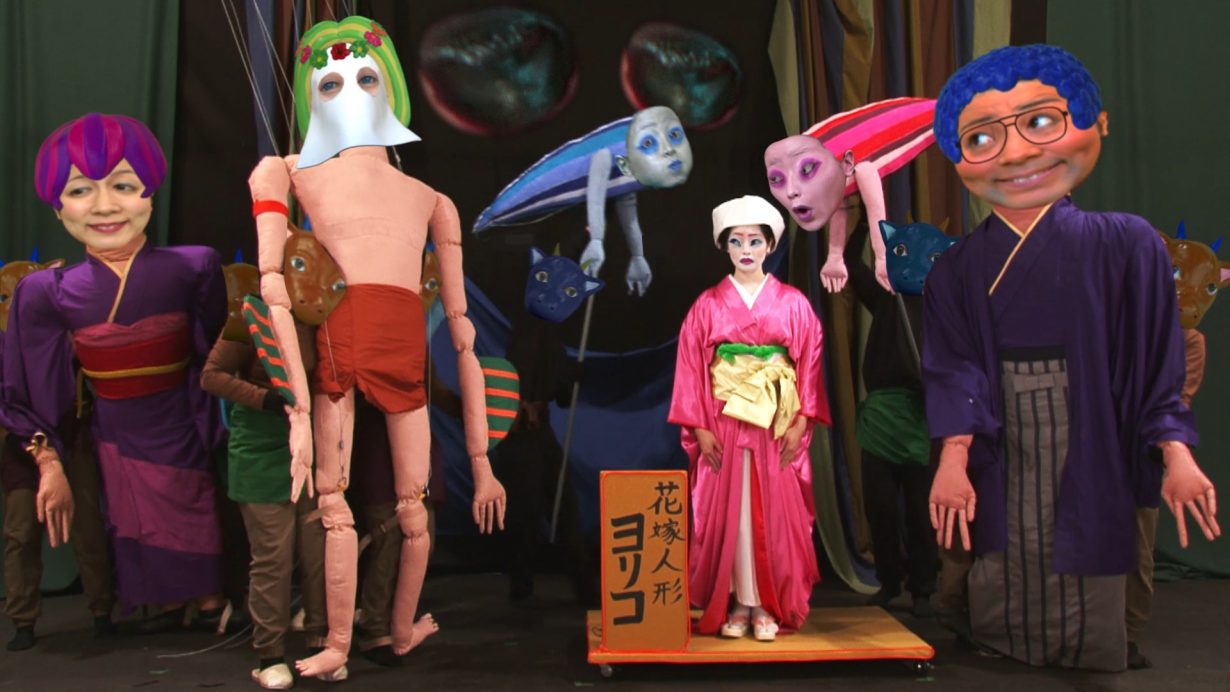
There is a tension between performance and judgment that recurs in Sasaoka’s subsequent projects – her puppets, intrinsically performative objects, are frequently manipulated into violent scenarios, which are then evaluated by other characters or, implicitly, by the artist and her audience. In Animale (2024–25), which is inspired by the plight of animals enlisted in experiments and other human endeavours, three towering sculptures assembled from stuffed toys, salvaged instruments and bedazzled screens depicting eyes and mouths ‘sing’ about gruelling labour. The sculptural incorporation of unwanted items alludes to the way society carelessly discards anything, animate or inanimate, that has outlived its perceived usefulness.
Torch (2026), a dazzling installation of screens embedded in mirrored pyramids, features kaleidoscopic scenes of costumed figures representing different foods mentioned in the accompanying song: ‘pigs’ are in pink spandex, ‘peppers’ wave red ribbons, ‘edamame’ bounce green exercise balls. Like many of Sasaoka’s self-composed soundtracks, the song in Torch is carnivalesque, all fairground organs and tinkling percussion. Yet the lyrics speak of brutal sacrifice: “You scorch my body. Moisten my eyes.” Sasaoka is too clever for moral didacticism, but her grotesqueries confront us with humanity’s callous excesses.
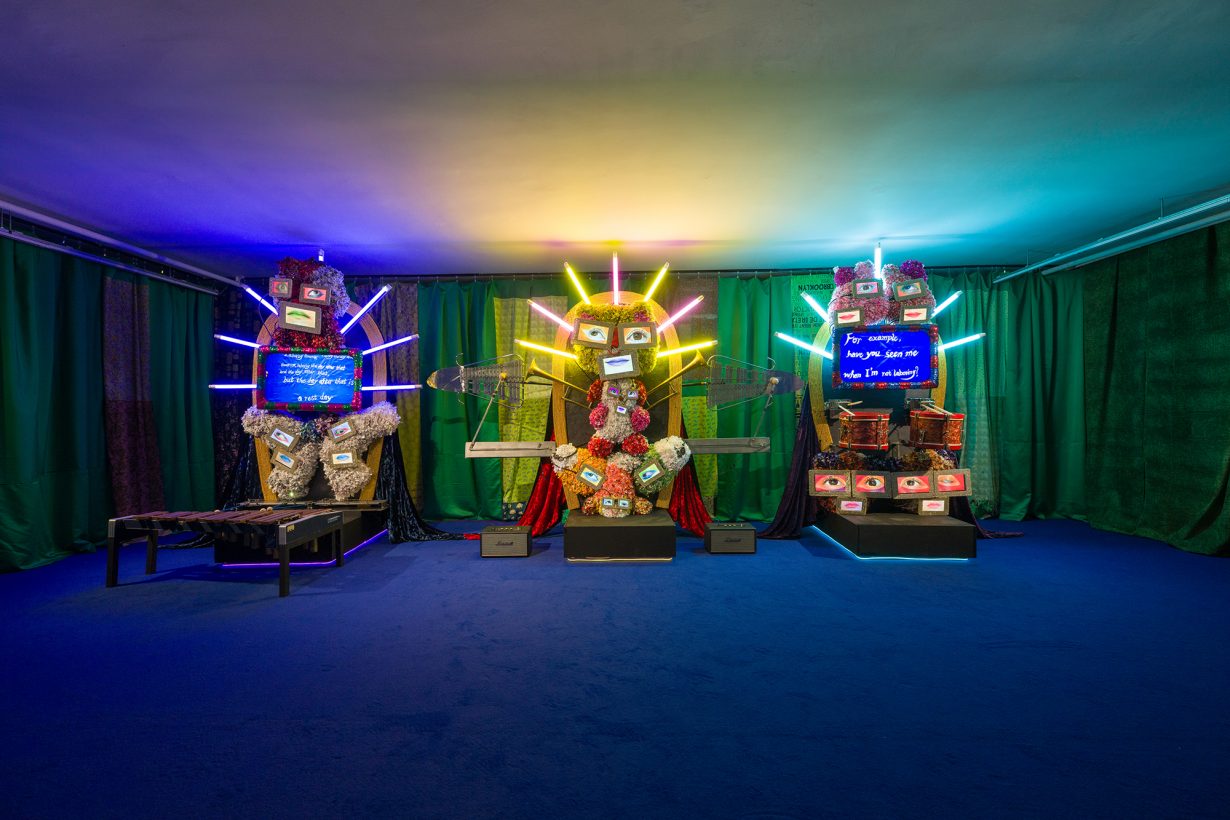
Humans, too, are victims of violence, whether resulting from acts of God or our own dark impulses. In Planaria (2020–21), three omnipotent furry figures preside over the freakish deaths of fish-head dolls, from electrocution and train collision to coitus-induced heart failure. To make things more disturbing, the dolls, per the wall text, are wearing the national costumes of the countries with the highest reported suicide rates at the time of the work’s creation; fish appear in Korean hanbok, Japanese kimono and Slovenian kurent, among other folk attire.
Sasaoka’s cinematic universe is permeated by a sense of powerlessness in the face of relentless suffering, with characters doomed to endlessly gruesome scenarios. Yet there is also a beautiful exuberance to her mordant works, with handmade and embellished puppets and props that draw on traditional crafts such as embroidery and beading. The characters may await a grisly demise, but they’ll perform a song and dance about it first – and look good doing it. In her distinctively strange way, Sasaoka relates how we are all captive to our insatiable desires, our implacable fears and the vagaries of fate or an invisible creator. Still, we dance like marionettes through torment and triumph, waiting for the end in this troubled paradise.
Sasaoka Yuriko’s Paradise Dungeon at Shiga Museum of Art, Otsu, 17 January – 22 March
From the Spring 2026 issue of ArtReview Asia – get your copy.