Our editors on the exhibitions they’re looking forward to around the world this month, from Los Angeles to Seoul
Los Angeles
Several Eternities in a Day: Form in the Age of Living Materials
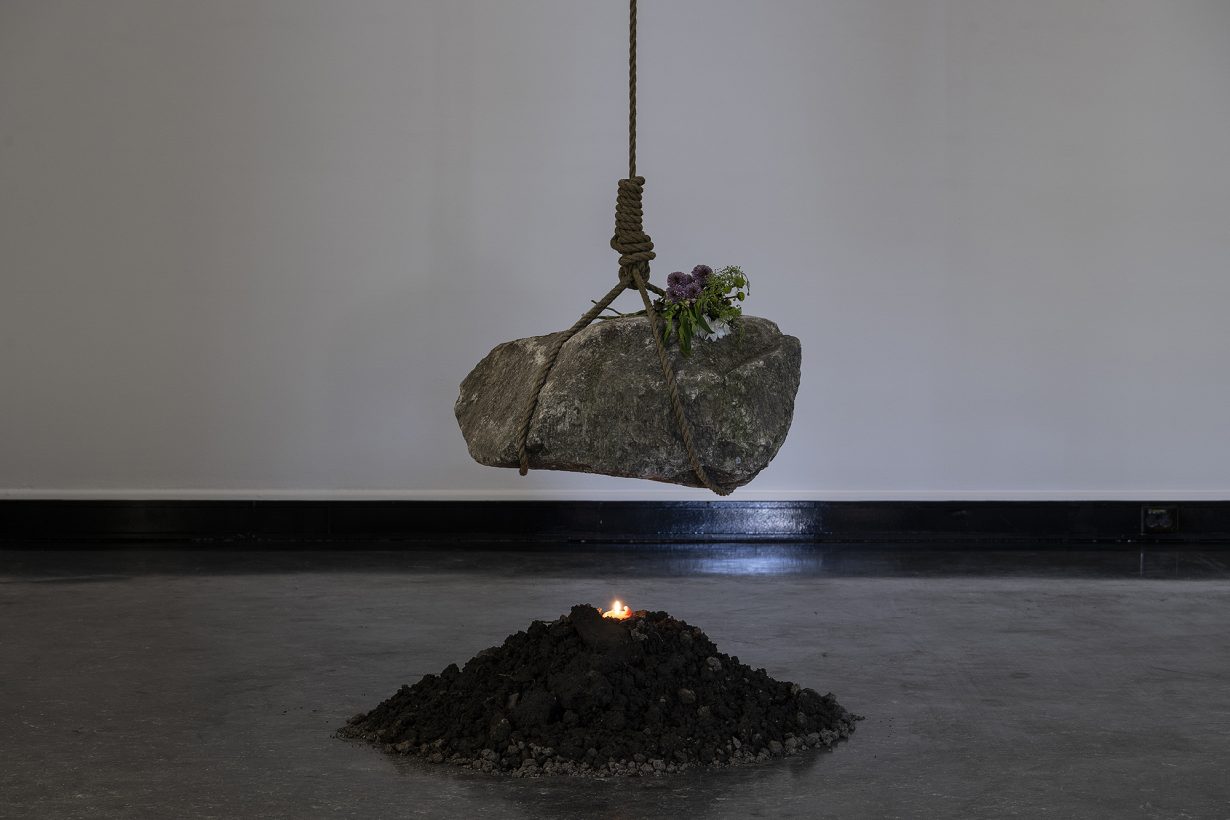
Several Eternities in a Day showcases installations, paintings, works on paper and sculptures by twenty-two artists putting ‘living materials’ – stone, clay, natural dyes, avocado, cacao and more – to use in practices rooted in Brown and Indigenous thinking. The exhibition will include a gallery filled with soil and ceramic vessels by Maya-Kaqchikel artist Edgar Calel; a sculpture composed of two large gongs buttressed by tentacular loofahs that Salvadoran American artist Guadalupe Maravilla collected while retracing the path of his personal migration (in 1984, at age eight, he fled the Salvadoran Civil War as an unaccompanied minor); and an ambient-toned video by Ho-Chunk artist Sky Hopinka depicting a road trip through an otherworldly landscape, where desert mountains are inverted and views are mediated through pale afterimages of human figures. These contemporary artists will exhibit alongside progenitors from past generations like the late Yankton Dakota artist Mary Sully, represented by an intricate work of geometric abstraction made with coloured pencil and ink on paper. Memory, the exhibition implies, is stored in matter, and as the materials artists use in their studios and integrate into their research continuously transform and decay, their artworks keep the score. Jenny Wu
Hammer Museum, 5 April – 23 August
London
Veronica Ryan: Multiple Conversations
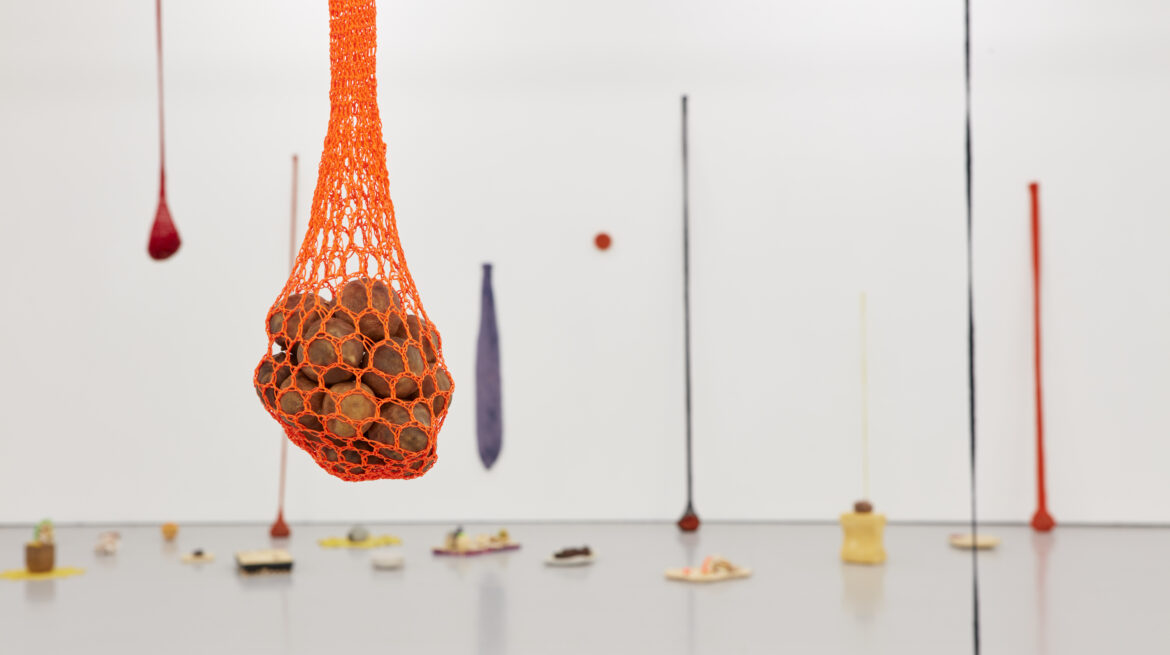
In Veronica Ryan’s work, which spans textile, sculpture and works on paper, materials operate as carriers of lived and inherited experience, where distinctions between object and meaning are deliberately unsettled. Seeds, nets and vessels recur as forms that suggest conditions of confinement and the possibility of growth, and at the same time, recall states of protection and precariousness. These motifs are not symbolic in a fixed sense but are activated through Ryan’s handling of matter: binding, stitching and clustering become gestures that register care as much as constraint. Similarly, her use of everyday and organic materials – teabags, oranges, plaster, lead – points to histories of colonialism, trade and ecology, where substances are never neutral but marked by conditions of circulation and extraction. Multiple Conversations gathers over 100 such works from four decades of Ryan’s career – including ‘rediscovered’ drawings and sculptures dusted-down from the 1980s. A line through it all: that nothing is inert; everything speaks. Fi Churchman
Whitechapel Gallery, 1 April – 14 June

Prague
Jiří Kolář: X Bienal de São Paulo
The 10th Bienal de São Paulo in 1969 was a sad affair. Eighty percent of the artists had pulled out following the implementation of the infamous Institutional Act No. 5 by Brazil’s military dictatorship, a law that ushered in the darkest and most censorial days of the regime. One of the few exhibits that did make its way to Brazil was the work of Jiří Kolář, representing Czechoslovakia. It’s unclear how much he was aware of the boycott, concocted among the Brazilian exile community in Paris: the poet and painter died in 2021 and while the curators of this new exhibition managed to track down most of the original artworks, nothing they’ve found in the archives suggests Kolář knew he’d be crossing a picket line. He was no fan of oppressive regimes, however, having survived Nazi occupation and spent several months in prison over a subversive manuscript in 1952. More likely, Kolář simply had matters closer to home on his mind: his deconstructed photographs, reassembled as collages on concrete plinth, works that were dangerously satirical in their representation of intellectual breakdown, had been produced before the Prague Spring in 1968; by the time they’d arrived in Brazil, the artist had seen the Warsaw Pact invasion crush what limited freedoms it had been achieved. Recreating the show in 2026, when boycotts, nationalism and the idea of representation and complicity are never far from big blockbuster art shows, might offer a timely lesson for the artist in navigating competing priorities. Oliver Basciano
National Gallery Prague, through 30 August
Cambridge, Massachusetts
Performing Conditions: Artistic Labor and Dependency as Form
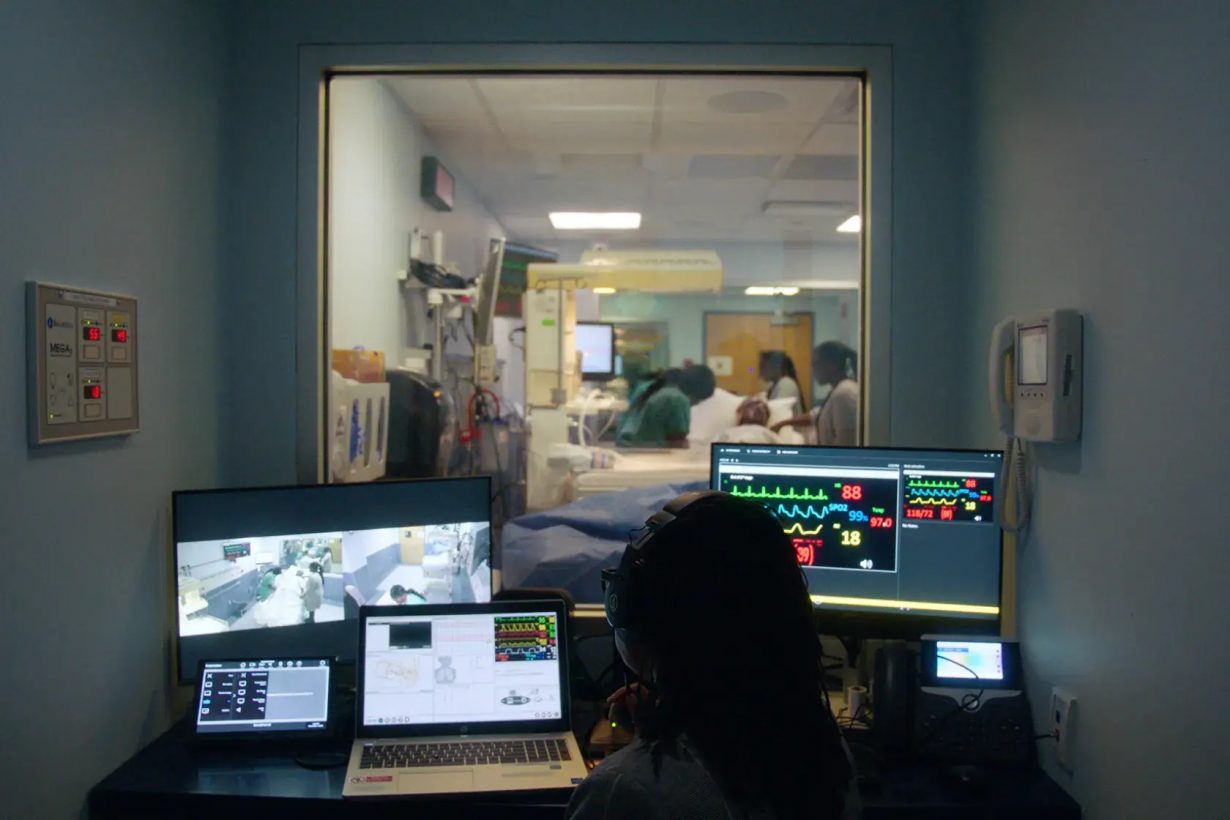
Performing Conditions sets out to query ‘the myriad ways that art and art workers are put to work, made to perform, or bound to appear under racial capitalism’, returning to the time-honoured tradition of institutional critique for a new era of institutions and their critics. Recent proponents included here certainly evidence a resurgence in the practice – like the Lusanga collective Cercle d’Art des Travailleurs de Plantation Congolaise (CATPC) drawing a line between Western art institutions and plantation practices in the Global South; or artists like Carolyn Lazard addressing the methods and insufficiencies of access policies at institutions; and Ghislaine Leung, who has previously critiqued the constructed neutrality of art institutions through the visual language of early motherhood. Indeed, that institutional critique is back in contemporary-art vogue both tells us something about the requirements facing the world in which art is made; and that the era of its heyday – predominantly the 1970s – is the subject of a certain aesthetic nostalgia. An exhibition connecting recent efforts with those that came before – indicated by the inclusion of the totemic Adrian Piper – should ask if, under such a ‘racial capitalism’, the more things change, the more they stay the same. Alexander Leissle
MIT List Visual Arts Center, 11 April – 2 August
Seoul
Gabriel Orozco Garden: The Three Friends of Winter
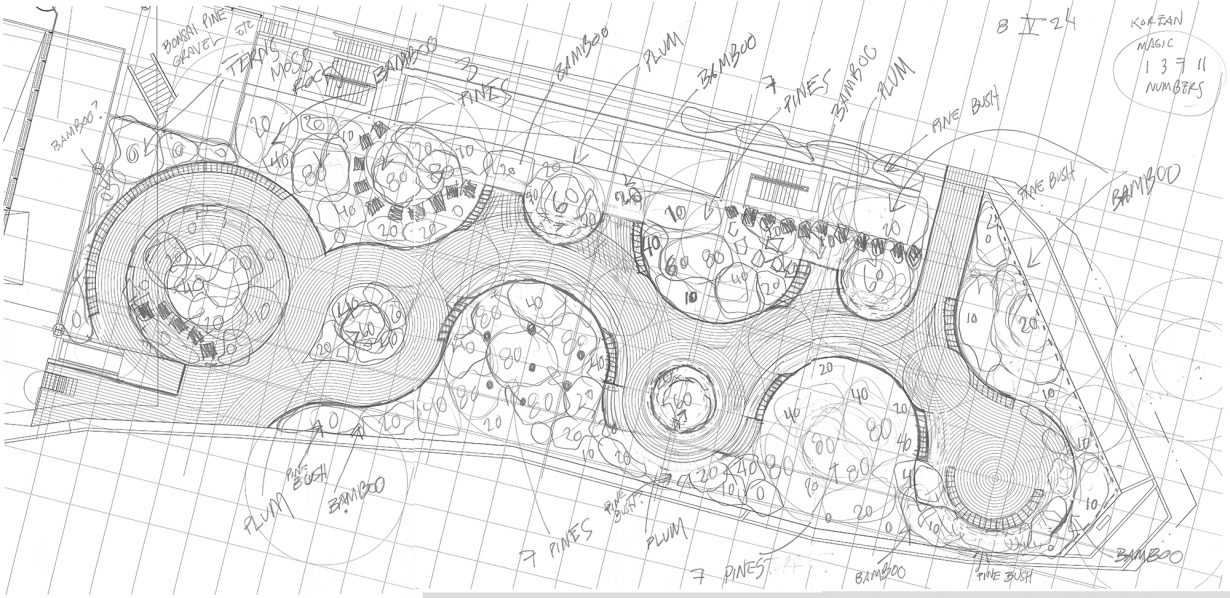
Gabriel Orozco’s new garden is not so much an exhibition as a remodel of Leeum’s outdoor deck into a permanent installation. For precedent, see the Mexican artist’s 2016-designed garden at the South London Gallery, composed of swirls of stone blocks purpose-made to be overgrown by local flora. In Seoul, Orozco remains faithful to his circular stone arrangements that this time make way for the so-called ‘three friends of winter’: bamboo, plum and pine trees. These plants, known for their endurance through harsh winter days, are traditional symbols of resilience in East Asian culture. As part of Orozco’s newest installation, they give life to a year-round space of congregation on the threshold of the museum – a meeting point, or a welcome relief. Mia Stern
Leeum Seoul, 3 April – ongoing
Berlin
Creating Space: The Constructivist Marlow Moss
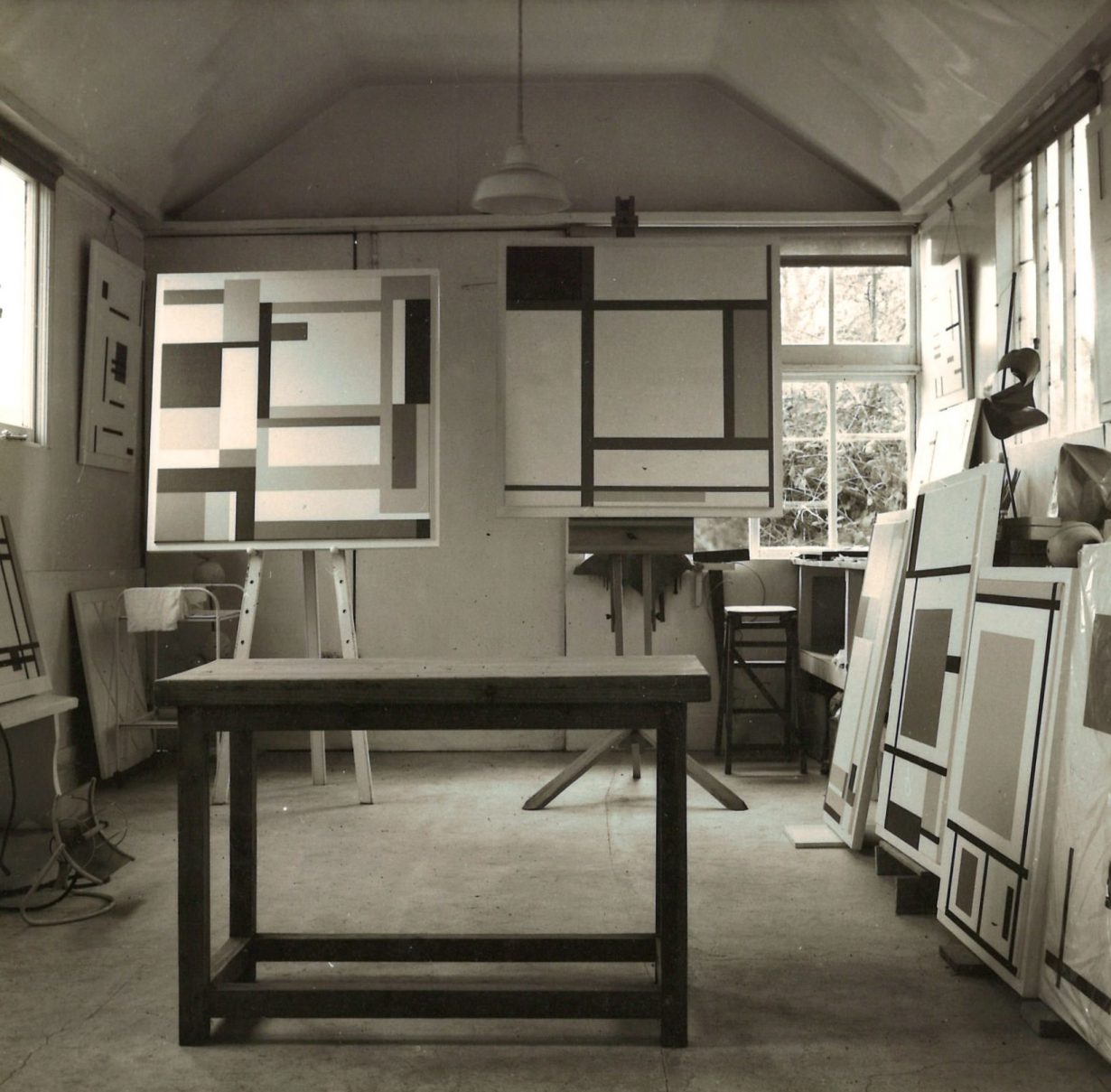
Contemporary art is into identity in a big way, and expressing one’s ‘lived experience’ – whether it’s the experience of race, ethnicity, sex, gender, nationality, culture – drives the work of many artists. So the life and art of British artist Marlow Moss presents an interesting historical counterpoint to our identitarian age. Born Marjorie Jewel Moss in London in 1889, Moss studied at the Slade, but after the First World War she moved to Cornwall, cutting her hair, adopting men’s attire and changing her name to Marlow. By the late 1920s she was in Paris, with a female lover, and part of the group ‘Abstraction-Creation’, whose leading figure was Piet Mondrian. Fleeing the Nazi persecution of Jews, Moss returned to England and died in 1958. For a long time she was forgotten, her geometric paintings dismissed as derivative of Mondrian’s by-then celebrated hard-edged abstraction. Recent scholarship suggests a more nuanced, two-way relationship of influences, and this retrospective puts her works in dialogue with that of artists including Leonor Antunes and Tacita Dean. But above art-historical arguments over influence, what Creating Space offers is an opportunity to consider the work of an artist who once declared of herself that ‘I destroyed my old personality and created a new one’; and to reflect on how geometric abstraction – that supposedly objective and universal genre of modernist art – might offer a space of individual expression, especially for an individual as self-inventing and, for her time, unrepresentable as Moss. J.J. Charlesworth
Georg Kolbe Museum, 2 April – 26 July
New York
RTRU* (Konstantin Raudive Technoculture Research Unit)
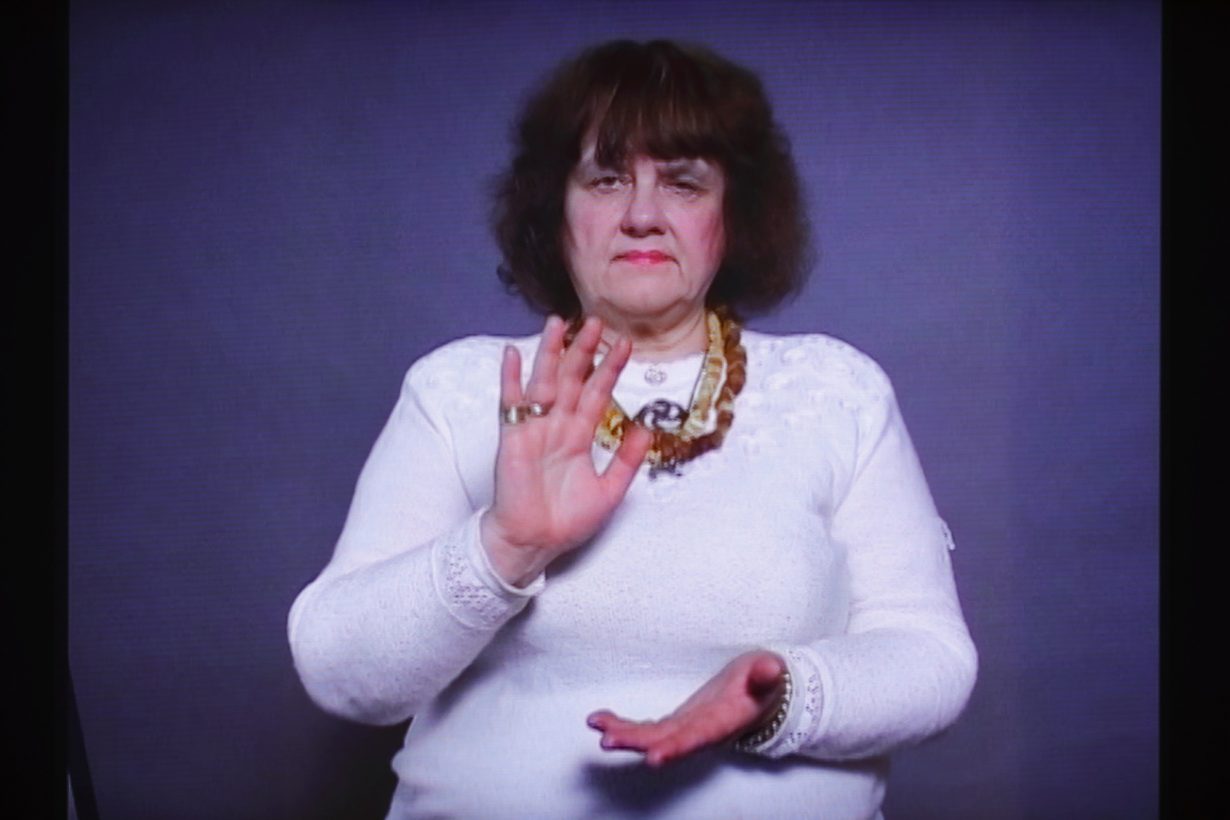
‘It certainly sounds fantastic to assert that we have made contact with spirit-beings, i.e. the dead, through tape-recordings.’ So writes the late Latvian parapsychologist Konstantīns Raudive at the start of his 1971 book Breakthrough, but this is precisely what he claims to have done in the mid-twentieth century, when he, in collaboration with fellow researchers, produced a series of Electronic Voice Phenomena (EVP) recordings that captured brief, garbled utterances. These he attributed to anyone from his mother to Winston Churchill, claiming that they delivered in multiple languages – Raudive himself was a polyglot – such cryptic messages as, “Heat the bathroom. Company is coming,” and “You belong probably to the cucumbers.” Today, traces of these recordings can be heard in music by the Smiths and in works by Mike Kelley. At KAJE, the group exhibition RTRU* (*Raudive Technoculture Research Unit), featuring one of Raudive’s enigmatic notebooks alongside sculptures, photographs, a video and sound commissions by nine contemporary artists, will unfold within an environment of egg-carton acoustic structures, encouraging visitors to engage in listening ‘as a deliberate and speculative labor’. Jenny Wu
KAJE, 4 April – 17 May
Turin
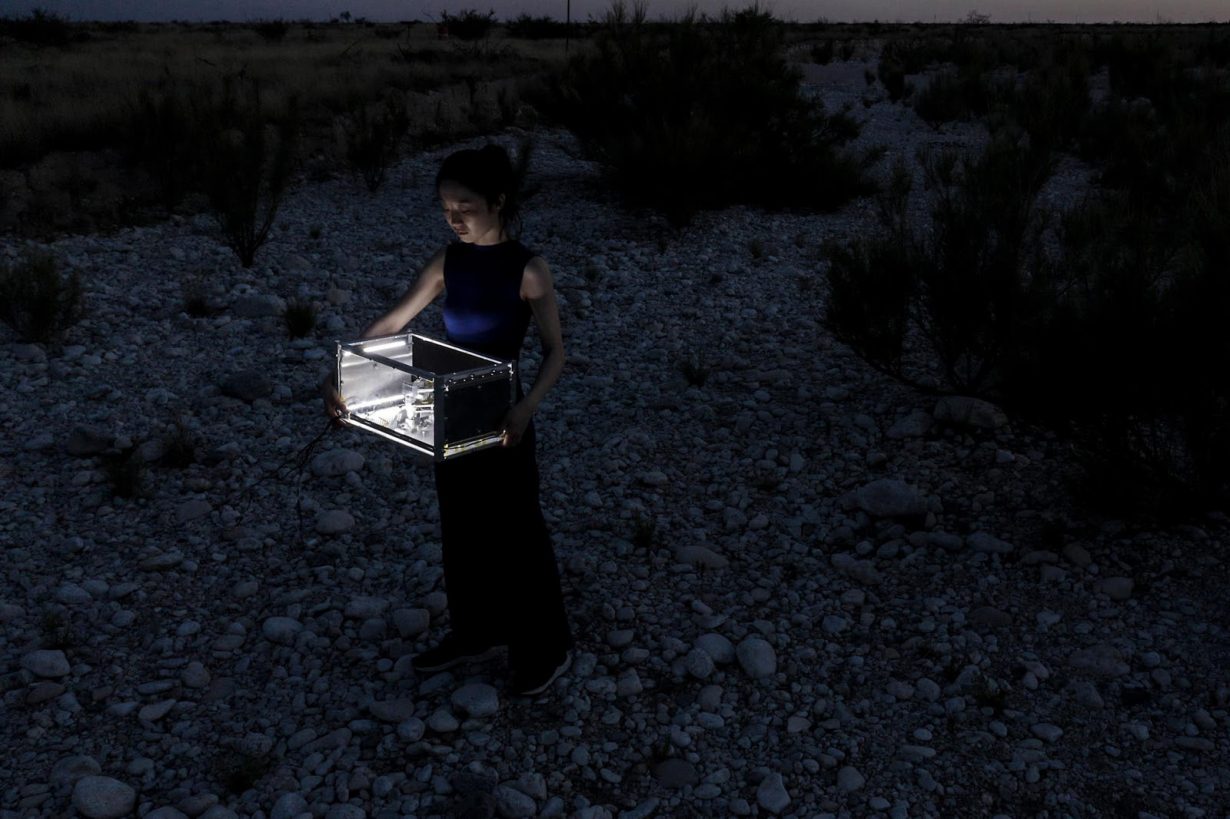
Before heading to Venice to join up with the Uzbekistan Pavilion at this year’s Biennale, Xin Liu will give i Torinesi a crash course in her practice. Crash being the operative word, as Exhaust focuses on the ‘consequences of technological and scientific aspirations by focusing on their residues: space debris, degraded materials, altered codes and organisms’. The artist and engineer is one of a slew of artists exploring the philosophical potential of posthumanism and cybernetics – the shadow of Pierre Huyghe looming – but her own brand complements the customary existentialism with elements of gothic wonder: the Cry:O series (2023–25), for example, pins bronze mouths, cryogenically maintained in the gallery, to silicone boards – part-Cassandra, part-Evelyn tables; or Insomnia (2025), which cultivates duckweed, an invasive species but one also touted as a candidate for extraterrestrial fuel and food production, in a tungsten-lit bath. Each is characterised by a strange beauty, horror and an ambivalent sense of play. While you’re at FSRR – and speaking of absurdism – don’t miss Diego Marcon’s new videowork Krapfen. Alexander Leissle
Fondazione Sandretto Re Rebaudengo, 15 April – 11 October
London
The Music is Black: A British Story
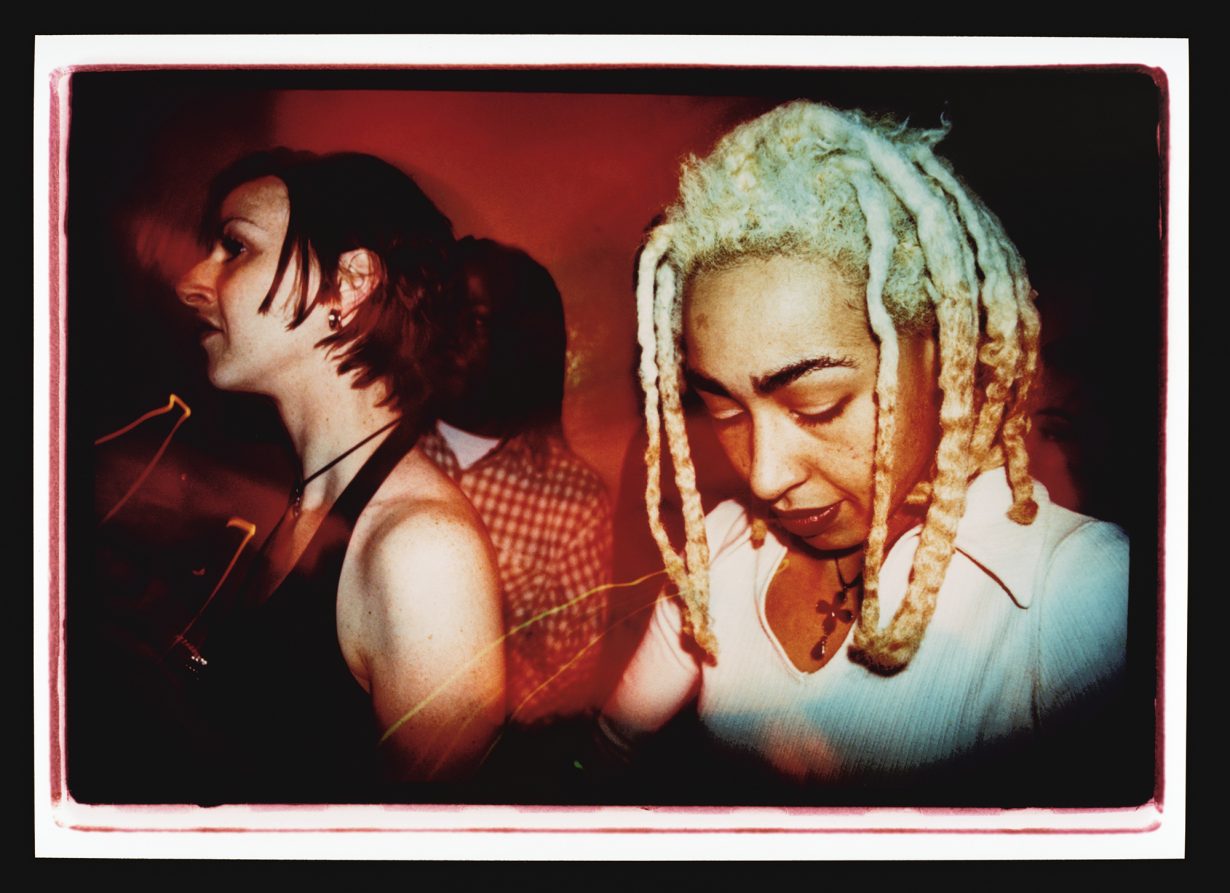
Quintessential British culture, I figured from watching Skins as a non-British teenager, is drum and bass. The TV show, though, failed to teach me how and why that came to be. That the popular genre was created and popularised by Black British musicians is just one of the stories that the The Music is Black will tell. The museum’s inaugural exhibition has the ambitious objective of tracing the impact of Black music on British culture from the 1900s to today. There’ll be photographs, films, posters, garments, musical instruments and, of course, a soundtrack spanning over a hundred years: highlighted musicians include legendary pianist Winifred Atwell, influential reggae group Aswad, godfathers of drum and bass Fabio and Grooverider and many more working across broad or locally specific genres such as Jazz, R&B, 2 Tone, Jungle, Trip Hop and Grime. The exhibition will also be the occasion to experience Black British music and its influence firsthand through a series of programmes developed in partnership between the V&A East and its neighbours – the BBC, Sadlers Wells East, the London College of Fashion and UCL East. Mia Stern
V&A East, 18 April – ongoing