The Year in Borders: In 2025, tech oligarchs redrew the lines of political power across the world
At the beginning of 2025 – in fact, the day after his inauguration into his second term – Donald Trump hosted the CEOs of OpenAI (Sam Altman), database and cloud computing giant Oracle (Larry Ellison) and Japanese technology holding company SoftBank (Masayoshi Son) to announce the launch of a new artificial-intelligence project, Stargate. Stargate is intended to ‘reindustrialise’ the US and contribute to the country’s ‘national security’. Absent from the events, but crucial to the funding of the project is the Abu Dhabi-based MGX, whose chairman is Tahnoun bin Zayed, the Abu Dhabi royal who seems to monopolise much of the emirate’s state resources. MGX will pump their share of the projected $500 billion into Stargate, in return, seemingly, for receiving semiconductors whose export from the US is otherwise restricted. The consortium will be headquartered in Austin, Texas, and will also include chipmakers Nvidia and Arm, and Microsoft, whose Azure platform will be part of the computing juggernaut. Stargate has already begun with the construction of ten data centres in Texas. The irony of Emirati and Japanese capital underwriting a decidedly nationalist project of US reindustrialisation was not lost on the observers.
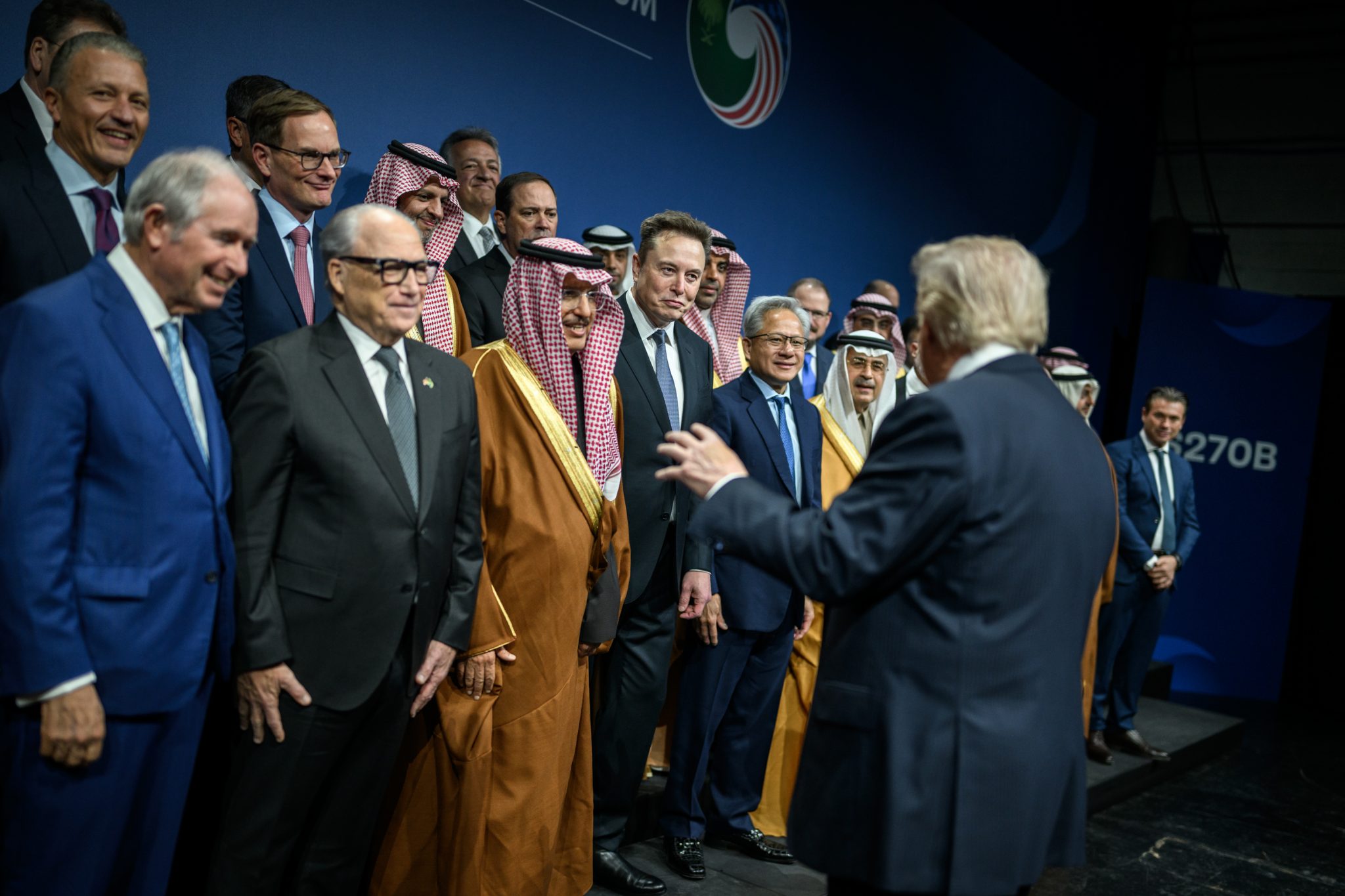
The second Trump presidency seems to be especially appealing to tech billionaires. The dons leading the ‘Magnificent Seven’ technology companies (Alphabet, Amazon, Apple, Meta, Microsoft, Nvidia and Tesla) were queuing up for handshakes in the first weeks of the term. Many others attended both the inauguration and the state dinner thrown for Mohammed bin Salman of Saudi Arabia, whose sovereign wealth fund PFI is a major investor in technology firms. Most – but not all – tech barons are circumspect about full identification with the Trump administration, or even the US government, but those who are not are ardent about their US-centric chauvinism.
Elon Musk was for a few months perhaps the most significant unofficial cabinet member in the Trump administration. Alex Karp of Palantir has unashamedly called for his firm and other tech-surveillance firms to serve US – and its closest allies’ – national security interests. Venture capitalists David Sacks, Bill Ackman, Joe Lonsdale and Peter Thiel (cofounders of Palantir along with Karp), and Marc Andreessen and Ben Horowitz (of Andreessen Horowitz) have all used the language of national(ist) belonging and patriotism inseparably from their vociferous defence of unfettered capital accumulation. Many if not all of them have at one point or another collaborated with the US government; Sacks is still an official adviser to the Trump administration.
Such intimate interweaving of US-based capital with the domestic affairs of a stridently xenophobic regime may indicate a turn inwards for US technology production and accumulation. The surging US stock market, carried on a wave of AI expenditures, has left its rivals across the Atlantic and Pacific oceans in the dust. Heedless of warnings from financial analysts and market observers about a cataclysmic AI bubble bursting, barely legal circular investments between chip producers, AI software companies and tech infrastructure firms have driven the market capitalisation of many AI companies to atmospheric realms beyond imagination (or indeed rationality). A boom in capital expenditure in US data centres – which may never be actually utilised – is at $500bn at the time of writing. All this because government officials at all levels seem to be feeding at the trough of questionable projects; a bonfire of regulations has removed most emergency brakes on the monstrous expansion of such tech infrastructure, and the apocalyptic cynicism of the aforementioned tech oligarchy add fuel to the fire of the irrational market.
What does this all have to do with borders? Well, these data centre infrastructures are physically, concretely tied to territories. And protectionist restrictions on technology exports mean that the state underwrites the national growth of the tech industry in the US (and also in China). Although US satrapies or rivals across the oceans, in the EU, the UK, China and Japan, try to match US AI enthusiasms, existing palimpsests of laws and regulations mixed with public scepticism towards the irrational exuberance of US markets has meant that tech-related growth is neither as celebrated nor as fully realised as in the US. In China, the state has in fact reined in its homegrown billionaires when their possible ventures have run afoul of state politics. Most famous was the case of Jack Ma, whose initial public offering of the Ant Group (owner of Alipay) was halted by the state in 2020. When it comes to the technology race and trade wars, states and borders seem to matter.
There is, however, another channel of investment that paradoxically transcends national containers: surveillance and defence technology. I say paradoxically because the substantial initial investment in commercial defence-tech is often seeded by public contracts from the state or other security agencies. Famously the infrastructure of the internet was initially created by the Pentagon during the 1960s to facilitate communication between the US security apparatuses and universities. More recently, seed investments by the CIA’s venture capital firm, In-Q-Tel, funded Palantir and the software that was eventually acquired by Google (later renamed Google Earth). It was Palantir, of course, that took advantage of the US security paranoia and regime of violence after 11 September 2001 to expand its market, and now sells its data analytics products to governments in Britain and Israel inter alia.
Indeed, since 7 October 2023, billionaires’ WhatsApp group communications have bristled with support for Israel. Musk, Thiel and Lonsdale have visited Israel; Ackman, Sacks and Michael Dell continue to invest in various defence-tech startups in Israel. Ellison is one of the most generous supporters of Friends of the IDF. Cloud, software and hardware platforms offered by Oracle, Google, Amazon, IBM and Microsoft have all been utilised by the Israeli military both in managing and monitoring Palestinian populations under occupation and in its genocidal war against Palestinians. Nvidia, Microsoft and Intel operate research and development centres in Israel.
There is a seeming contradiction between the jingoist discourse of so many tech billionaires and the ease with which they ‘defer to Israel’, as Thiel phrased it when questioned about the Israeli use of software on his own books to target Palestinians. This contradiction can however be resolved if one recognises the centrality of Israel in the US imperial complex. Nearly 50 years ago, Reagan’s secretary of state Alexander Haig described Israel as ‘the United States’ largest unsinkable aircraft carrier on the Mediterranean’. In 2025 Israel provides the technological infrastructures for a savage system of governance that has Palestinians in its gunsight today, and intransigent polities elsewhere tomorrow.