Theresa Hak Kyung Cha’s spectral work anticipated the ways in which we tend to the wounds inflicted by nationalism
The work of artist and writer Theresa Hak Kyung Cha evades interpretation. This retrospective, born out of recent reassessments of Cha’s contributions to feminist conceptual art, highlights videos and performances that animate the asymmetries between addresser and addressee and the violence of being made legible or illegible. It reconstructs the image of a figure often associated with a radical group of performance artists in the Bay Area – whose brief career spanning from the mid-1970s to her death in 1982 anticipated how we still tend to the wounds of nationalism through and despite language.
Dispossessed by the Korean War’s aftermath, Cha immigrated to the US with her family in 1962, when she was eleven. While studying at UC Berkeley, Cha started producing art that worked through her sense of displacement, often via the structure of language. Cha confronts her genealogy and the burden of history in works such as the print series Chronology (1977), which layers and manipulates family photographs to form eerie composites. Meanwhile Photo Essay (c. 1978), which pairs her photographs of everyday observations next to pieces of poetic or confessional writing, offers an unfiltered critique of America, where no truth can be found in San Francisco’s ‘inexhaustible duplication’ and ‘tyranny of objects’.
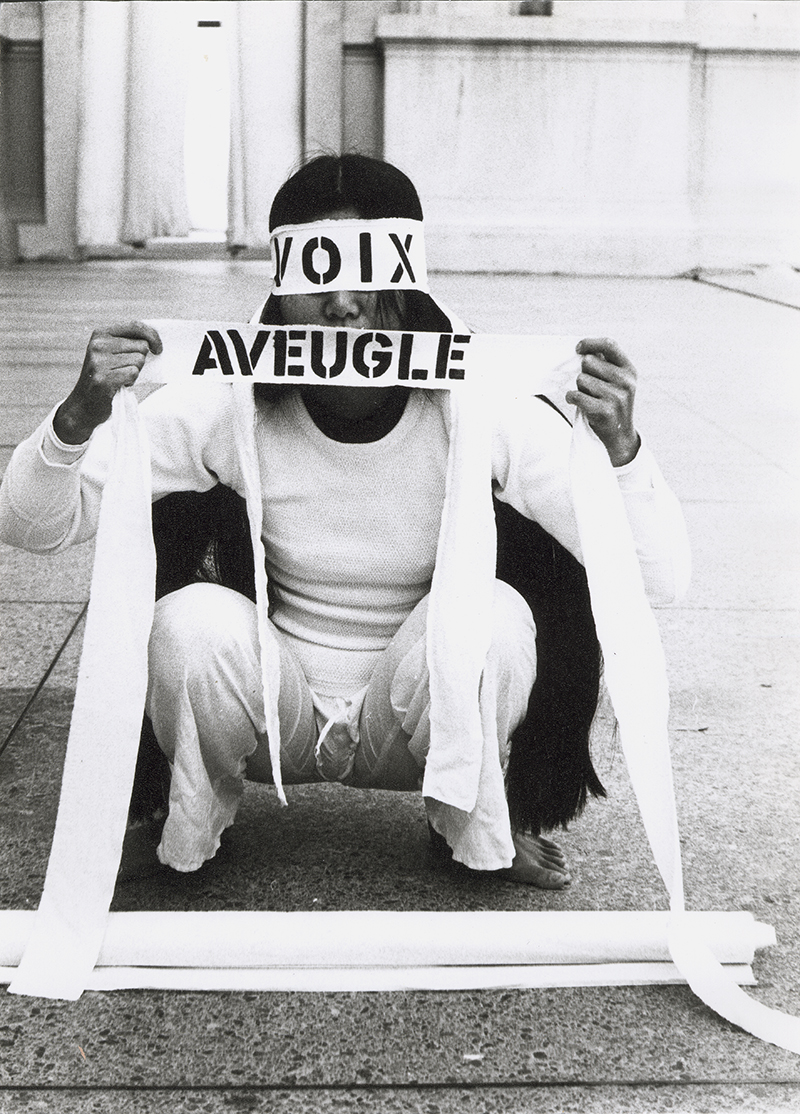
The most compelling works in Multiple Offerings express her critical view of displacement and cultural hegemony by deploying discrete units of language. The video Ripples (c. 1974) consists of enigmatic words silently moving across a monitor: ‘gone’, ‘going’, ‘far’ and ‘farther’ recombine and suggest a maze of scenarios (one can imagine the artist setting off from home). In the photographic documentation of her performance Aveugle Voix (1975), Cha dons a white garment, which recalls the plain cotton attire worn by Korean nationalists protesting Japanese rule, and covers her eyes and face with white cloths inscribed with the titular French phrase meaning ‘blind voice’, but which when spoken might also sound like ‘the blind sees’. On another piece of cloth used in the performance, Cha wrote, ‘ME FAIL WORDS’. Blind and mute, she squats, a gesture that declares political speech obsolete – and language itself a tool of the oppressor. In the video Mouth to Mouth (1975), static and ambient sounds disrupt a closeup of Cha’s lips mouthing Korean vowels. The work parodies and sabotages dictation, a pedagogical tool that stands in here for authority and standardisation. Its obstructed transmission suggests that as much as one can harbour fantasies of origin and belonging, such illicit desire often gets trapped in the throat.
In the back of the gallery, Cha’s unfinished film White Dust from Mongolia (c. 1979–80) is projected on a screen. Supposedly about a Korean woman from Manchuria overcoming historical amnesia, it contains only footage of daily life in Korea and no plot. The exhibition ends with works by contemporary Asian diasporic artists lamenting their own linguistic foreclosures, several of which pay homage to White Dust. In Na Mira’s film installation Marquee (2023), a ghost haunts an empty theatre, clicking a clapperboard. Inverted subtitles, vaguely recognisable words such as ‘hologram’ and ‘hole’, emanate from the apparition’s mouth. In Cici Wu’s installation Upon Leaving the White Dust (2017/18), objects related to Cha’s storyboard, like model planes, gloves and crystal balls, cast shadows onto a projection of white light recorded at a screening of Cha’s film. In these contemporary homages, the full force of Cha’s work – its spectrality, pallor and ungovernable tremor – feels distant. Even amid all these eulogies, Cha evades us.
Theresa Hak Kyung Cha: Multiple Offerings is on view at Berkeley Art Museum and Pacific Film Archive through 19 April
From the Spring 2026 issue of ArtReview Asia – get your copy.