A new exhibition at the Freud Museum in London goes in search of Sigmund Freud’s maid
Sigmund Freud and the poet H.D. ‘met in [their] love of antiquity’, as if history were a game they played together. In Tribute to Freud (1956), H.D. describes the 82-year-old professor’s escape from Nazi-annexed Vienna and how his ‘famous collection of Greek and Egyptian antiquities and the various Chinese and other Oriental treasures’, of which there are over 2,000, arrived in England, via Paris, with the help of Marie Bonaparte, ‘a flying, frightening journey’. H.D’s ‘excursion’ into his collection was an invitation, perhaps also a test: ‘Did he want to find out how I would react to certain ideas embodied in these little statues,’ H.D. wondered, ‘… a sort of roundabout way of finding out something that perhaps my unconscious guard or censor was anxious to keep from him’? In the consulting room, the shelves of objects form desire lines through the psychoanalytic session. Decades later, these objects exist within the institutional logic of the house museum: ‘roundabout ways’ are more constrained by official paths and signposts.
Artist Cathie Pilkington’s exhibition Housekeeper at the Freud Museum in London accepts this invitation to play in and with the collection, finding ways to sneak ideas past the conscious and ‘unconscious guard’ alike. As I enter, the shop assistant pulls what looks like an acorn out of his pocket: “This is my lucky charm,” he says to a colleague. Earlier that morning, I had passingly toyed with the idea of wearing my mother’s charm bracelet – eleven perfectly singular, silver talismans: a tiny frog that hinges at the jaw (for my grandmother); a sharp-talloned claw wrapped around a pearl (after ‘The Power of Love’ by Frankie Goes to Hollywood, for my godfather); a long-necked stork carrying a baby not bigger than an ant (for me). I’ve kept the bracelet because it’s precious to me, and it’s precious in part because it’s been kept, through the years and against the odds. In and against the imperious collection, it’s this tendency to keep – carrying, cleaning, preserving, surviving – that Pilkington takes as her subject and method, following in the footsteps of Paula Fichtl, the Freuds’ housekeeper.
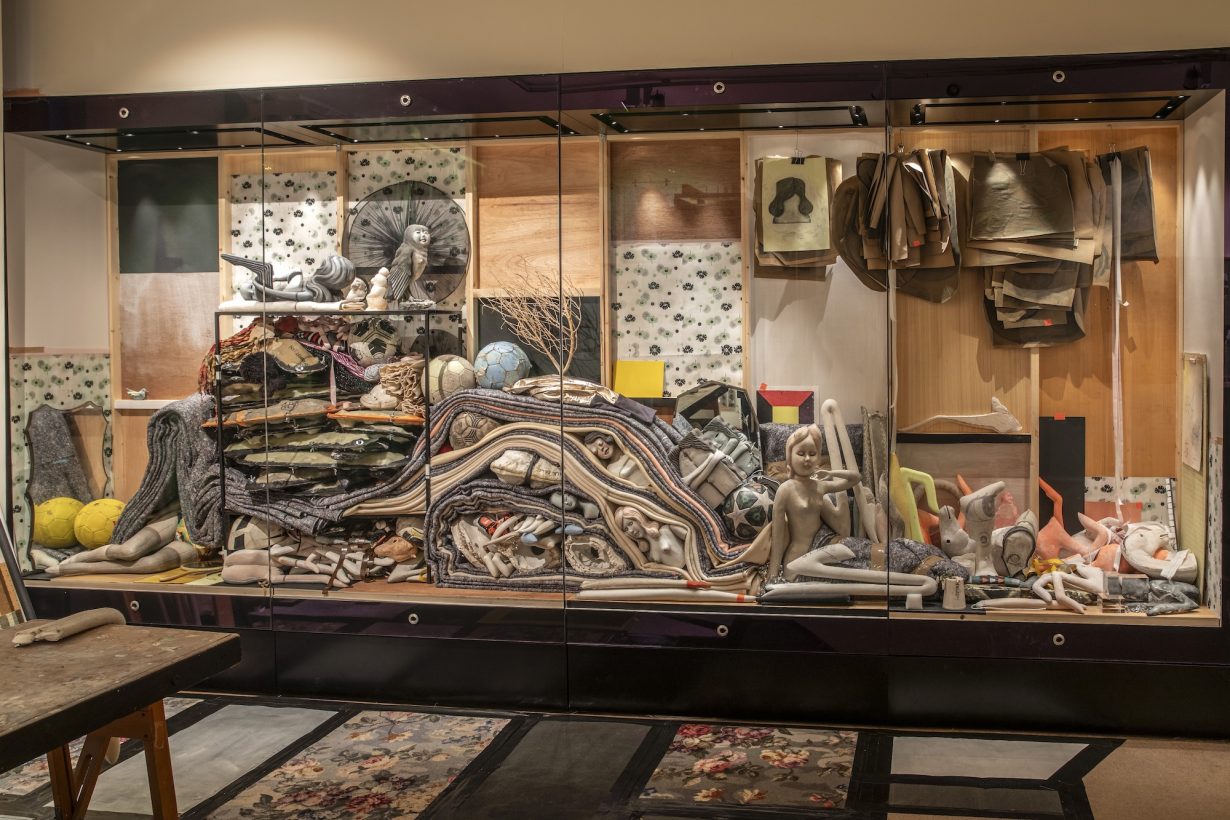
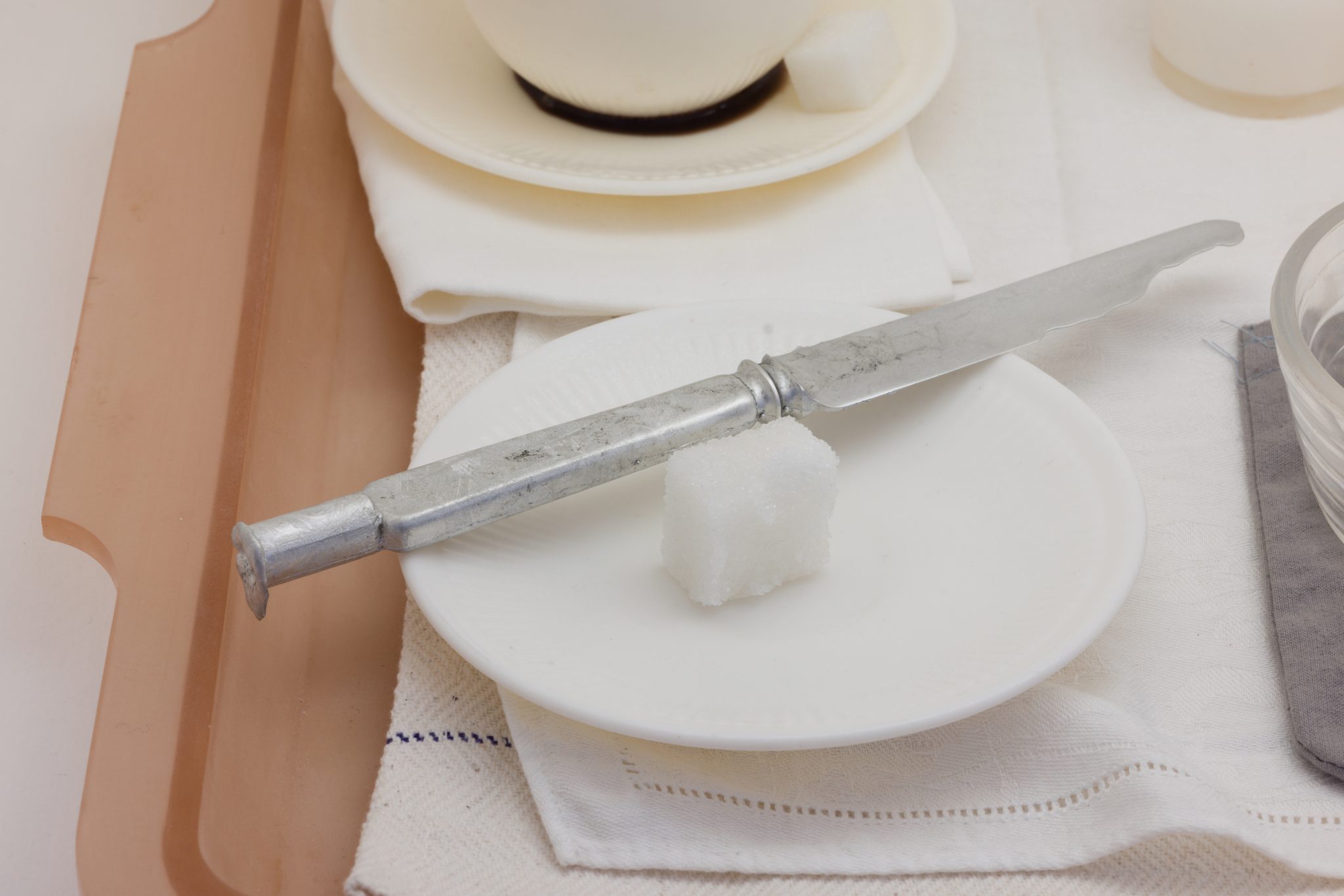
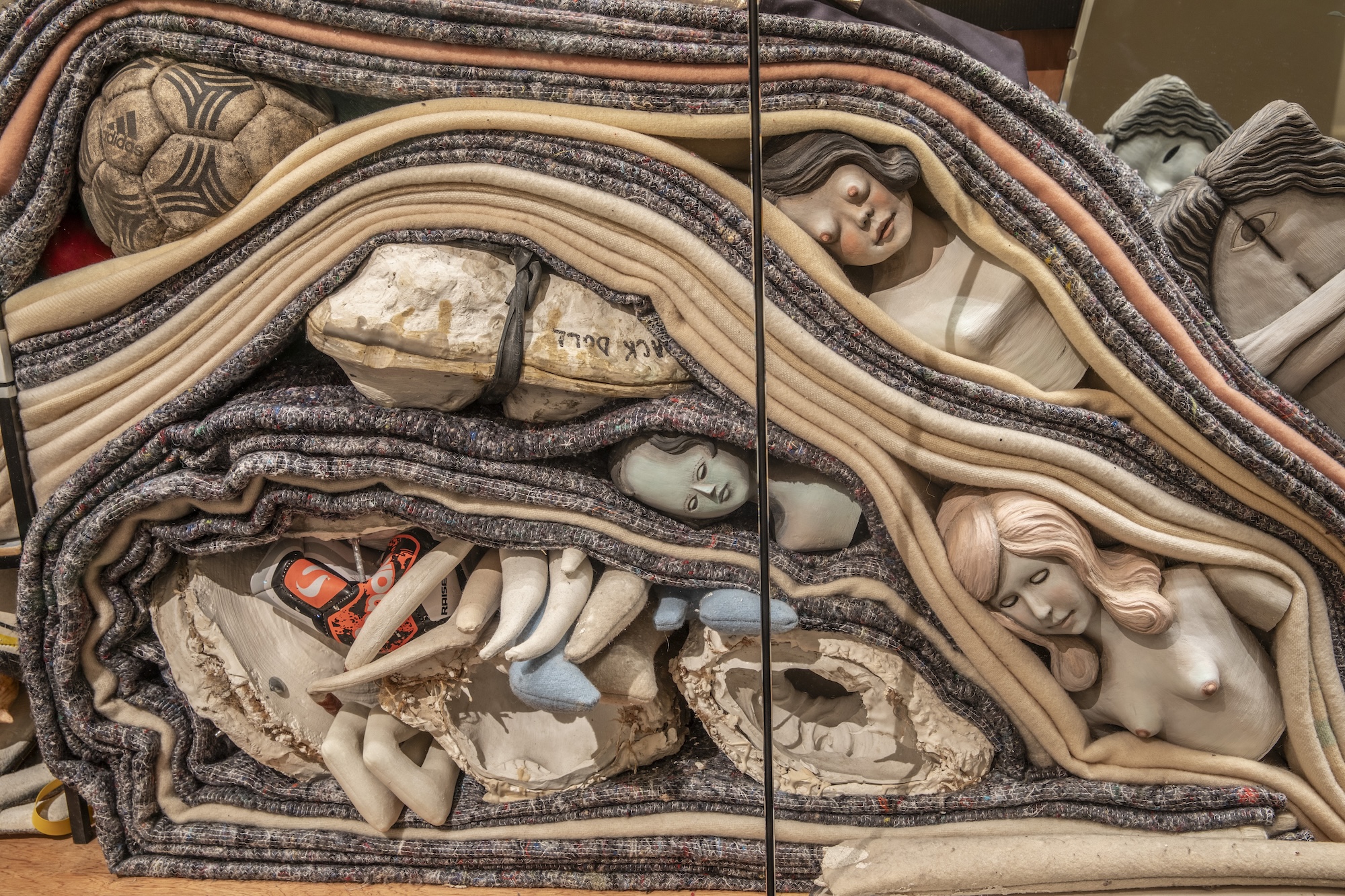
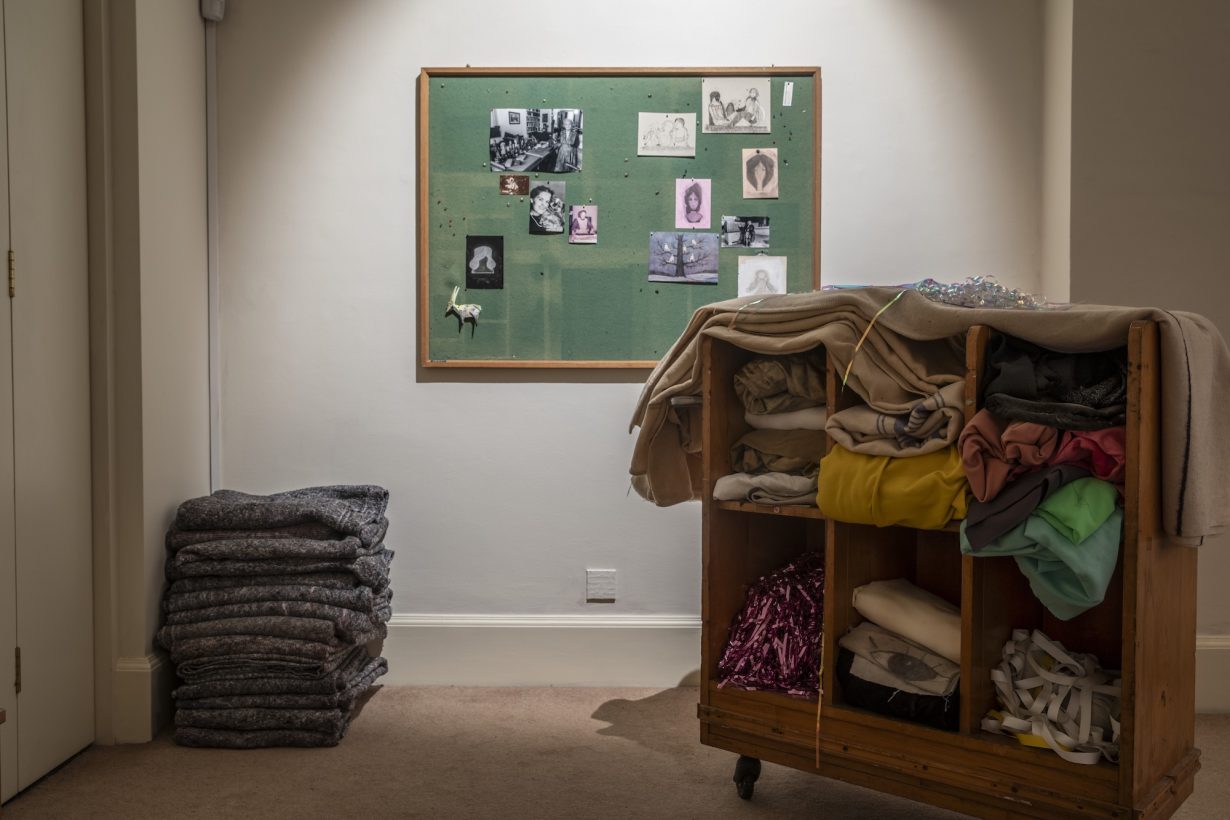
On the first floor of the house-museum, the exhibition room is transformed into a ‘storeroom’ overflowing with mannequin limbs, tinsel, drawings and swatches, layers of wombish pink and pastel blue; there are grey blankets folded and piled in the corner, as if (but not) for use. The small space has the feeling of a nursery – block prints, quilted fabric, limp footballs and dolllike forms – or a workshop, crowded with handmade and half-made sculptures and sketches. Almost everything here is plush or rounded, a great gathering of soft, curved forms. Elsewhere around the house Pilkington intersperses her own uncanny artefacts throughout Freud’s collection: her primary mode is recollective mischief-making, troubling the collection at large.
Housekeeper presents a complicated question of agency: the art worker and the domestic worker are companionable makers, settling and unsettling objects, yet they wield vastly different degrees of power. Fichtl herself remains a somewhat distant presence, brought more directly into view by the exhibition’s accompanying texts. Upon entry, viewers are given a small pink pamphlet. It contains brief explanatory notes and pencil sketches. Pilkington’s sculpture Messenger (2019) is reproduced in pencil, to the left of the centrefold, an owl with breasts, a wide moonlike face and a perfectly thin, straight nose in place of a beak. Over the page there are three questions in large italics: ‘Can she be trusted? What of her own tastes? Does she prefer things elsewhere’. Pilkington’s intervention is a curious tribute, always questioning in roundabout ways what our unconscious guard could be censoring: what do you want, asks the owl, squinting; what will you dare to claim as your own? Taken as a whole, the exhibition is less a representation of the housekeeper than a provocation on the relations inherent to housekeeping – between work and life, public and private, keeper and kept.
Fichtl was employed by the Freuds from 1929 and fled Vienna with them in 1938, shortly after assisting the photographer Edmund Engelman in making an exact record of Freud’s consulting room, waiting room and family rooms. They worked in the dark, without a camera flash, to avoid alerting the Gestapo. Fichtl then packed Freud’s antiquities, books and furniture for transportation. Later, she was entrusted with carrying his favourite object – a small bronze statuette of Athena – from Paris to England, hidden in her suitcase between layers of folded clothes. On arrival, Fichtl unpacked and arranged the collection in London consulting room to closely resemble the interior of the house in Vienna, returning Athena to pride of place. If Fichtl worked to minimise disruption to the displaced collection, Pilkington is working with and against her subject. The larger question, perhaps, is to what end: what new kinds of relation might such disruption make possible?
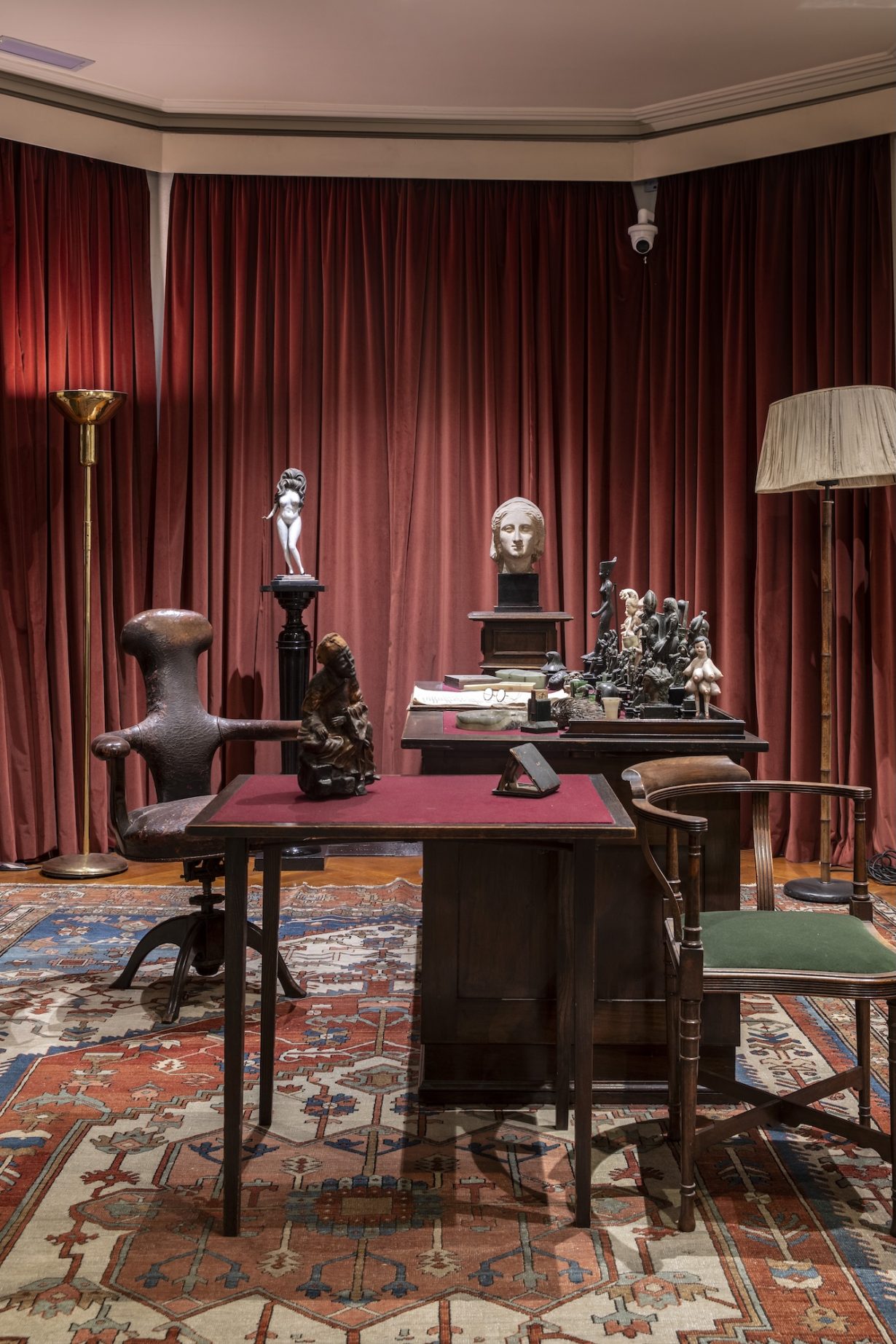
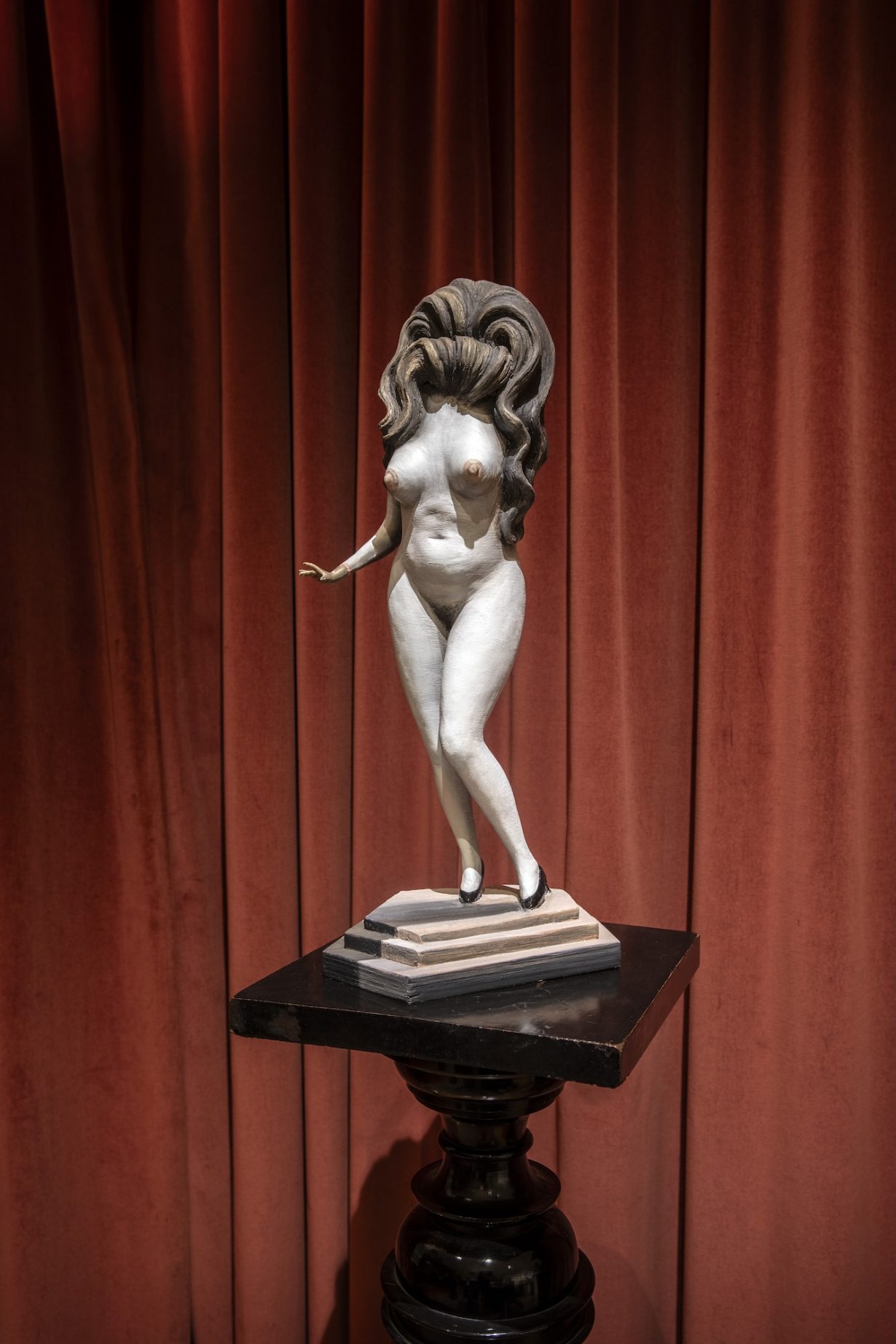
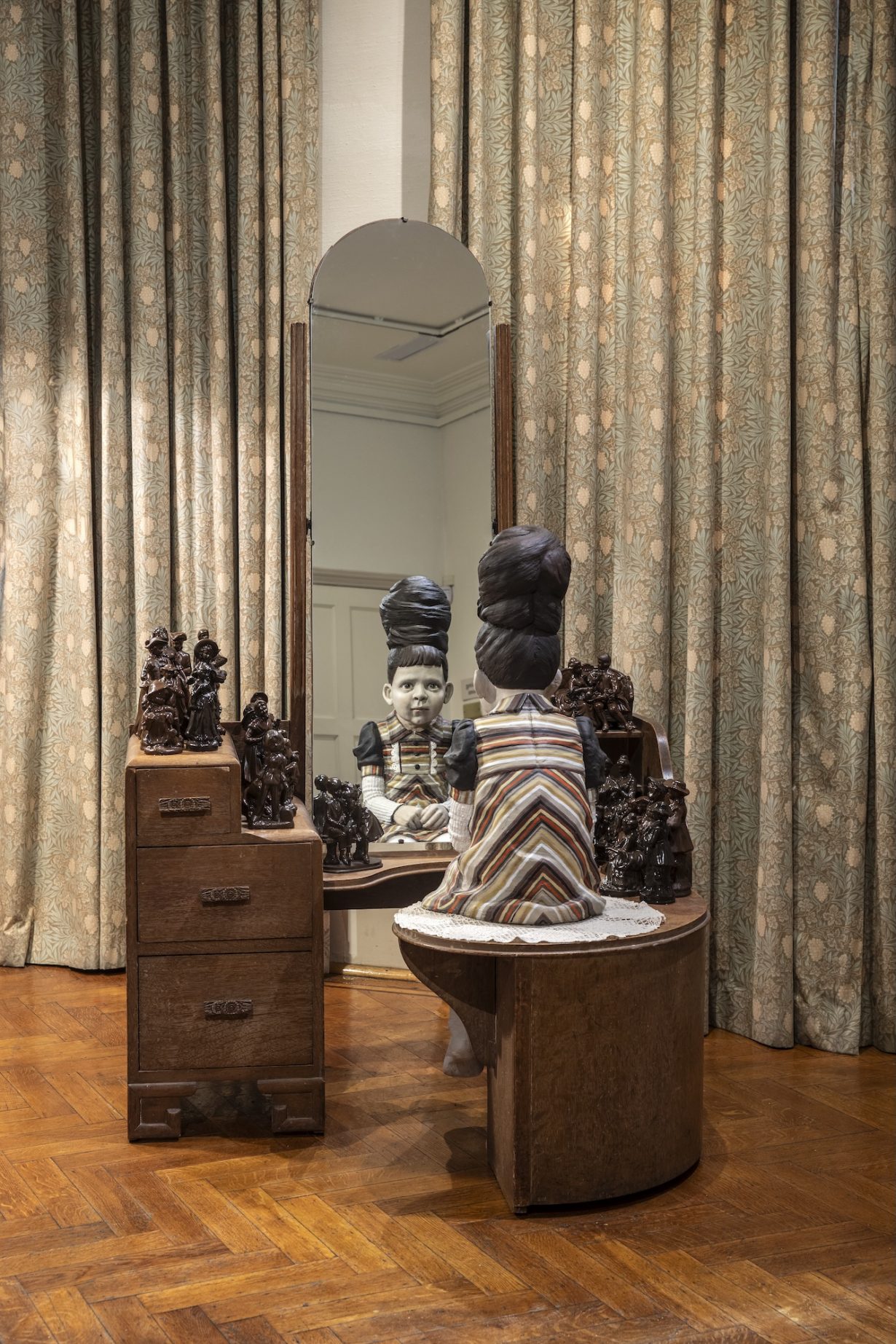
Housekeeper is a partial retrospective of Pilkington’s own work. Pilkington works in figurative sculpture, often incorporating archival research and working on site-specific installations and questions of habitation and residency. Her work is concerned with unearthing and combining. Her sculptures are made from plaster, clay, fabric, wood and paint. Like the housekeeper, her work is never finished. Curio (2003) – featuring a life-size child sat at a small 1920s dresser surrounded by small sentimental figurines – is positioned by the entrance to the Freud museum; Herself (2019), a statuette of a naked woman in heels, with a thick mound of hair in place of a head, is paced in the study; Strata (2025) houses a collection of figures and fabrics in a glass vitrine in the storeroom. Taken together, Housekeeper materialises the fragmentation and accumulation of psychic and domestic material layering blankets and limbs like sediment.
Pilkington is not the first person to wonder how Fichtl went about her work. Freud’s housekeeper was the occasional subject of patients’ speculation, meeting them as she did at the door and accompanying them into the consulting room. Sliding her hands under the rug covering the couch, H.D. wondered: ‘Did the little maid Paula come in from the hall and fold the rug or did the preceding analysand fold it, as I always carefully did before leaving?’ The little maid is as diminutive to H.D. as Freud’s ‘little statues’, as if the housekeeper were herself a kept thing, living-in, knowing her place. Folding blankets and rearranging objects, Pilkington luxuriates in this companionable questioning – did she? what if? – without pinning her work on a single answer.
Fichtl’s inconspicuous presence is knitted into the fabric of the house, hidden in plain sight. ‘I wouldn’t have dared ask for a room of my own,’ she reported to her biographer, the journalist Detlef Berthelsen, who recorded her experiences verbatim, in secret. In Vienna, she slept for years on a bench-seat in a passageway between Freud’s consulting room and waiting room, tidying her blankets away each morning. The bench-seat is darkly ironic in a house in which the centre of gravity is the analytic couch.
There are five photographs of Fichtl pinned to a notice board in the storeroom, just opposite the door. Three in black and white, one in sepia and another in full colour. Like Strata, their changing hues show daily moments crystallising as history. ‘What of the young Fichtl in the Freud family photograph album, her hair up-twisted’, curator Gemma Blackshaw wonders in the exhibition’s catalogue, ‘what of her holiday romances?’ What is her relationship to the objects around her, to the home in which she lives which is not her own, to the dreams dreamed in passageways?
If Pilkington lingers on housekeeping’s domestic, cultural and psychological aspects, its political ones warrant more attention. Freud died on 23 September 1939, at the outbreak of the Second World War. As an Austrian citizen in the UK, Fichtl was classed as an ‘enemy alien’ and, in 1940, arrested and detained first at Holloway Prison then at Rushen Internment Camp on the Isle of Man. Fichtl’s entry in the archive of Manx National Heritage Museum describes how her ‘housekeeping abilities quickly gained recognition and she was placed in the kitchen, serving food to her fellow internees and feeding the hotel cats’, eventually buying a black fur jacket with her earnings. Her release was negotiated by Marie Bonaparte, who had arranged for her journey from Vienna and through Paris with the Athena statue. Displaced by war and dispossessed by class, Fichtl’s relationship to the Freuds’ home was contingent; housework only temporarily, only notionally guaranteed her safety. What then does her black fur jacket disclose about desire? It is not a rug diligently folded on the analyst’s couch nor a coarse grey blanket draped over sculptures, but rather something impossibly luxurious, defiant. If I could wish any disruptive object back into the museum, it would be the black fur jacket.
If a tribute is something granted or gifted (often money, sometimes praise; always a kind of attention), it is also, here, a kind of tributary, a stream flowing into a larger body of water, something of itself and bigger than itself, at once commemorative and speculative. ‘Is it possible to exceed or negotiate the constitutive limits of the archive,’ Saidiya Hartman asks in her essay ‘Venus in Two Acts’, ‘to reckon with the precarious lives which are visible only in the moment of their disappearance’? Housekeeper joins in this reckoning.
In the world around Housekeeper, the problem expressed in Mierle Laderman Ukeles’s Manifesto for Maintenance Art (1969) persists: ‘culture confers lousy status on maintenance jobs’. In December, staff at the British Library and the Louvre were out on strike; workers at London Museum have voted to take industrial action over pay. This ‘lousy’ treatment is even more pronounced for maintenance jobs that take place in the home. Migrant domestic workers face a sharpened double-edge sword: more at risk of trafficking and exploitation within the labour market than UK citizens, yet less able, under draconian visa regulations, to move employers, apply for leave to remain or unionise. In this respect, Pilkington’s intervention has a particular kind of power – recognising the housekeeper as a curator and worker within the institution – just as it faces a hard limit in the distance between the domestic worker and the art worker’s access to recognition and protection. I wonder about the cleaners enabling public access to the Freud Museum today, perhaps each of them with an acorn or some other lucky charm in their pocket. The dust still falls on statues; people still sleep in passageways, if not here at 20 Maresfield Gardens.
Housekeeper is on view at Freud Museum London through 1 March
Read next Baya, the artist Picasso envied