The Japanese artist’s latest exhibition in Milan is best viewed as a single constellation than a series of individual works
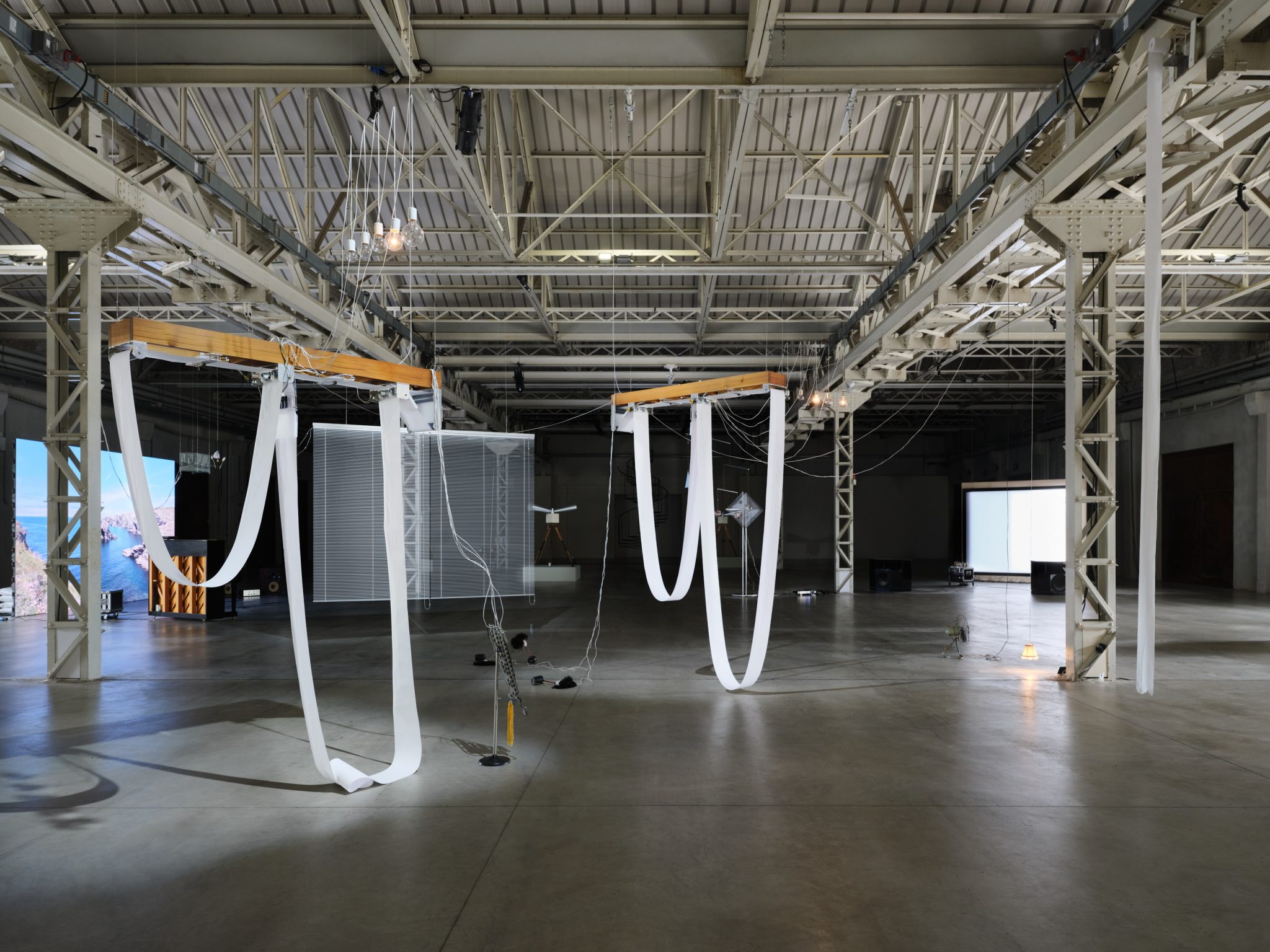
Like many of Yuko Mohri’s previous shows, Entanglements is more of a performance than an exhibition. Housed in a single open space, it includes seven kinetic sculptures, with sonic elements that collectively function as a mini orchestra, producing crescendos and diminuendos, bursts of activity and rests. Among those items pressganged into this ensemble are spinning spiral staircases, dangling reams of paper, whirring electric fans, a beach, rubber gloves, a traffic cone, an organ, a fish-filled aquarium, an automated piano, a flock of feather dusters and a glockenspiel. Although to list these ingredients is to say nothing of the extent to which, in the Japanese artist’s hands, they become animate forms.
In I/O (2011–) rolls of paper dangle from the ceiling, like paper spooling out of an old-fashioned printer or fax machine in a data centre (there’s a general vibe of redundant technologies in the works gathered here), picking up dust and dirt from the gallery floor. The rolls are then scanned and that data converted into signals that trigger lightbulbs to turn on and off, feather dusters to flip and that glockenspiel to play. The effect is reminiscent of Fischli/Weiss’s celebrated video catalogue of cause and effect, The Way Things Go (1987) – I/O stands for Input/ Output – except in Mohri’s work the causes (the dust in this case) are not always so obviously evident. The mystery is part of her works’ allure: you know there’s a system at play, but you’re not always sure exactly how it works. Which, you might further project, is rather like society as a whole.
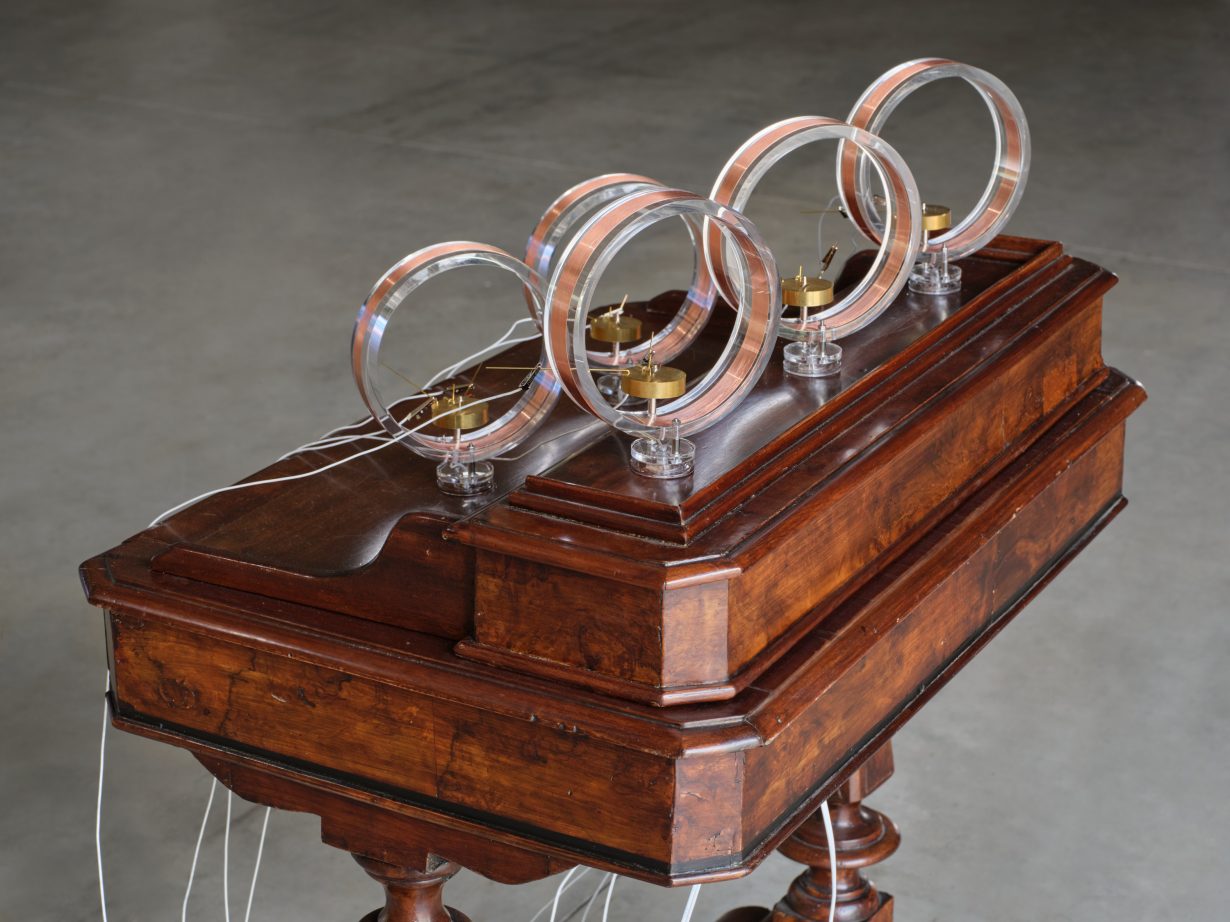
In Flutter (2018–25), the movement of the fish in an aquarium triggers light sensors that activate an organ. That one, the handout tells us, is influenced by the work of artists such as John Cage (Water Walk, 1952; a performance involving a rubber fish, a piano, steam from a pressure cooker, a bathtub full of water and some walking around) and Nam June Paik’s Video Fish (1975; live fish swimming around in 24 tanks in front of 24 TV monitors). The art-historical connections are more literally present in Piano Solo: Belle-Île (2024), which features a video of the beach on which Claude Monet created his first series of paintings, the sounds from which trigger a self-playing piano. (It was first exhibited last year at the Artizon Museum in Tokyo next to Monet’s Belle-Île, Rain Effect, 1886, from the museum’s collection. But here, in a shed in Milan, you’re even more conscious of the extent to which sound becomes something more like a proof of life for the staged and projected scene.)
Yet, while each work (there is a work from the Decomposition series, 2021–, in which light and sound are triggered by rotting fruit, which formed the mainstay of Mohri’s presentation in the Japanese Pavilion at last year’s Venice Biennale) is full of its own systemic wonders and eccentric logical leaps, the exhibition is more remarkable for how the sculptures are collectively orchestrated to perform, with sound and movement coming through in waves of agitation and passivity, sometimes like the chatter of a crowd, at others like the whisper of a wind. In the end, the exhibition isn’t about a focus on individual works, rather on the constellation as a whole.
Yuko Mohri: Entanglements at Pirelli Hangar Bicocca, through 11 January
From the Winter 2025 issue of ArtReview Asia – get your copy.
Read next Hito Steyerl’s ‘Conservative’ Turn