The Chinese artist comes across most authentic in his stripped-back sketches rather than heavy-handed video work
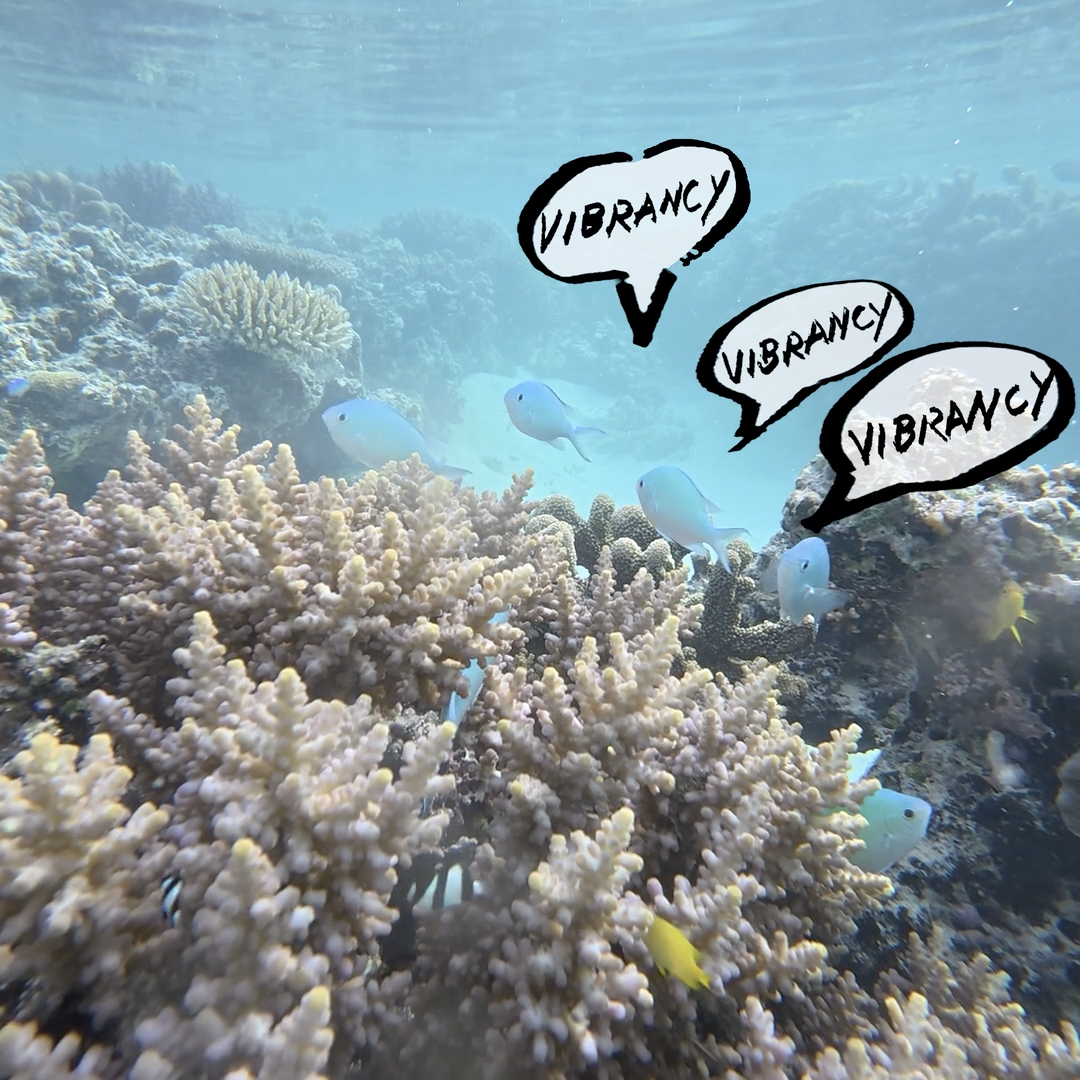
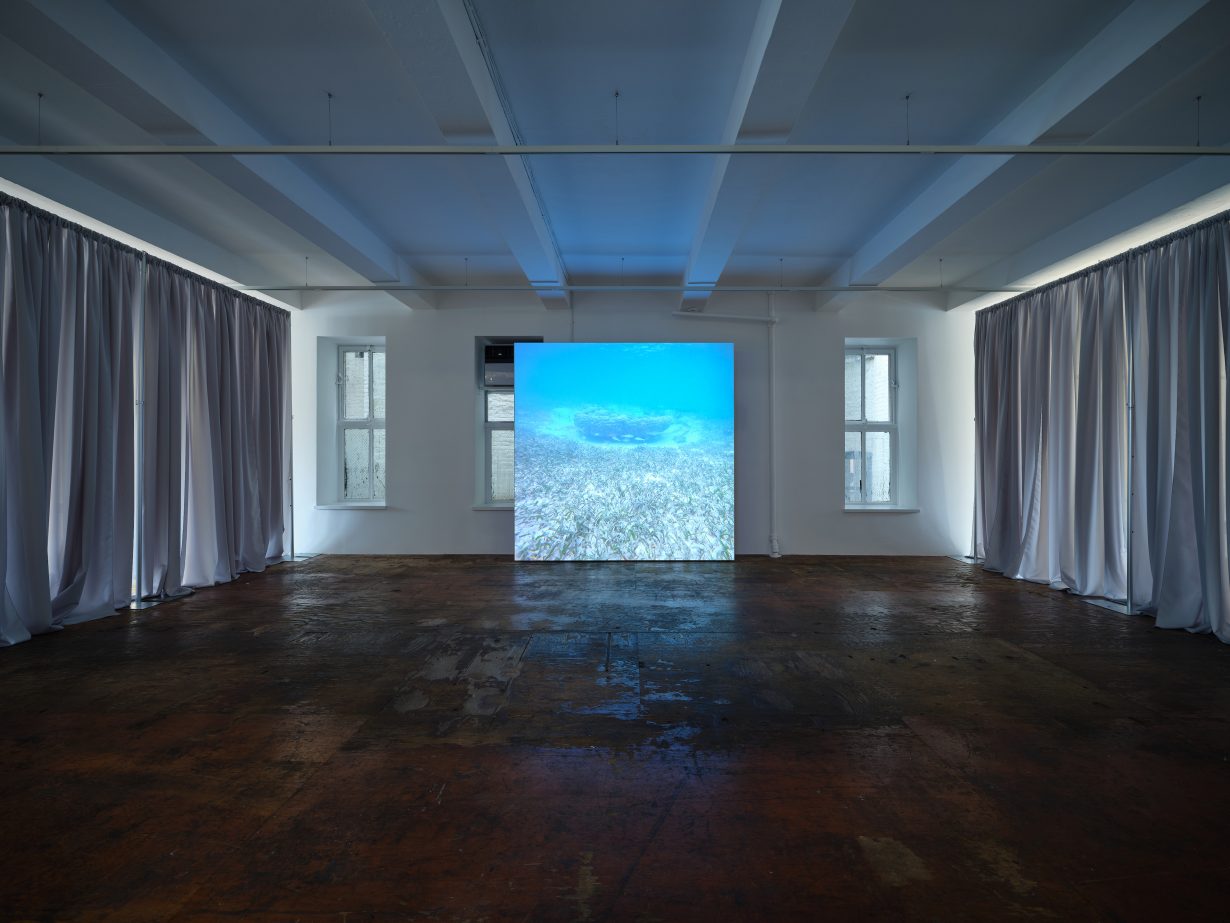
For an artist who has spent much of their career exploring nonhuman ecosystems and envisioning erotic interspecies relations, Zheng Bo has taken an odd turn with their recent work, The Political Life of a Coral Lagoon 1 (仙湖之治 1, 2025). The 15-minute manifestolike video presents an aquatic ecosystem as a model society. But in both style and content, it registers as a surprisingly cursory form of engagement. The work splices together underwater footage from the Poé Lagoon, off the island of New Caledonia in the South Pacific. As colourful fish dart in and out of branching and bulging coral formations, cartoonish speech bubbles pop up next to select aquatic creatures, as if they were responding to off-camera questions.
‘The corals inspired us to work together,’ a school of blue fish seems to say. ‘No male asserts supremacy over the female,’ a yellow-tailed species is made to chime in. ‘Here in the lagoon being different is a given,’ a brown, squarish fish is conscripted to add. It comes as a relief when, as soon as a speech bubble pops up, the fish it’s imposed on darts away. While these statements may, in a sense, be true, they read as overly simplistic and morally convenient, as if written to prove the natural occurrence of a particular human value-system that the artist wants to support. At worst, the proclamations are infantilising in tone: ‘Some say I’m territorial / Because I’m a farmer! / I cultivate red algae / I work hard / And my land is tiny.’ Why must this evidently complex world be reduced to story-book narratives? The fact that the artist enlisted ChatGPT to complete this script only underlines its tendency towards flattening statements.
A second video, though less heavy-handed, bears similar flaws of imposition. Le Sacre du printemps (春之祭, 2021–22) opens on a dim forest in which several nude dancers stand apart, each facing a tree and engaged in a somewhat erotic, potentially spiritual exercise: with arms slack and knees slightly bent, they bounce on their feet. Their jiggling skin and appendages draw attention to their pale fleshliness and mobility, in contrast to the still stand of dark trees. After a few minutes, the ambient forest sounds are joined by the grunts, exhalations and low moans of the performers, who then, in what would be a moment of ecstasy, suddenly drop to a crouched foetal position as the camera flips upside down.
The second half of the video is slower: the now-inverted performers descend into yogic headstands while straddling and gripping the stoic pines – which inevitably look phallic and proplike, mutely subjected to the humans’ acrobatics. The press release describes this sacre, or ritual, as a means of ‘channeling collective ecosexual desire’. The term ‘ecosexual’ has a longer, multifaceted history, but Zheng is particularly interested in making ‘eco-porn’. ‘I’ve been thinking more about the sexuality of plants than that of humans’, they noted in an interview published in 2021. Their example: ‘scientists had to invent an expansive vocabulary to describe intricate and complex sexual anatomies and behaviors of ferns’. This interesting research seems discordant with the almost uniformly choreographed advances of the men in the moss here, which evince little inspiration from the mechanics or poetics of pine tree sexuality and procreation. What about this work is of or for the trees?
The most genuine-feeling ecosexual interest manifests in the less overtly sensuous project on view: grids of humble pencil drawings, displayed under glass on low wood platforms, index the artist’s routine of sketching the flora near their home on Lantau Island, Hong Kong. Some pages isolate a few blossoms or a cluster of healthy stalks; elsewhere, buds, leaves and stems crisscross into dense webs. Zheng’s roving gaze is evident; the line quality suggests a light touch, the isolated focus of a ray of sunlight. The attention here is not on the human actor, nor on a human narrative. Instead, viewers are asked to simply sit with the nonhuman muse, without being told what to think.
Zheng Bo: Vibrancy, Vibrancy, Vibrancy was at Kiang Malingue, New York, 19 September – 1 November
From the Winter 2025 issue of ArtReview Asia – get your copy.
Read next Young In Hong: Look But Don’t Touch