Skoog’s latest film and exhibition Redoubt address the complicated beliefs required to prepare for an apocalyptic end
John Skoog’s new feature film, Redoubt (2025), is beautifully cinematographed in black and white and stars the French actor Denis Lavant, notably of Claire Denis’s classic Beau Travail (1999). We see Lavant, his small, tightly set body somewhat hunched, as the single dynamic form moving across an empty field, the frame held still. We see his deeply furrowed face in chiaroscuro as a flashlight blinks and he mumbles repetitively, rhythmically: “War is coming.” The fiction is set in midcentury rural Sweden and shows Lavant in the role of Karl-Göran, a farmhand and apparent village simpleton, as he responds to a nationally distributed pamphlet titled ‘If War Comes’ by building a redoubt, an above-ground bomb shelter, out of found materials. Lavant’s Swedish is coarse and rusty, more sound than language. We see him beg for scrap from a local mechanic and load a section of decommissioned railroad track onto his bicycle; we hear him whisper the names of his neighbours as he marks out where each would find a place inside his bunker.
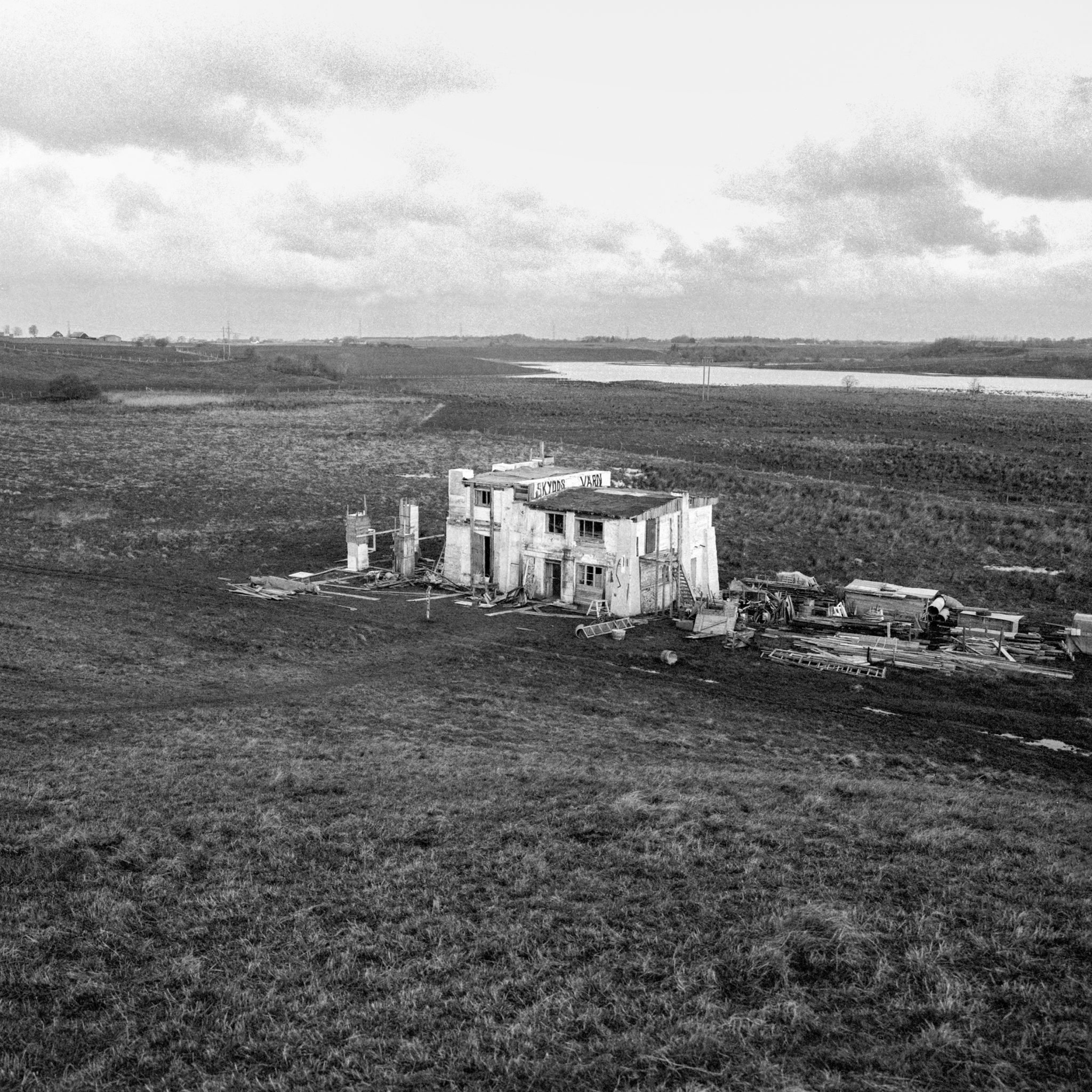
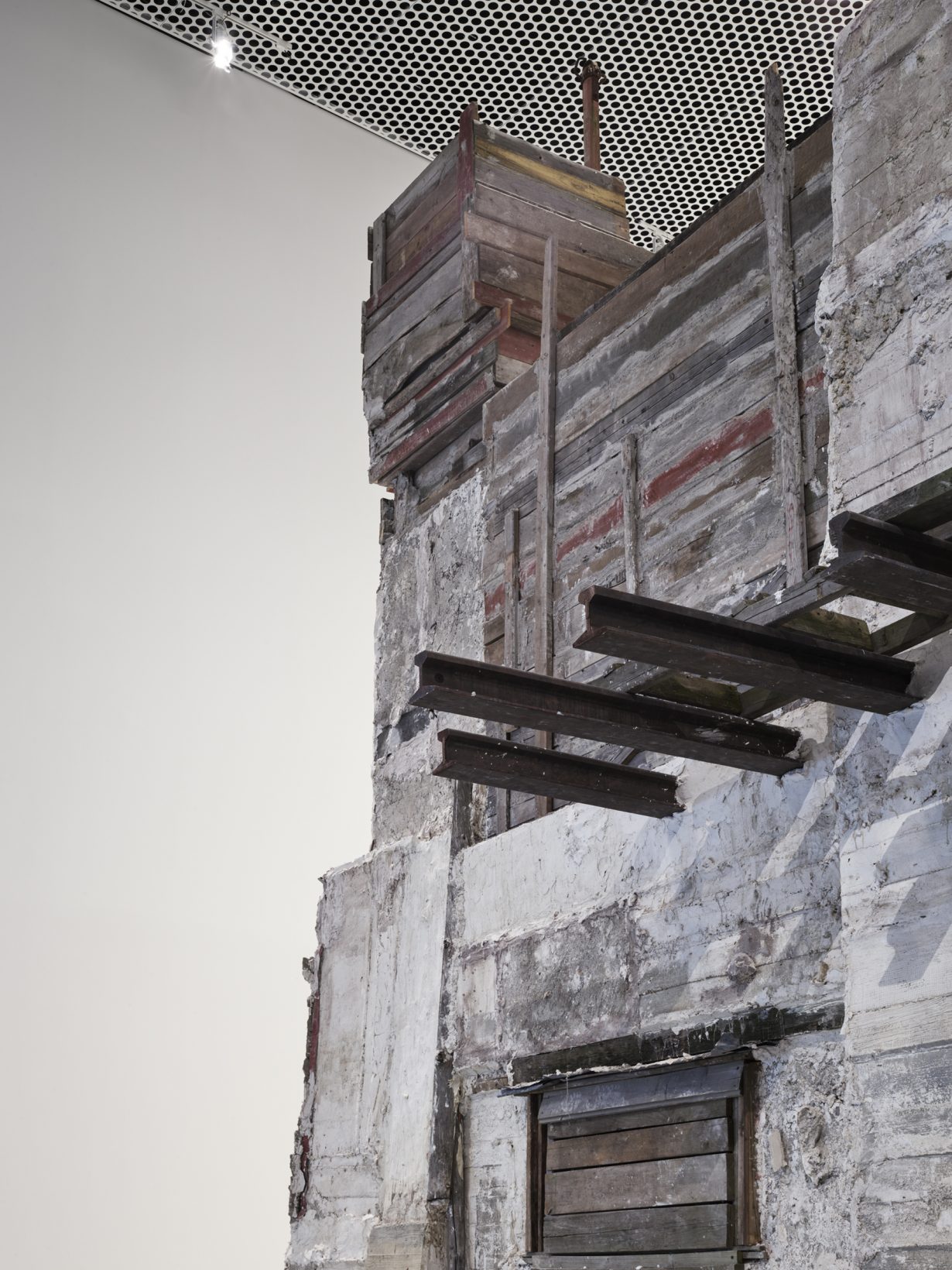
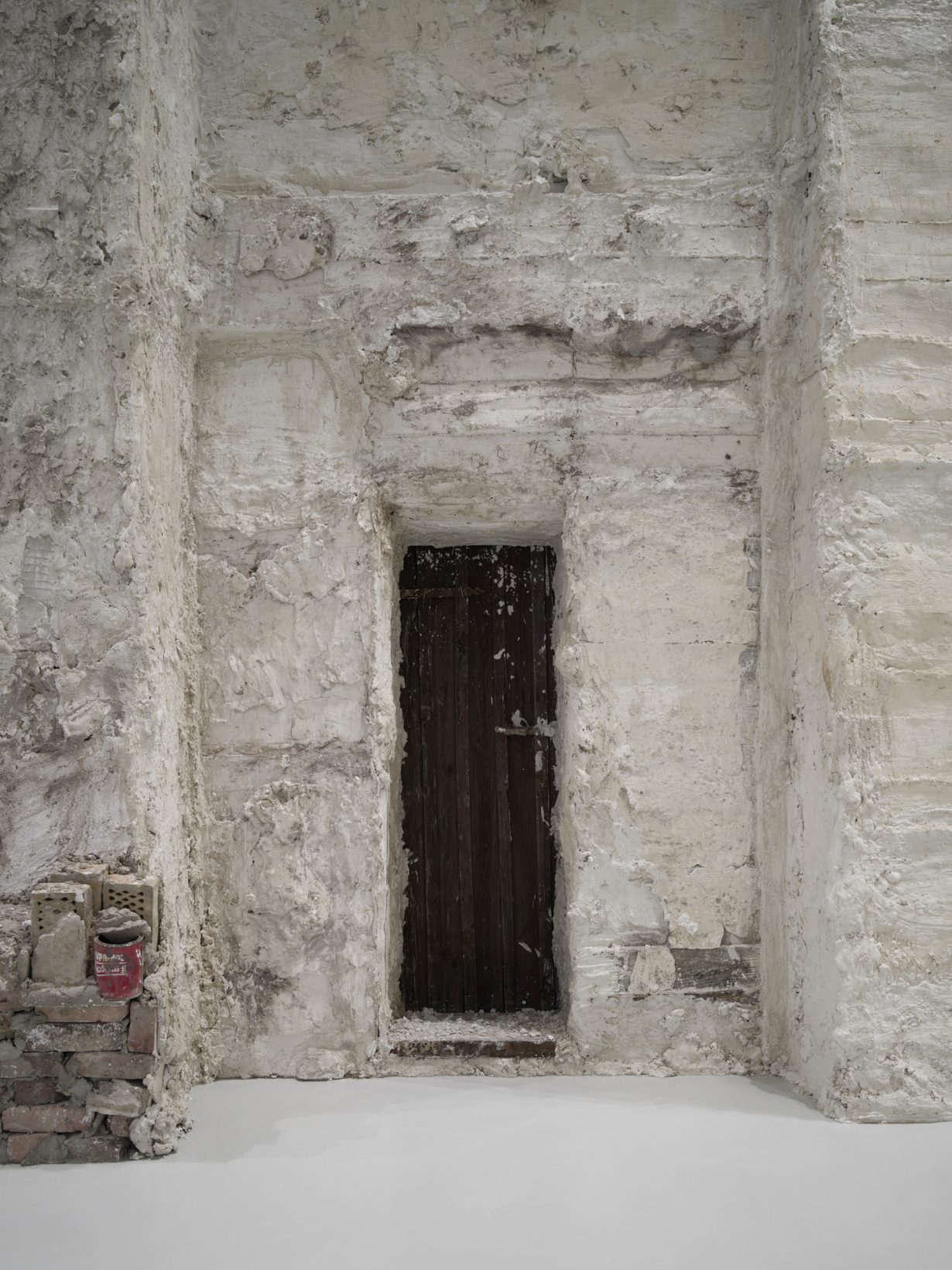
As an artist-director, Skoog, born in 1985 in the same part of Skåne in which the film takes place, is not much interested in plot. What accumulates, rather, through the film’s sequence of dioramas, is an opaque yet forceful soul-image of Karl-Göran – and of his redoubt. For while Redoubt is currently the subject of an exhibition at Moderna Museet in Malmö, the full version of Skoog’s film only screens in cinemas. What fills the grand space of the museum’s former turbine hall is the actual redoubt that he had fabricated for the shoot, as true to life as could be. This emphasis would suggest that the impetus behind Skoog’s project is not so much the pamphlet – though an updated version has recently been reissued by the government – as it is this curious piece of architecture itself. For there really is, in a field in Skåne, to this day, a two-storey bunker made from chains, farming equipment and mattress springs – any piece of metal, it seems, would do – poured over with concrete. I have seen it with my own eyes. In places where the concrete has crumbled away, an enamel pitcher or the rear-end of a bicycle protrudes from the wall. The original, constructed by one Karl-Göran Persson from the 1940s until he passed away in the mid-1970s, makes for a strangely moving encounter, testament to immense human will and sacrifice. It is a building – a monument? a sculpture? – so idiosyncratic in style and mysterious in atmosphere, that it’s no wonder an artist like Skoog would find in it a kind of muse.
Redoubt has its roots in his short film Reduit, which won Skoog the Baloise Art Prize in 2014. In this earlier, relatively documentarian work, he hews close to his source material, slowly panning the camera around the building while anecdotes offered by locals who knew Persson from childhood play in voiceover. Reduit is reminiscent, in turn, of Karl-Heinz Klopf’s film portrait of Tokyo’s Tower House (2013) or Paul Virilio’s photographs of the Atlantic Wall in Bunker Archeology (1975), which likewise transform architectural structures into solemn witnesses to their time. If this redoubt is a monument, though, then to what?
Encountering Karl-Göran’s story, we might ask about the relations of paranoia to caution, authoritarianism to warmongering and naked belief to conspiracy thinking. Such questions easily spill over into our current moribund political circumstance; nevertheless, Skoog’s film is not a letter to the editor. While Reduit far from exhausted the potential material, it seems that Redoubt’s further leap into fiction provided the necessary license to elevate Karl-Göran from eccentric recluse to archetype: a highly ambivalent cipher of faith, endurance and self-sacrifice. Lavant plays the part like a sexless Marlon Brando, a body, almost animal, grunting and tireless and yet iconic: the human incarnation of his fortification project, in real life so much bigger than any one man. Add the highly stylised cinematography, and this leap becomes an also rather self-conscious one into cinema proper, in which Virilio’s bunker meets the idea, associated with André Bazin’s What Is Cinema? (1958–62), that cinema is to the twentieth century what the cathedral was to the eleventh.

To this end, Redoubt also builds on Skoog’s 2015 short Shadowland, set in Los Angeles, with its grainy black-and-white shots of famous locations that featured in early Hollywood films. The film cuts between exterior views and the inside of a tour bus as Skoog piles the fiction on; we see the relevant scenes play on small screens inside the bus as it passes their real-world counterparts. Shadowland makes for melancholy viewing insofar as these images of images only seem to empty the real places of meaning. But in REDOUBT (the exhibition), Skoog’s replica of the fortress and Lavant’s incarnation of Karl-Göran, I would argue, function according to the Hegelian notion of aufhebung as repetitions that simultaneously annul specificity and elevate to universality. As painters of orthodox icons carefully repeat the image of the Madonna, at once removing the figure from reality and inscribing it in its centre, so Persson’s fortress has been made anew, one rusty bicycle and chain-link fence at a time. One implication of Bazin’s cathedral/cinema analogy is that cinema makes an architecture for the suspension of disbelief, or what in religion is known as faith. Redoubt transforms Persson’s redoubt into a spiritual proposition.
Transformation through the aforesaid aufhebung is a specialty of Skoog’s. Like Redoubt, the short film Late on Earth (2011) functions as a de facto portrait of the artist’s homeland, Sweden’s rural south – though documentary indexicality is quickly foregone in favour of iconicity, beauty and existential angst. This film also shares with his recent feature a structure of consecutive scenes that do not come together as plot, but rather accumulate into a feeling of uncanny suspense. Children play at the edge of a sand quarry, an immigrant worker picks strawberries, a young woman screams as a train drives by. Ditto Ridge, a 71-minute feature from 2019 that is set in the same geography and further dramatises similar motifs. It opens with an anecdote that goes some way in phrasing the question underlying Skoog’s fascination with Karl-Göran, too: two cows, we are told in voiceover, have broken out of their fence to go and live on the titular ridge – but why would anyone leave their herd? The ridge is cast as the mysterious edge of the film’s world where the familiar breaks into strangeness; where cows become feral and teenagers get drunk and transform. Embodying the social periphery in the film are a group of Polish agricultural workers, alienated among the locals – and yet as necessarily present as the ridge, because every type of belonging is defined by its nearest point of difference. Skoog marks those points while also showing us how each little thing contains the potential for otherness and transcendence – the impulse towards flight and towards fear.
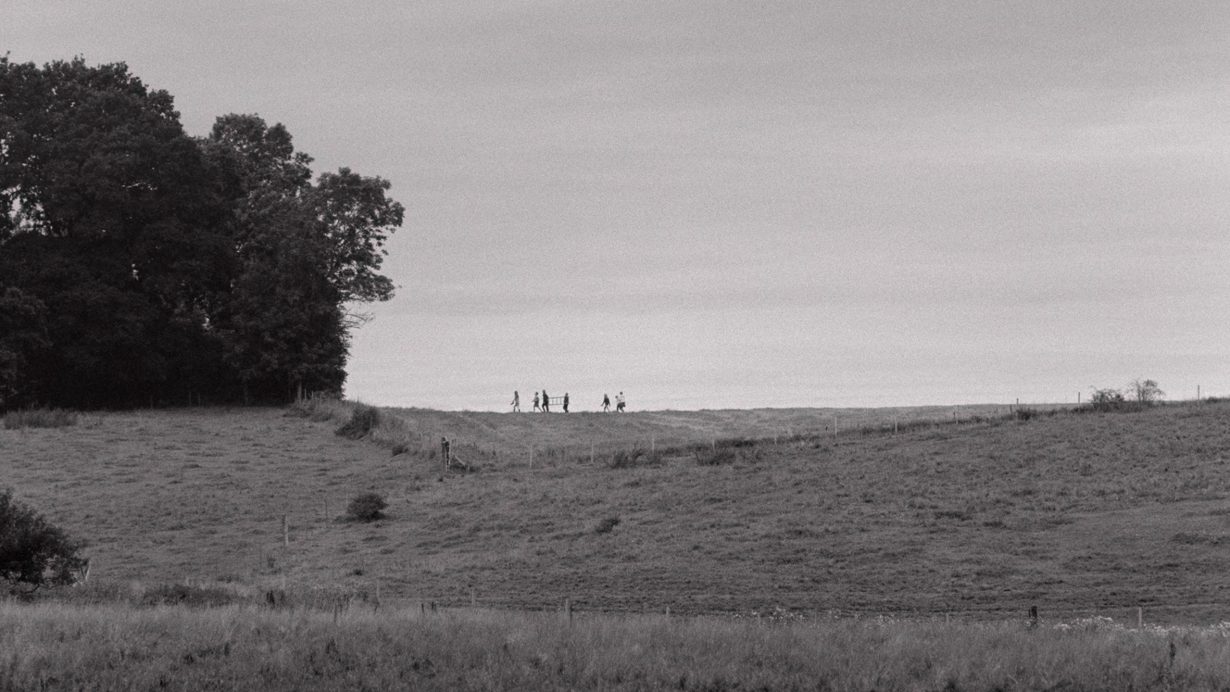
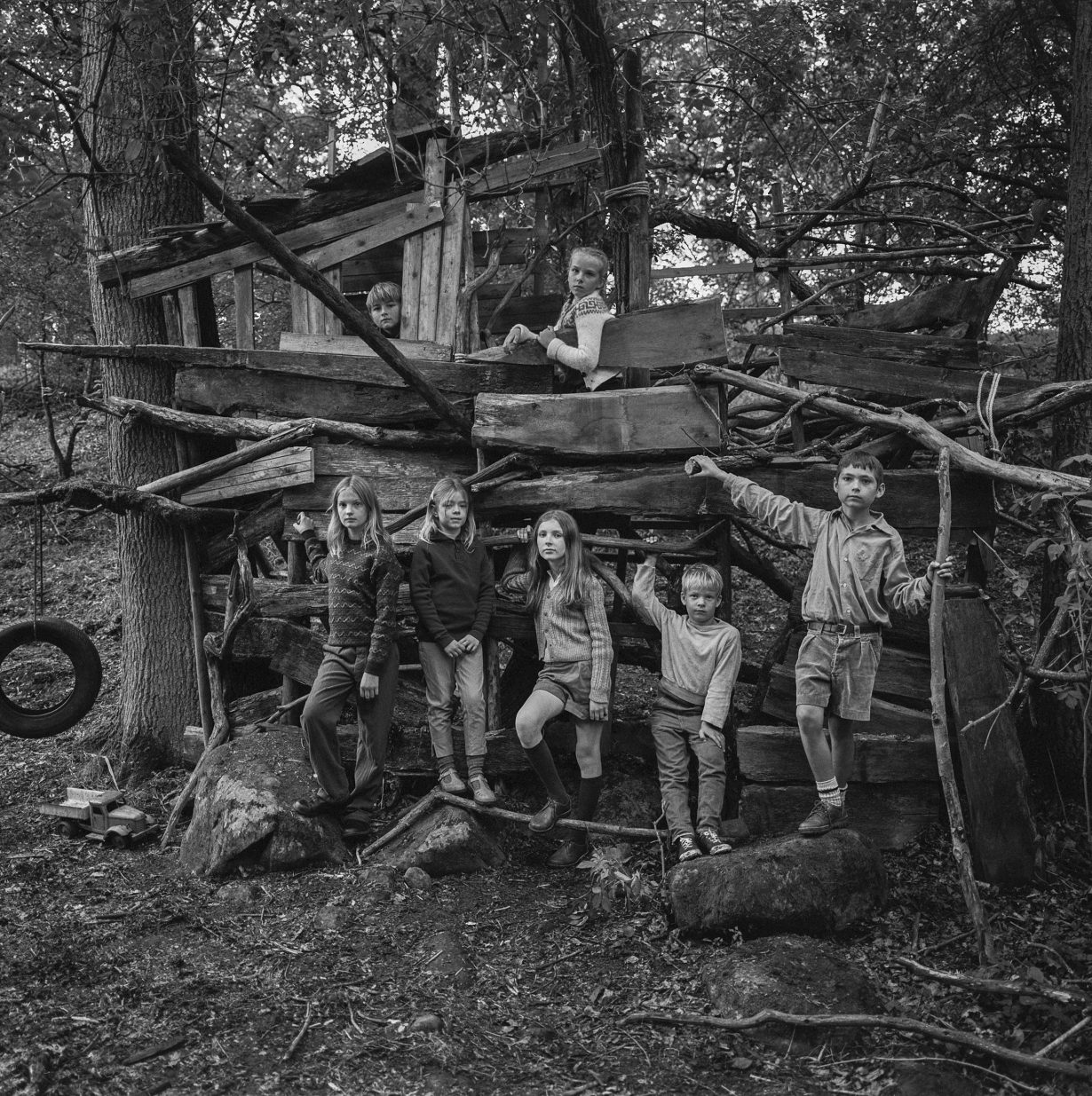
Redoubt is similarly animated by the presence of the Other within the group, and the otherworldly within society as we know it. Here the limit of normality is defined by the possibility of war, and Karl-Göran’s redoubt is the imaginary valve between the two. We see him at the edge of society, harassed by the local youth, alone in his fantastical endeavour, while at the same time – in two ensemble scenes where the camera pans a full circle to show the whole village – completely integrated, dancing with the children at a summer party. In the opening scene, Karl-Göran tenderly pets a chicken while the children sit at his feet. One shot shows the children building a treehouse, the next – repeating the composition – Karl-Göran’s fortress. Play and a certain childish innocence sit alongside the solemn, self-imposed slavery of duty as he toils away on his redoubt – the hard labour of faith.
As the film draws to a close, faith does not give way to doubt, but innocence does wither into frustration. In a late scene the redoubt’s architect expresses feeling chained to this endless waiting – “I want it to end!” he screams. Does Karl-Göran want the war to come? In spite of repeated warnings, he has been burning rubber tires in his oven, and their toxic fumes are filling his house. We do not know why. What we know is that his wish is full of contradictions: the redoubt is a survival machine, but it is also killing him. He is trapped inside his calling, living the reality of the structure he builds. The film does not dwell on whether Karl-Göran’s project makes sense, but simply confronts us with the fact of it as an act of faith, a great sacrifice – can we imagine this kind of selflessness? The redoubt itself, the one in the real world, is proof. I’ve seen it with my own eyes. For most others, Skoog’s artful impression will have to suffice to appease their incredulity.
REDOUBT, an exhibition of work by John Skoog in collaboration with Laslo Chenchanna, Julian Ernst, Gabriel Karlsson, Erlend Rødsten, Søren Schwarzberg and Ernst Skoog, is on view at Moderna Museet Malmö through 17 May. The feature film Redoubt (2025) is on general release.
From the March 2026 issue of ArtReview – get your copy.
Read next Thomas Hirschhorn: The Long Afterlife of Temporary Monuments


