The artist’s first institutional solo in his native Indonesia for three decades is most enchanting when it speaks for itself
Three decades after he emigrated to Australia, Jumaadi’s first institutional solo exhibition in his native Indonesia gathers recent drawings, paintings, installations and a performance (the latter happens on three occasions, but is also available as a recording). In a dark screening-room lined with paper cutouts, a two-channel black-andwhite projection Laut Masih Menjadi Misteri (The Sea is Still a Mystery, 2023) shows a shadow-play set in a maritime environment: fishing boats, gigantic crustaceans, odd plants. Mounted nearby is a monitor concurrently playing behind-the-scenes footage: the artist moves the puppets closer to the lamp then sneaks them out of the screen, their silhouettes turning blurry to provide the illusion of distance. Right outside the screening room, storyboards are drawn on pleated papers and encased in a glass box. But however much the exhibition attempts to steer visitors into seeing how the sausage gets made, so to speak, the play is at its most enchanting when its primary elements – light and shadow – speak for themselves.
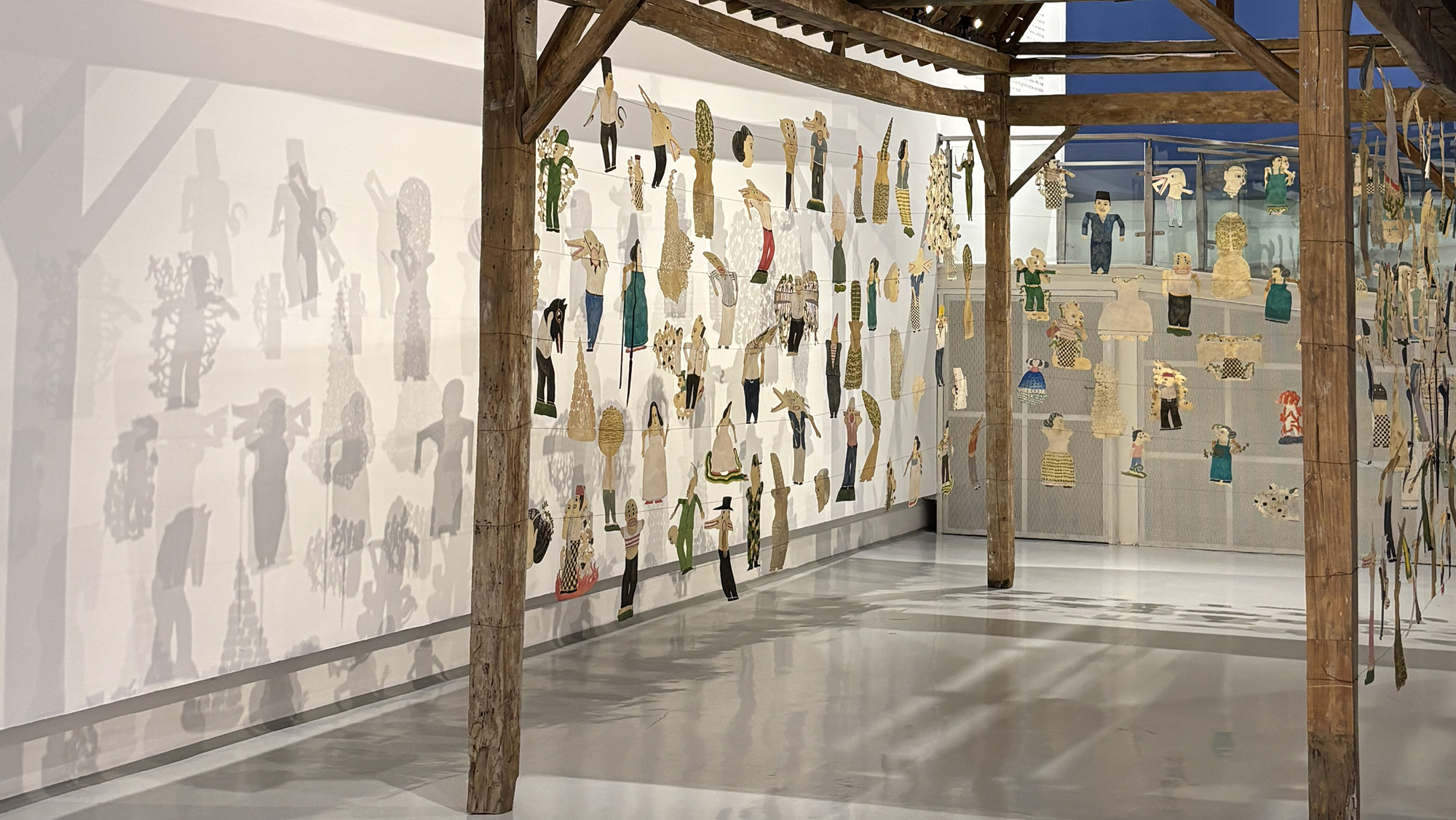
Alongside paintings made in acrylic on cloth, Jumaadi’s practice often draws on the traditional art of wayang kulit, or shadow puppetry – featuring characters with exaggerated features, generally presented in the side profile – to explore human relationships and natural cycles. For the exhibition’s centerpiece Orang Terkasih dan Bayang Bayangnya Abadi (The Eternal Shadows of Loved Ones, 2025–26), rows of 147 buffalo-hide cutouts (the traditional form of wayang-kulit puppets) depicting a cast of colourful characters are strung between the pillars of a wooden hut. The shadows of these inhabitants, cast on the wall, intermingle, suggesting a complex social constellation, one that is populated by people in domestic relationships (such as husband–wife or parent–child pairs) and chimeric creatures (such as humans with twin crocodile heads or others enveloped by fiery red snakes) alike.
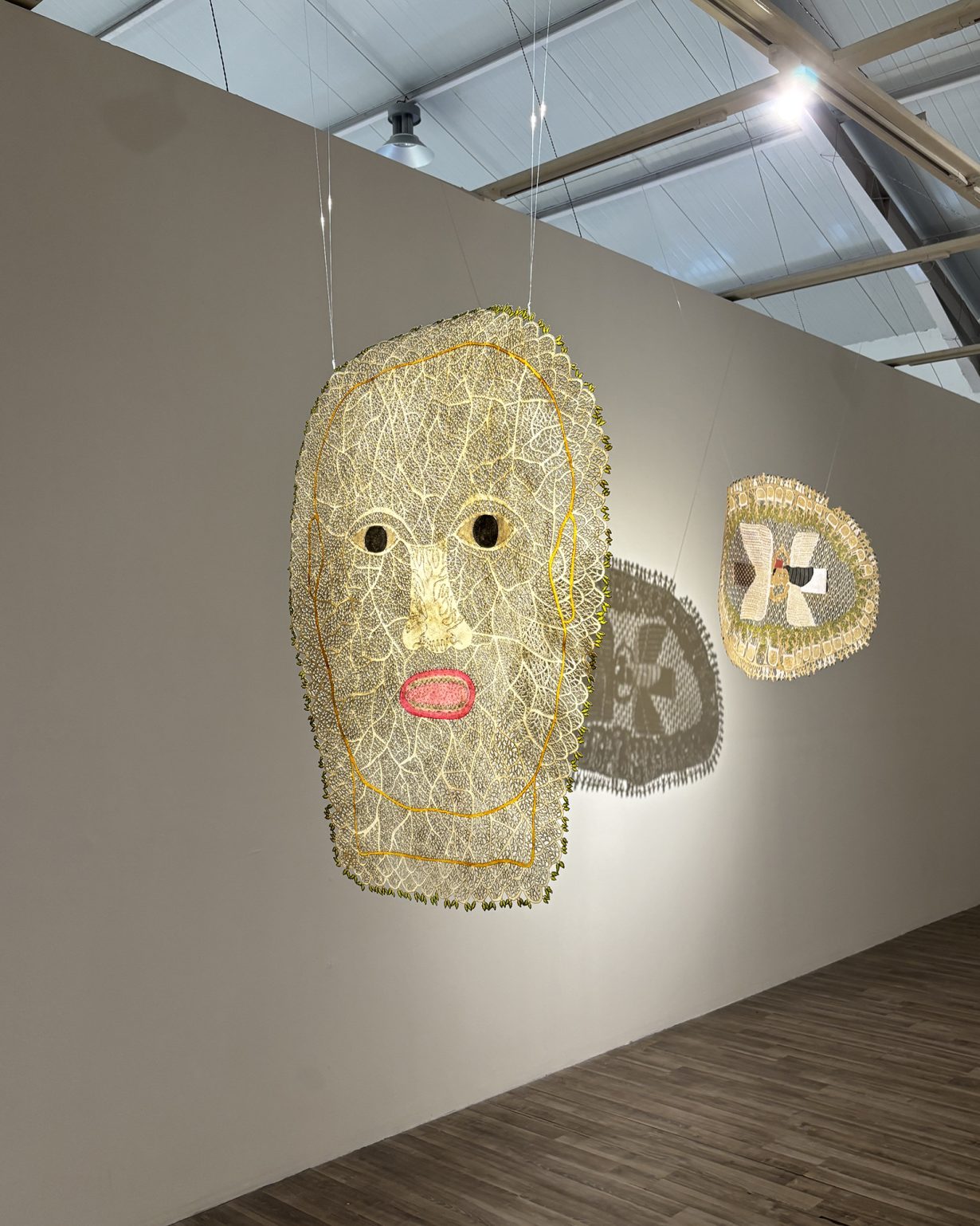
Further up on the museum’s mezzanine floor, 13 intricately carved buffalo hides hang suspended from the ceiling. Each depicts myriad scenes at once. Take Sepasang Malaikat #2 (A Pair of Angels, 2026), an oval-shaped hide, painted in acrylic, in which the titular dyad takes centre stage, with each winged creature, one male, one female, swooping in to smooch the other as both spread their wings. A fringe of cutouts of tiny humans holding hands (as do the central angels) makes up the puppet’s perimeter. Motifs of waves, and trees with fetuses for roots, flood the rest of the surface area. Like all the works here, Sepasang Malaikat #2 can be observed recto verso, though all are hung close to the walls, perhaps to make clear that the most elegant standpoint remains the one that allows visitors to see (in this case) the painted work and its shadow imprinted on the wall behind it.
The exhibition demonstrates Jumaadi’s versatile take on the traditional artform as he deploys it to represent his original and inventive cosmological visions in which physical and spiritual realms intermingle. This is evident in Kaki Langit (The Sky’s Feet, 2026), in which a foot-shaped puppet depicts the human journey from life to death: nodal root systems inhabited by a curled-up body fill the puppet’s toes and heel, while a larger body, lying head down, and an array of skulls occupy the sole. Surrounding the rest of the foot are repetitive engravings of plants, birds and circular patterns; nature abounds from womb to tomb.
Jumaadi: Yang Bersayap Rangka Daun (The Winged One with the Skeleton of a Leaf) is on view at Tumurun Museum, Surakarta, through 10 January
From the Autumn 2026 issue of ArtReview Asia – get your copy.


