Staging the artist’s sculptures in the UK’s late-capitalist haven tells Owen Hatherley plenty about the various false aesthetics of ‘Englishness’
An hour northwest of London, the Oxfordshire designer-outlet shopping mall known as Bicester Village is one of Britain’s major tourist destinations. On the outskirts of an otherwise obscure village, it is marketed to the peripatetic global upper-middle classes; uniquely for transport-hub PAs in the UK, announcements for Bicester-bound trains at Marylebone station are made in Arabic and Mandarin as well as English. Opened in 1995 and gradually expanded ever since, its success is based on global brands, offered at a discount in a strip mall with a common, homogeneous ‘traditional’ aesthetic. Its appeal is cleanliness, order – spotless, with its own private security force – and predictability. It has a reputation as being a simulacrum ‘English village’, but its muted clapboard facades bear almost no relation to any tradition at all – weather aside, you could be in California, or in the New England village in Murder She Wrote. Its clientele is largely international, with the ‘village’ element surely secondary to the fact that this is really a place for people who would both like, and can afford, a Vivienne Westwood bag but are tight enough to travel to Oxfordshire to get it at a 20 percent discount. The extraordinarily strange thing about Bicester Village is its combination of extreme homogeneity and dullness, in its buildings and its shops – no surprises here, but if you want the world’s biggest branch of Pret, you’re in luck – and the equally striking cosmopolitanism of its visitors.
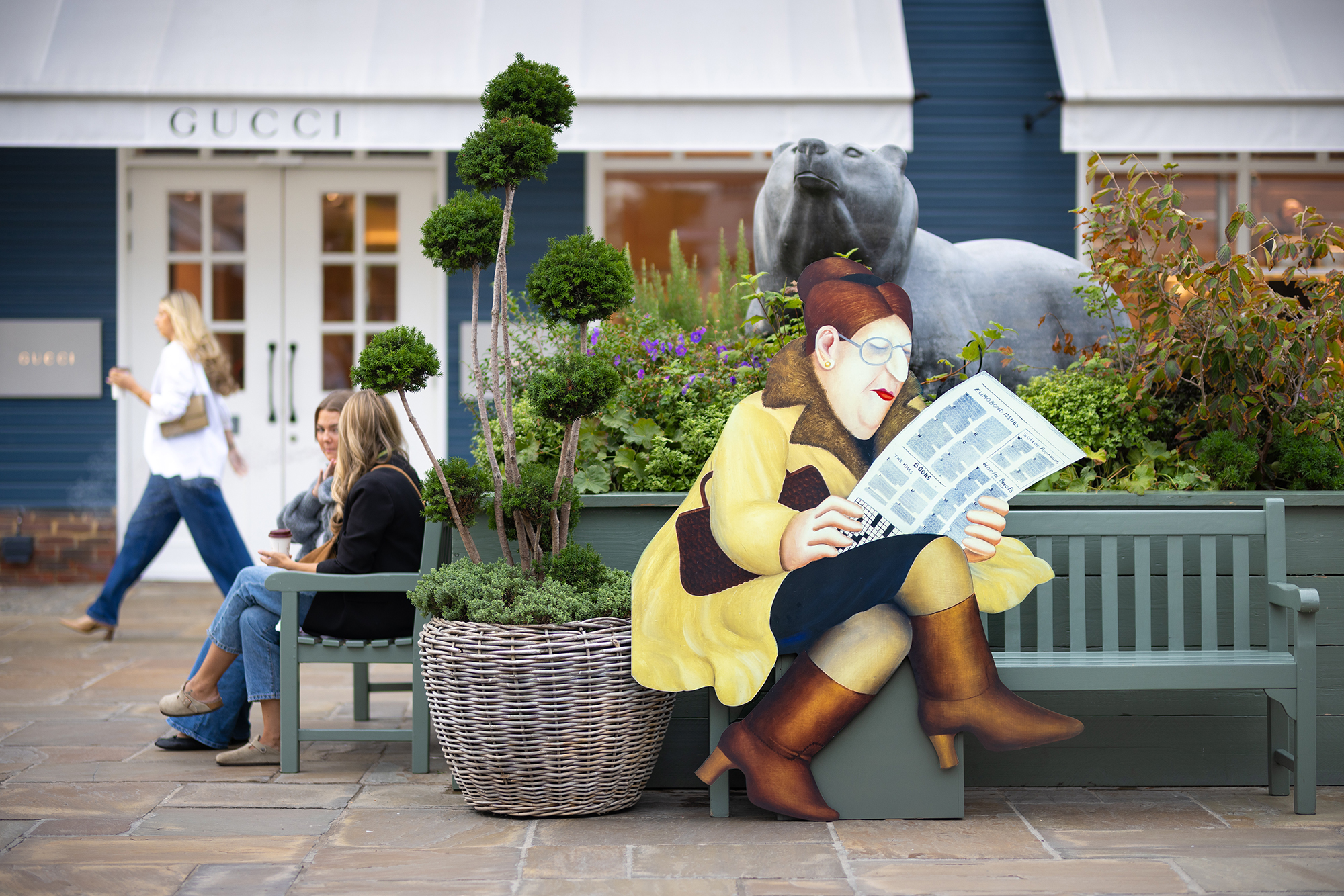
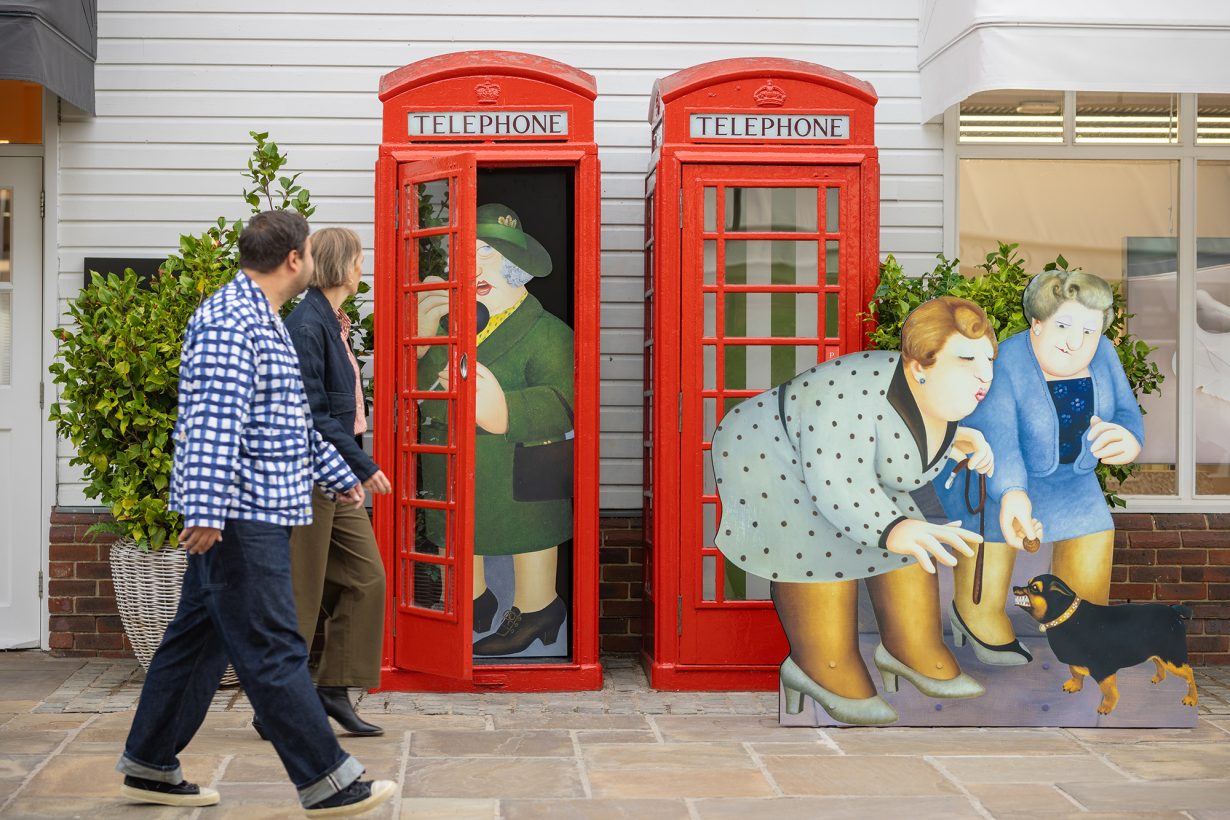
As a place of apparently questionable taste, it’s maybe fitting that it has become the temporary home of Beryl Cook and Friends, an offsite project of House of Voltaire, Studio Voltaire’s shop, comprising giant wooden cutouts of figures from quintessentially English painter Beryl Cook’s paintings, placed between, in front of and atop the shops.
There are two equally dubious positions that could colour how an art-lover might approach a contemporary art installation here. On the one hand, you might be appalled that art is being scattered among the bargain bins of Paul Smith, Ralph Lauren and co, as if art has finally ceded its autonomy to commerce; on the other, you might hail it as a celebratory meeting of art and life, with the works placed where people can see them rather than in the quasi-temple of the art gallery. Similarly, the journey of Cook’s bulbous figures from sharing the aesthete’s doghouse with Jack Vettriano or Vladimir Tretchikoff, to her garlanding by institutional showcases (at contemporary art spaces like Studio Voltaire in London or The Box in her longtime home Plymouth, where she died in 2008) has been accompanied by two predictable critical reactions. One is to be scandalised, to continue to claim with the likes of former Arts Council head Nicholas Serota that there was some important way in which her irony-drenched, instantly understandable and instantly recognisable art about sexuality and Britishness was lesser or stupider than the irony-drenched, instantly understandable and instantly recognisable art about sexuality and Britishness of, say, Sarah Lucas. The other is to claim her unambiguously as one of the greats – Edward Burra if he was a B&B landlady, ‘Rubens with jokes’, in comedian Victoria Wood’s words. But there are few layers to a Cook painting. She was a gifted caricaturist, and what you can see is usually what you get: bright, vigorously outlined paintings of tumbling, garishly dressed bodies, often engaged in various pleasures of the flesh: Thomas Rowlandson in Wetherspoons.
At first, it all works well. As you exit Bicester Village’s railway station, into a carefully landscaped path under an arc of tree cover and with the sound of birdsong above you (which is real, not piped – there are birdboxes everywhere), you find first, in the bushes, a not quite lifesize, flat, cartoonish wooden cutout of the outrageously dressed gay couple in the painting Ted and Heinrich (1989); on the green between two raised-concrete car parks featuring Mock Tudor elevators are the cricketers extracted from Pretty Wood, Sir (c. 1981), while the bowls-playing matrons falling over each other in Bowling (c. 1975) are lurking in the cut grass. In the granite pathway between the trees, the bee-woman from Madam Jo Jos (1987) practically leaps out. I might enjoy this after all, I thought.

One of the usual defences of Cook’s work is its authenticity – this is what ordinary working-class British (despite some excursions to New York and to France, it usually is that) people are really like. There are far worse national self-portraits. Cook’s world is feminine, horny, democratic and trashily glamorous, and it always looks like a fun place to be. Nobody is shut out of it. But Bicester is both too weird and too bland to accommodate that world. As a space, it’s not really ‘villagelike’ at all, not even a Poundbury, let alone a Portmeirion – its buildings are a joyless sequence of wooden gables as repetitious as any modernist grid, enlivened only by the logos of shops that sell really expensive things at small discounts, flanked by vast car parks that cut the place off from the actual village of Bicester (which you would barely know existed but for the top of a church tower poking out above the trees) nearby. There’s a certain wit when the artworks are used as punctuation to the retail units, as with the recreation of Cook’s painting Breakfast at Elvira’s (1996) as a miniature shopfront or the group of party girls from Doing the Lambada (c. 1994) on the balcony of the village ‘pub’, but mostly they’re just dotted around a bleak but very clean strip mall, and then clustered around a ‘popup’ branch of House of Voltaire: therein, Cook geegaws are sold for sizeable sums, as if you can’t buy Beryl Cook tat in thousands of charity shops. But Bicester Village is the antithesis of a charity shop.
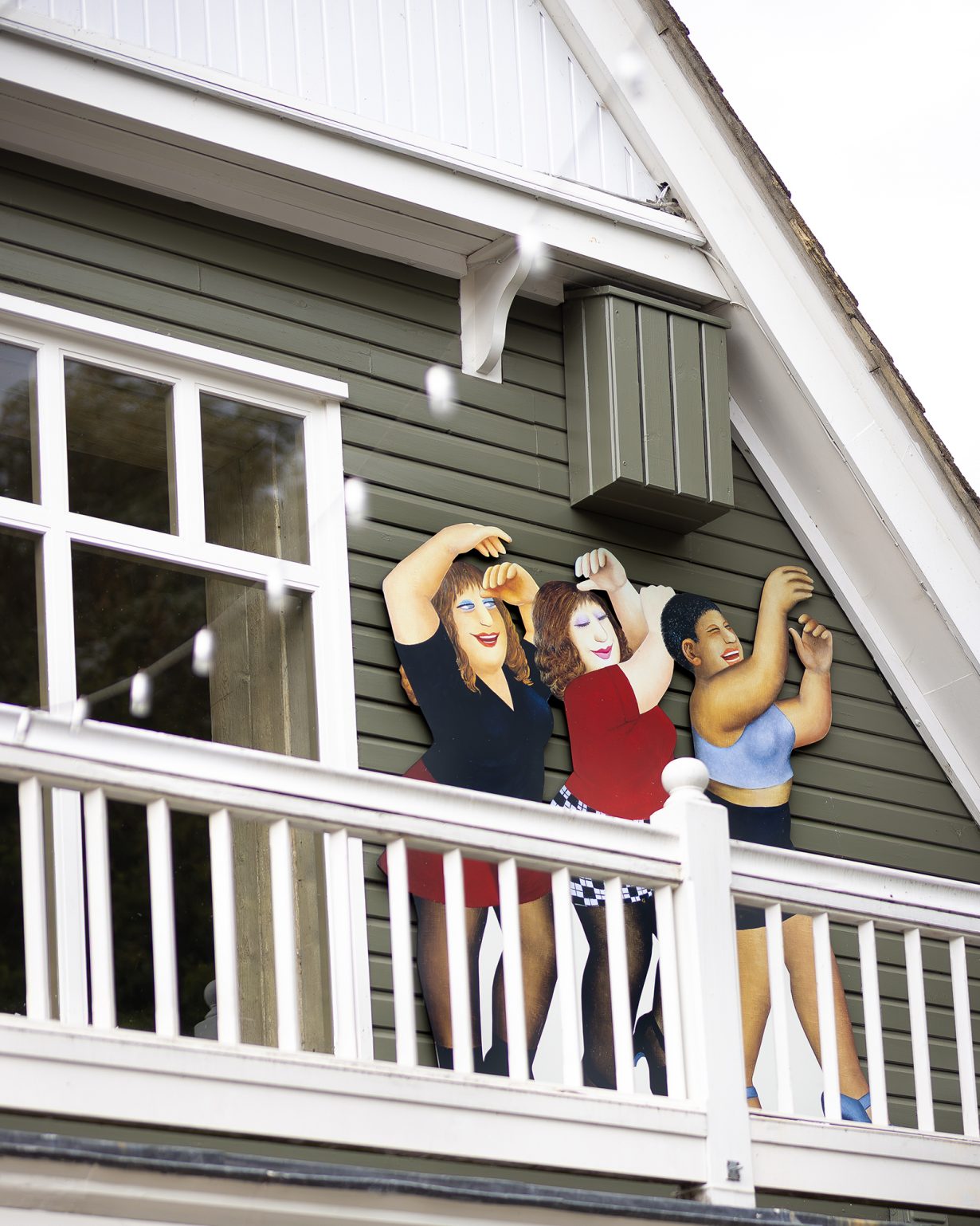
Milling around looking for the cutouts of Beryl Cook and Friends, you’re impelled to people-watch, just like she did in her pubs, parks, ports and nightclubs. In a place that is so artificial, so extreme a hothouse, this voyeurism is actually rather uncomfortable; you’re being asked to stare at, say, the Saudi couple with a load of Versace bags or some bored twentysomethings from Chengdu glad they can get a pair of trousers for £350 rather than £400, which can easily become an alienated, othering look. Were she able, would Cook have painted these figures too, and made them as lively and jolly as those of her paintings? It seems implausible to me, with everyone dressed in comfortable grey and beige luxury, and treating shopping as a very serious business. Cook’s raucous cutout figures Doing the Lambada on the balcony of the pub would surely be told to pipe down by the private security, or ejected altogether. As a result, it’s hard to know what to think of this particular combination. ‘A Legacy of Joy’ is the heading on the explanatory boards left around Bicester Village to draw attention to Beryl Cook and Friends, but discount shopping in exurban Oxfordshire does not come across as a particularly joyful experience. In the end, torn between wanting to avoid the dual traps of snobbery and authenticity – equally ill-suited to a place that is both very rich and very fake – the effect is unnerving more than anything else.
Read next Beryl Cook, From Kitsch to Canon