The latest edition, A Chorus of Strangers, feels much like the reality of Britain today – confused, messed up, angry, threatening and full of mixed messages
Between the skeleton of Dippy the Diplodocus (which has ‘stomped’ – according to promotional materials – all the way from the Natural History Museum in London to be with us at Coventry’s Herbert Art Gallery & Museum) and an exhibition about marine life in the county of Warwickshire when it was submerged during the Jurassic Period, you’ll find one of three parts of the quinquennial British Art Show (BAS). And unlike those souvenirs of yesterday, the BAS – this tenth edition curated by writer, curator, broadcaster and former Institute of Contemporary Arts director Ekow Eshun – promises to bring us bang up to date: on the state of art (the works on show, by 37 artists, have been made over the past five years) and of the nation (this is roughly the period since Britain officially left the European Union) today. By the time you get to the cutting-edge contemporary you’ll be inescapably aware that the venue itself is set up (like so many British cultural institutions) to distract us from our inglorious present with displays of a supposedly glorious past.
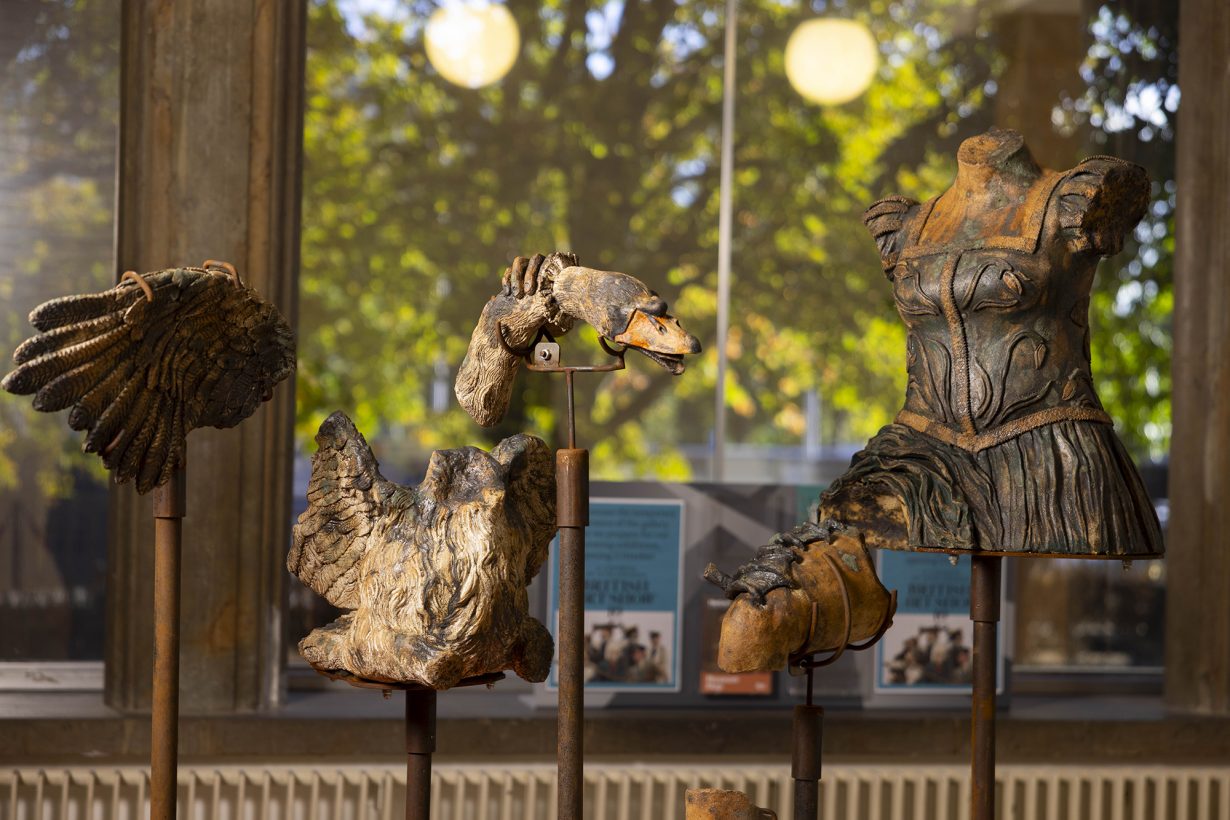
Even so, cutting-edge contemporary might not be the first thing that comes to mind when you encounter the first work in the BAS display: Lindsey Mendick’s series of clay sculptures, Wicked Game (2025), arranged as if part of a fragmented, almost lifesize chess set, featuring anthropomorphised animal pieces (exuding the faint whiff of Beatrix Potter characters) that look like the fractured remains (held together by pins and armatures) of an antique sculpture garden. In fact, you’ll likely feel that it only adds a further dreamlike varnish to the all-our-yesterdays vibe that permeates this institution. A wall text tells us that Mendick’s work combines the history of Queen Elizabeth I (here she’s a lion) and female characters from Ancient Greek mythology to evoke the story of the queen’s celebrated refusal to marry. It’s unclear if this is about viewing the past through a feminist lens, or if it’s suggesting that feminism is nothing new. Or perhaps a sense of animism or closeness to nature is more the point. Installed on the museum’s ground floor, just around the corner from Dippy, it blends in so seamlessly with the rest of the Herbert’s displays that it’s hard to imagine what more it might be telling us. Upstairs, however, where the bulk of the BAS display is housed, it’s literally another story.
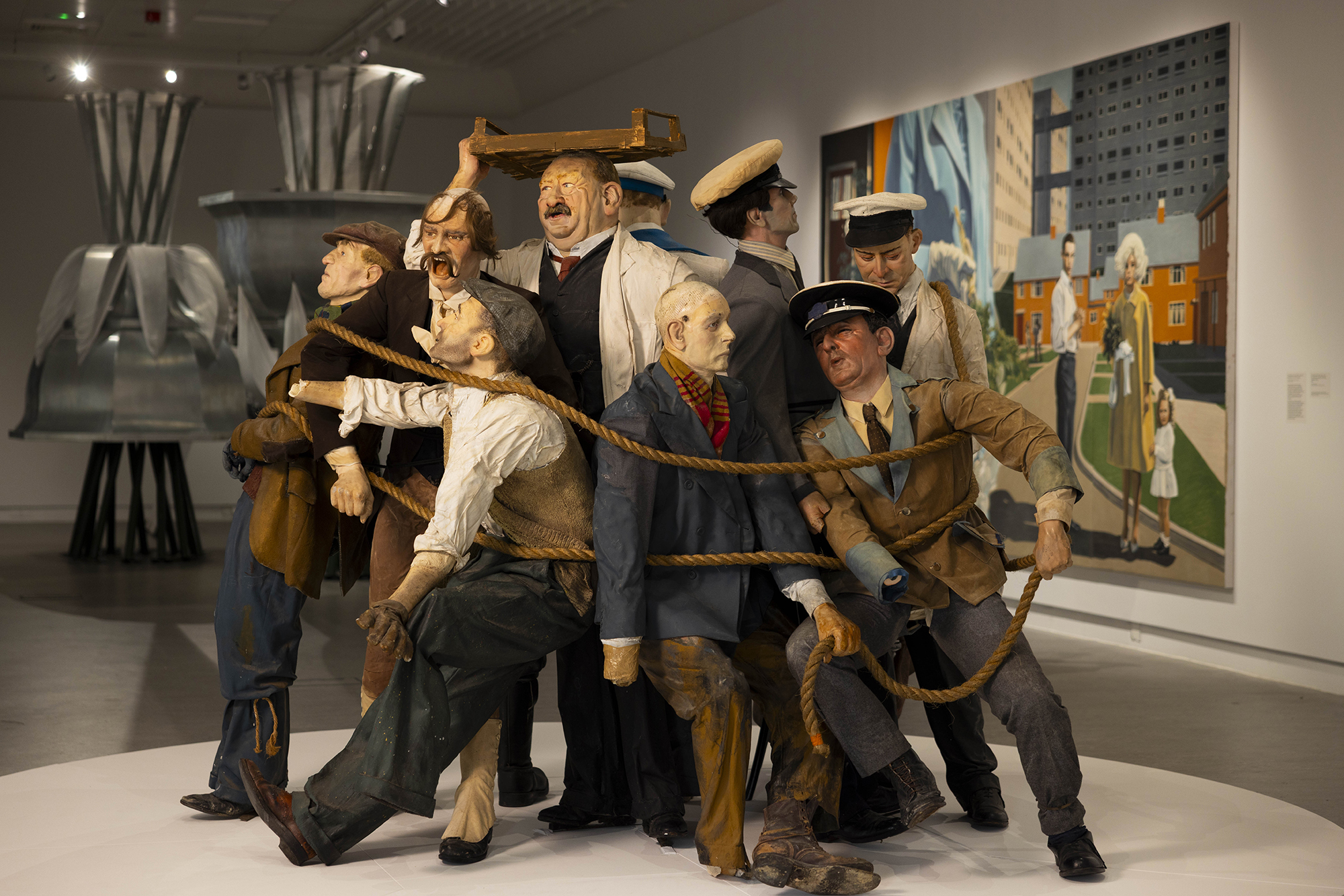
Buried in the middle of it all is a 13-minute video by photographer Mahtab Hussain and filmmaker and writer Guy Gunaratne. Presented on a monitor, with the audio heard through headphones, it’s unobtrusive and unassuming. Unlike Alex Margo Arden’s Accounts (2025), a giant bouquet of 11 lifesize white male mannequins representing various trades of mid-twentieth-century Britain – milkmen, butchers, bus conductors, labourers. It brings to mind the extras from a BBC production of a Miss Marple detective story. Somewhat ghoulish and somewhat broken (the odd missing hand or foot), they’re each frozen in the middle of some sort of action or reaction and collectively roped together into a sad, confused, but sometimes angry-looking mass. And perhaps they’ve got something to be upset about: castoffs from scrapped dioramas at the National Motor Museum in Hampshire, they’ve gone the way of the dinosaurs. A bit like the British automobile industry itself (vehicle production today is at its lowest since 1952). But while all that (the Motor Museum info is on a wall label) might tempt you to interpret the work as a wry nod to Coventry’s status as the birthplace of the dying British automobile industry, Hussain and Gunaratne’s work, Here Is The Brick (2025), gives it a rather different, more sinister spin.
The title of the work derives from the story of a brick thrown in the face of an Asian shopkeeper (he’s shown in news footage, clutching the offensive object, which smashed his teeth, near the beginning of the video). The remainder of the work is a fast-paced mashup of found footage documenting other instances of violence, outright racism and its opposite: the fawning acceptance of British South Asian and Muslim individuals when they do something of which the nation can be proud. Generally in the field of sports, where race doesn’t matter, apparently, when you’re winning (we see athlete Mo Farah, or boxer Naseem Hamed). It’s all epitomised in the chants of adulation we hear for former Liverpool football star Mohamed Salah: “If he’s good enough for you, he’s good enough for me, if he scores another few, then I’ll be Muslim too / If he’s good enough for you, he’s good enough for me, he’s sitting in a mosque, that’s where I want to be.” Before being quickly undone by a series of references to ‘Fucking Pakis’. Beside the monitor is a wall filled by Hussain’s Mosque City: Birmingham’s Spiritual Landscape (2023–25), casual photographs of 160 mosques: some that look like mosques (with minarets); others that don’t, these last blending almost seamlessly into domestic settings, warehouses or Birmingham’s commercial high streets. After you’ve seen the video, you’re aware of the extent to which some people might view this as a portrait of assimilation, while others might see it as infiltration. Now you look back at Arden’s white mannequins (which are in the same gallery) thinking they may have been restrained for the protection of nonwhite visitors. It’s a clever piece of curating that in many ways captures something of the reality of Britain today – confused, messed up, angry, threatening and full of mixed messages. A chorus of strangers who lack any clarity about what being ‘British’ means; or who refuse to accept that any definition of Britishness might be more contingent than necessary.
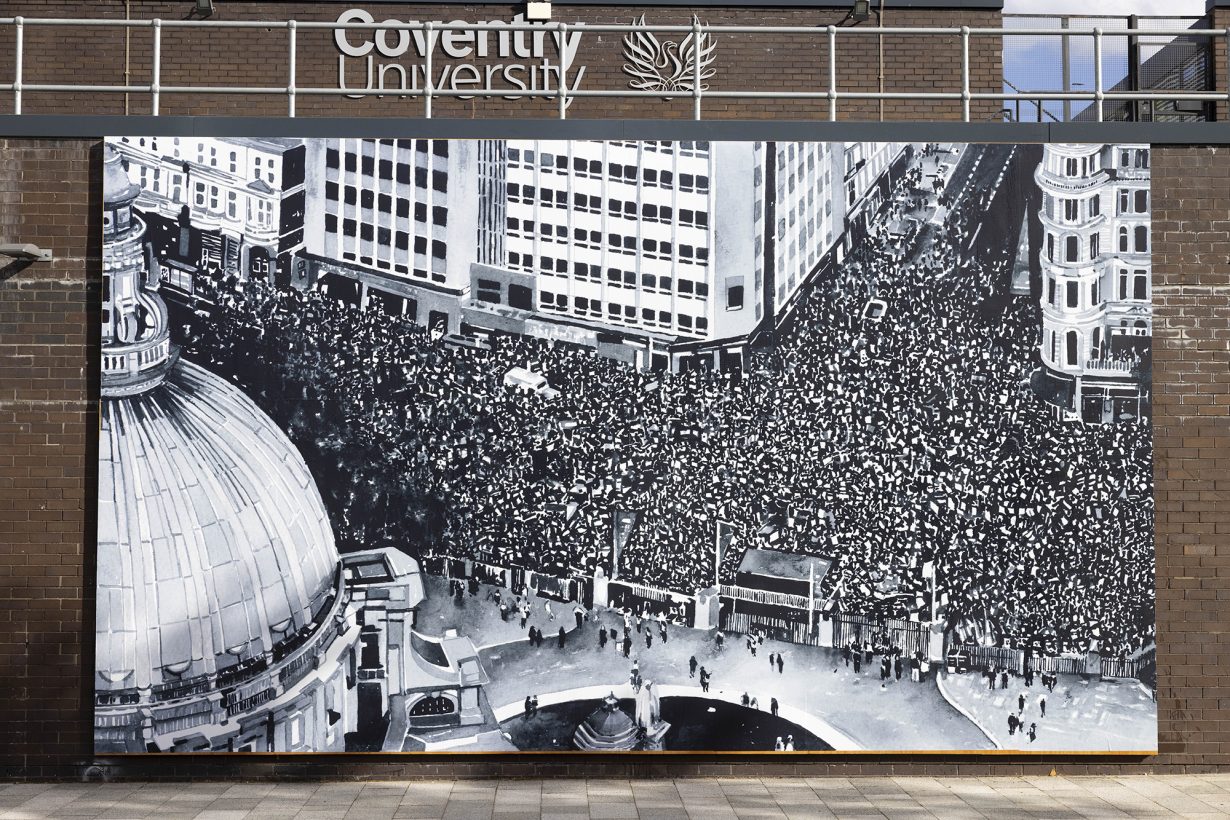
Lest the medium wasn’t carrying the message, a nearby wall text quotes Jamaican-British cultural-theorist Stuart Hall (who, alongside novelist Virginia Woolf and philosopher Timothy Morton, is one of a trinity of muses for the exhibition): ‘the capacity to live with difference is… the coming question of the twenty-first century’. Next up is Joy Gerrard’s black-and-white paintings of crowds and power, among them Together Alliance March, Protest against the far right (Central London, March 28, 2026) (2026), featuring a crowd formed around a banner featuring the slogan ‘DON’T LET RACIST FARAGE AND REFORM DIVIDE THE COUNTRY’, just in case you’d forgotten that answering Hall’s question remains a work in progress (for non-Brits, Nigel Farage is the leader of the rightwing, anti-immigrant Reform Party). It’s a shame, though, that the polite fury on show here is about as punchy as this British Art Show gets. Sometimes, as any good therapist will tell you, it’s better just to let it all out.
Over at the Mead Gallery, it’s the sense of the contingency of ‘Britishness’ that comes to the fore. In Matthew Krishanu’s dreamlike paintings recalling his mixed-race childhood in the lush landscapes of Bangladesh; or in Nnena Kalu’s rapid and repeated, obsessive even, drawings of spiralling, eyelike vortices; or in Dala Nasser’s Church of St Christopher – Kabr Hiram Qana (2025–26), a reinterpretation of a sixth-century Byzantine basilica from her native Lebanon, now in ruins, reimagined as a wooden frame (recreating the church’s doorway), and hanging fabric cyanotypes standing in for missing mosaics. Looking like a giant’s drying rack, it captures all the messiness, ephemerality and fragility of the past in a way that the general exhibits at the Herbert seemingly seek to ignore. And of course the run of works here seeks to emphasise that British art, and artists working in Britain, derives from many influences that might not be located on a clump of relatively tiny islands floating off the edge of mainland Europe and may not also take one particular shape or form. The suggestion being, of course, that ideas of ‘Britishness’ could work in a similar way. And yet the conventional, sterile, white-cube architecture of the Mead, and the fact that there is a distinct focus on painting and sculpture, means that none of this feels truly unruly: all of it looks like it belongs here, contained in the framework of ‘art’, removed from the domain of ‘life’. Safe. Unreal. Although that might contain some truths in and of itself.
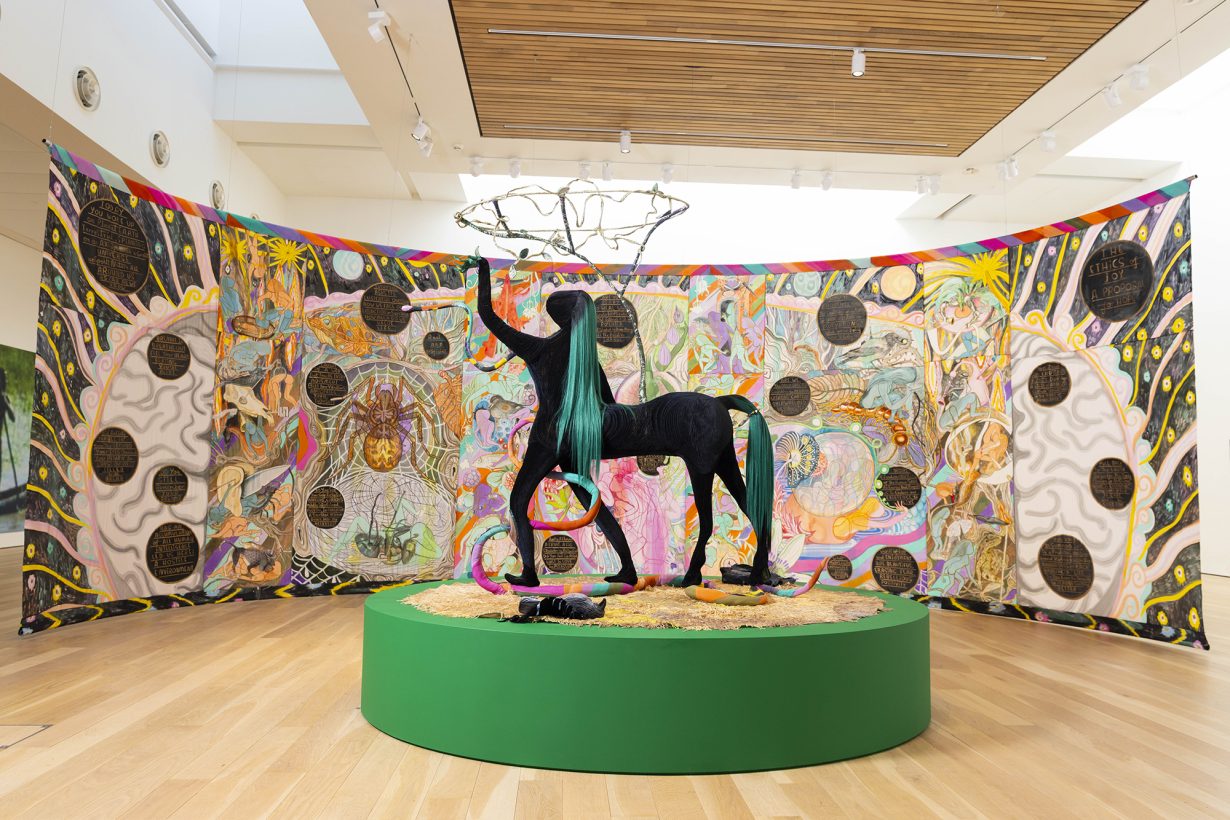
There’s a corrective of sorts over at the Delia Derbyshire Building in Coventry University – which functions as a creative lab (with students going in and out of seminar rooms as BAS viewers seek out the artworks). Here video is the prime medium; Melanie Manchot’s Night Moves (2026) features a series of performers using their bodies to occupy various liminal spaces in nocturnal Bristol via the medium of dance – to a soundtrack that features reggaeton, Yoruba music, jungle and dance forms that range from salsa to classical ballet – in a way that offers an alternative take on the idea of individual and collective agency to that iterated in Gerrard’s paintings of protests and crowded streets. It finds an (real life) echo here in photographs from Liz Johnson Artur’s Black Balloon Archive (2026), featuring dancing bodies (belonging to members of the African diaspora) in clubs, churches and boxing rings; and in Ufuoma Essi’s video Bodies in Dissent (2021), which fuses found archival footage from movies and current-affairs TV shows aimed at African Americans with a narrative about religious frenzy in the form of dance. Similarly emphasising the performative is Hannah Perry’s sculpture RAGE FLUIDS (2018), in which stretched, snaking, largescale coppery skins of car-body-wrap (vinyl film often used, by boy racers, to change the colour of a car without incurring the expense of a respray) vibrate according to the emissions of a series of subwoofers. Extending, perhaps, the exhibition’s earlier propositions of contingency when it comes to ‘Britishness’, to encompass a notion of animate rather than static form. Indeed, perhaps it’s only here that you truly get a suggestion of the form and function of the BAS coming together as one: that art might play an active role in life rather than simply offering a commentary on it. Which, one would hope, should be the ultimate goal of any edition of the BAS.
The British Art Show 10: A Chorus of Strangers is across various venues in Coventry, 2 October – 10 January