An exhibition at Jupiter Artland asks what new ruins will be left behind in the pivot away from fossil fuels
To the north, from the grounds of Bonnington House, a nineteenth-century manor within Jupiter Artland’s sculpture park, are visible a series of rust-red flat-topped mounds. These are the bings, huge heaps of burnt shale, a byproduct of Scotland’s early oil industry. They’re also artworks, according to idiosyncratic conceptualist John Latham, who designated them ‘process sculptures’ while hosted by the Scottish Office with the Artist Placement Group in 1975–76. The late artist’s approach to the postindustrial landscape, reckoning with its wastage and the cultural history it inadvertently memorialises, underpins many of the works in Extraction, by five artists of different generations, each processing our complex relationship to energy, industry and the environment.
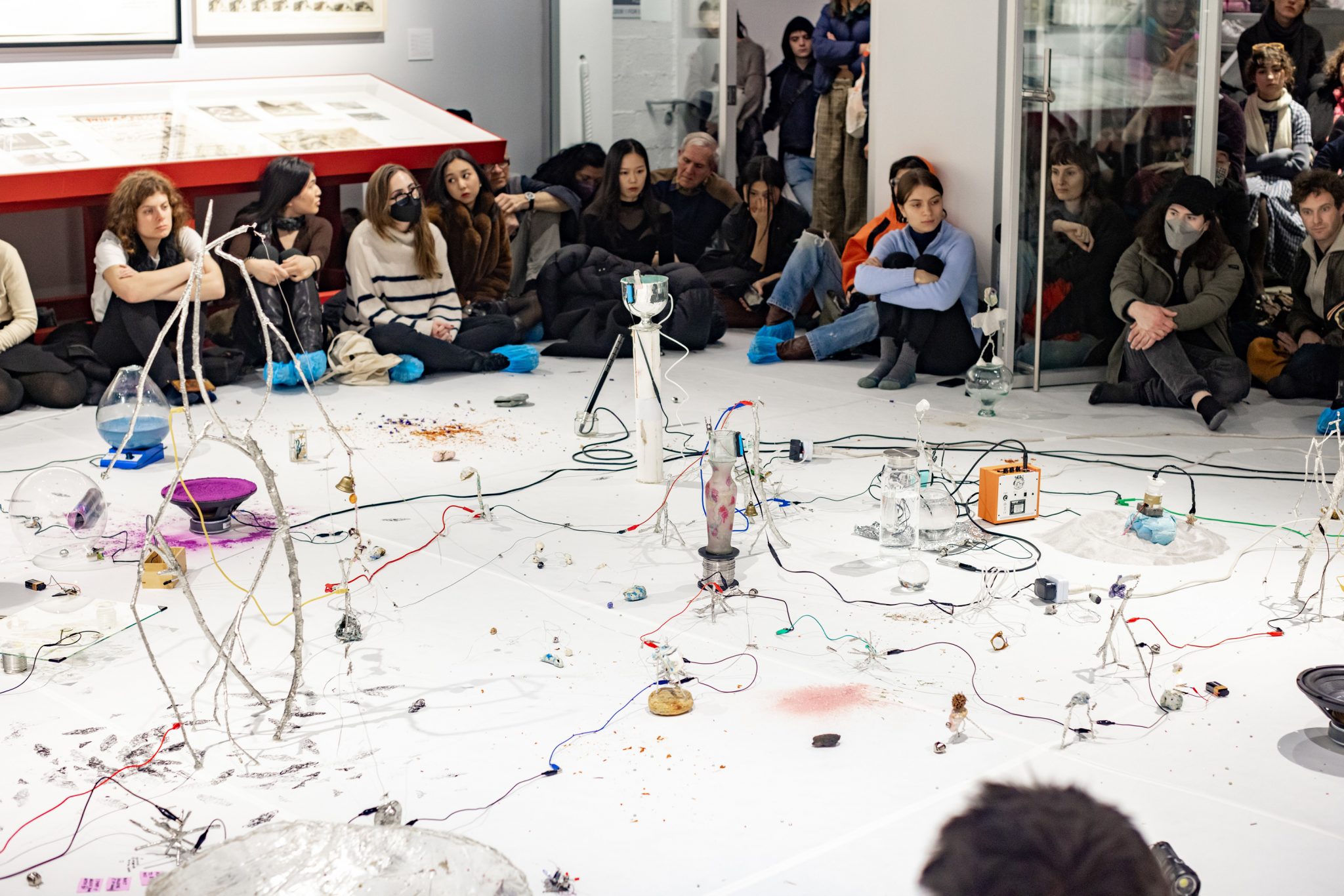
Latham named these ‘process sculptures’ Niddrie Woman, after the nearby Niddry Castle and the bings’ apparent resemblance to a female form when seen from the sky. In the gallery, a partial restaging of the artist’s installation The N-U Niddrie Heart (1991) is gnomically described in the wall text as constituting the heart of this figure. A curving pile of sand links a row of bent glass sheets, like open books, each pierced by pairs of roughly spliced hardbacks. Wires, motors and crushed paperbacks are arranged haphazardly around these stable forms. The hardbacks’ provocative titles, Vanished Species and The Pregnancy Survival Manual, point to the destructive impact each generation’s scramble for resources has on the natural world.
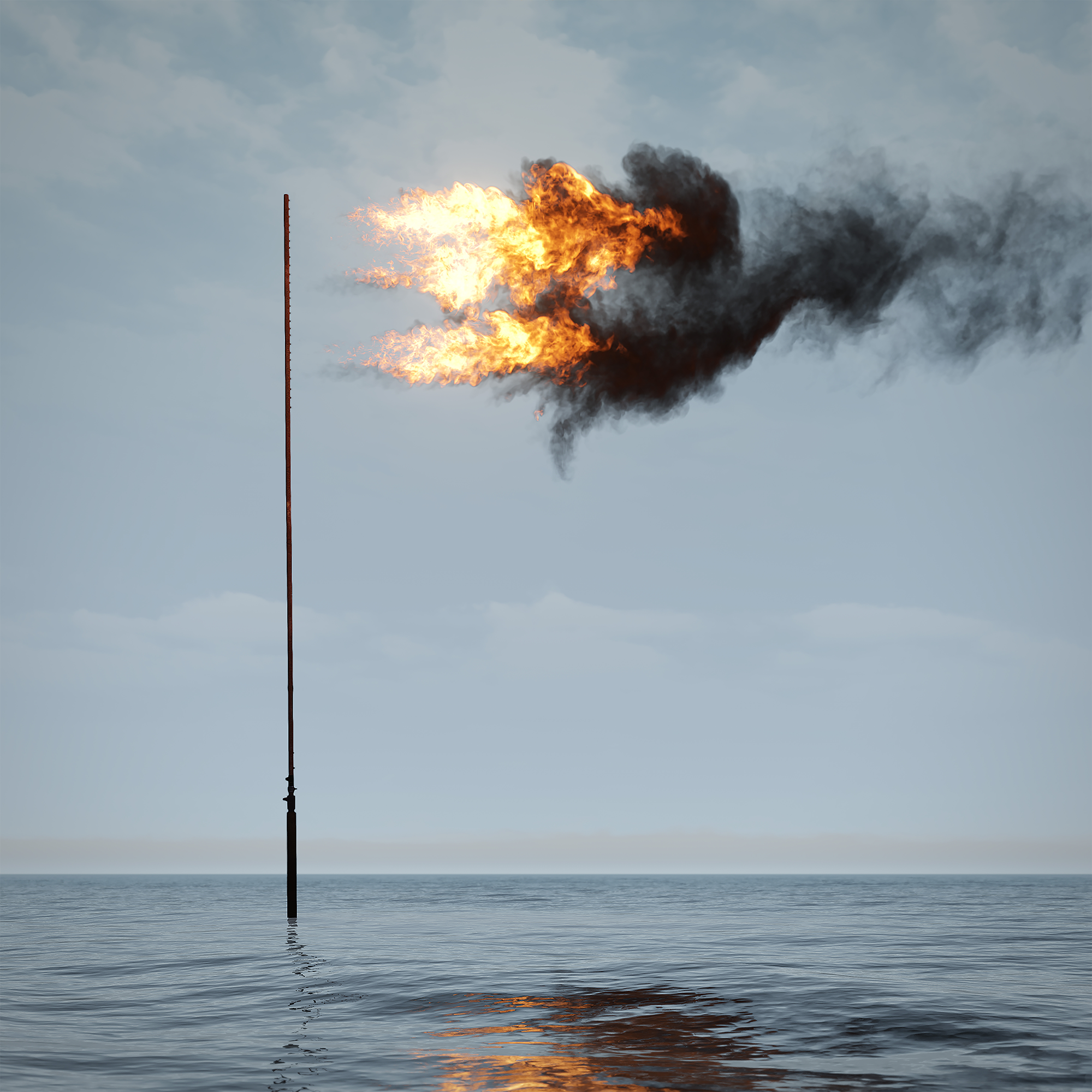
Opposite, a large LED screen displays john gerrard’s Flare (Oceania) (2022), a hyperrealistic animation of a gas flare emerging from the sea, flame and smoke jetting, flag-shaped. Symbol of conquest or surrender, the blazing flag gestures to debates around fossil fuels and nationalism. By the mid-1970s, shale mining had largely stopped, but North Sea oil was booming and the Scottish National Party rose to prominence with the slogan ‘It’s Scotland’s Oil’. By placing Flare alongside Latham’s installation, derived from the latter’s engagement with a defunct energy industry during this period, Extraction reframes our current transitional moment. What new ruins will be left behind in the pivot away from fossil fuels, and how will they shape our relationship to place and nationhood?
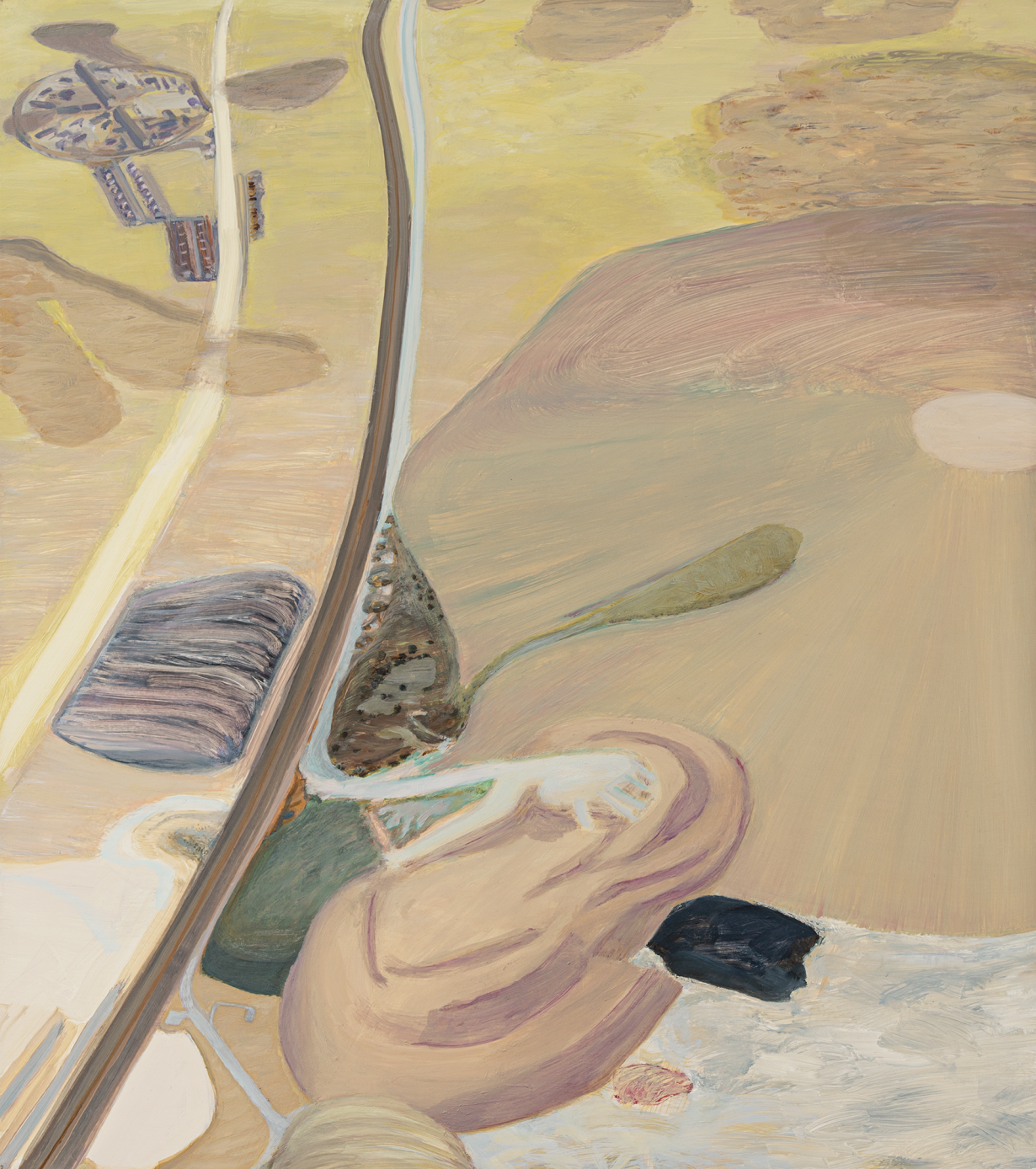
The late Carol Rhodes’s uncanny horizonless landscapes depict areas marked by extraction and its infrastructures. In Deposits (2009) a curving road stretches across the canvas, bypassing barracks, slag heaps and other undefinable manmade structures. Rhodes’s patient brushwork and flowing districts of colour display a sincere affinity for the specific emotional qualities of industrial edgelands. The handwritten notes scattered across the large preparatory drawing Untitled (2005–07) witness her meticulous planning of these fictional vistas, synthesised from various sources. Against Rhodes’s eerily cool palette, the earthy tones of Siobhan McLaughlin’s paintings are relatively plain. Using pigments made from ground shale and stone, McLaughlin paints blocky, abstracted landscapes on canvases patchworked from discarded fabric scraps. Rooted in waste materials, their frayed edges and rough textures look towards forms of life that unexpectedly emerge from terrains ravaged by industry, like the small purple buds of Pioneer Species (2025) – a reprise of Latham’s ‘vanished species’ emerging from the dirt.
Given the resonant dialogue between these cross-generational practices, it is difficult to see where Marguerite Humeau’s amorphous natural forms fit in. The handblown glass cones of The Brewer and the chain of bulbous beeswax slabs in The Honey Holder (both 2023) feel plucked from another, all-too-familiar show about the generalised Anthropocene, out of kilter with a selection of works that cannily reckon with the cultural and political impact of one-and-a-half centuries of industrialised extraction in Scotland. Seen together, the practices in Extraction sift through the waste products of their respective presents, assessing and adapting as the landscape is slowly overturned.
Extraction is on view at Jupiter Artland, Edinburgh through 26 July
From the Summer 2026 issue of ArtReview – get your copy.
Read next Eco Exhibitions Won’t Save Us