La Alegría de Vivir is unequivocal in its message, that war and violence are now continuous conditions rather than exceptional events
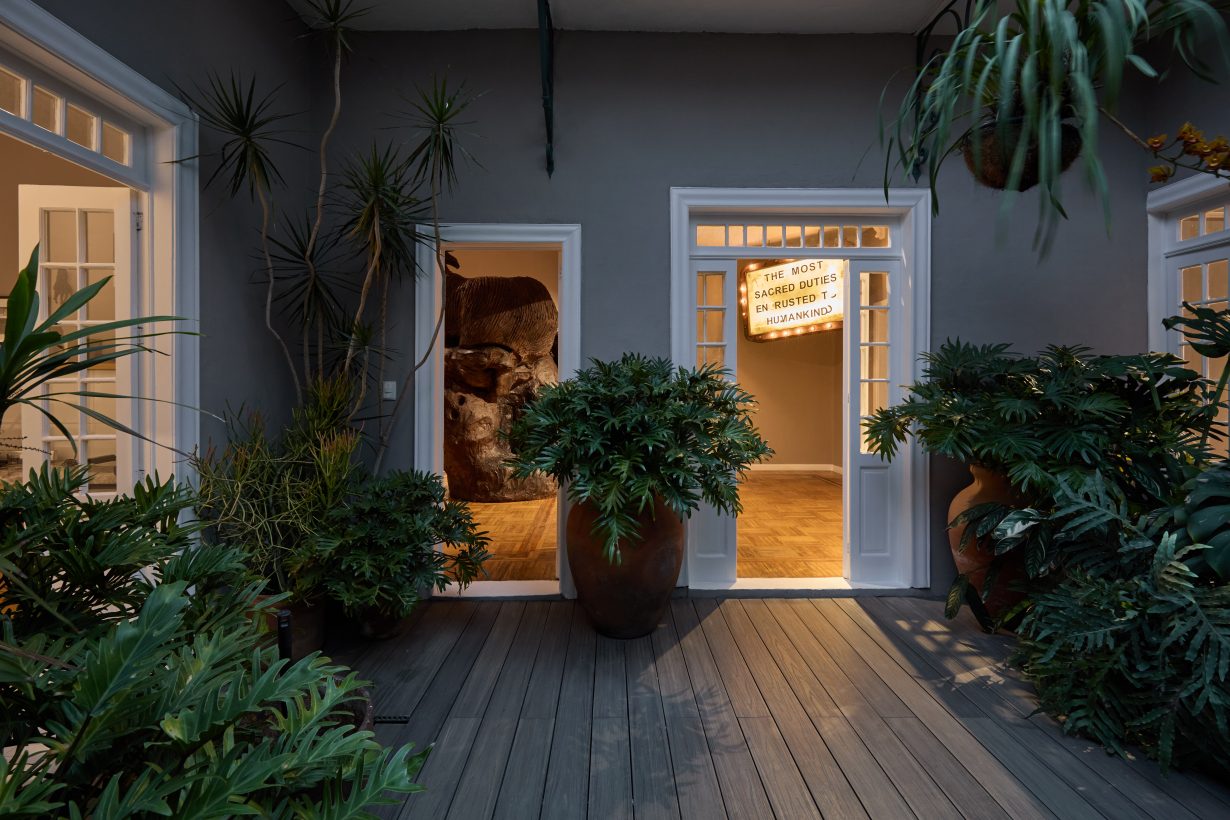
As one sets foot into Anuar Maauad’s sundrenched courtyard, it’s clear that this is no half-baked, fit-in-a-suitcase kind of Mexico City art-week popup show. At the top of the entrance stairs, surrounded by greenery and Acapulco chairs, stands Jorge de León’s Guillotina (Guillotine, 2015), a remake of a functional one that the artist once installed as a protest outside Guatemala’s National Palace, a day after the general elections and general unrest of 2015. The piece sets the mood for an exhibition, cocurated by artist and collector Maauad and artist Roger Muñoz; equal parts ambitious and sinister, bringing together exceptional works that raise the question of necropolitics, the prosaic and undignified management of life within current and past systems of power.
The show is smart, even elegant, especially in the choices it makes around depictions of violence. A first gallery is taken up by Benjamin Orlow’s sculpture Ritual City (2025): a hulking brown mass barely shaped as a deformed torso, its big head digging into its hollowed-out chest as its unshapely arms rest heavily on the floor. Next to it, Maaud’s own work from 2026, a rusty, run-down marquee missing a few of its lightbulbs and letters forming the titular words ‘THE MOST SACRED DUTIES ENTRUSTED TO HUMANKIND’, is the centre of a grouping completed by Miguel Ángel Rojas’s celebrated photograph David IV (2005) – a monochrome photoportrait of a young and beautiful Colombian farmer, victim of a quiebrapatas – antipersonnel mines that dotted the landscape in Colombia’s long-lasting internal conflict. ‘David’, like his more famous referent, stands on his remaining right leg, his left elbow flexed so the hand rests on the same shoulder, his gaze focused slightly to the side. The lifesize print is remarkable: light, composition, the classical proportions of the model and the dignity of his beauty come together in a truly timeless image.
The rest of the show is surprising and impeccably installed. Few remember – and I had never seen – Berenice Olmedo’s early Bienes muebles o bienes mostrencos: La jerarquización de la vida (Personal Property or Unowned Property: The Hierarchisation of Life, 2017), hanging humbly in a corner: a hooded jacket, a messenger bag and a pair of boots, all made out of the honey-coloured fur of run-over stray dogs that the artist collected, skinned and treated to make the piece – striking, hideous, its message aggressively succinct. Miguel Ventura’s installation is a standout: an abridged version of his Cantos cívicos/NILC (Civic Cantos /NILC, 2008) here covers the room with original portrait photographs of Nazi officers, made ridiculous by their oversize, toylike plastic frames, the men in them as small and clownish as their project was evil. A sad stuffed vulture overlooks them. The last gallery keeps up the gambit: Shit Face (2002) is a crude, malformed silicone bust by Paul McCarthy, with fragile tentacles that dangle precariously as one walks around it; next to it a tiny screen plays Pier Paolo Pasolini’s Saló, or the 120 Days of Sodom (1975), the oft-banned, gruesome critique of fascism that premiered after his murder; and finally, Teresa Margolles’s Catafalco (Catafalque, 1997), a plaster torso cast from one of the many dead bodies that fill Mexico’s morgues, X-shaped stitches indented from belly button to neck.
So the show is relentless in its message: that war and violence are now continuous conditions rather than exceptional events, and that perhaps this has been the case for a long time. Yet La Alegría de Vivir is never preachy or crass. With so much terrible beauty and humour in it, one can’t help but be thankful for a breath of blunt honesty during an already brutal year.
La Alegría de Vivir is on view at Estudio Anuar Maauad, Mexico City, through 30 June
From the April & May 2026 issue of ArtReview – get your copy.