Political dissidence, enshittified film, ambient sound-gardens – ArtReview editors on the off-site pavilions and exhibitions not to miss at the 61st Venice Biennale, running from 9 May through 22 November 2026
Li Yi-Fan: Screen Melancholy
Palazzo delle Prigioni
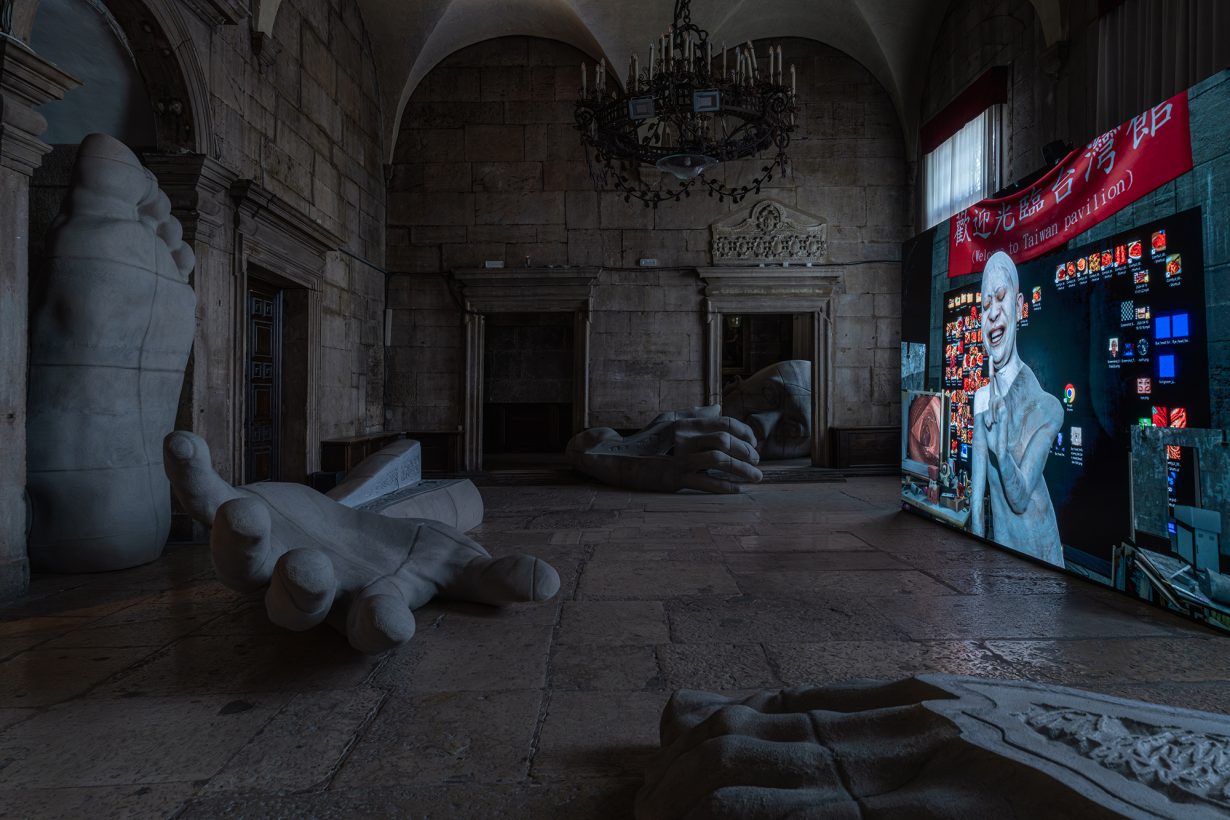
A nameless figure, naked but crotchless, flesh pasted an ashy white, jitters in the middle of a room. Over the course of this 60-minute film, he (?) gives a frenzied lecture on digital colour frequencies; orchestrates a seated banquet for each of its own organs; explains AI image representation while casting shadow-puppets on a wall. That’s Li Yi-Fan’s approach to ‘artmaking in the enshittosphere’, a phrase coined by Travis Jeppesen in his ArtReview Asia feature on the artist. In this new film Screen Melancholy, shot using a free-trial videogame engine on a set resembling the Palazzo it is screened in, Li puppeteers his character via motion capture technology, pulling and pushing it into position in realtime while digitally removing his own figure – the artist as both god and ghost in the system. While Li’s camerawork riffs off the homemade style of bunker insurgents and (Batman’s) Joker ransom videos, his character is otherwise endearing: smiling awkwardly and extremely, stammering and stumbling, a digital bambi in the setlights. There’s not much in the way of narrative, as Li instead drags us through this character’s madcap thoughts as we indulge in its absurd, hilarious chaos. Is this what will become of us, Li wonders: deranged, passionate lunatics made isolated and mad by the onslaught of advancing technology? Somehow, nothing else at this year’s biennale felt so real. Alexander Leissle
Roberto Diago: Free Men
Pavilion of Cuban Republic, Il Giardino Bianco – Art Space
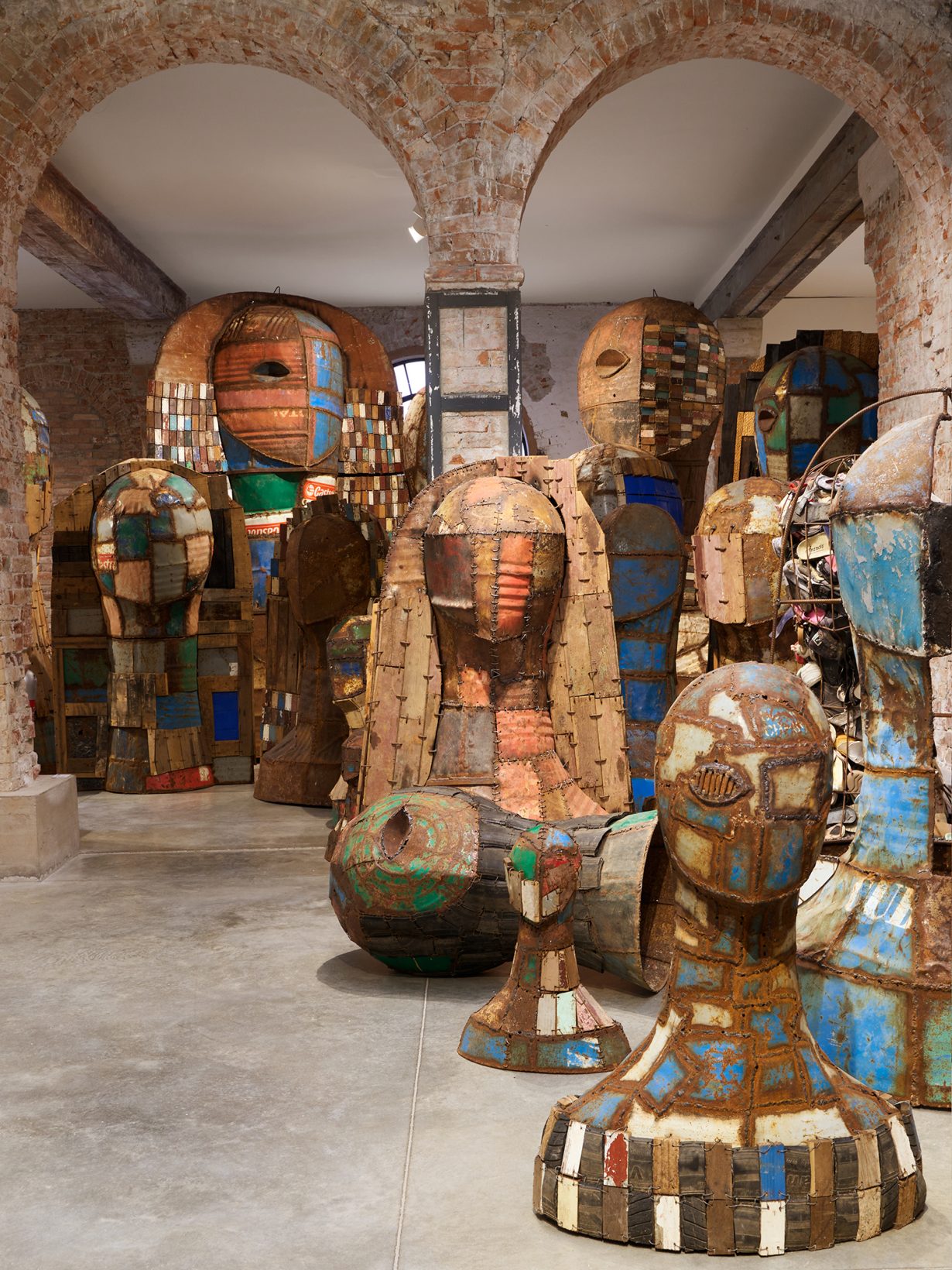
Roberto Diago’s Cuban Pavilion brings together rusted iron heads, fragmented wooden figures and small birdhouse-like structures that recall the structures of a shrine, shelter or prison cell. Installed within the rough brick architecture of the Venetian space, the works carry the appearance of things salvaged after collapse: weathered surfaces, patched timbers and bodies assembled from scraps. Throughout the exhibition, Diago returns to the human figure as both witness and survivor. Some sculptures resemble masks or sentinels; others appear burdened, anonymous, silenced. Text works spelling out phrases such as ‘El sistema no nos quiere’ (‘The system does not want us’) leave little ambiguity about the political charge of the exhibition.
The pavilion arrives at a time when Cuba continues to face military threat from the US (whose own pavilion is a stone’s throw away in the Giardini), a collapsing infrastructure, fuel and food shortages – not to mention international scrutiny over the detention of its political prisoners following the mass protests of July 2021. Earlier this year, the Cuban government renewed promises to release a number of detainees, presenting the move as a humanitarian gesture, yet rights groups and activists have pointed to the limited scope of the releases, the continued surveillance of dissidents and the re-arrest or intimidation of some protesters after their release. One of the exhibition’s strongest works stages this tension directly: a rusted bust positioned within a recessed brick chamber, over which the shadow of a barred window falls like a prison grille. There is a peculiar kind of friction at work in Free Men, which operates within the framework of Cuba’s national pavilion (the country’s culture ministry has given the exhibition its stamp of approval) while being produced entirely by the commercial gallery Artizar – reflecting the economic pressures and institutional contradictions that challenge Cuban cultural production today. The result is a pavilion that neither functions as straightforward state propaganda nor as fully autonomous critique; instead it exposes the uneasy compromises through which freedom of expression in Cuban art is able to circulate internationally. Fi Churchman
Canicula
Complesso dell’Ospedaletto
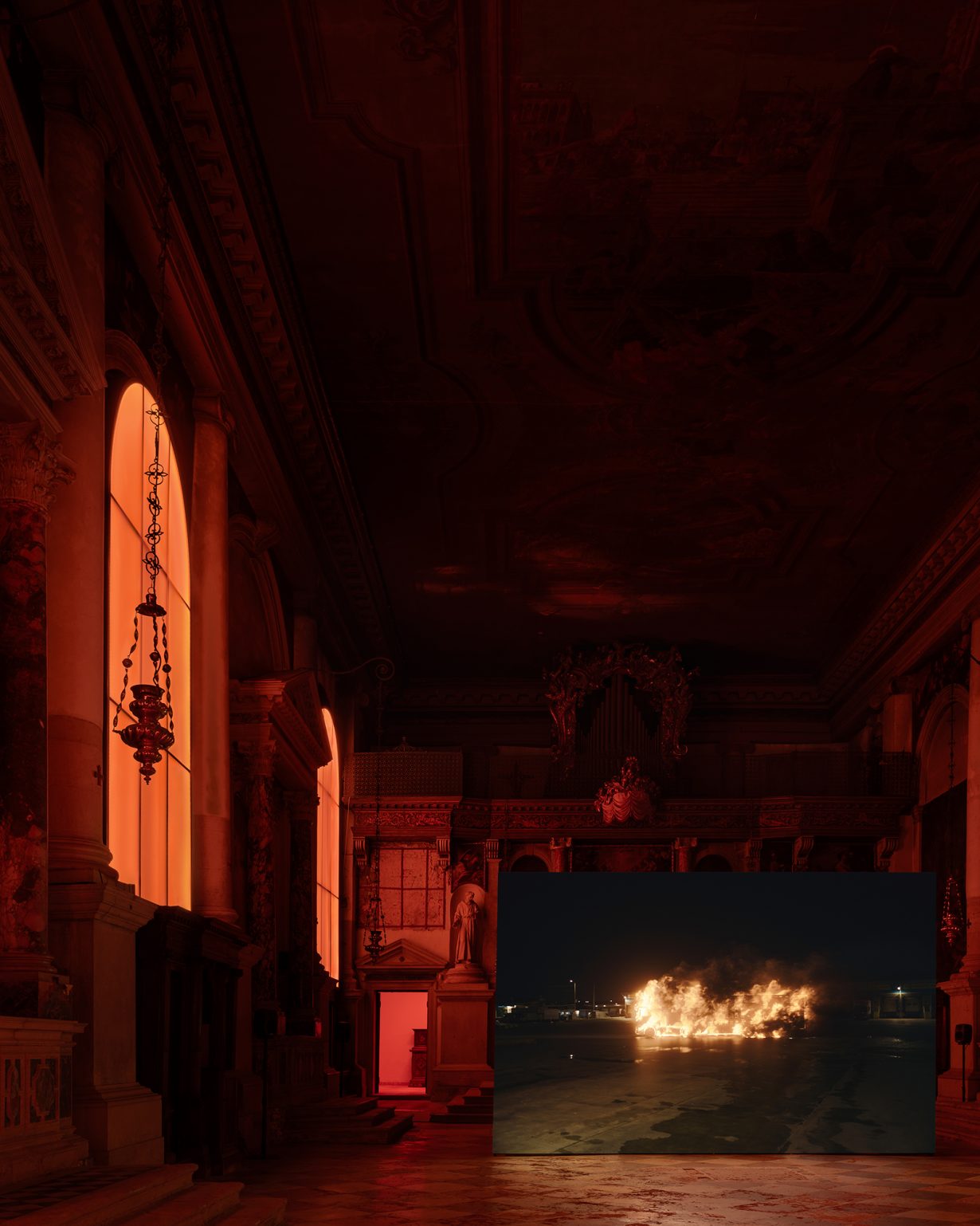
Did the Complesso dell’Ospedaletto even exist before Fondazione in Between Art Film established a biennial residency in its chambered, mazelike premises – accessed through a church, passing through a former hospital and ending in a nondescript courtyard, with unpredictable throughlines, frosted windows, blind hallways, locked doors, heavy curtains, a dramatic spiral stone staircase and atmospheric video installations – four years ago? Will it exist after the Fondazione has left? Canicula, translated as ‘dog days’ and referring to the feast or famine of high summer, is a showing of moving-image installations by eight artists and artist pairings. It is the final chapter in a series titled The Trilogy of Uncertainties, following Penumbra (2022) and Nebula (2024), and opens with Janis Rafa’s Baby I’m Yours Forever (2026) – like all of the works here a site-specific commission – consisting of stark, unsettling scenes set in a meat storage facility and scored by the low-frequencies of machinery at work. In subsequent spaces and half-spaces, darkness, strobes, washes of light and sound emanate from installations by Yuyan Wang, Massimo D’Anolfi and Martini Parenti, P. Staff, Lawrence Abu Hamdan, Wang Tuo, Maya Watanabe and Roman Khimei and Yarema Malashchuk, each resonating with the physical and metaphysical implications of the setting. Such is the fit between form and function, such the intrigue of the films and the staging of the space, that I am already mourning the fact that a fourth instalment will not be on the menu for Venice 2028. David Terrien
Official. Unofficial. Belarus.
La Chiesa di San Giovanni Evangelista di Venezia, San Polo
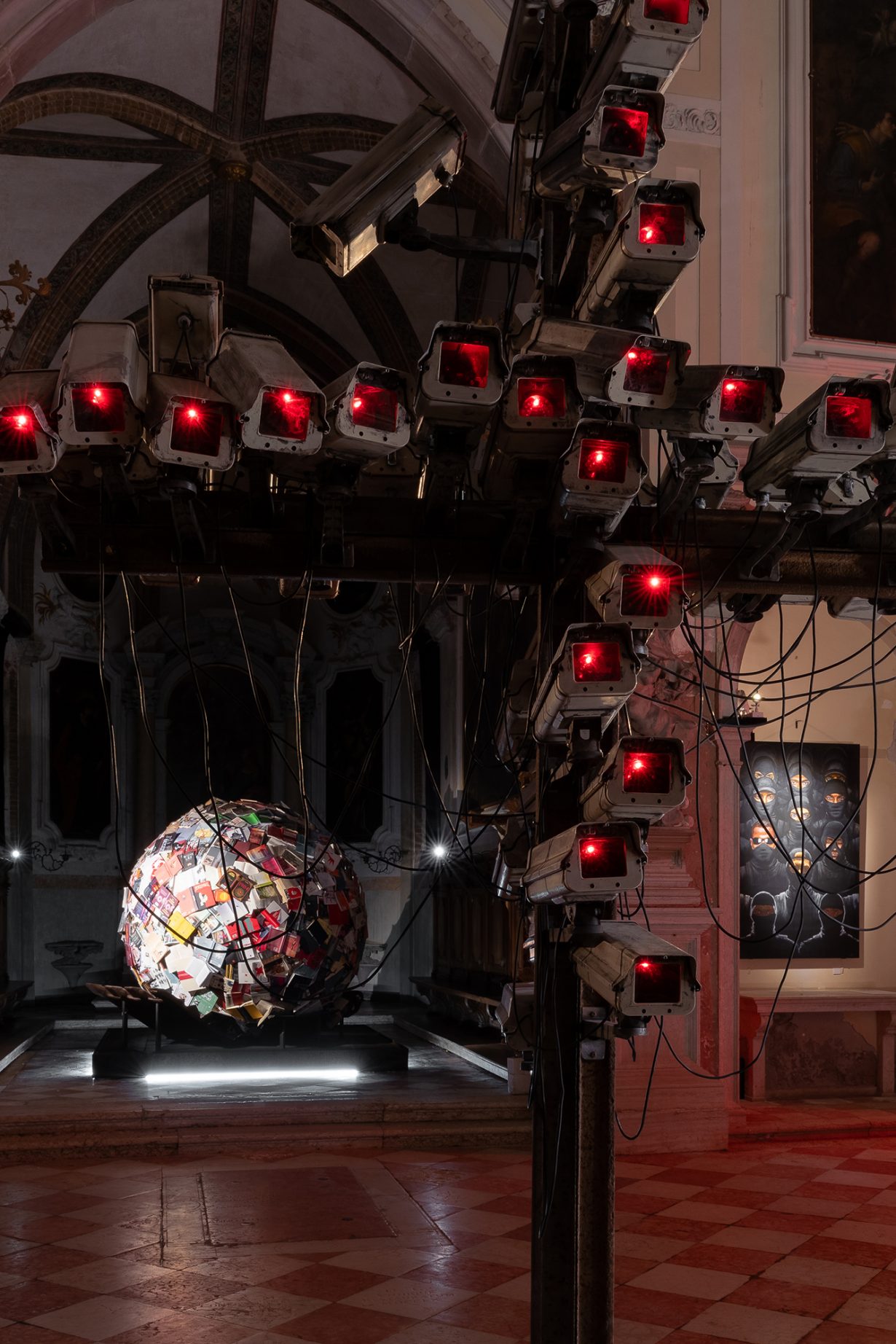
If the Biennale preview week was marked by the fury of protests against the participation of Israel and Russia, less attention was paid to the fact that the Biennale chose to recognise some artistic and political dissidents among the official ‘collateral’ presentations. Official. Unofficial. Belarus. is a dark, disquieting group show in a low-lit eighteenth-century baroque church, organised by the exiled Belarus Free Theatre, banned in Belarus by the government of de facto dictator Alexander Lukashenko. Perhaps it’s no surprise that much of the work is a stark visual polemic against state surveillance and censorship; you’re greeted by a Surveillance Crucifix (by Daniella Kaliada and Natalia Kaliada), a huge cross made of CCTV cameras, red LEDs glowing like eyes, while nearby Nicolai Khalezin’s Dogs of Europe is a 2.5m sphere composed of books banned in Belarus. All around the church are boldly figurative canvases by Sergey Grinevich, dystopian visions of ranks of crouched naked figures, their backs taut and scarred, or contemporary revisitings of Jesus on the cross, itself mounted with cameras. Then, in the privacy of the church’s confessional booth you sit and watch multiple CCTV screens monitor your fellow visitors outside, while watching yourself being watched by facial recognition software, busy mapping your features and assessing you against various security criteria; a nod to the mass arrest of protesters in 2020, and the recent persecution of priests calling for the end of Russia’s war on Ukraine. These are unsubtle works, whose bleak message rails against Belarus’s current authoritarianism. Though here such expression is sanctioned by the Biennale, which asks, from another angle, the familiar questions about if, or how, an institution like the Biennale should take sides.
Aside from the more bombastic works, in an anteroom is an installation of a field of wheat. Above it hang diamond-shaped rebar sculptures by Vladimir Tsesler, a reference to traditional Belarus folk-amulets hung to ward off evil. In the air are spoken-word testimonials of, we’re told, released Belarusian political prisoners, voiced in English by actors. These fade away to silence as you approach the speakers. As an ensemble it’s a subtle, shifting experience, evocative of loss and displacement. These are works by exiles about exile, but also about what a nation is, what there is worth returning to, and the difference between regimes, countries and their people. JJ Charlesworth

The Ear is the Eye of the Soul
Holy See Pavilion, Giardino Mistico dei Carmelitani Scalzi
The overarching dedication of the musical works in the Holy See (aka the Vatican) pavilion is to the Benedictine abbess Hildegard von Bingen (1098–1179), poet, healer, composer; of recent fame in Holly Herndon & Mat Dryhurst’s Starmirror and Rosalia’s LUX (both 2025). You’ll know that from the exhibition text, but otherwise the experience is ambient. You’re handed a pair of wireless headphones on arrival. There’s a device like a shoe-tongue on the headband, which connects to a spatial tracking system to follow your movements around the space and accordingly deliver the 19 recorded musical works you will hear as you move into various zones around this sequestered garden. It’s raining a little, so my set has a little clear plastic shower cap on it. As you pass through each zone, you hear everything from new age master Laraaji’s playful pianowork, all double-stabs of descending polyphonic chords performed by a hand trembling with excitement; Kali Malone’s masterful command of the organ, exacting tension and release from long-drawn, mournful tones; Devonte Hynes’s Reichian minimalism, chords pinballing off each other on sixteenth-notes to euphoric effect; and Brian Eno doing a bunch of Brian Eno. The emphasis is on a personal experience of listening, perceiving and receiving, but as I move around the garden, inhaling the flora and fauna, I can’t ignore the relational aspect of it all: am I following this person too much? Why are they walking the opposite direction to me? Should I go there too? Is the scratch of gravel under my feet disrupting them as it is me? Of course, that’s probably where the ‘minor keys’ of this year’s Biennale might take us: somewhere square between the world within and the one all around. And then the church gets the bill. Alexander Leissle

Tawna & Oscar
Ecuador Pavilion, Castello Gallery
The collective Tawna and the artist Oscar Santillán present works shaped by memory, ritual and transformation across Andean and Amazonian territories. Tawna’s films move fluidly between dream and waking life, asking how colonial violence ruptured older systems of knowledge and relation. In Kawashima (2026), a disembodied voice recounts a world in which “the veil between the worlds” was broken, destroyed by a “cannibal people” whose “breath contaminated everything… they killed our language.” Images of clay vessels, dense palm forests and bodies folded into earthen forms appear alongside a soundtrack of tropical forest, the scraping noises of clay dragged across the floor and the sound of death gasps. In one scene, a baby lies at the bottom of a clay pot as a bodiless voice insists: “We come from the dream, we are dream made flesh.”
Llaki (2026), meanwhile, centres queer and warmipangui (a complex Kichwa-Canelos term that describes a third gender) experiences in the Ecuadorian Amazon. Military footage is intercut with scenes of two warmipangui embracing beneath a tree while discussing machismo culture and the violence directed toward effeminate bodies. Close-up shots follow manicured nails shaping clay or delicately stroking skin; in a forest, several warmipangui laugh together over a fermented drink while discussing transformation, deities and the way Christianity imposed rigid gender binaries onto cosmologies that once understood identity as fluid and relational. “The West did not know how to look without judgement or desire,” they reflect.
While Tawna’s films root themselves in Indigenous cosmologies and embodied communal knowledge, Santillán extends these concerns outward into speculative and planetary space, producing a kind of tension between ancestral knowledge systems and technological futures. In the sculpture Placenta (2026), for example, stripped computer motherboards resemble geological fragments. Medulla (2026), meanwhile, constructs what the artist describes as a sculptural ecology populated by hybrid animal-plant forms, comet references and tubes containing speculative ‘alien DNA’. They all imagine life as something mutable and planetary rather than purely material. Fi Churchman