Naked piss-tank dancers; Wohnung dioramas; monuments to massacre and more – ArtReview editors on the national pavilions not to miss at the 61st Venice Biennale, running from 9 May through 22 November 2026.
Austria
Florentina Holzinger: Seaworld Venice in the Giardini
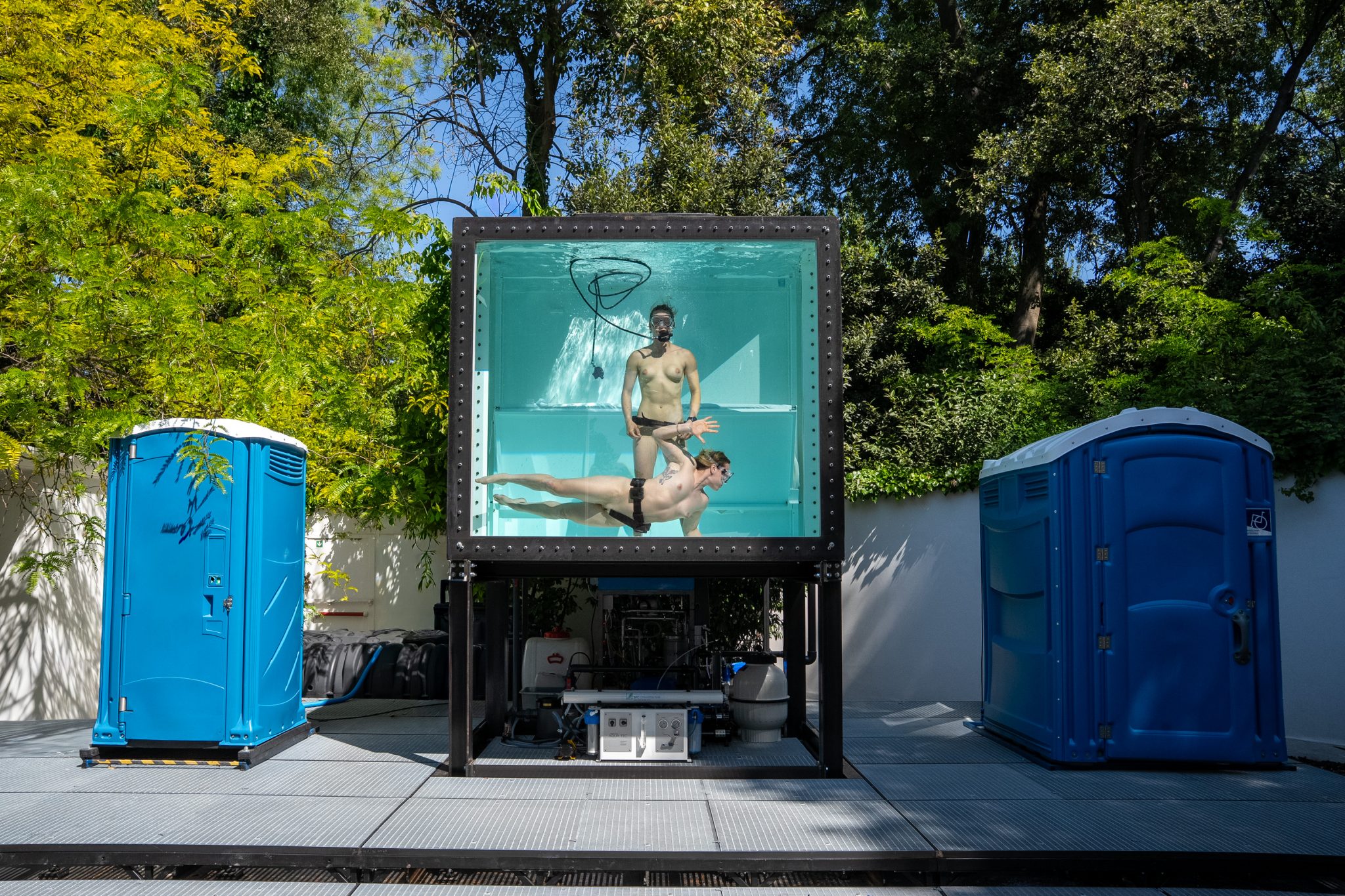
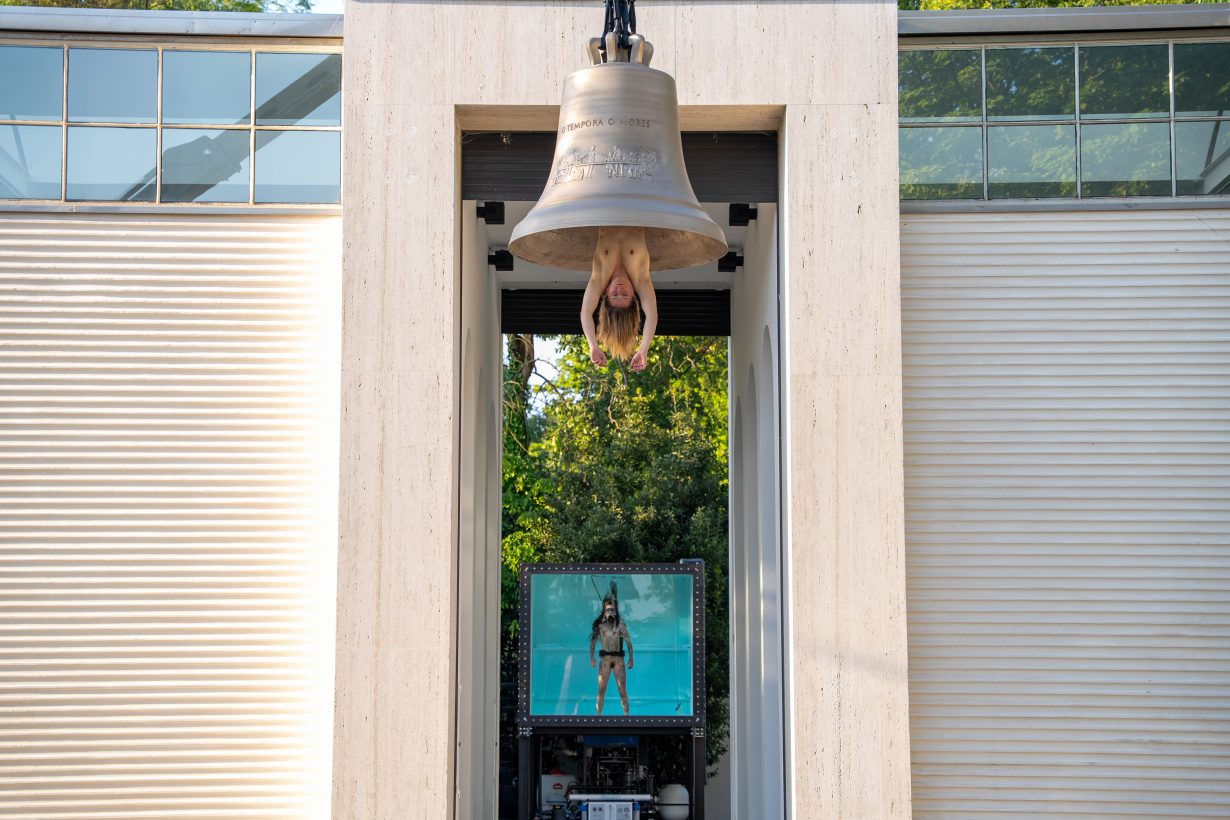
Seaworld Venice combines an extension and critique of Viennese Actionism (a male-dominated performance art movement from the 1960s and 70s), a commentary on the entanglements of people and nature, a blurring of the distinctions between high and low culture, and an assault on the pavilion’s listed architecture – which Florentina Holzinger has turned into a toilet and sewage-treatment plant in which a series of naked female performers are living. Better known in the worlds of theatre and dance, the Austrian’s productions are famously brutal. (The New Yorker described one early work as a ‘feminist freakshow’, while other productions have led to audience members fainting and vomiting.) Here however she simply asks visitors to take a piss, in one of two portable toilets, the product of which circulates through the pavilion’s chambers in a manner that mimics the water exchange of the Venice Lagoon’s tidal cycles. And our pollution of them. That effluent provides the artificial ‘sea’ in which her troupe of nude performers shockingly frolic (there’s a jet ski among other props). It’s a brutal reminder of what we are and what we’re doing to the planet (and Venice’s tourist-saturated waters in particular). Look out for human bell clappers and a series of offsite ‘études’ (involving, during the biennial’s preview week, a nude all-female punk band performing in the rain, while a performer swung from a crane, suspended by what looked like flesh hooks) that extend the argument. And, make no mistake, what makes this pavilion stand out in this year’s edition is that it has one to offer. Nirmala Devi
Germany
Henrike Naumann, Sung Tieu: Ruin in the Giardini
The architecture for the fascist-era neoclassical German Pavilion didn’t allow for many windows; Sung Tieu has given it some. The artist has adorned the building’s exterior with a to-scale mosaic design of the balconied windows from the artist’s former home, a prefabricated socialist housing block in East Berlin currently slated for demolition. Inside, Tieu has infested the walls of one gallery with small aluminium recasts of chocolate ladybirds and staged a series of refined aluminium structures that arrange and rearrange the outline of her mother’s body – as if, faced with the impossibility of measuring maternal love, she turns instead to the body that carries it. Among them, aluminium bars on the floor contain cutouts measured to Tieu’s neck and wrists, like a pillory. It’s an astoundingly beautiful approach to conceptual minimalism.
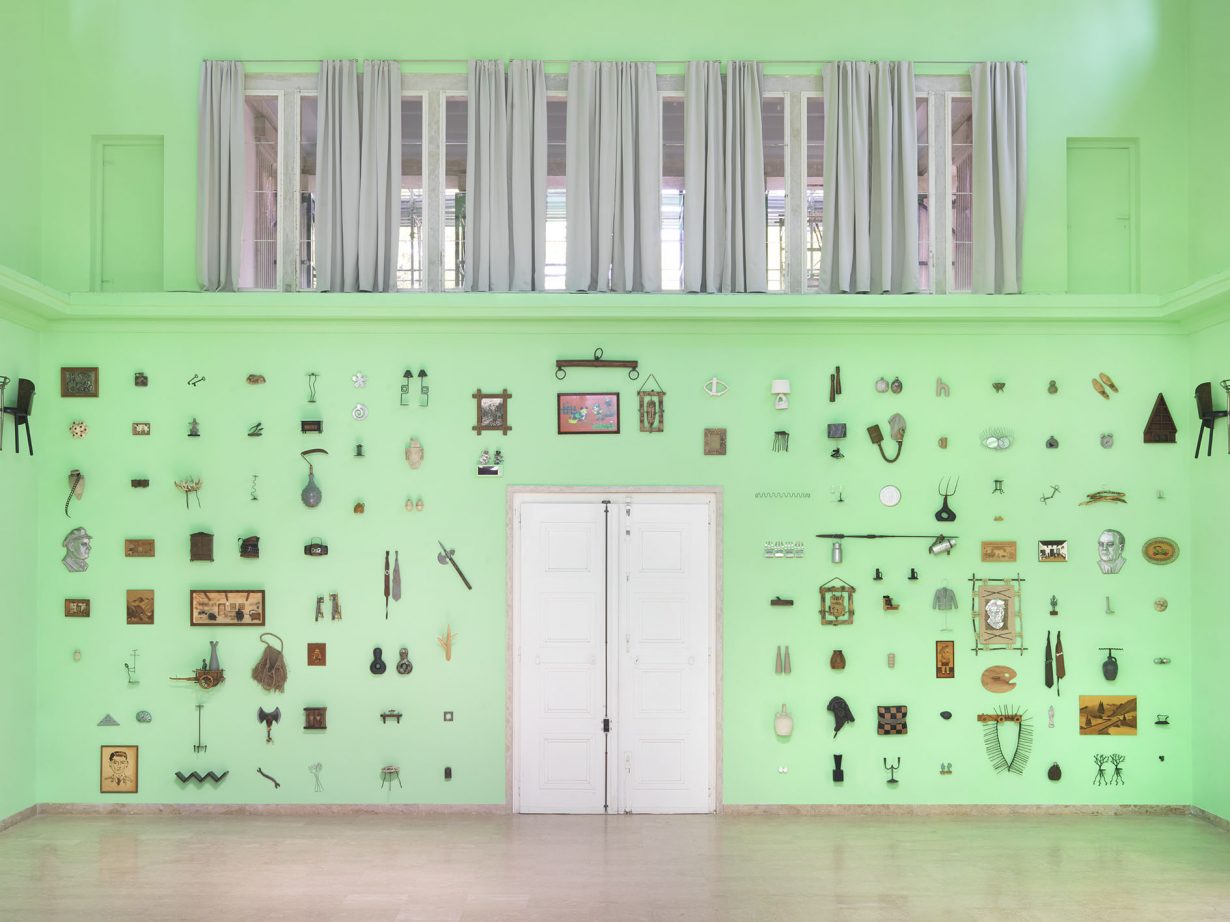
The windows the pavilion does have are curtained by Henrike Naumann. The light shines between the gaps and tatters of various drapes in the washed-out colours typical of East German houses. In the pavilion, the artist, who died in February with her work for Ruin mostly complete, renders the world she remembers growing up in Soviet Germany. A series of midcentury chairs, cut in half and attached to a wall as if partially submerged into the marble, line the upper skirting of the pavilion’s central space; a farmhouse diorama of West German furniture fills another wall like a fake showroom. The space is painted a minty green, in reference to that typical of Deutsche Demokratische Republik military barracks, but also like a green screen, as if to say: imagine you aren’t here.
Two things are happening here: artists from outside the German ‘centre’ are pulling their own centres into view, along with all of the associated absurdities, sufferings and hauntings they carry; in doing so, they expose the bizarreness of these long-venerated power structures. Alexander Leissle
Denmark
Maja Malou Lyse: Things to Come in the Giardini
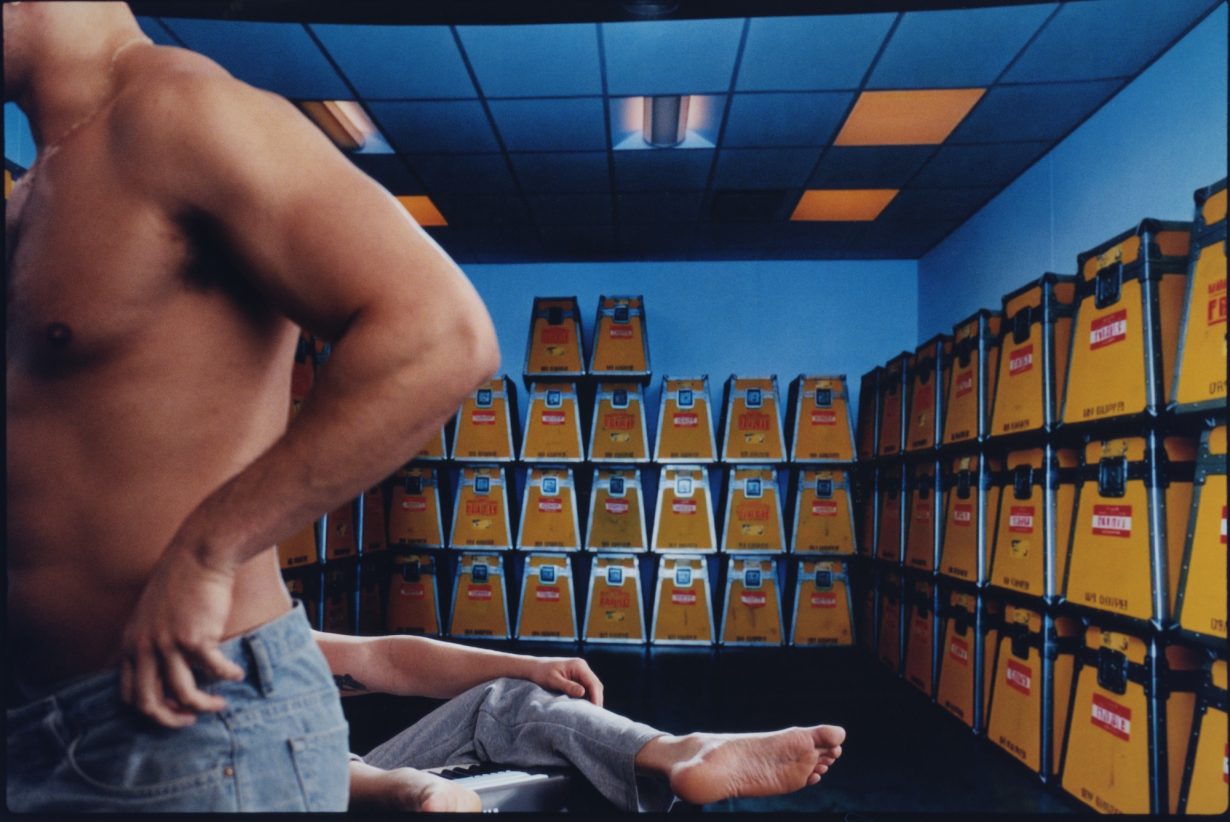
Maja Malou Lyse turns the Danish Pavilion into something between a luxury fertility clinic, a porn set and the waiting room of a biotech startup. Borrowing its title from William Cameron Menzies’s 1936 sci-fi film (written by H. G. Wells and set in a world in which a major war has broken out, and gone on for so long that no one knows why they’re fighting each other anymore), the exhibition imagines a future in which pornography and reproductive technology have merged in response to declining sperm counts and a creeping fertility crisis. Which, as it turns out, is not entirely speculative: one study found that watching VR pornography can increase sperm motility by up to 50 percent.
Lyse’s central film, projected onto the curved wall of the pavilion, unfolds inside a cryogenic sperm lab staffed by porn actors who drift through the space with the kind of detached serenity of persons already living several evolutionary steps ahead of the rest of us. Lyse leans hard into absurdity without tipping fully into parody. Among the film’s more serious and wacky scenes is one in which a woman turns to the camera and says, “Hey, I have something really important to say, so I’m going to take my clothes off while I say it, okay?” She then lists a series of awful medical side effects while stripping off, giggling and slapping her arse. At this point I become very aware of the men in the audience, who are watching these women stripping, running naked through a CGI forest, stuffing lettuce into their mouths and jiggling one another’s boobs via puppet strings, all while wearing very serious expressions fixed to their faces and definitely only assessing this work for its artistic quality. In another scene, a blonde woman presses her breasts against microscope eyepieces while a man plays the piano with his pecs, surrounded by sperm canisters, as though some sort of fertility lounge Liberace. Elsewhere, baby photos line sterile medical corridors, while all the adults also appear suspiciously free of body hair, hygienic and optimised.
In the second gallery, sperm transport containers, displayed in wall niches like holy relics, point towards a culture within the manosphere where reproductive anxiety has become both commodity and spectator sport. One of the exhibition’s recurring references is the emergence of ‘sperm racing’, a real online phenomenon in which male fertility metrics are transformed into competitive spectacle. Lyse’s point lands somewhere between bleak and darkly funny: late capitalism has exhausted almost every other frontier, and so in the end what cums around goes around. Fi Churchman
Timor-Leste
Across Words in the Arsenale
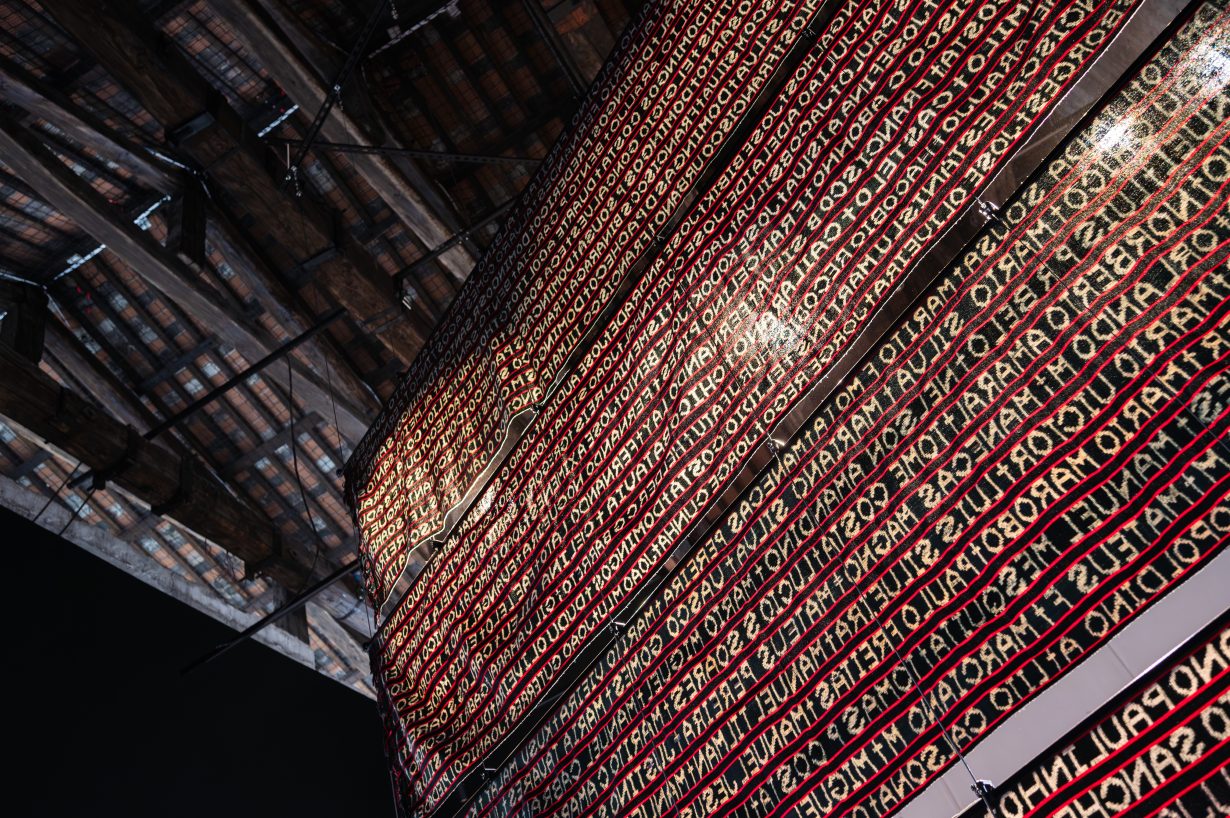
This is Timor-Leste’s second appearance at the Biennale, and its first in the Arsenale, following an offsite pavilion for Southeast Asia’s youngest country in 2024. The sound bleeding from a neighbouring pavilion hardly detracts, and arguably adds (certainly conceptually) to the experience of this powerful, well-balanced presentation, whose theme is the multiple voices and languages – oral, written and entirely visual – through which the culture of this island nation has been transmitted across centuries of colonisation and decades of occupation, into a continuously evolving present.
Verónica Pereira Maia’s Tais Don (1994–99), a five-panel textile work inscribed with the names of 271 people killed in a 1991 massacre during Indonesia’s 24-year occupation of the country, anchors the pavilion physically, morally and in time, its completion coinciding with the country’s independence referendum. Pereira Maia, now in her nineties, is joined by Etson Caminha, whose newly commissioned sound installation CUALE (Flow) mixes spoken and sung languages with soundscapes evoking both nature and culture. Juventino Madeira, the youngest of the artists, also presents a newly commissioned work, Fraze ne’ebe seidauk hotu (An Unfinished Sentence), a jumpy, layered multiscreen video installation featuring a charismatic female character who dances her way into the present, seemingly soundtracked by Caminha’s work and backstopped by Pereira Maia’s, the three overlapping with and enhancing each other in waves of looped meaning: cacophony emerging as polyphony. David Terrien
Uzbekistan
The Aural Sea in the Arsenale
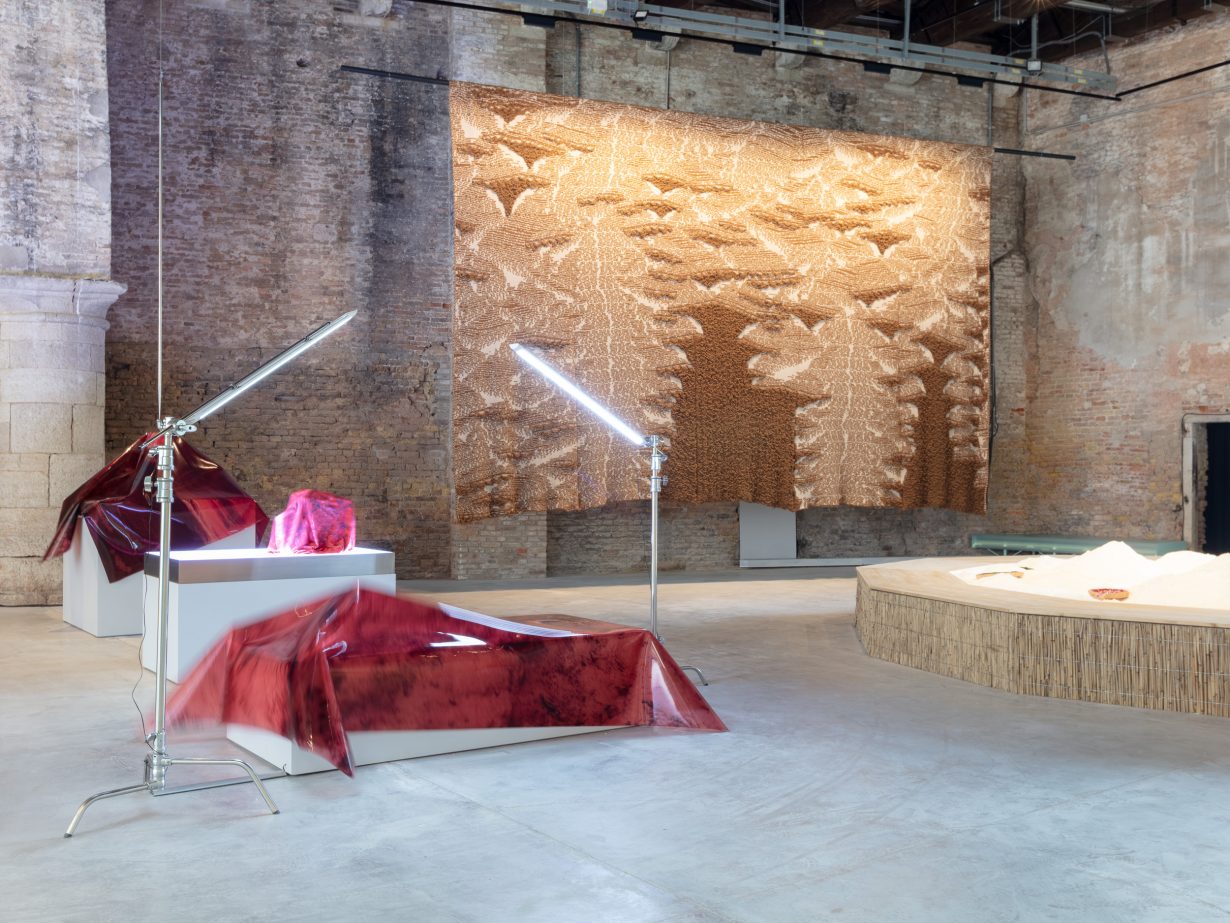
The Uzbekistan Pavilion gathers artists connected by the Aral Sea, once the fourth largest inland water before multiple Soviet government irrigation projects drove it almost entirely out of existence. It’s a topic that has been broached frequently in recent years (perhaps best by the remarkable Indigo Waves at Zeitz MOCAA in Cape Town and at Berlin’s Gropius Bau in 2022 and 2023), and this show continues that trend, finding waterways to connect lived experiences and environmental crises.
Zulfiya Spowart begins with carved woodblocks of sea creatures, working hands and ancient ships: in one, two hands are held out, the grain descending like palm creases. Nguyen Phuong Linh stages three animatronic mechanisms on light boxes, one of which features a silklike sheet that contorts and writhes as if concealing, or entrapping, a pair of dancers. Xin Liu’s distinctive enzyme tanks sustain life and yet couldn’t look more alien, cultures arranged by clear, straight-edged acrylic corals – less an aquarium than a farm. And Aygul Sarsen’s gouache painting Tús (Dream) reinterprets Picasso’s The Dream (1932): here, our central figure’s eyes are entirely white and dreaming, all-seeing; her weary arms are dashed with crude white crosshatch, like dried, scored fish skin. In the centre of the space, visiting children play in a sea salt pit by Zi Kahramonova, their hands powdered by fine saline grain like the ashes of water. I loved it all. Alexander Leissle
Slovenia
Nonument Group: Soundtrack for an Invisible House in the Arsenale
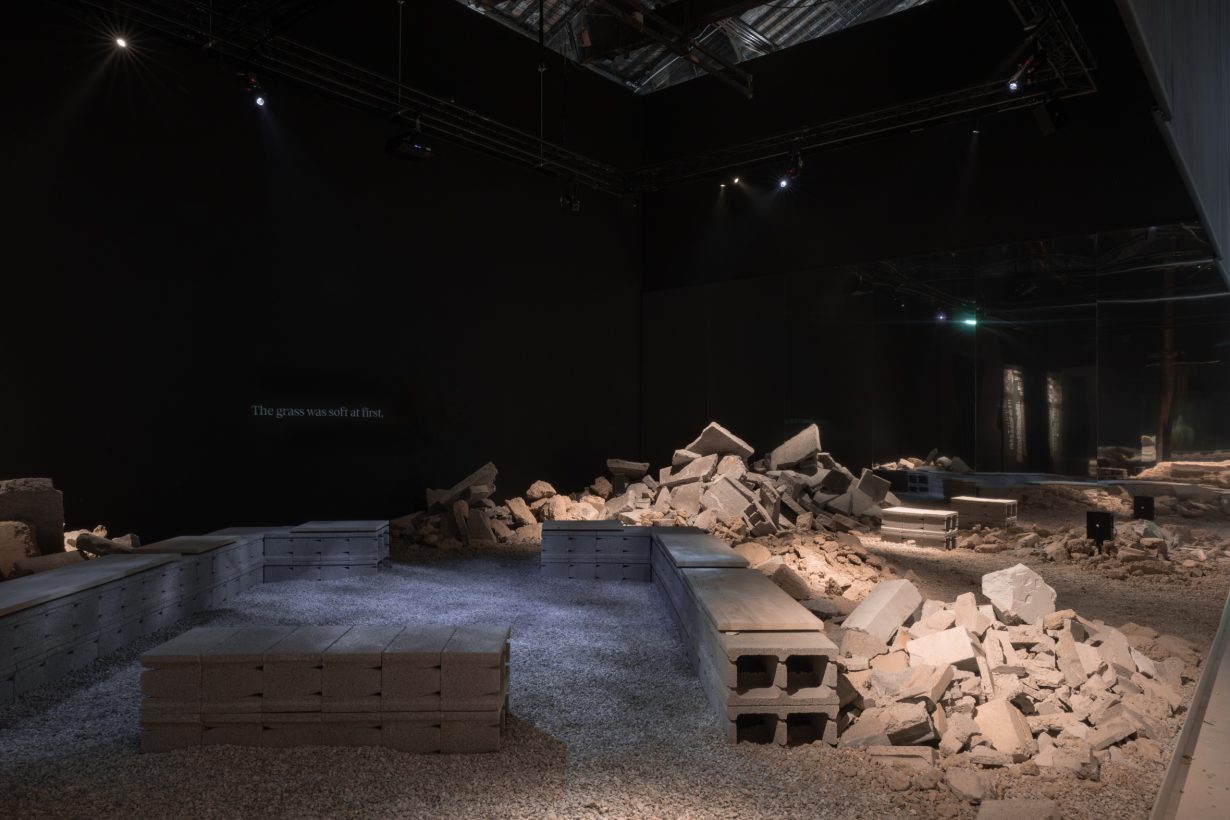
It is hard to tell whether I’ve become allergic to the flashiness and pomposity of the Venice Biennale, the visual excess and the general backslapping nature of the national presentations. Or if I’m just recovering from a cold. And so it is a balm to sit amid the rubble of the Slovenian Pavilion and view Soundtrack for an Invisible House. The Nonument Group has filled their space in the Arsenale with the crushed remains of the previous Architecture Biennale, turning the detritus of one exhibition cycle into the physical ground of another. It feels both practical and symbolic: an acknowledgment of the endless churn of cultural production, but also of history’s tendency to accumulate detritus, both in the material sense and in the way that messy, uncomfortable truths refuse to disappear. Mirrors at either end of the space extend this field of debris infinitely, implicating viewers within it.
The work takes as its point of departure the ruins of a mosque in Log pod Mangartom, built in 1917 for Bosnian Muslim soldiers fighting for the Austro-Hungarian army on the Isonzo Front. Little of the structure survives today beyond archaeological traces uncovered in recent years, yet the site has become the focus of competing heritage narratives, with debates over whether it should remain a ruin, become a memorial park or be reconstructed entirely. Rather than offering a resolution, the Nonument Group sits with the instability of the place itself, while inviting visitors here to sit, literally, among piles of concrete debris.
A soothing polyphonic soundscape drifts through the installation in Slovenian, Bosnian, Hungarian and Italian, interspersed with birdsong, and the sounds of wind and running water. This is not an attempt at reconstruction, but rather one of attunement: to contested memory, to the afterlives of empire and war, and to the uneasy question of how histories continue to inhabit the present long after their physical structures have vanished. Fi Churchman