Vatanajyankur’s recent work considers the subject of AI and its ramifications
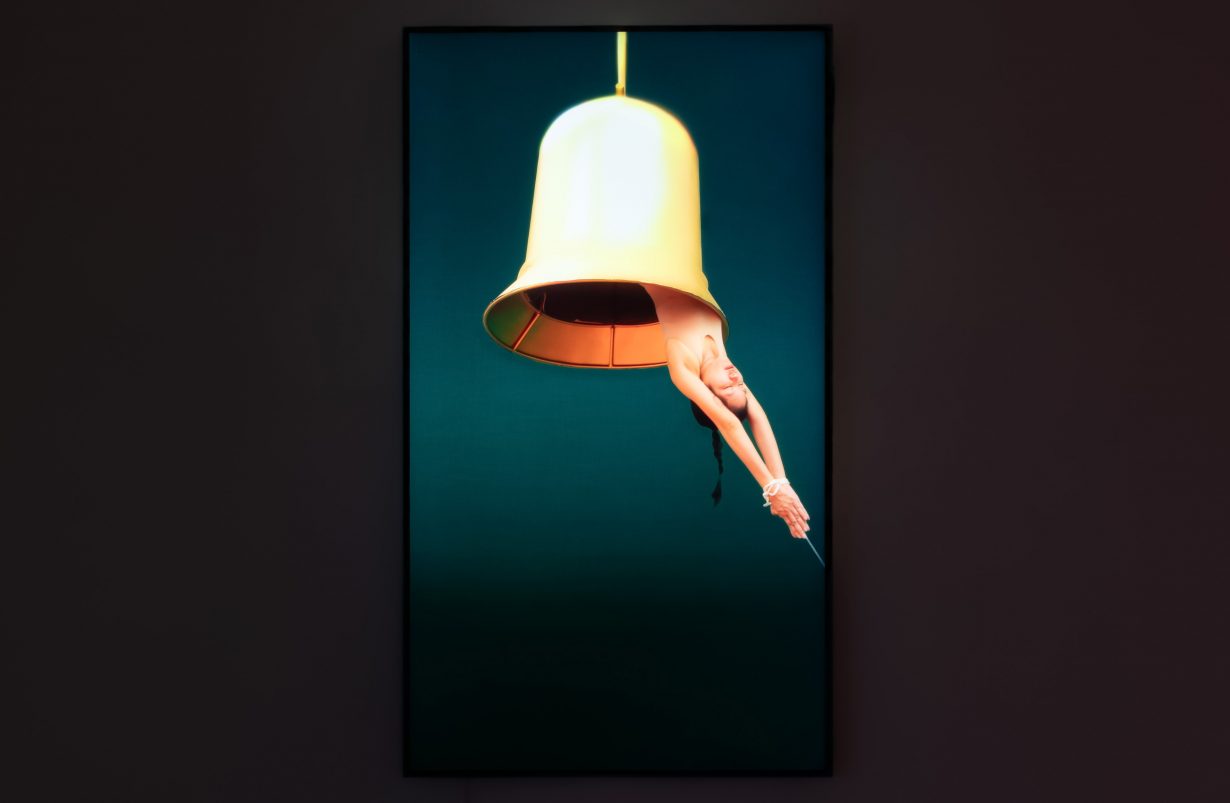
Judging from this mini survey of Kawita Vatanajyankur’s video-performances, she has no intention of vacating the dazzling dayglo universe into which her practice has bedded over the past decade or so. It is, after all, what gives her endurance art – which resembles bright, acerbic billboard adverts and reifies the societal oppression of female workers (and the objectification of women in general) – its sociocritical bite. Covering Nova Contemporary’s exterior window is a still from The Carrying Pole (2015), in which her carefully balanced and outstretched body holds two bamboo baskets of bananas aloft against a lurid pink background. And in a dark room inside are recent works such as Flight (2025), a lightbox still in which she is a loaded arrow presented against a solid blue, and Echoes (2025), a video in which she is a bell clapper being violently rung (in a manner not dissimilar to Florentina Holzinger’s recent Venice Biennale performance) against a deep green. But while the striking formal qualities of her work, her high-gloss backgrounds and commitment to machinic performances, appear largely unchanged, close watching – and listening – reveals a thematic bifurcation.
This fork in the road is most pronounced upstairs, where older works in which Vatanajyankur’s body mimics the relentless, repetitious movements of household objects or market tools in use – fruit scales, an egg rack, a textile spinning wheel – sit near a newer one in which she plays, well, herself. Or a dramatised avatar of herself: in the video installation The Machine Ghost in the Human Shell (2024), her attempts to draw concentric circles in chalk, while lying on a red surface with electrical cables fastened to her body, are disrupted by the debilitating jolt of an electric current. The discomfort etched on her face when her muscles involuntarily tense is real, the exhibition pamphlet points out – the product of ‘AI-powered electric muscle stimulation’.
Vatanajyankur’s recent shift towards the subject of AI and its ramifications appears to have prompted the addition of audio to her popping visuals: accompanying the crackle of electricity throughout this work is a speech written by AI. Voiced by her (in Thai for this iteration) is a screed about the prospect of a ‘machine-only world’ free of daft, feckless humanity. In it, you may well discern a hyperbolic, Haraway-esque commentary about how we are, more than ever, cyborgs in a metaphorical sense, becoming ever-more blended with search algorithms and LLMs. Or, given its eschatological tone, you might consider the work a stark depiction of Skynet vs. humanity: a future in which we might literally become puppets. Either way, while Vatanajyankur is typically machinelike, or treated like a machine, here she is operated by one, at once as a plaything, a mouthpiece and a guinea pig.
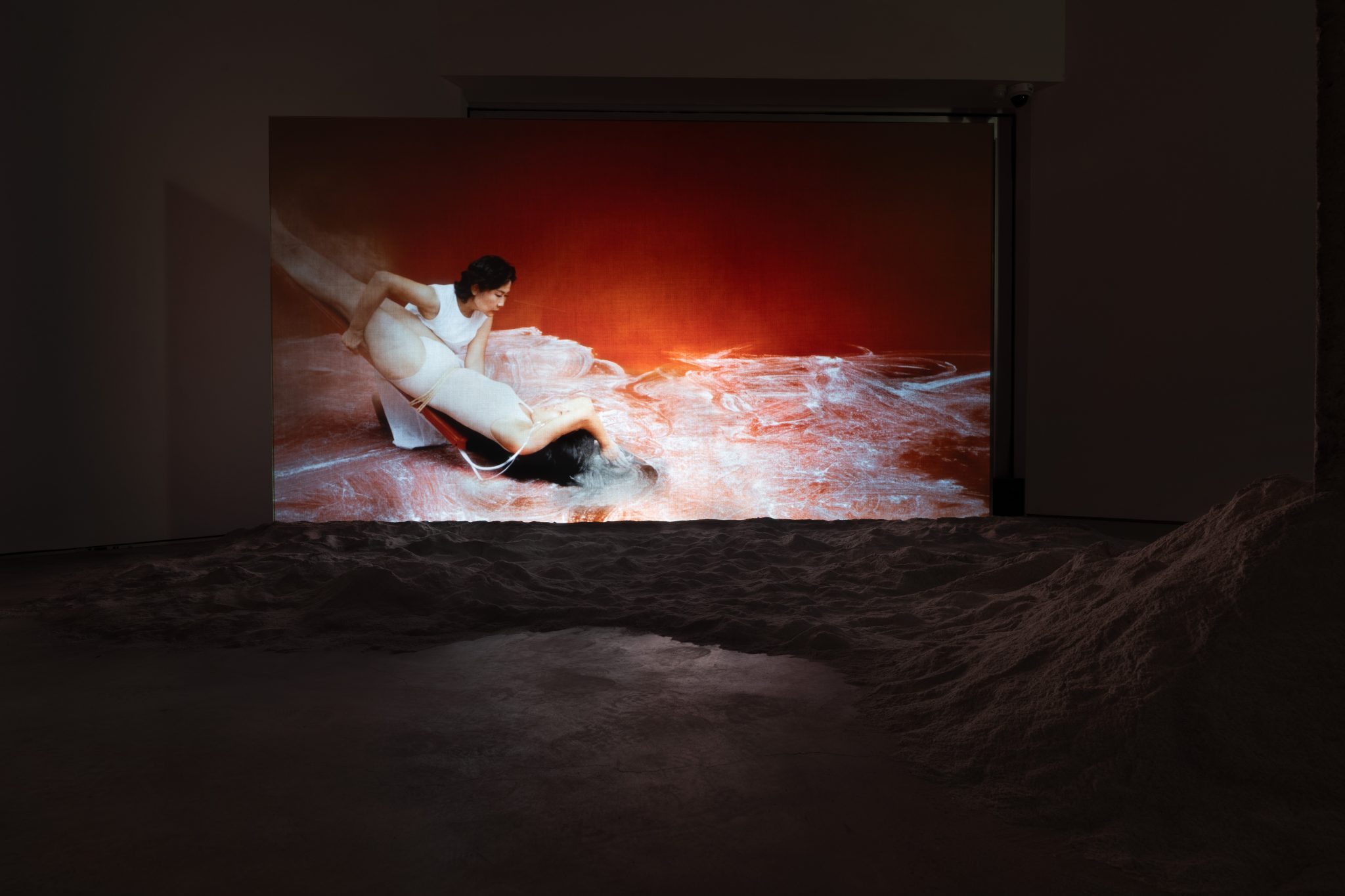
A less heavy-handed engagement with AI takes place downstairs. The single-channel video installation My Mother and (A)I (2025) pairs footage of Vatanajyankur as a paintbrush, being swept by her mother through piles of ash, with an AI voiceover trained on the writings of her late father. Perhaps inspired by the advent of therapist chatbots, and apps such as 2wai (which allows users to build an avatar of a late loved one), the result is uncommonly strange – a work more personal, brooding and opaque than its forebears. Hot steam rises from Vatanajyankur’s long hair as her mother swipes her ramrod-straight body across the floor; gnomic couplets are uttered by disembodied voices, including a generated recreation of her father’s (‘The machine remembers / Not with blood but with code’). With these elements looping alongside Flight and Echoes – pithy visual epigrams in which archery and bell tolling, respectively, seem to operate as metaphors for the unpredictable drive of a nimble external force – the AI presence in this room seems less an evil master-manipulator and more a deft choreographer of grief and memory. Which, when you think about it, is also an alarming prospect.
Kawita Vatanajyankur: Tracing was at Nova Contemporary, Bangkok, 6 June – 25 July