Sam Jacob looks to Elvis to ponder the meaning of restoration
‘Perfect Sound Forever’ was the slogan that launched the compact disc. No crackle, no scratches, no dust, no decay. Music’s presentness would persist in an infinite technical permanence, frictionless and immaculate.
Sony’s and Philips’s fantasy was instructive: a dream that culture could be stripped of wear, accident and mortality. But anyone who remembers the glitchy sub-soundtrack of the vinyl/streaming interregnum knows that wasn’t quite the case. Skips, judders and loops marked a return of the real to wipe out the frictionless world of CDs.
But now that the frictionless fantasy is back, its vector is reversed: not present to future, but past to present. No longer attached to what is being made now, but drilling back into the archive. Reprocessing rather than invention is the great technical project of contemporary culture. Perhaps because it’s hard to believe in the future anymore, the ‘past’ is where the money is, where the aura is, where the certainty is, where the IP is. No new forms, just old ones scrubbed up, resharpened, de-noised, interpolated, upscaled and repackaged for resale. And I’m buying it. Which is why I’m back at the IMAX cinema, that cathedral of scale, watching Elvis Presley blown up to colossal size.
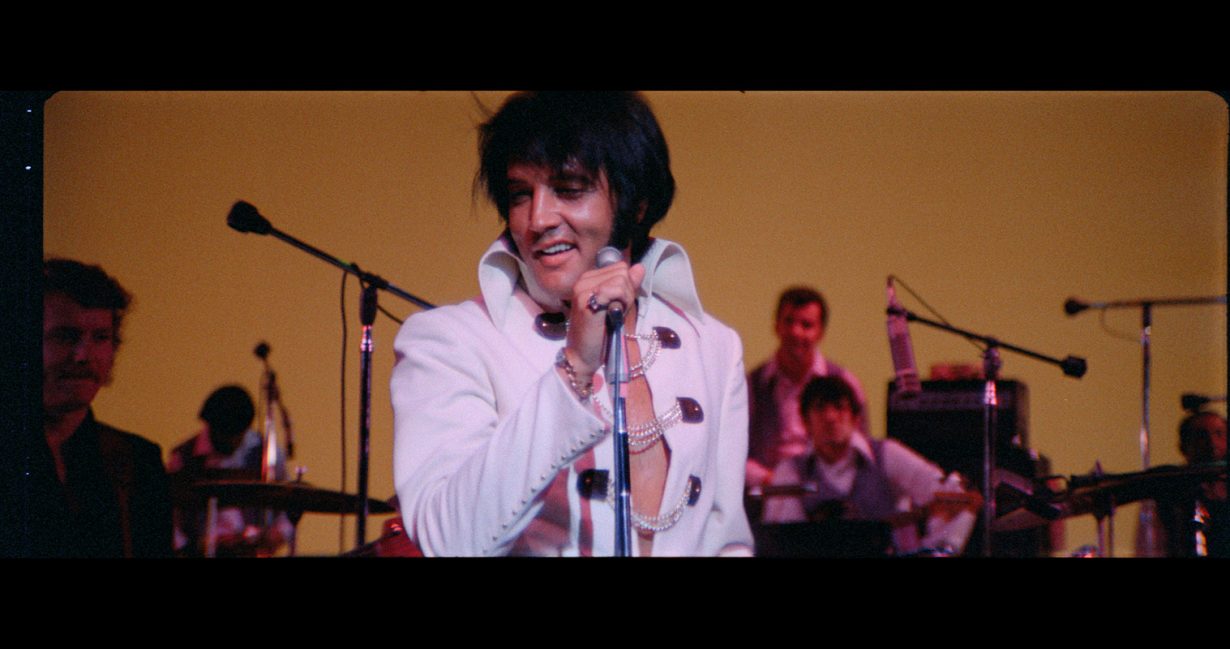
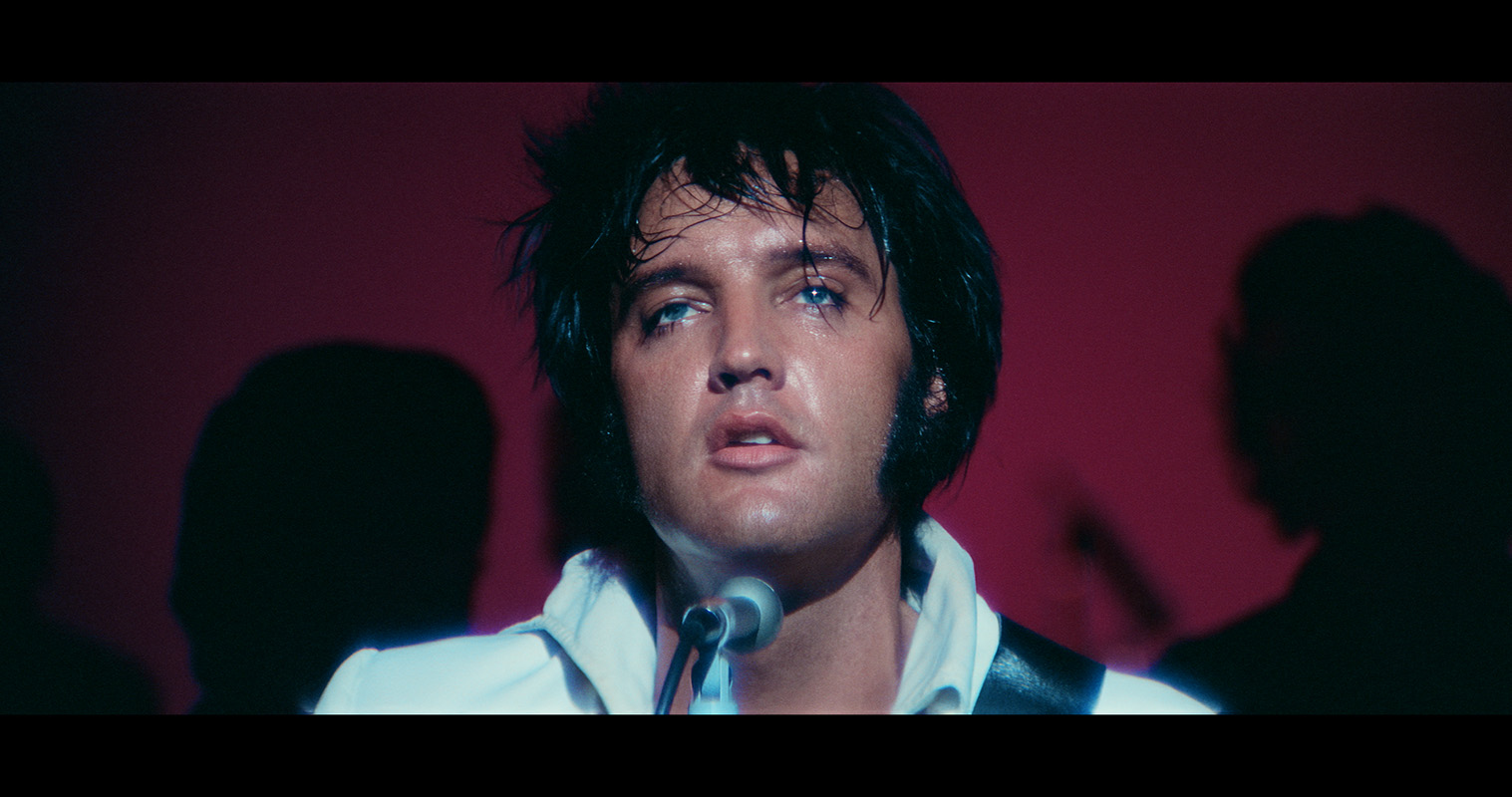
Everything here is exaggerated. There is Elvis’s massive, beautiful face; his gigantic, wonderful nose; his huge sideburns made huger; a tooth the size of a gravestone; a drop of sweat with the volume of a beer barrel; sunglasses the size of a bus; sequins like giant boulders. There’s Elvis in a psychedelic shirt that makes your eyes go wonky.
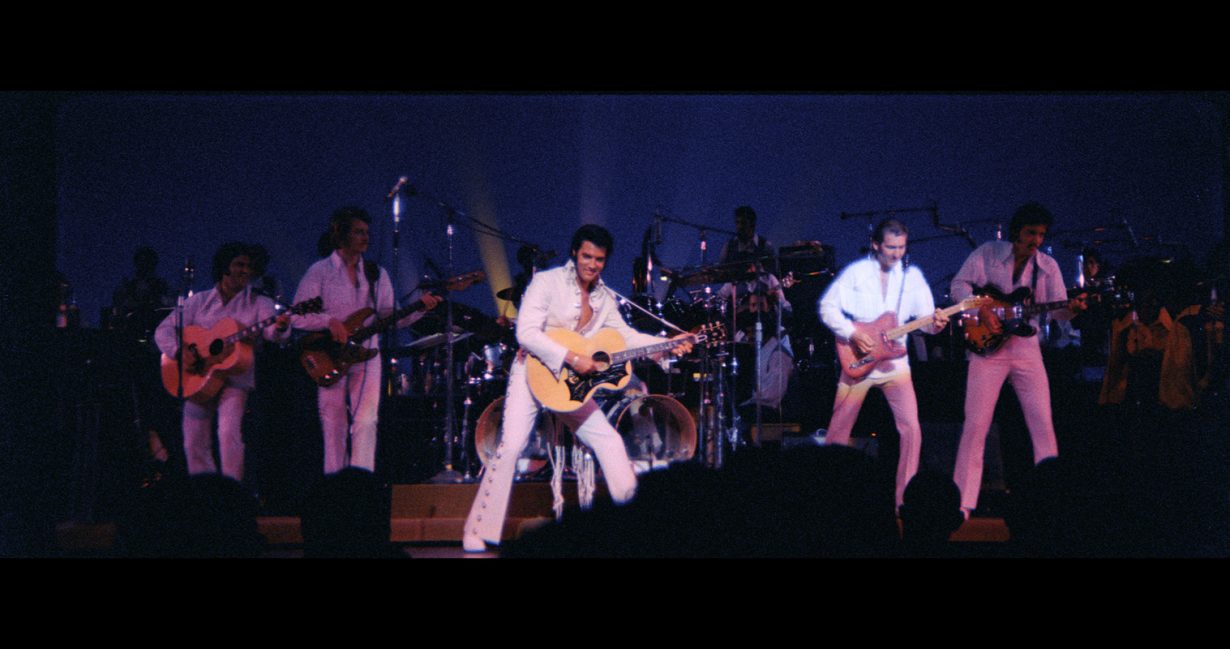
Baz Luhrmann’s EPIC: Elvis Presley in Concert is a spinoff from his 2022 Elvis biopic. Rumours of unseen Elvis material led Luhrmann to Warner’s Kansas salt-mine archive, where he found 59 hours of unseen footage shot in 1970 and 1972 during Elvis’s Las Vegas pomp. It included concerts, rehearsals, backstage reportage and audience reaction. Much of it typically unusable: mixed format, fragmented, damaged, unsynched sound. All of it then digitally scanned, reconstructed and made legible using Peter Jackson / Park Road Post technology first developed for the eight-hour The Beatles: Get Back (2021). This proprietary Machine Assisted Learning (MAL, after both Kubrick’s HAL and the Beatles roadie Mal Evans) is a ‘demixing’ technology that uses spectrogram modelling, pattern recognition and deep learning training to prise voices and images out of muddy recordings, damaged or otherwise unusable film.
The rhetoric surrounding these projects is redemptive: history recovered, damage repaired, truth revealed, the past saved. Digital processing reformats the past so that it looks like now. Archival footage subjected to the full cosmetic battery of contemporary makeover culture. The past as seen in laser-projected 4k resolution, 26 × 20 metres with 12-channel sound. The promise is a kind of supercharged authenticity: Elvis, ‘like never before’.
Luhrmann says “there’s not a frame of AI in this”, but technology is blurrier than that. Not on or off, but, as Elvis might have said, all mixed up. The archive returns not only preserved but improved. Reconstructed, interpolated, remixed so that it feels more ‘present’. Sharper. Cleaner. Brighter. Smoother. EPIC’s claim to realness is double: both ‘real’ in the morally or legally authenticated nature of the archive, of provenance, of validation; but also real as an intense contemporary experience. Together they constitute a new kind of enhanced authenticity that is simultaneously document and spectacle, historical truth and sensory excess.
Extracting value from historic IP is nothing new. “Re-issue, re-package, re-package / Re-evaluate the songs / Double-pack with a photograph / Extra track and a tacky badge,” as The Smiths put it in 1987. Pop culture had already learned to feed vampirically on its own remains. Today’s version goes further. No longer repackaging the object but penetrating and surgically altering its skin. Pop doesn’t just eat itself anymore. Pop digests, metabolises and then regurgitates itself as premium content. These acts of restoration are not only aesthetic. They are also legal and economic operations. A cleaned-up, reedited, remastered object becomes a contemporary media-event circulating through new distribution networks, generating new revenue streams and new layers of IP rights around old material. Like fracking, new technology enables new forms of extraction of value from the archive. Expect more of this very soon as other estates realise they can hone their archives into super-big, super-long product.
Elvis was never a person, perhaps the first human body to be truly globally mediated. EPIC takes this to a new dimension, both impressive and grotesque, blown up to a size verging on Swiftian disgust (pores ‘like great holes’, hair ‘thicker than packthreads’). Despite the super-sized spittle and fleshiness, another contradictory sense of embalming.
Where once upon a time grain, hiss, blur and flicker told you something about mediation, storage, circulation, survival and more general historical conditions, now it all that gets treated as contamination, defects that require luxury refurbishment. Memory, once scratched and partial, now arrives with the infernal sheen of a premium appliance.
Architecture has had arguments about this for centuries. John Ruskin described restoration as ‘false description of the thing destroyed’. Viollet-le-Duc thought restoration meant returning a thing to a state of completeness, even if that completeness was invented. EPIC wants both positions at once: the sanctity of the document and the pleasure of completion. A position that is not about safeguarding the past but a dominant technique for managing the present. The preserved object is not frozen, but continuously reformatted for immediate relevance.