Among all the artist’s canvases is a repeated attempt to grasp a certain meaninglessness
A tall, teetering pile of rocks in vibrant blues, greens and greys lines up on the small canvas Futile Effort 2025.10.9 – 12.14 (2025). Each rock is annotated with a number seemingly setting out the date on which it was painted. In the hallway nearby is the larger Futile Effort (2025), featuring a similar pile of rocks, this time painted in more muted greys and browns, though here rendered as more loosely abstract painterly shapes, as if each stone was a single, wide brush stroke. In the next room, in the small landscape painting Nammaetop Pagoda (2024), a group of people stand in a lush field at dusk, their backs turned away from us as they look at two pagodas in the distance. Among four other paintings of rocks, and another of the backs of people ogling another pagoda, the sense of futility settles in. Why look at rocks, or pagodas? Why look at paintings? Why look at anything?
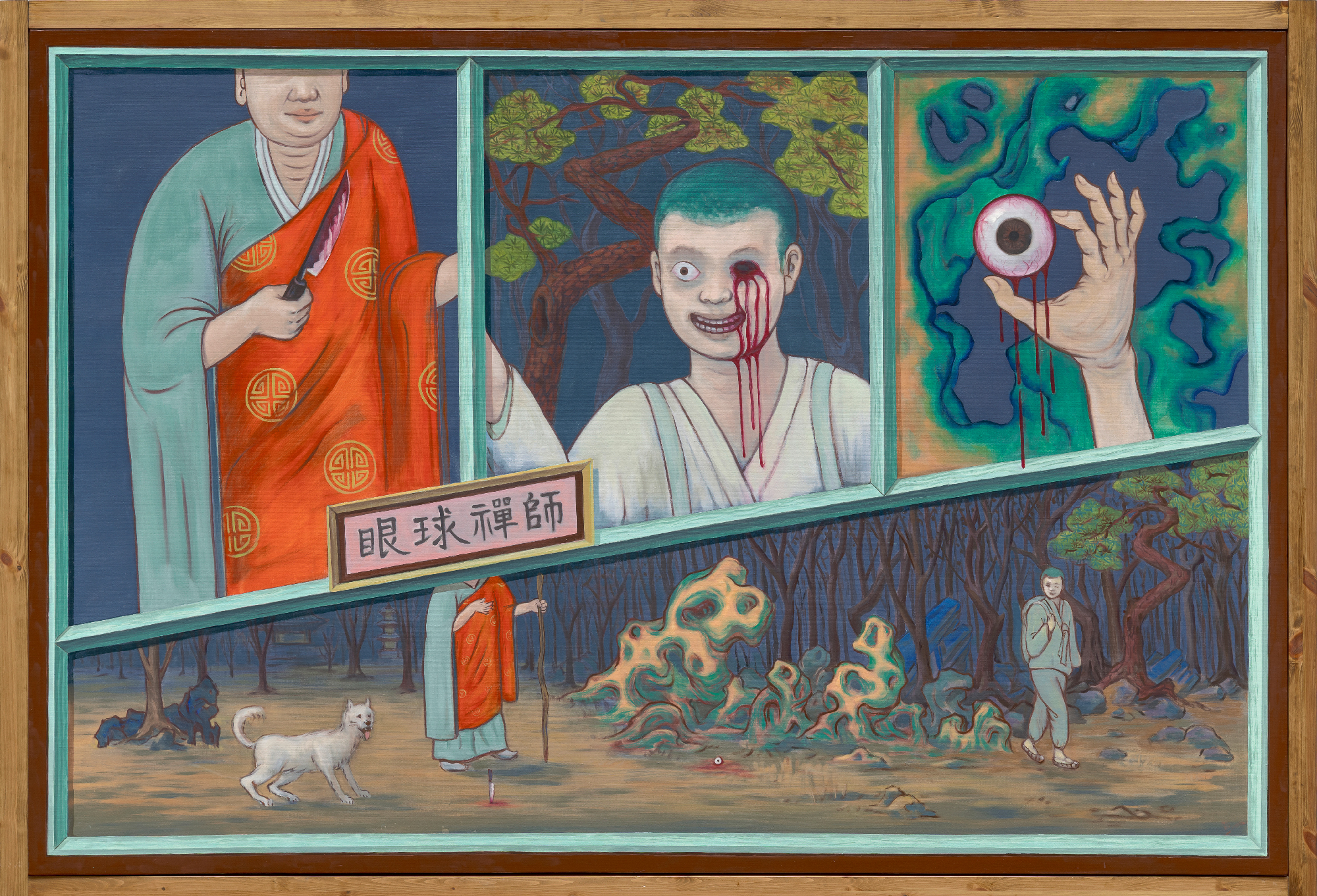
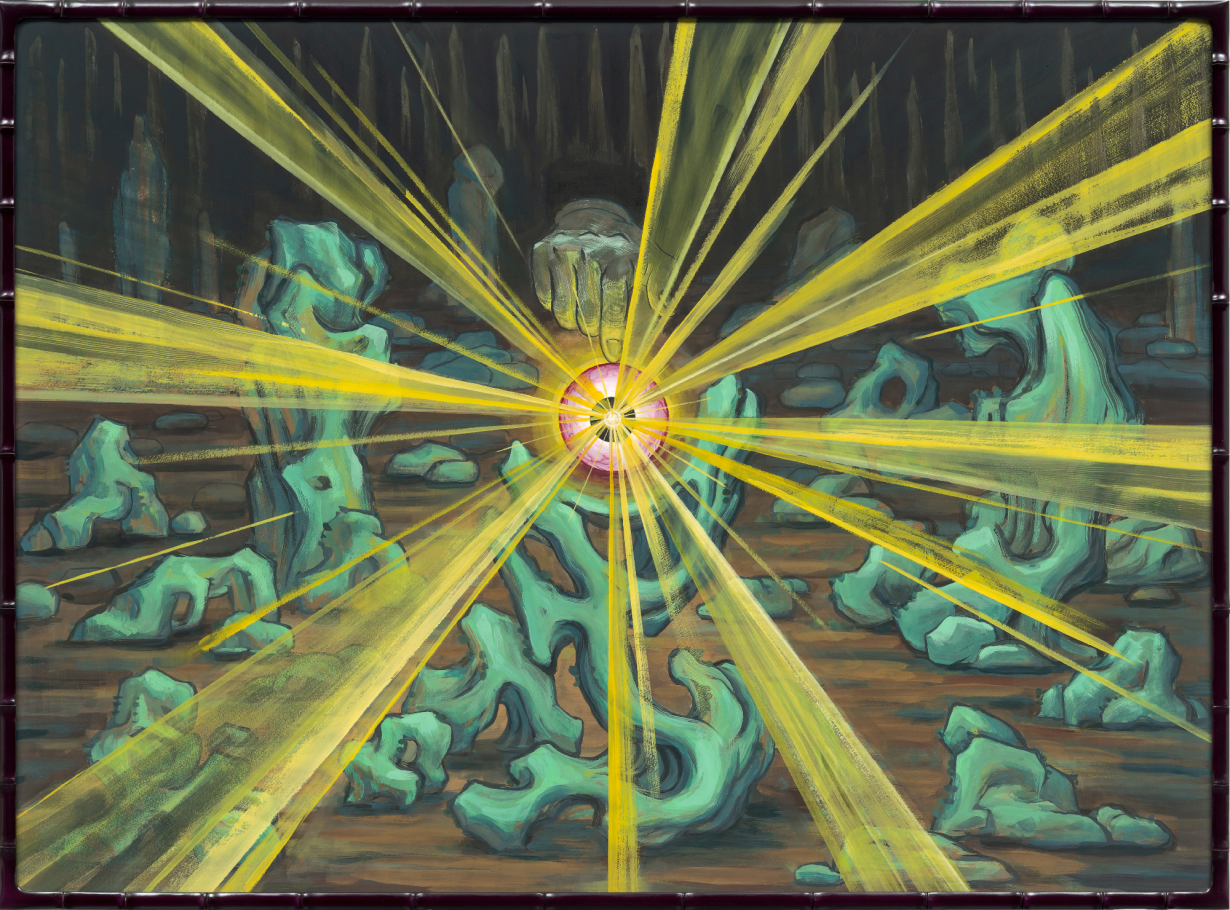
Writer, filmmaker and installation artist Park has set out a deliberately uneven show of over two dozen recent paintings (and one diorama) in a range of styles, from neon-tinted realism to kitschy, cartoonish surrealism. The turn to painting seems, at first, like a novelty turn, to make a self-referential, pick’n’mix body of work about looking at looking. But while one half of the show is more serene, all philosophers, stones and temples, the other half is more macabre and disjointed, with large canvases segmented into sequential quasi-narratives that resemble both comic-strip panels and the storytelling seen in the types of murals that might decorate a place of worship. In the eponymous painting Zen Master Eyeball (2025), a young man, bleeding profusely from one gaping eye socket, smilingly proffers up his own eyeball, before, in the next panel, calmly following the knife-wielding monk who did the deed through a forest. (Apparently, Park’s thorough notes to the exhibition inform us, this is a riff on the story of Jùzhī Yīzhǐ, a Zen monk who removed his pupil’s finger; such tales of monkish devotion are the starting points for many of the scenes depicted here.) His gory offering evidently enables other visions: the eyeball returns in Projection 1 (2025), a canvas framed in dark imitation bamboo plastic, in which a phantom hand places the bloody organ on a mound of dirt in a stalagmite-riddled cave as it casts a rectangular, cinema-like light onto the rocky wall. In the accompanying Projection 3 (2026) the eyeball faces towards the viewer, throwing its light directly towards us; it doesn’t feel so much like the painting is the screen, as that we are in the cave – we are the projection, the illusion.
It seems, then, that between these two bodies of work, inhabiting as we are such an imaginary cave, it doesn’t matter what we look at. Among all these canvases is a repeated attempt to grasp such meaninglessness, and Park’s pointed pointlessness has a sense of humour and irreverence to it. It’s an ironic use of painting to make a sincere point: that making meaning out of anything requires a commitment both to the seriousness and ridiculousness of the attempt; that it demands a willingness to both look silly as well as sacrifice something on the way. It’s an impossible lesson that Park offers with a knowing smirk, waiting for us to offer up an appendage or a limb.
Park Chan-kyong: Zen Master Eyeball, Kukje Gallery, Seoul, 19 March – 10 May
From the Summer 2026 issue of ArtReview Asia – get your copy.