The latest in this showcase series turns its focus to the South Korean capital and fills Art Sonje with queer life
There’s been an ongoing debate in recent years as to whether or not an artist’s art should be read through the lens of their biography. Whether how we judge the latter should affect the former, or vice versa. It’s a debate because, for the most part, the connection is not a necessary one: it’s possible to judge a work of art while knowing nothing about its maker. Spectrosynthesis Seoul pointedly rejects that.
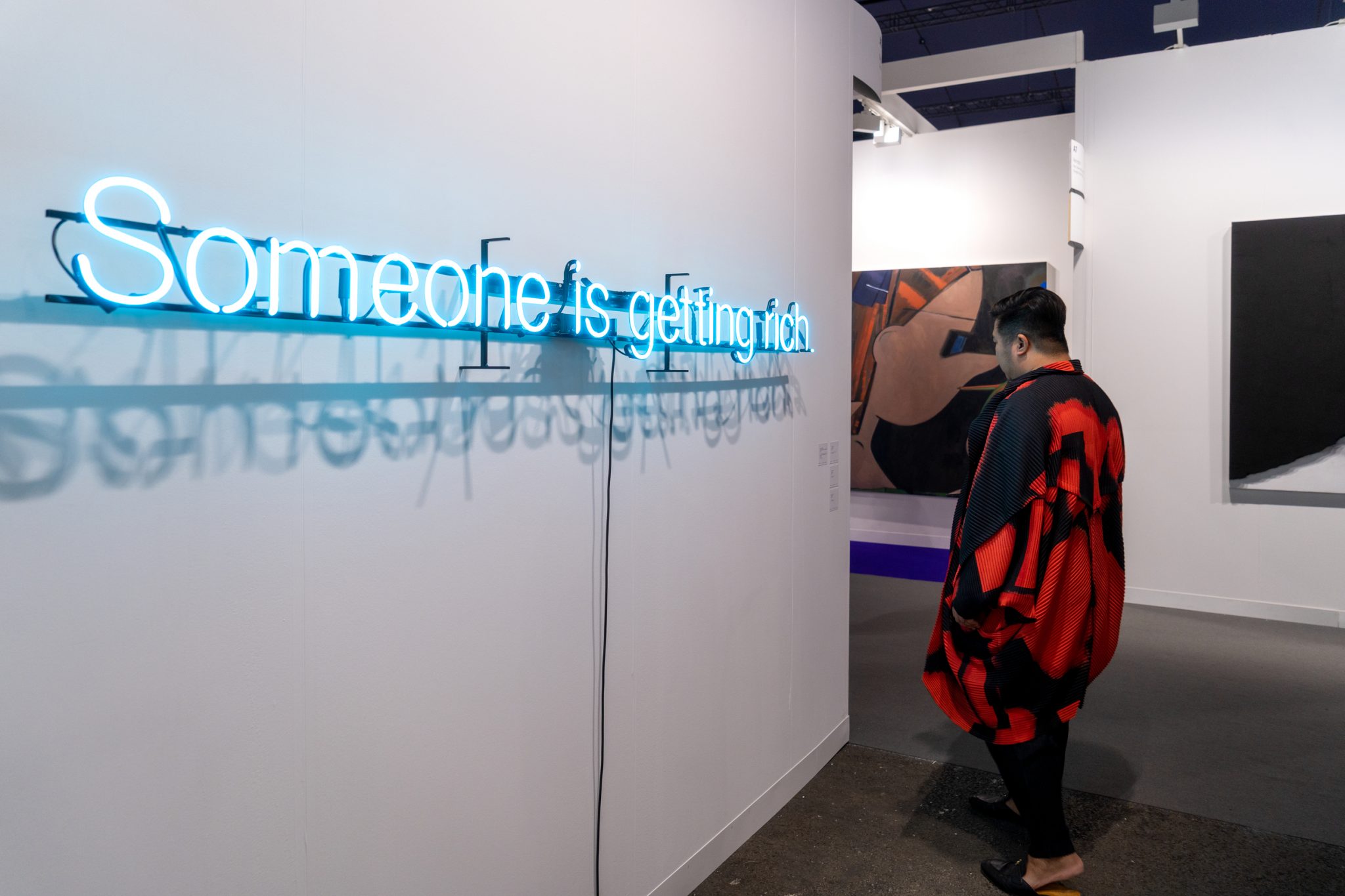
The latest in a series of similarly titled exhibitions (this is the fourth) that have been touring major cities in East and Southeast Asian since 2017, Spectrosynthesis Seoul, like those that preceded it, is a showcase for art by LGBTQ+ artists and, more broadly, art that explores queerness as a subject matter. Initiated by Hong Kong’s Sunpride Foundation – a sample of its collection of works, generally by brand-name international artists such as Gilbert & George, Danh Võ, Annie Leibovitz and Robert Rauschenberg anchors one floor of this exhibition – this latest edition of the franchise features work by 74 artists in total, with a pronounced focus on South Korea. The exhibition is spread out over all four floors of Art Sonje, without ever feeling spacious. Rather, it feels like an explosion: a takeover of every nook and cranny of the building, with corridors, staircases and backstage areas repurposed as places for display and exhibition. There are zines and paintings, videos, animations, records of sex acts, comic art, drag acts, nightlife ephemera, signs, sculptures and murals all competing for our attention like a neon-lit downtown area on steroids. At times, this profusion conveys the message that LGBTQ+ communities are everywhere, a part of rather than apart from a broader social whole; at other times you wonder if, for the sake of the exhibition, a little more editing might have helped create more succinct messaging and a more even aesthetic tone. Nevertheless, the revolutionary takeover vibes given off by the installation are complimented by many of the artworks themselves and the extent to which, given the LGBTQ+/queer selection criteria mentioned above, they are a record of people (often the artists themselves) and communities in effect populating this space. At points it feels more like an assembly or a rally than an exhibition. And this is important, given that Seoul’s mayor is on record as stating that he personally ‘cannot support homosexuality’ and declared certain public areas off-limits to the city’s annual Pride festival.
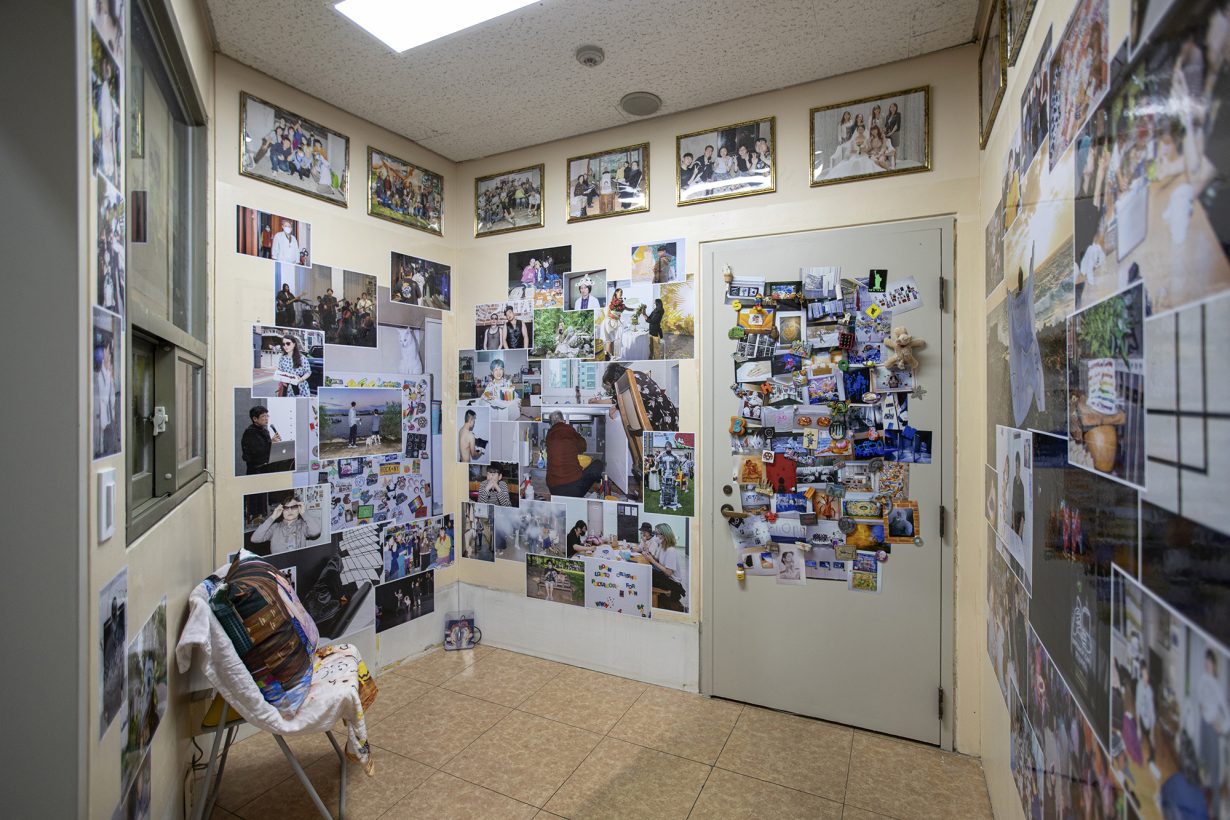
That this is a show about people as much as it is about artworks is a message that’s emitted from the get go, when, entering via the basement rather than Art Sonje’s ground-floor main entrance (a détournement that’s been enacted before, most recently in Adrián Villar Rojas’s exhibition last autumn, which makes you feel that any unruliness here is performed rather than real) you find yourself immersed in Yang Seungwook’s Chosen Family Next Door (2025), an accumulation of photographs, some framed, some just stuck on the wall, of old people, young people, queer people, plumbing people – greeting the sun, loafing at home, posing for portraits, gathering for meals – interspersed with other images of places and objects and with the cheap souvenirs of a peripatetic life: fridge magnets, postcards. All of that plastered around the room so as to suggest an attempt to create a refuge or a shelter (there are photographs on cushion covers too). You don’t really know who these people are, but clearly at some point they were important to someone who captured, preserved and shaped them into a community. A metaphor, if you like, for this show as a whole.
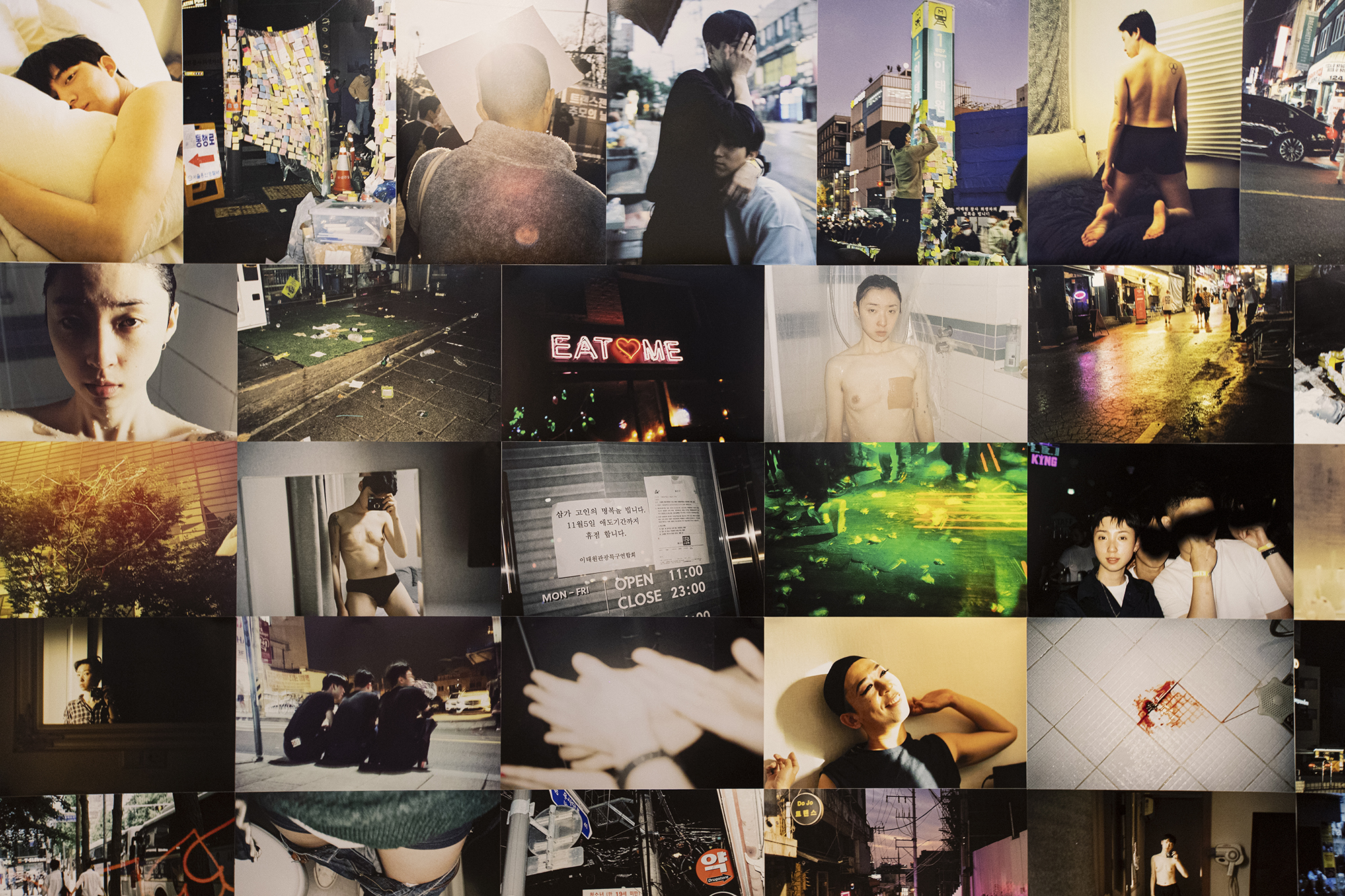
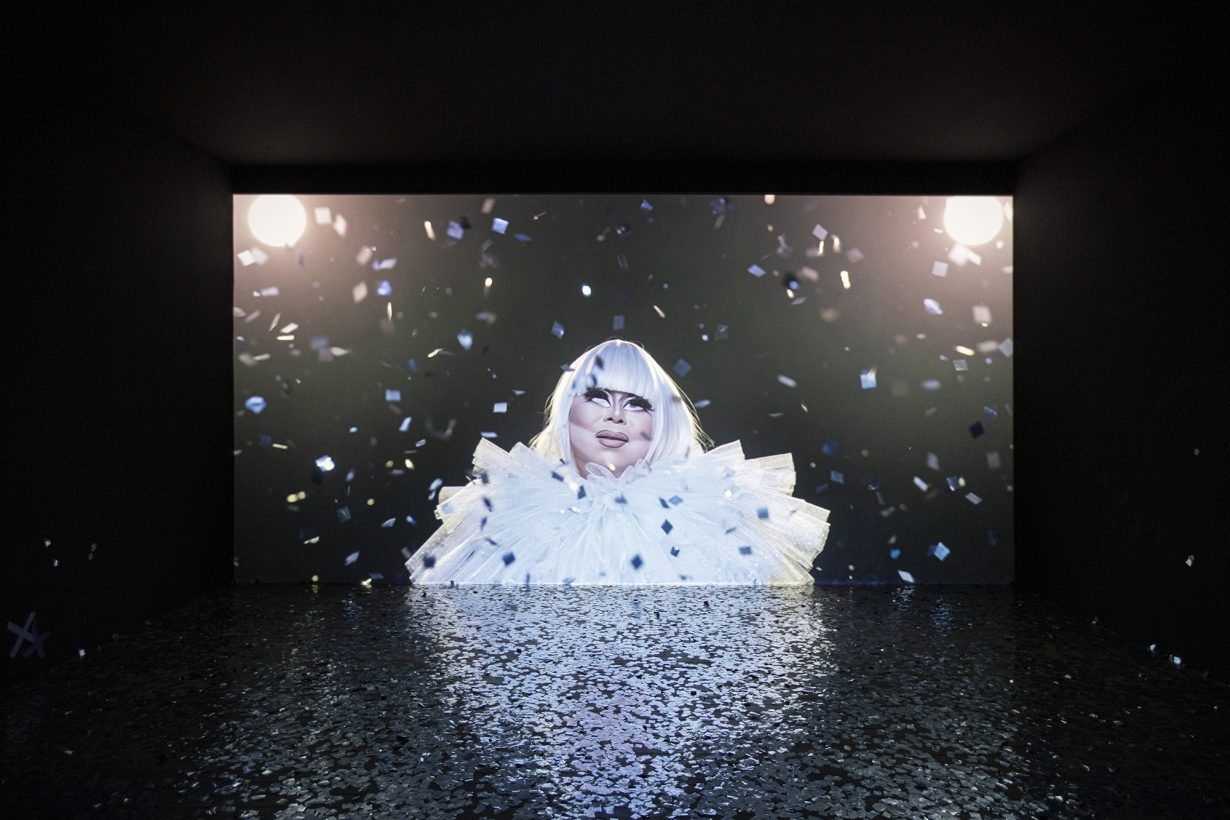
Later on, we get Sung Jaeyun’s The Guy Days (2022–), snapshots of himself, people and environments, presented on the gallery walls like the index of a photo app, and documenting the artist’s identity as a trans man. We see Jeon Nahwan’s single-channel video For a Flash (2021), in which Seoul-based drag queen Hong Il-pyo, transforms into his alter ego Anessa, in such a way that we feel we are watching a portrait being painted, by Hong as much by Jeon. And that identity and biography can be fluid, rather than fixed things.
That’s a theme that’s taken up to brilliant effect in a series of pseudoscientific collages by American Candice Lin, each of which features natural specimens, such as leaves and petals, anatomic or molecular drawings and extracts of texts relating to the queering of received taxonomies: males producing breast milk (Minimizing Males; 2015), female spiritualists claiming to be channelling the voice of ‘great’ male authorities (The Hand of an Important Man; 2015). The theme also resurfaces in Jeon’s collection of torn-off club entry wristbands, The Wristband (2021), from pandemic-era gay clubs in the Itaewon district of Seoul that no longer exist or changed their names. Stretched out in rows, as if by a bangle-obsessed lepidopterist, this is a simplified, economy-class coda to Yang’s barrage of photographs in the basement, part of an interplay between the raw and the (sometimes over-) cooked that echoes through this vast show as a whole.
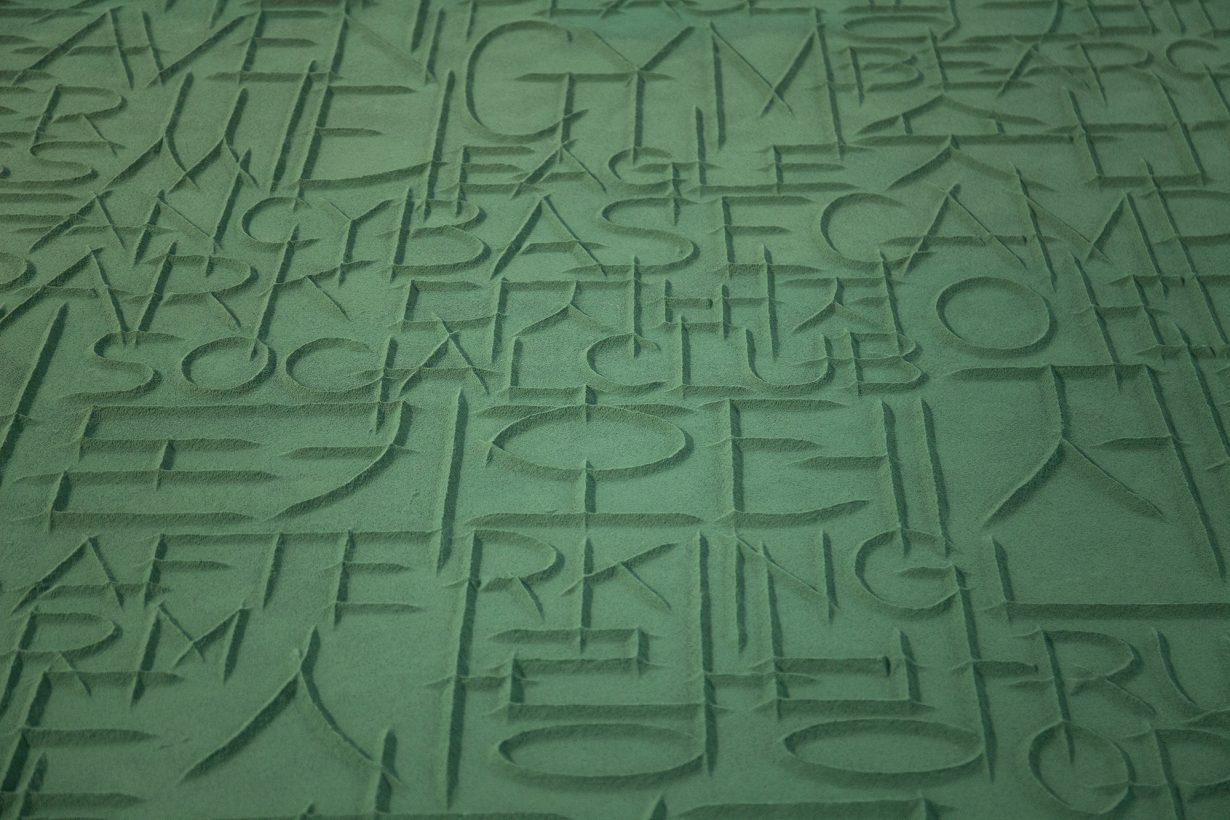
What gets recorded – by whom and how – becomes the subject of Hiju Yoon’s single-channel, 35-minute video Seoul Angel’s Poem (2025) as the central protagonist loafs belly-down on their bed staring at their laptop while telling us that, while looking for a job, they watched 365 movies in constant succession: they ‘just kept on watching’. The video’s overarching narrative is a semi sci-fi tale of life and death, real and simulated existence, the relation between humans and their avatars, people versus statistics and the prospects for intimacy within all that. All assembled within the framework of a mysterious not-quite-disappearance that cannily picks at the overlaps between lived and digital existence. It’s a refrain that’s picked up in Minki Hong’s more retrospective 30-minute video, Paradise (2023), which deploys an elflike animated narrator (who looks like they might have got lost on the way to a convention for devotees of 1980s computer game The Legend of Zelda), alongside animated bottle caps, drinks cans, cardboard models and real-life interviews to narrate a history of cruising sites in the disappearing cinemas of Seoul’s Jongno district. While the general focus on avatars and fantasy characters (also present in a wallpaper mural from Ayoung Kim’s Delivery Dancer [2022–] series), equally speak back to Jeon’s explorations of drag, these works cumulatively develop an argument about queerness being embedded in the physical and psychogeographies of the city. Although it is Inhwan Oh’s more physically ephemeral work, Where He Meets in Seoul (2020), a field of powdered incense placed on the floor and arranged to spell out the names of Seoul’s existing gay clubs, that’s lit at the beginning of the show and consumes itself by the end of it, that arguably delivers the message about the coiled and intertwined nature of the ghostly and physical presence of queer Seoul most directly of all. Of course, what this really makes you think about is the extent to which this exhibition needs the anchoring of the Sunpride Collection or the art history (even reframed and retold) that it represents at all; given that so many of the artworks on show seem to argue so persuasively that the stories and histories it foregrounds are already ingrained in the fabric of Seoul itself. Perhaps, though, it’s not so much a question of what that collection contains, as much as it is of how and for what it encourages you to look.
Spectrosynthesis Seoul at Art Sonje Center, Seoul, through 28 June
From the Summer 2026 issue of ArtReview Asia – get your copy.