On a visit to an exhibition by Raqs Media Collective, Pramodha Weerasekera finds that art can still play for high stakes at high altitude
Ladakh, despite being located on lands visibly impacted by Indo-Pakistan wars in the politically tenuous union territory in the Himalayas, boasts a tourism industry that stands at odds with its ecosystem. Over 200,000 people visited in June and July 2026 alone. The region’s ecological balance has been further disrupted by power projects funded by public-private partnerships, mining and highway expansions promising access to remote areas in the mountains, strategically embedded with the rhetoric of sustainability and environmental conservation. Now the Ladakh Arts and Media Organisation (LAMO), a public charitable trust housed in two historic buildings, is also home to Delhi-based Raqs Media Collective’s first solo exhibition in India in over ten years.
My flight landed in Leh Ladakh after a glacial outburst along the Himalayan mountain range caused severe flash floods in Nepal; hundreds of people had died, and thousands had disappeared. Thus, I was already thinking about the contentious role – as favourable and attractive yet exploitative and extractive of their landscapes – of contemporary art initiatives in the complex South Asian art scene. Biennales, museums, artist-led projects and public programming spaces have facilitated tourism for decades. For Ladakh, remoteness is only part of the equation. The other is its climate-endangered status.
Inside the exhibition, titled The Time is Never Ripe, a glass fruit fly stares at me with bright, tenacious blue eyes. This hand-blown Drosophila melanogaster, housed in a bell jar, is part of a work by Raqs titled Dew Lover, Drosophil(i)a (2022). In the booklet accompanying the show, the fly is described as an ‘irksome’ creature that exploits others; much like the way we exploit our environment. And indeed, Raqs’s Jeebesh Bagchi, Monica Narula and Shuddhabrata Sengupta have been wrestling, for over three decades, with the concept of time and the broken bond between humanity and nature.
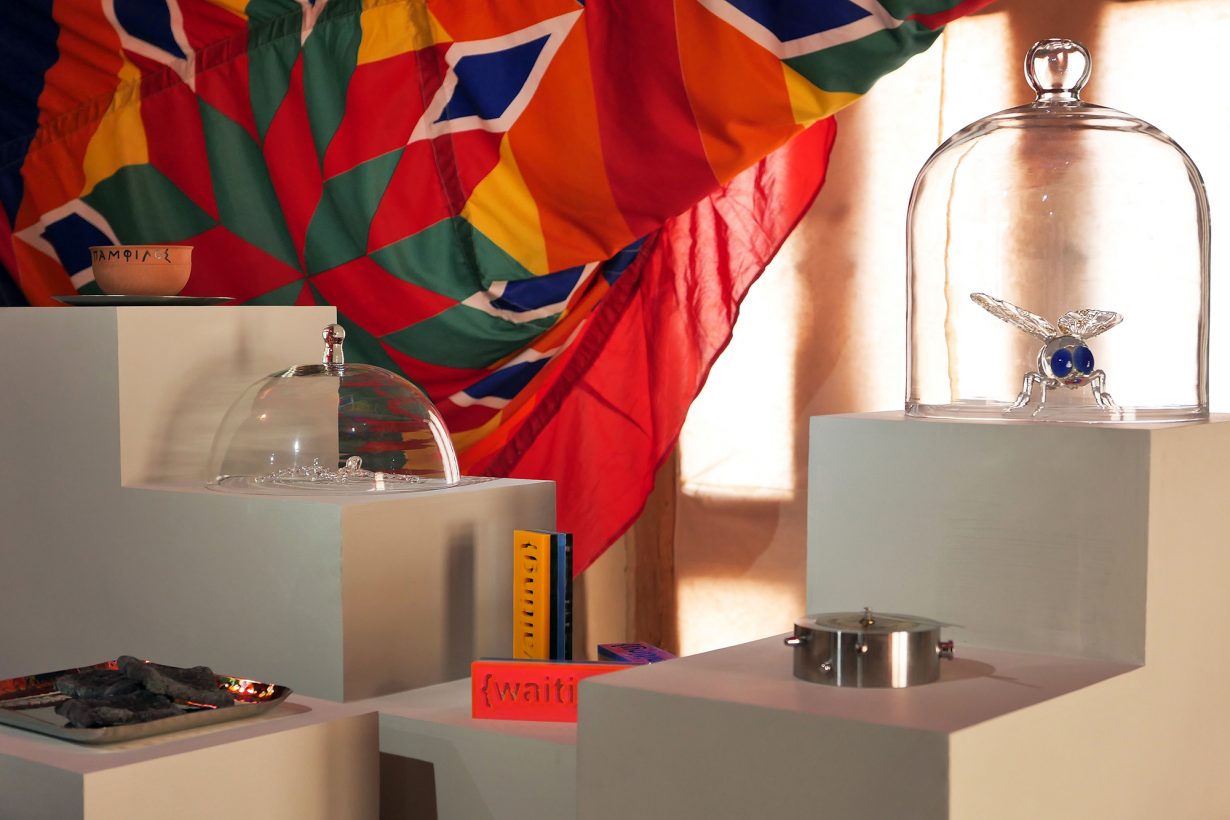
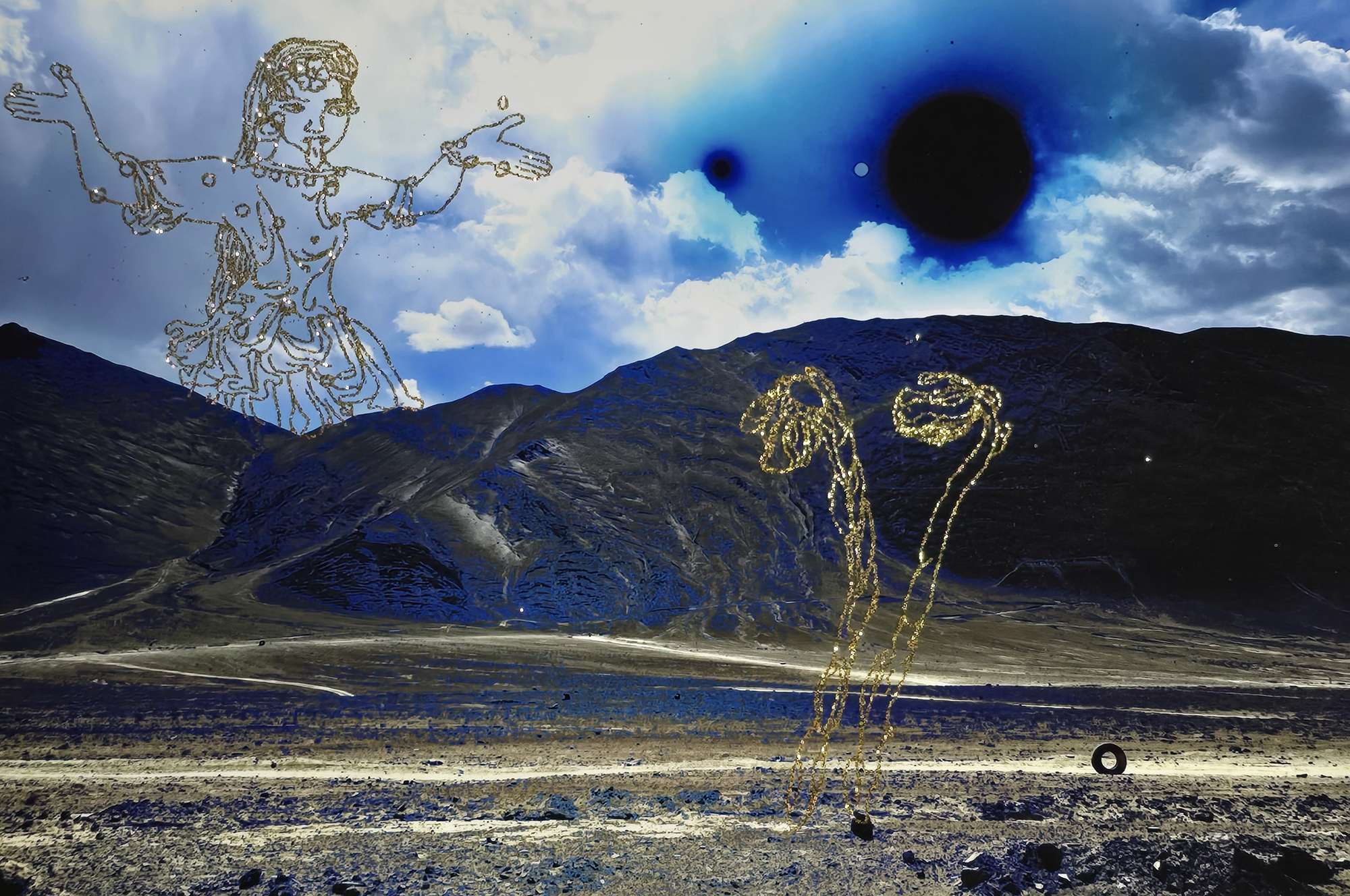
Raqs’s show begins with Chimera Chorus (2025), a hybrid human-animal figure covered in embroidered organza fabric that stares at visitors. The figure resembled women in the frescoes of the Ajanta Caves in India or Sigiriya in Sri Lanka; she seems to be dreaming up a utopic ‘drosophi(i)a’, whereby humans and nature remain connected. Several steps beyond, four photographs of Ladakh landscapes in the Wayfarers series (2025) act as substrates for glitter drawings of other ancient-yet-futuristic figures. On the lower floor, Raqs engages with time using sculptural and found object artworks about relics, remnants, violence and speed, placed on pedestals of various heights. Cleverly assembled under Ferment (Sear) (2026), an embroidered canopylike shamiana, these smallscale works embody Raqs’s preoccupation with collecting sources, as evident in the ‘sourcebook’ that accompanied their curatorial endeavour Afterglow, the 2020 Yokohama Triennale. An Infra-vocabulary for Capital (2023) paid homage to Bhishma’s deathbed recital of the thousand names of Vishnu in the Mahabharata with a large board listing a thousand unpunctuated nouns and adjectives in vinyl. I wondered if time would pause as I pondered the notion of death. It did not. The work immediately directed my attention to various expressions of power: ‘trenchant ruinous inequitable neutralizer lord industrial sucker…’, it read. Turns out even in a dying declaration, struggles and imbalances persist, among voices that challenge injustice and mythologies and epic narratives that form South Asia’s identity.
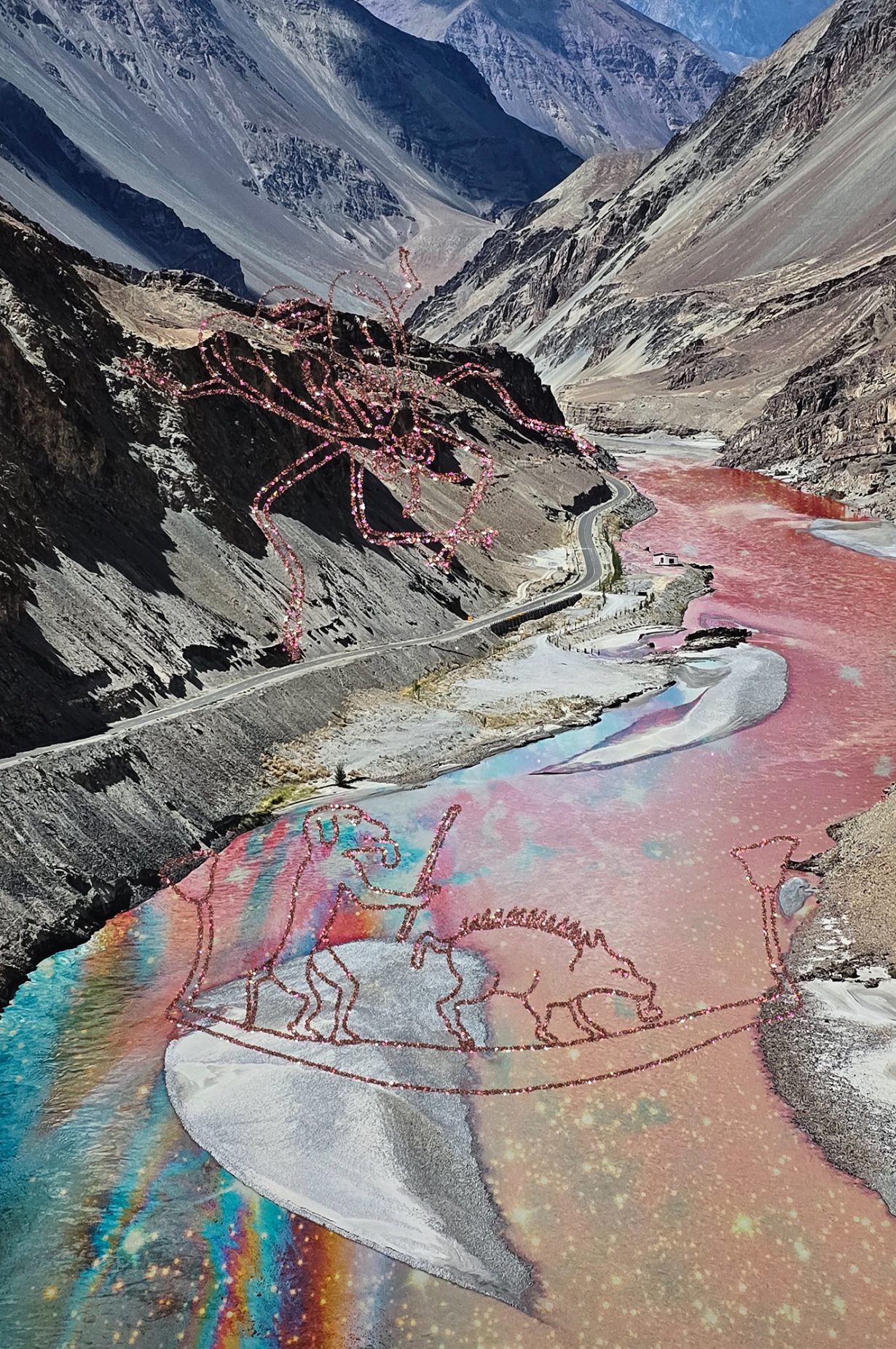
In their essay ‘How to be An Artist by Night’, Raqs writes that industrialisation in the arts demands ‘entrepreneurial acceleration’, but this tightly curated 25-work show does not give in to this demand: it instead sits with the Ladakhi people and acknowledges that their experience of time is vastly different from those of many others. I would argue that the exhibition’s true ‘elevation’ lies in Qamoos Bukhari’s curatorial ambition within LAMO’s architectural and cultural legacy. Bukhari, himself a native of Kashmir (neighbour territory of Ladakh), states in the exhibition materials that the works were ‘placed into direct conversation with the utopic, humanist values that sustain the Himalayan society’s relationship with its air, water, land, and pastoral movement’. The curatorial framework of time forces visitors to deliberate on the concept as fleeting yet stationary, unstable yet embedded in memory: a selection of works about histories of mythical creatures and deities; the infinity symbol’s deceptive nature when painted on dated newspaper pages in the series Seven Billion and One (2015); the ‘clock’ in the video Blood Moon (2025) that measures time in emotions and not chronometry; Waiting (2013), a text-sculpture laser-cut on acrylic, which presents the states of ‘not yet’ and ‘has been’. The curating stated that Ladakhis’ experience of time is unique, and presented the local community with alternative ways to comprehend the passage of time when surrounded by climate catastrophes and political conflict.
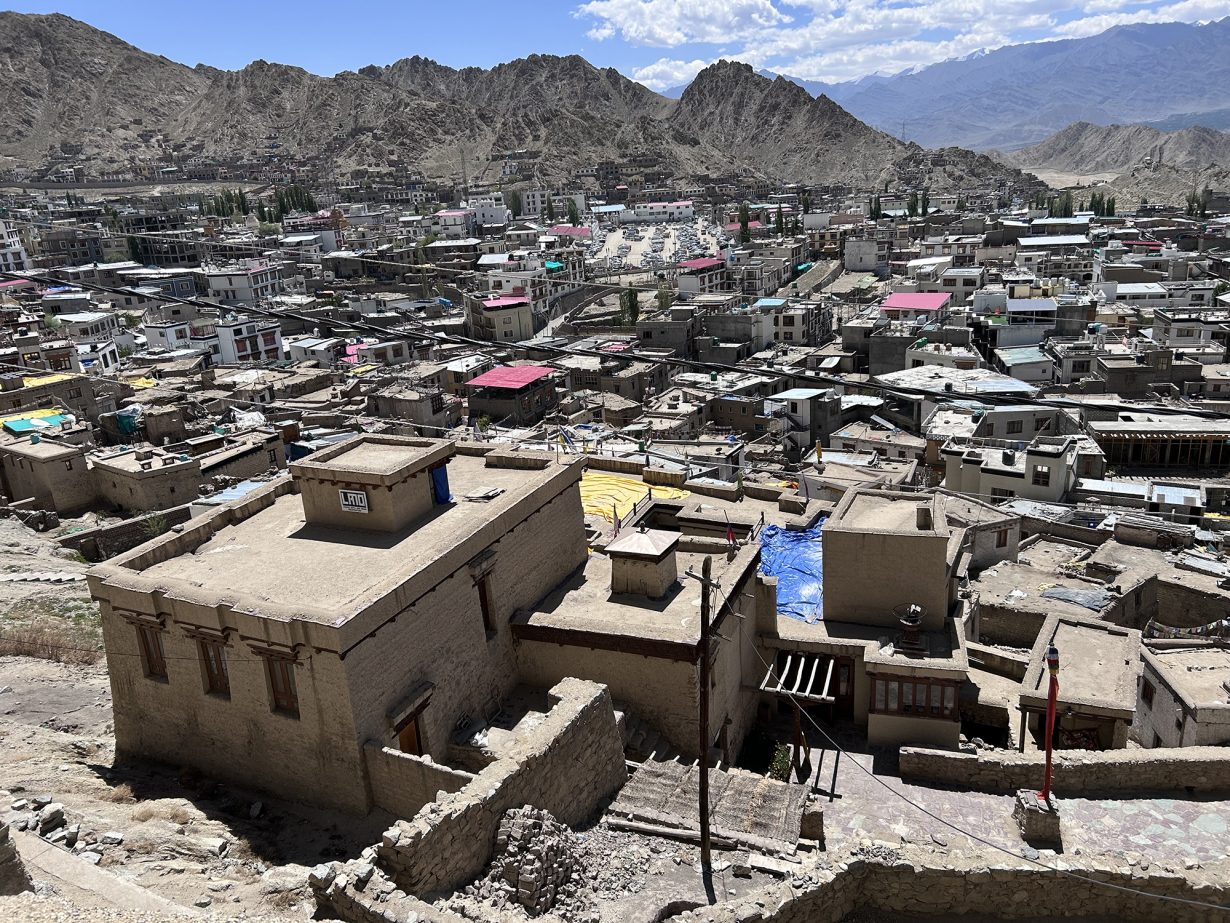
This curatorial approach was strengthened further when situated in LAMO. Founded by a pair of anthropologists, LAMO the organisation and its programming aim to empathise with and listen to Ladakh’s climate and community. The low-ceilinged seventeenth-century stone building that LAMO occupies comprises two connected houses overlooking the Old Town of Leh: one belonged to the King’s financial adviser, the other to an artisan. The exhibition occupies the artisan’s wing and slightly ventures into the financial adviser’s kitchen. The artworks, some previously shown in climate-controlled white-cube spaces abroad made specially for exhibition purposes, were installed with precision, without a single nail disrupting a wall of this heritage building, with utmost care for their substance within Ladakh. There was also no unnecessary sense of devotion towards Raqs’s international reputation preceding the exhibition.
The city of Leh is deteriorating; tomorrow is foggy, and the day after is bleak. As such, the time is never ripe for an exhibition of this nature, but LAMO does not aim to become the Guggenheim Museum Bilbao or the West Kowloon Cultural District in Hong Kong through their initiatives. In keeping with that, the curating of Raqs’s presence here allows local audiences to reflect on the bereft lands of Ladakh with hope.
From the Autumn 2026 issue of ArtReview Asia – get your copy.