An exhibition in Ohio reminds Zoé Samudzi that, even in times when people are afraid to speak out, art can sometimes say what it means
In 2024, amid still-ongoing genocidal annihilation in Gaza, Israeli ambassador Gilad Erdan put the UN Charter through a tiny handheld shredder before the General Assembly to protest the organisation’s vote to accept Palestine’s bid for full membership. Erdan’s theatrics inhabit a position in the war hawk’s visual canon alongside Colin Powell’s vial of fake anthrax and clownish insistence that the alleged existence of Iraqi weapons of mass destruction necessitated urgent American intervention in the wake of September 11. There’s barely anything original in the gestural playbook of colonialism’s appetite for destruction: we continue to witness the inevitably global fallout of American aggression in another West Asian country – this time Iran, and under the same auspices of regime change and petropolitical desire that animated the 1953 CIA co-coordinated deposition of Prime Minister Mohammad Mosaddegh.
In mid-March a show of paintings by Shiva Addanki and Nikholis Planck opened at No Place Gallery, an artist-run space in Columbus, Ohio. Deriving its title, American Inquisition, from lines written by the Popular Front for the Liberation of Palestine in solidarity with then-detained Algerian-Palestinian activist Mahmoud Khalil – ‘No to silence in the face of repression… Freedom for detainees… Down with the American Inquisition courts’ – and its critical nucleus from social theorist Mike Davis’s book Buda’s Wagon (2007), a global history of the car bomb and urban insurgencies, the exhibition contends with paranoic US security politics in which imperial identity is defined by obsessive identification, alienation and preemptive containment of often ambiguous enemies and security threats. The two artists here build out an architectonic intimacy of threat-countering infrastructure by deploying the spectacular déjà vu of imperial violence.
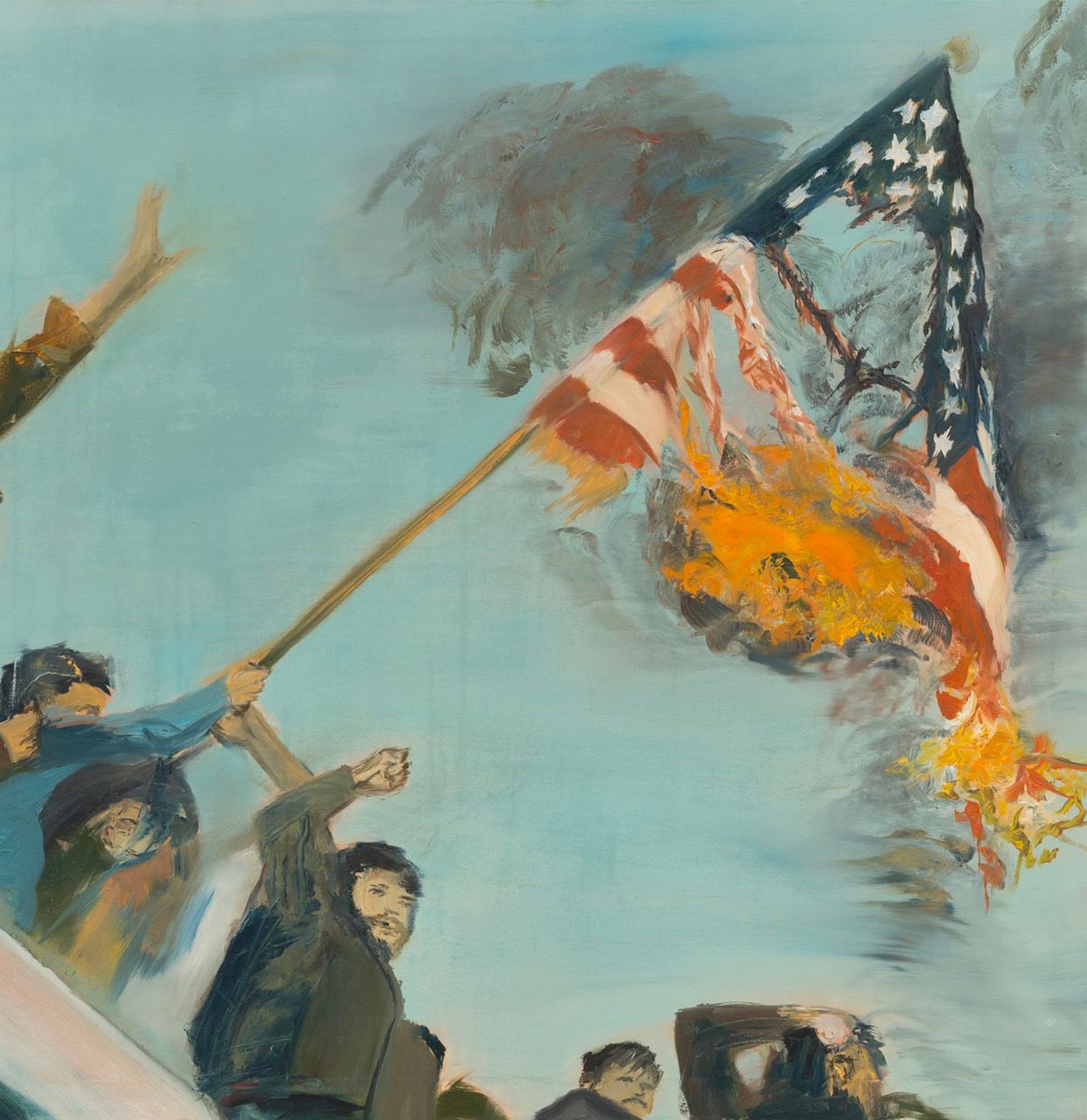
There’s an unsettling familiarity to Addanki’s paintings. Although viewers may not recognise the locations of the felled drones in US MQ-9 Reaper Shot Down in Marib (2025) or the identities of the helmeted counterinsurgents juxtaposed with the facade of the immigrant-detention centre known as Alligator Alcatraz in Border & Rule (2025), the images are nevertheless haunting. One characteristic of the new New Imperialism of the US is its routine violence: even if we have not seen those very people there, we have seen them somewhere. The affective crescendo of struggle reaches its apotheosis with a painting of men holding a burning American flag against a cheery blue sky marred by smoke. The Great Satan (2025), a rendering of the 1979 photograph of Iranian protesters atop the US Embassy in Tehran during the hostage crisis, is painfully prescient of Trump’s apocalyptic threats towards the country, which are in turn enlivened by political antagonisms that have animated decades of devastating economic sanctions.
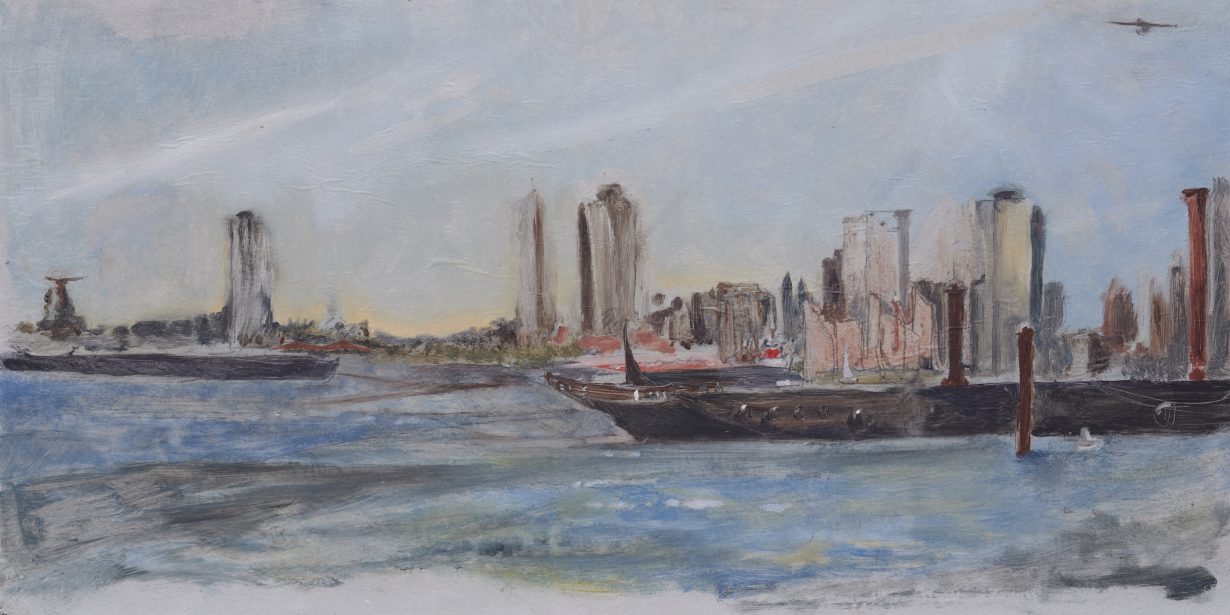
While Addanki presents the conjoined Muslim and communist antagonists of the imperial present, Planck maps out imperialism’s extractive infrastructure. Desert Study (it will be 10 pm again…) (2025) renders a familiarly patterned ‘Oriental’ rug as land unto itself: collapsing centuries of regional plunder into a Western commodity that signals access to the commercial rewards of international trade. Further subverting Western traditions of landscape painting, bucolic rolling hills and idyllic waterways are supplanted by craggy cityscapes, petroleum tankers and industrial detritus local to any coastal city with heavy industry. If landscape paintings ultimately communicate land’s sublimity and the settler’s subtextual aspirations for its enclosure, Planck explores the consequential latter with a plein-air impressionistic style that belies the fortification of cityscapes in New York, which happened to be colonised by the Dutch during their Golden Age of painting. The tall buildings in his Bush Terminal Access (CRM) paintings (2023 and 2025), so named for the intermodal-industrialcomplex-turned-First-World-War-naval-base in Brooklyn, reveal the industrial imperial dream as always already deeply financially and operationally implicated in the violence of militarism.
After September 11, John Berger deduced that, for many who take up arms against domination, despair leads to the revelation that ‘to offer one’s own life in contesting the forces that have pushed the world to where it is, is the only way of invoking an all which is larger than that of despair’. Even as American Inquisition presents images of collective anti-imperial resistance, Addanki’s painting Regime Change at the Ends of Spring (2026) – which depicts a dark-skinned man wearing a headscarf and sitting in a loaded truck bed, head resting gently in his hand, dressed in garments the same brilliant green as the Libyan flag he fights for – intercedes in its reminder of the individual, the atomic unit of struggle, that comprises the mass.
To be sure, the exhibition is incredibly on the nose: it sprints away from subtlety at every opportunity. But in a moment at which many artists and institutions falter and shroud their political commentary in generalspeak about ‘crisis’ and ‘conflict’, this urgent directness is incredibly refreshing. It is a reminder of the incredible stakes of the neocolonial violence of the US generally, and the Trump administration specifically: of the brutalities that necessarily sustain the comforts and existences of Westerners and the capital that circulates throughout the artworld.
From the April & May 2026 issue of ArtReview – get your copy.
Read next The Artworld That Cried Wolf