“What people usually call nationalism today is more often a form of political manipulation”
ArtReview sent a questionnaire to artists and curators exhibiting in and curating the various national pavilions of the 2026 Venice Biennale, the responses to which will be published daily in the leadup to and during the Venice Biennale, which runs from 9 May through 22 November.
Alexey Morosov is representing Kyrgyzstan. The pavilion is located in the Santa Catarina Church.
Celebrating Visions. Versace partners with ArtReview to share stories from the 2026 Venice Biennale.
ArtReview Tell ArtReview what you plan to exhibit in Venice. What has influenced or inspired you?
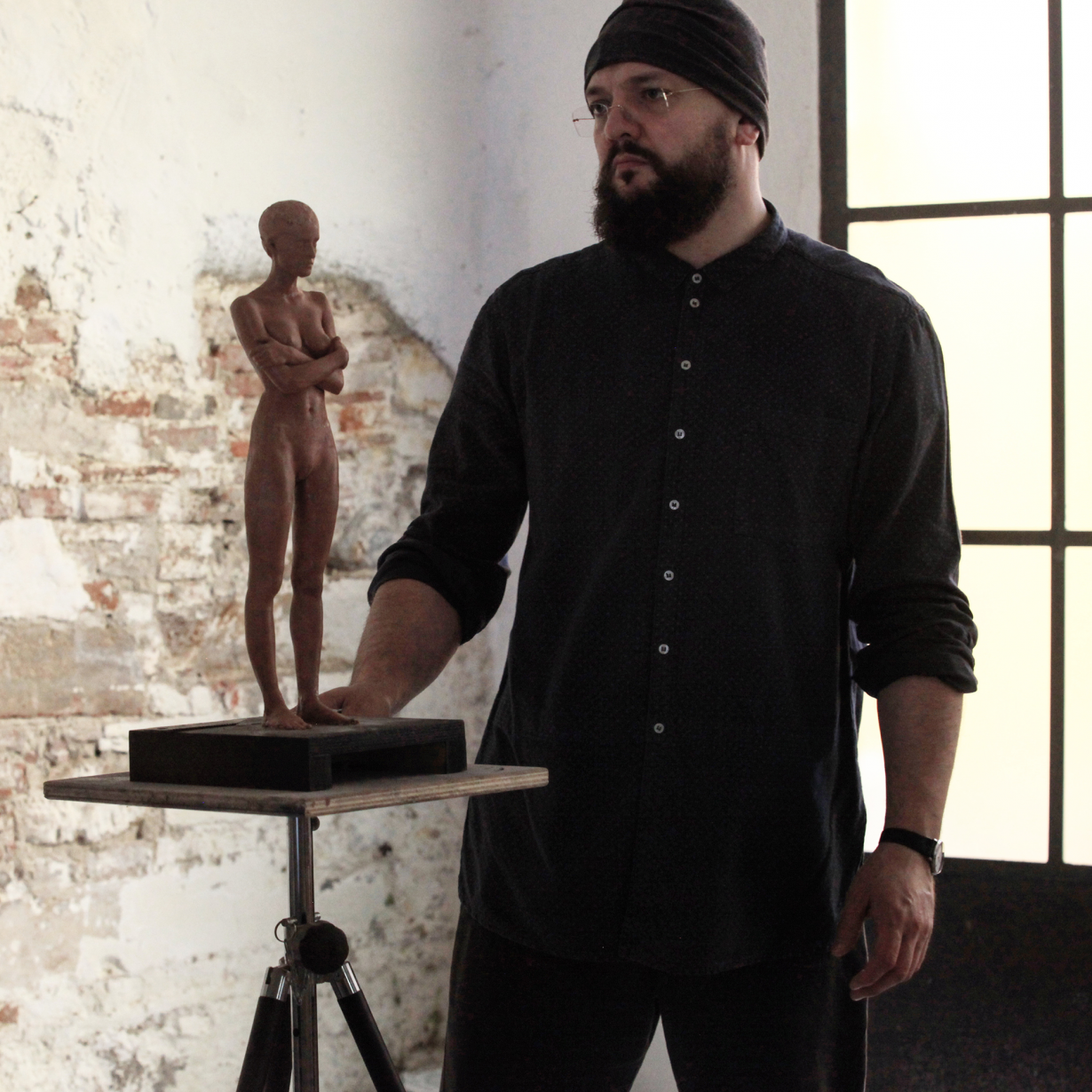
Alexey Morosov I will be presenting a site-specific installation titled BELEK. It is conceived as a complex spatial system that brings together sculpture, video and painting, while the architecture of the Church of Santa Caterina itself acts as the binding element – the single body of the project.
The sculptural elements are made from terra cruda (unfired clay, known in Central Asia as saman) and poplar, a highly symbolic tree in my homeland. I have modified and modernized this ancient technique to make it technologically relevant to the demands of contemporary sculpture. I experiment extensively with various technologies, as I enjoy infusing traditional media with a high-tech spirit. For me, engineering in art is a fundamental method.
The space is further expanded by a massive 8K video fresco built on a stark visual contrast: footage of the ancient equestrian game kok-boru collides here with brutalist dams that resemble cyclopean water altars. Finally, the painting located directly in the church’s altar anchors the work, engaging with the historical memory of the site and the visual legacy of Paolo Veronese. This entire structure is a tool to expose ontological questions through contemporary art, which I view as a form of visual philosophy.
AR In what ways (if at all) does your work relate to the theme of the Biennale exhibition, In Minor Keys?
AM Whenever I approach a project, I always rely on a certain tonality, almost like in music, so the theme of this Biennale feels very close to me. BELEK directly addresses the issue of water resources and the complex relationships built around them.
In Central Asia, water isn’t an abstract issue; it is a very concrete, often tense reality. The choice of materials and imagery here is deeply symbolic. The clay (terra cruda) physically depends on water, while the video fresco with its brutalist dams – these ‘water altars’ – emphasizes the scale of human dependence on the elements. This isn’t a subject for loud declarations. Instead, it is an attempt to use the tactility of saman, the raw energy of kok-boru, and the monumentality of the dams to convey the underlying, ‘minor’ conditions that actually shape our existence.
AR Why is the Venice Biennale still important, if at all?
AM There are plenty of international art forums, but for sheer scale and density of meaning, Venice has no equal. It is a space where each country tries to articulate its grasp of the present moment.
Art moved past the logic of ‘showcases of achievements’ a long time ago. Today, its role is much broader: it wrestles directly with reality and its contradictions. In that context, the Biennale remains a completely unique platform. Furthermore, it is an institution with a massive history and a specific spirit – a kind of ‘terroir’ that simply cannot be replicated anywhere else.
AR What role does a national pavilion play at a time of increasing confrontational nationalisms?
AM The era of nation-states in the classical sense ended in the last century. Today, the borders between economies and global structures are incredibly blurred. What people usually call nationalism today is more often a form of political manipulation.
The role of art is the exact opposite: not to reinforce barriers, but to overcome them. For me, a national pavilion isn’t a manifesto of isolation, but a point of articulation. It is an opportunity to speak from a specific context without being confined by it.

AR Who, for you, is the most important artist (in any discipline) that your country has produced?
AM For me, there are two foundational figures: Chinghiz Aitmatov and Dinara Asanova. They both worked within the Soviet system but managed to step outside of it.
Aitmatov was a thinker who wove nomadic tradition and modernity into a cohesive system. A pivotal moment in his recognition was Louis Aragon’s French translation of Aitmatov’s novella Jamilia (1958). It was an honor for me to create a monument to Aitmatov in Rome, as a continuation of that cultural dialogue. Asanova was a filmmaker with an incredibly sharp vision; her ‘romantic neorealism’ still feels vastly underestimated to me. Both are vital because their work sounds global while entirely preserving the internal structure of its local context.
AR What is something you want people to know about your nation that they might not know already?
AM For many, Kyrgyzstan remains a blank spot on the map. Yet it is a territory with incredibly deep roots, sitting right at the center of the Eurasian Silk Road. Geographically, it is predominantly mountainous – around 90 percent of its territory is covered by the Tien Shan mountain ranges. That landscape shapes not only the visual environment but the very scale of how people think. But the country’s true wealth is its people, with their profound sense of inner freedom and tradition of hospitality. BELEK is my way of making this context visible.
AR Do you think art is a universal language?
AM Absolutely. I’ve never been interested in defining an artist by a national label. An artist is, first and foremost, their position and their work. It is important to distinguish between folklore and contemporary art. In the former, identity is the center; in the latter, it is present as a texture, but it is not determinative.
AR What, other than art, are you looking forward to seeing – or doing – while you are in Venice?
AM Having lived in Italy for many years, I can experience Venice beyond its touristic dimension. One place that holds special meaning for me is the island of San Michele, especially during the times when the temporary pontoon bridges are built. It possesses a very specific atmosphere, almost outside of time. And of course, the Biennale is a rare opportunity to reconnect with artists, curators and friends I might not have seen in years.
AR Can art really change the world?
AM It constantly does. But not through direct action – rather, through shifts in perception. Perception ultimately determines how people think, how they build relationships and why they enter into conflicts.
Many political or economic processes actually have an underlying aesthetic dimension. People are drawn to images and ways of life that seem appealing to them primarily on an aesthetic level. In this sense, art, as the foundation of aesthetic evolution, indirectly shapes the conditions in which change becomes possible.
The 61st Venice Biennale runs 9 May through 22 November 2026