Is it populism or profit that’s catching the eye of Philadelphia’s Rocky-obsessed cultural tiger, wonders Jenny Wu
According to the Philadelphia Museum of Art’s latest publicly released strategic plan, the museum aims to ‘increase average annual attendance to more than one million visitors within five years’. In an attempt to court these audiences, the PMA embarked on a botched rebrand in 2025, which coincided with the firing of the museum’s CEO and director. It has since turned to Rocky Balboa for guidance.
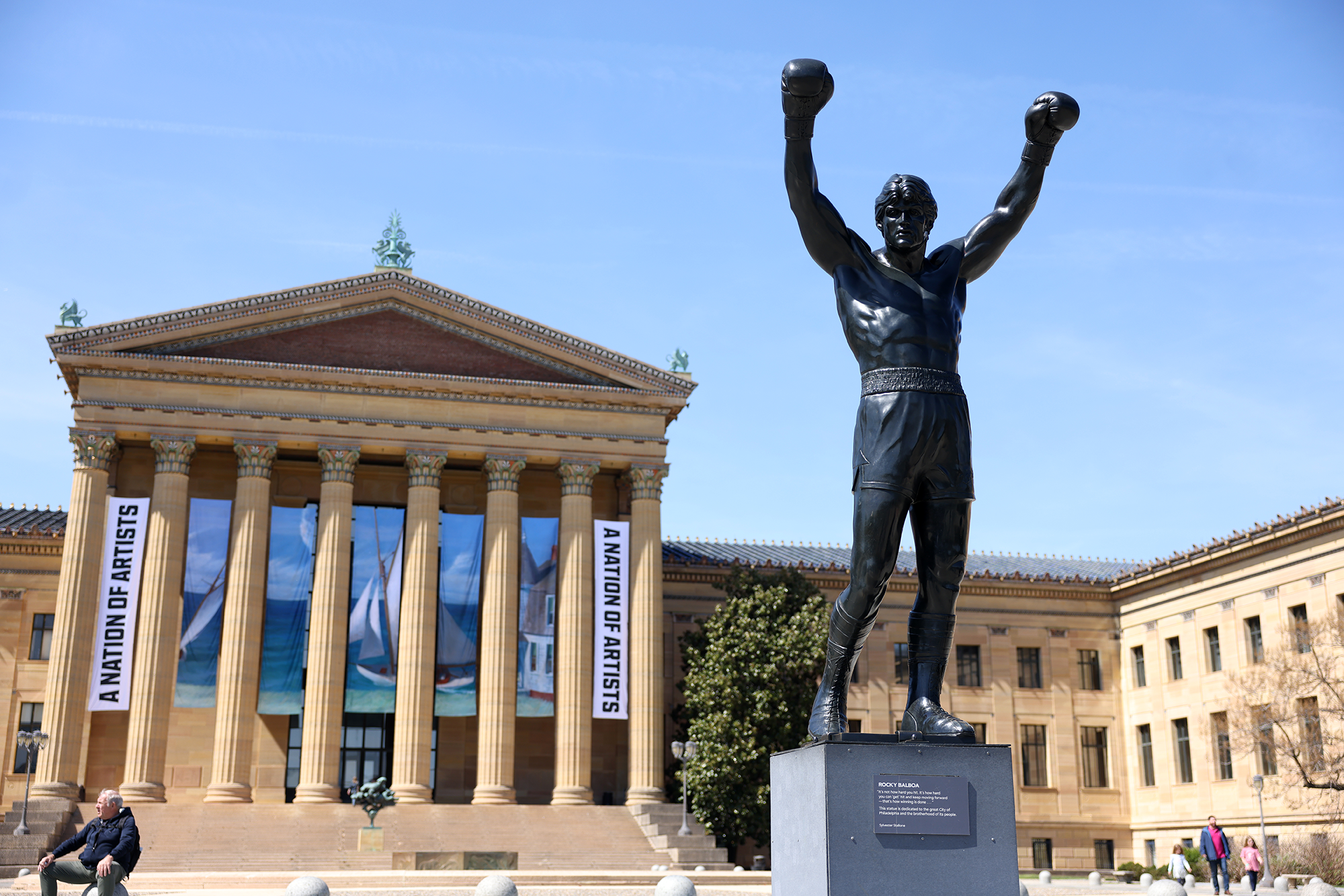
The exhibition Rising Up: Rocky and the Making of Monuments contextualises the bronze statue on the museum’s front steps, which commemorates the fictional Philadelphian heavyweight played by Sylvester Stallone, amid 2,500 years of art about boxing, celebrity, community and self-invention. Cast by A. Thomas Schomberg and modelled after Stallone, the world-famous effigy, which receives upward of four million visitors a year, stands about 2.6-metres tall and depicts Balboa with raised arms, in boxing trunks and gloves. Stallone commissioned it in 1980 for the set of Rocky III (1982), the third instalment of the Rocky movie franchise (1976–), alongside two other fullscale casts, one of which the actor owns. In the movie, the statue is unveiled during a triumphal ceremony with a marching band and a cheering crowd. In reality, it did not receive such a warm welcome: after filming wrapped and Stallone donated the bronze figure to the city, the PMA, known for its Picassos, Cézannes and Renoirs, briskly expelled the pop-culture novelty from its Greek Revival facade. Rocky went to the Spectrum sports complex in South Philly, then into storage, only to return to the museum, thanks to a vote by the Philadelphia Art Commission, in 2006.
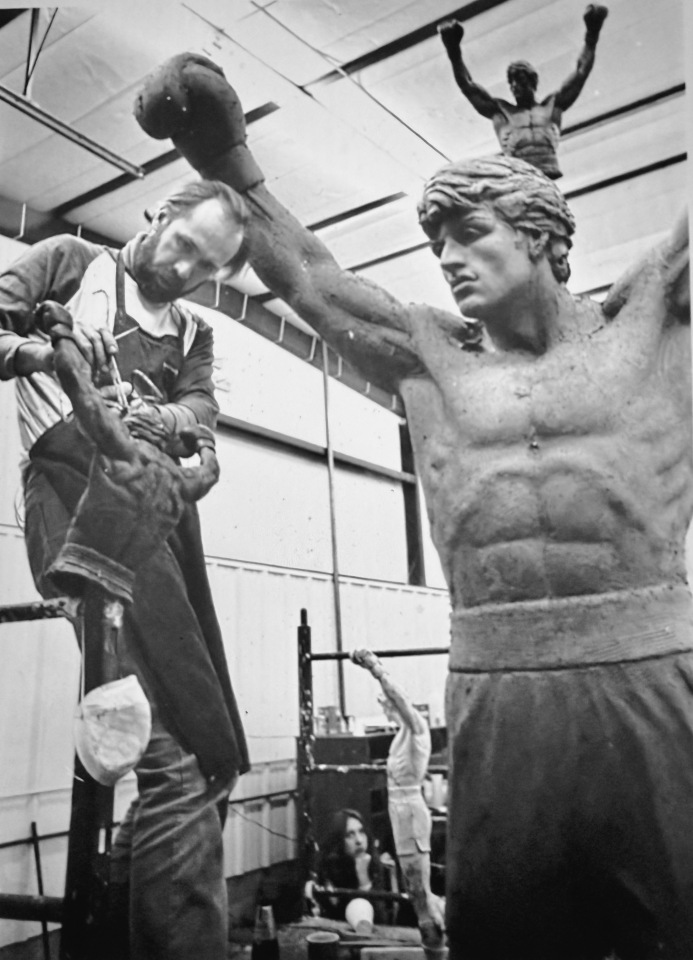
On a warm day in April, I watched adults and children sprint up the museum’s neoclassical steps – something Balboa does in several of the Rocky movies – towards the statue standing in graceful contrapposto (in the catalogue for Rising Up, Schomberg writes, ‘It was important for me that this figure be classical in nature, meaning physically perfect’). A man in a heavy-metal T-shirt and red sweatpants posed with Rocky – arms raised, fists clenched. Afterward, while another visitor – there was a queue – assumed the same stance in his place, red-sweatpants man dropped down and began doing inclined pushups on the steps, as if unwilling to give up the spotlight. Such quaint choreographies inspired by the statue are well documented: in the catalogue are photos of unnamed visitors similarly sprinting up the steps and posing like Rocky. Keith Haring is there, too – shirtless, arms stretched skyward – and so is the exhibition’s curator Paul Farber as a child, standing with four other boys, all of them flexing their biceps.
The spectacle on the museum steps reminded me of Siegfried Kracauer’s 1927 description of the Tiller Girls, synchronised dancers whose legs – which the German-Jewish theorist compares to the hands of factory workers – ‘swing in perfect parallel’ and whose torsos press together to form a mechanistic pattern of mimicry, which Kracauer called a ‘mass ornament’. Inside the exhibition, boxers, too, proliferated like patterns across time and space. Two men fighting on a Greek amphora reappeared as a pair of African terracotta statues, and again in an Eadweard Muybridge collotype. Red mitts linked the Iranian woman photographed by Newsha Tavakolian to the Black boy in Johannesburg pictured by Bieke Depoorter to the Afghan refugees in an underground boxing club in Kabul, documented by Thomas Dworzak. As before, visitors queued for photos with the Rocky statue at the centre of the exhibition (Stallone lent his so that the museum could have two – one inside, one outside).
In his essay on the Tiller Girls, Kracauer argued that although some may shun the mass ornament in pursuit of ‘edification at art events’, these patterns of mimicry reveal more about the character of a community – and the economic system that sponsors its pastimes – than ‘artistic productions which cultivate outdated noble sentiments’. A century later, Rising Up grapples with the still-present, problematic and inherently political rivalry between so-called high and low culture, as well as with how the human body has been trotted out throughout history – particularly with the aid of the mass entertainment industry – as a spectacle for moral education, propaganda and distraction. But suppose the exhibition succeeded in closing the gap between these two factions of culture by bringing scores of Rocky enthusiasts into the galleries. It matters little, in the end, whether the choreography of their pilgrimage leads them inside or stops them on the front steps, if they are conditioned by a system that views bodies – those of boxers and museumgoers alike – as merely quantifiable instruments of profit.
Rising Up: Rocky and the Making of Monuments is on view at the Philadelphia Museum of Art through 2 August