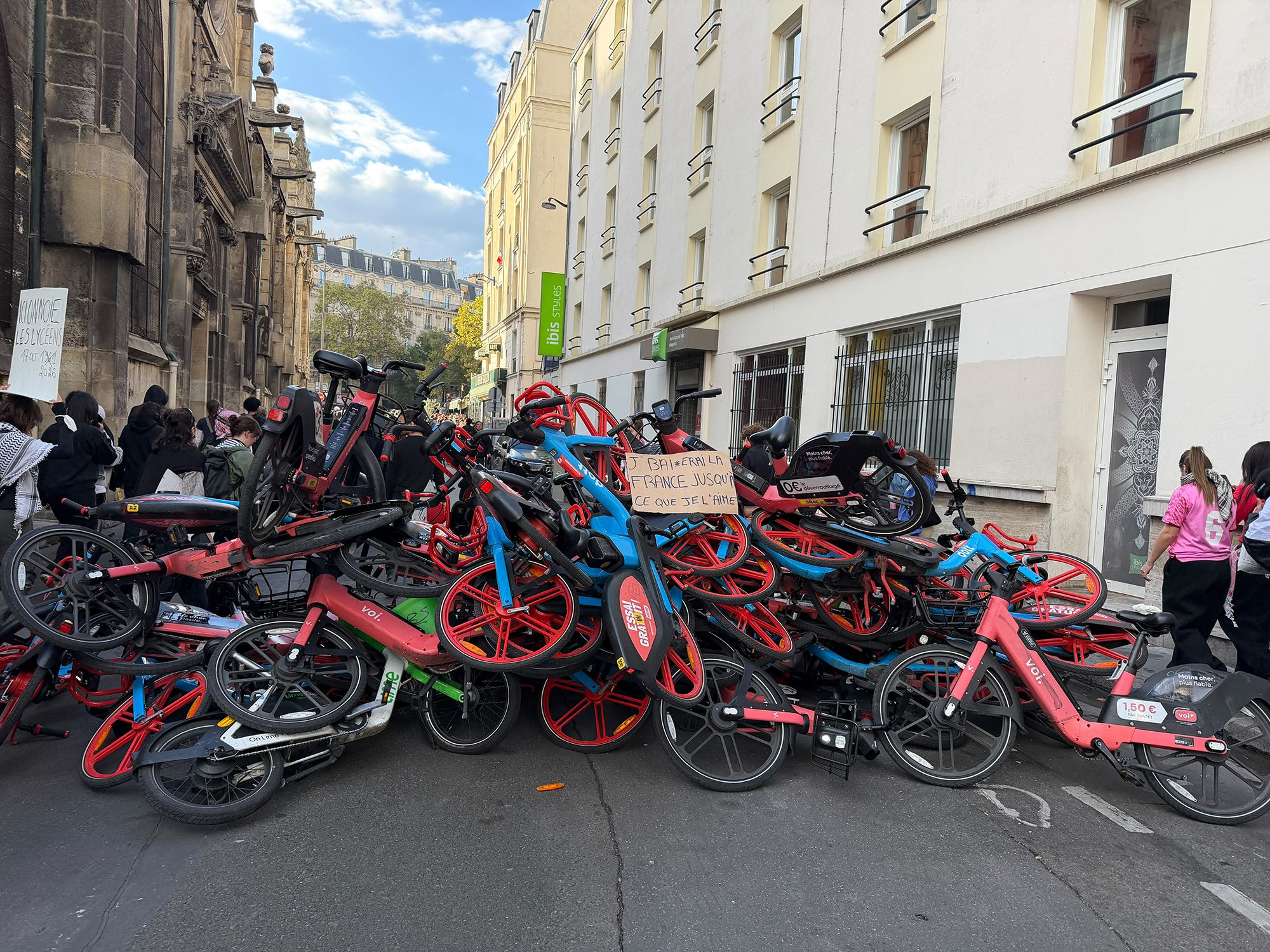
That this Autumn’s riots in France have occurred – and that the artworld, ever keen to wash its hands of politics when unable to dictate them, ran scared – can be seen as nothing else but inevitable
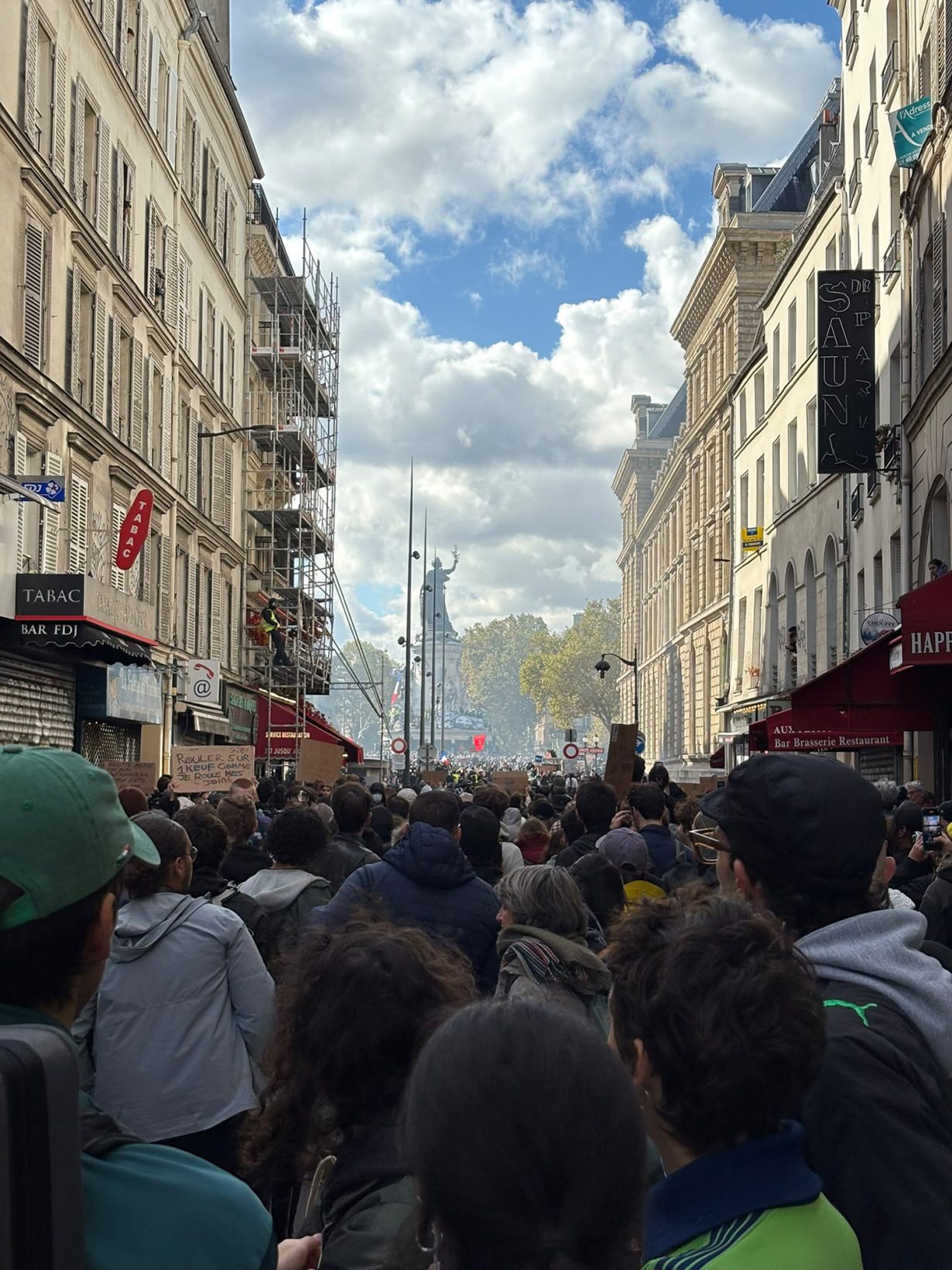
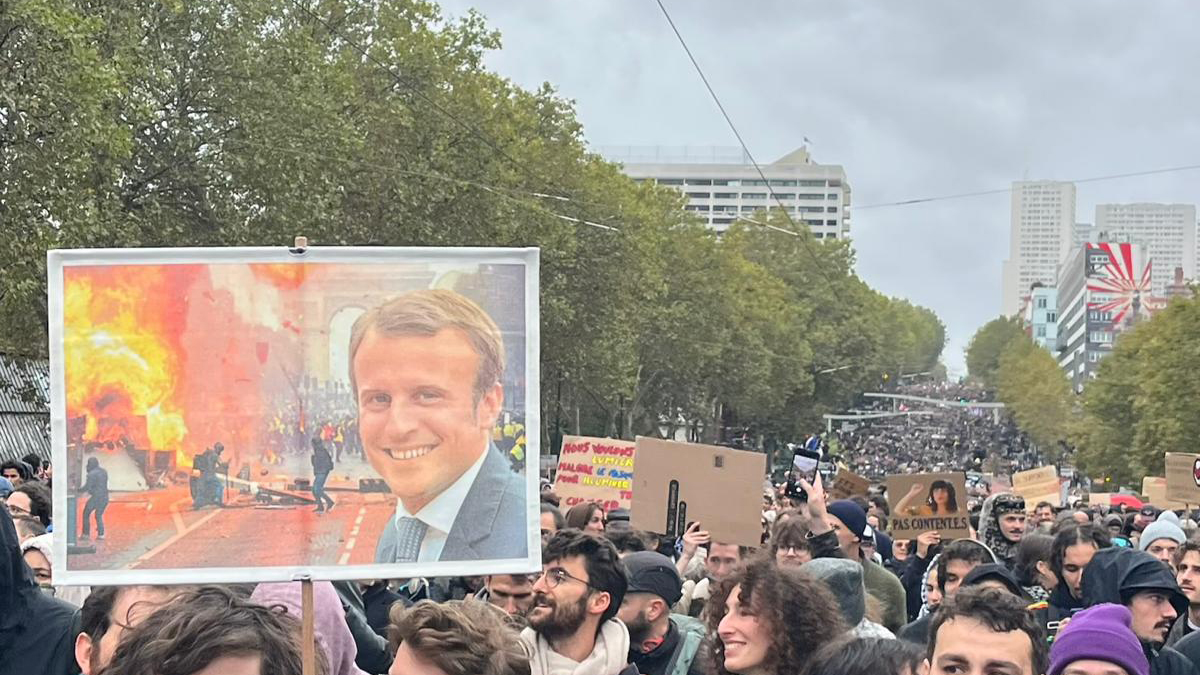
‘I was scared to come so I’m here,’ read one of the placards held up by a teenager at the protest that brought hundreds of thousands of people onto the streets of Paris last Saturday. On another was a photomontage of French President Emmanuel Macron, smirking, with the Champs-Élysées on fire behind him.
Also scared were the dons and doyennes of the Art Basel Paris art fair, a shopping mall for the world’s visiting elite, which opted to close before the protests for the ‘safety of everyone involved’. Because, in the space of a few weeks, what began as a high-school-student movement demanding better learning conditions has escalated into nationwide civil unrest, reaching a violent head on 17 October. The students’ concerns were pretty reasonable: deteriorating school conditions, a shortage of teachers and the pressures of Parcoursup, France’s algorithm-based university admissions platform.
As the government continued to ignore them, long refusing to meet with student representatives, the movement grew wider and angrier, eventually becoming a much broader expression of dissent over the rising cost of living, deteriorating public services and a president who is behaving increasingly like a monarch (Sus au roi! – down with the king – was a recurring protest slogan of these marches). Teachers, health workers, firefighters and former gilets jaunes joined the mobilisation; university students set up blockades and occupied campuses. Taken together, their grievances paint a pretty bleak picture of France after almost ten years under Macron: public services starved of resources, further cuts to education and culture, and environmental policies that continue to favour short-term economic interests over ecological concerns. Meanwhile, the president’s government has slowly but surely brought far-right ideas into the political mainstream, normalising anti-immigration and hardline security rhetoric, and bringing its proponents closer to power. The next presidential election is just six months away.
No longer able to ignore the movement, the government reached for a familiar solution: violent police repression. On 24 October, 70,000 police officers and gendarmes were deployed nationwide, backed by specialist tactical units and armoured vehicles, who unleashed water cannons, teargas, stun grenades and rubber bullets on the public. Their violence has left dozens of teenagers with life-changing injuries: a fifteen-year-old in Lens lost a hand after being struck by a stun grenade; another teenager had his jaw shattered after being hit at close range by a grenade launcher. Yet the president, his interior minister and large portions of the media have gone to almost absurd lengths to highlight the tragedy of the damage inflicted by the casseurs, or rioters. The leftosphere responded online, offering its deepest condolences to the families of the dustbins burnt on 17 October.
What received rather less attention were the claims at the heart of the protests, or the social conditions that brought France to this point. Both in 2023 and 2024, 9.8 million people in metropolitan France were living below the poverty line – 15.4 percent of the population, the highest rate since the country’s Institute of Statistics and Economic Studies began measuring in 1996 – while income inequality reached a record high. Rather than addressing these underlying conditions, increasingly influential rightwing media voices have coopted the protests to fuel anti-immigration and Islamophobic discourse. On TV, far-right politician Éric Zemmour described the looters as “hordes of Maghrebi and African barbarians entering the cities”. On 23 October a gunman armed with a submachine gun opened fire from his car window in Trappes, a banlieue southwest of Paris, killing French MMA fighter Pengo Bossio Wangi and wounding five others. He reportedly told investigators that he wanted to avenge shopkeepers targeted during the looting on 17 October, and had deliberately set out to shoot Black people and Arabs.
As one of the hundreds of thousands of protesters who have marched in Paris and Toulouse – where I live – since the movement began, I have mostly seen peaceful crowds dancing, accompanied by brass bands and carrying placards that are both hilarious and brutally lucid. And, perhaps more surprisingly, teenagers waving French flags and bursting into ‘La Marseillaise’. What I have also witnessed, as I have over the past ten years of protesting, is the overwhelming and disproportionate use of force: crowds of unarmed citizens kettled – surrounded by police and prevented from moving freely – before being charged and teargassed; police searches at the start of marches, with protective equipment including swimming goggles, masks and saline solution used to mitigate the effects of teargas confiscated; and racial slurs directed at protesters by officers. And then there is the staggering number of arrests: 8,000 in a single month – a figure that anthropologist Chowra Makaremi pointed out in a recent interview with Equator was ‘surpassed only by events like 17 October 1961, when police detained over 12,000 Algerians in Paris, killing hundreds and throwing their bodies into the Seine’.
At the heart of the storm, rampant wealth. Art Basel Paris in the Grand Palais proceeded almost as usual – until it didn’t. The fair recorded millions in sales in its first days, as collectors came and went while the protests raged outside. Within the fair, the unrest was largely discussed in the same terms as the government’s response: as a problem of public order. On 22 October the fair announced that it would close two days early, citing the need to protect visitors, exhibitors, staff and artworks from demonstrations planned for the weekend. One post, widely shared on Instagram, targeted the fair itself: the collective Pillage de Classe called for the ‘reclaiming’ of the Grand Palais, denouncing Art Basel Paris as a ‘plundering fair’ that allows the superrich to shield their wealth from tax.
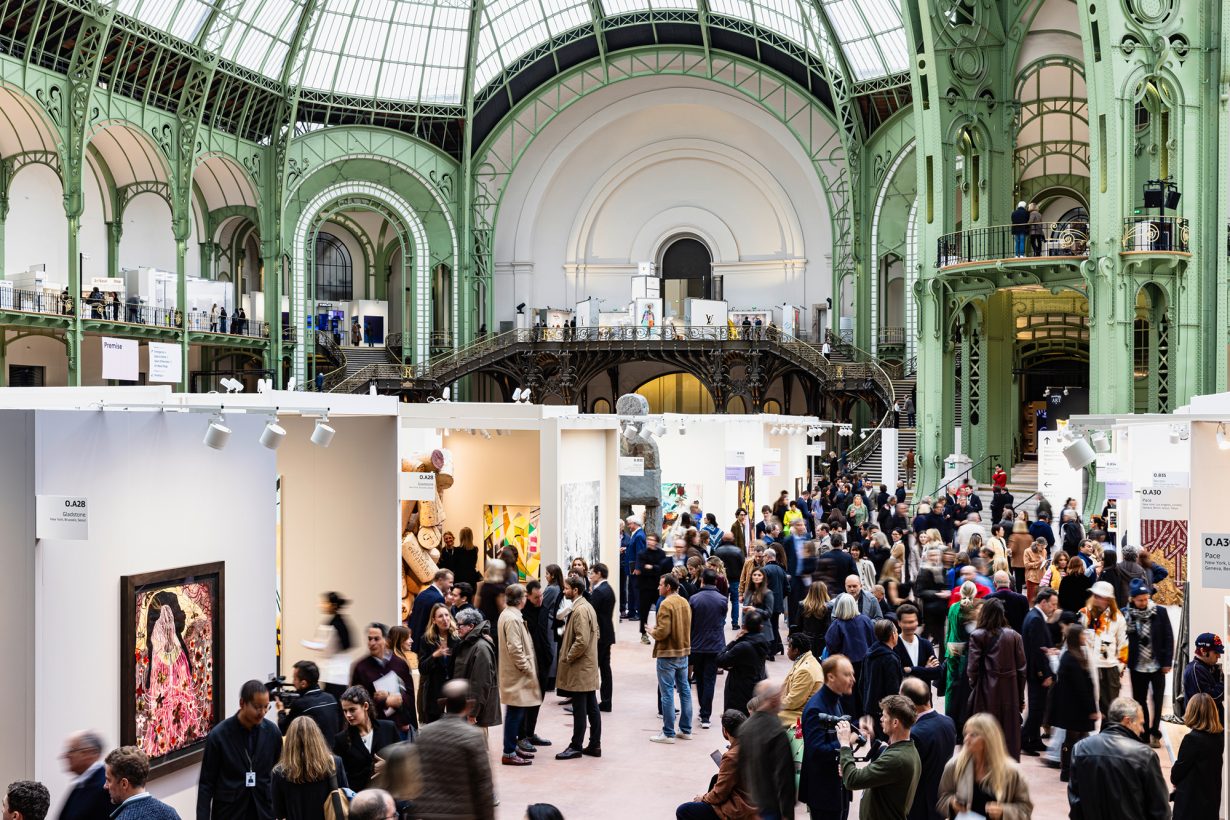
That a commercial machine like Art Basel should remain largely indifferent to the social realities of the city it descends upon for a week each year comes as no surprise. The artworld has long been good at turning rebellion into a selling point, celebrating radical ideas while happily profiting from the very inequalities they seek to challenge (‘The artworld loves rebellion provided it’s framed, insured and hanging in a gallery’, goes a meme). The protests brought into sharp relief the inequalities that Art Basel can usually afford to keep at a distance. The fair didn’t cause this unrest, of course, but its presence in Paris became a striking symbol of the concentration of wealth and power against which so many are protesting. Where’s all the money gone? Well, here’s one hiding place.
As I write, the protests continue, and I doubt the movement will subside so easily, intimidation notwithstanding. I may be scared to go out and protest, too, but I’m galvanised by a generation refusing to have its future decided for it. The presidential election is six months away; the fight over what comes next has barely begun. Standing on top of a bus stop, a kid held up a sign that read ‘Gen-Z vaincra’. Gen Z will prevail. A bold claim, perhaps, but one worth fighting for.


