What can art tell us about a country where ‘excess death’ has become the fait accompli of contemporary life?
Bioscleave House (Lifespan Extending Villa), privately commissioned in 1998 and completed in 2008 in East Hampton, is the only architectural project the late artists Arakawa and Madeline Gins realised in the US. In photographs, the four rooms of the single-family residence fan out from a central, green-ceilinged common area – the ‘meadow’, as they called it. The meadow is surrounded by undulating walls that, like the house’s exterior, have been painted in bold blocks of green, blue, red, yellow and purple. Its centre dips down to form a basin where the kitchen –the ‘campground’ – fits snugly amid a terrain as bumpy as the back of a toad, with fireman’s poles staked throughout to aid in the occupant’s climb from one area of the living space to another.
Circa 1980, following a decade of inflation and, particularly in the US, inflating healthcare costs, the artists began looking for ways to combat mortality through architecture made in service of the body. Your house can be your “physician” and your “ally”, Gins declares in a video for their Reversible Destiny Foundation. As with their handful of previous architectural projects, such as a ‘fantastical’ themepark in Yoro, Japan, and an enigmatic apartment complex in Tokyo – all designed to stimulate one’s immune system and reverse ageing through exposure to various somatic challenges – a list of ‘Directions for Use’ accompanies Bioscleave House. ‘The floor/terrain is a keyboard that is in the process of being invented,’ one directive states. ‘Try to help figure out what type of keyboard this is. Once in a while play upon this keyboard with your hands as well as your feet.’
Gins was born on Long Island in 1941 and passed away in Manhattan in 2014. Arakawa, five years her senior, had been a member of the Japanese avant-garde art collective the Neo-Dada Organizers before he moved to New York in the 1960s with, as the story goes, little besides Duchamp’s phone number and a mantra, allegedly lifted from Natsume Sōseki’s satirical novel I Am a Cat (1905–06): it went something like, ‘I’ve decided not to die.’ Over the course of their lifelong collaboration, beginning in 1963, the pair presented shows in North America, Europe and Asia with titles like Architecture Against Death (2004) and coauthored books such as Making Dying Illegal (2006); in late September, a posthumous survey of their work titled The Poetic Jump opened at the American Academy of Arts and Letters.
Bioscleave House sold for $1,250,000 upon its completion and has since been relisted multiple times. In 2023, it went for $800,000. I figured I’d be sated by a glimpse from the road, through the trees, of the broad, flat roofs on the four jutting wings. When I arrived, I saw a green industrial dumpster in the driveway. Before me, the life-extending villa stood in full view, its paint dull and peeling, wrapped in stale silence. My feet carried me forward until I saw, through the screen windows, a tableau of exposed wiring, spray-foam-encrusted ceiling beams, stripped walls and blue tape. Not even a life-extending villa is impervious to the elements and to change.
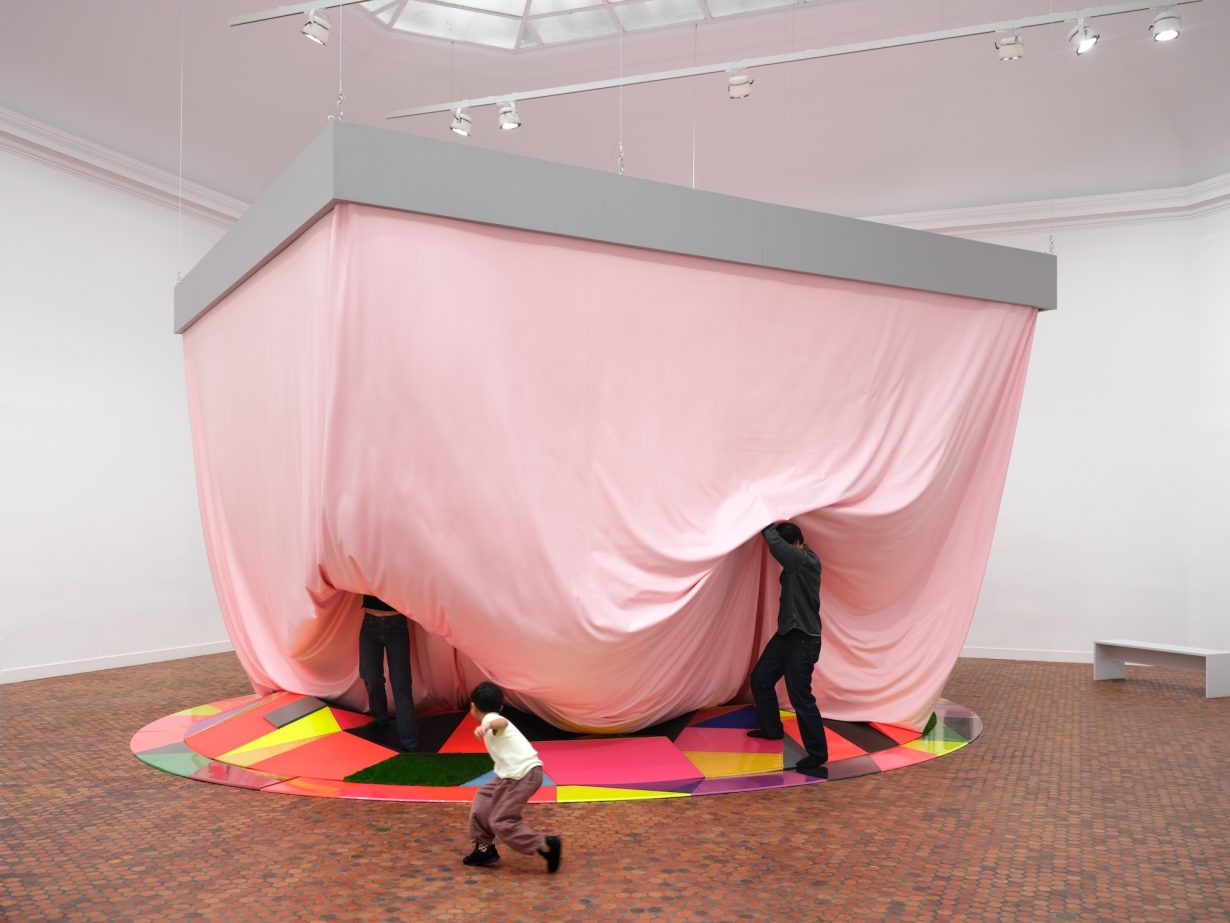
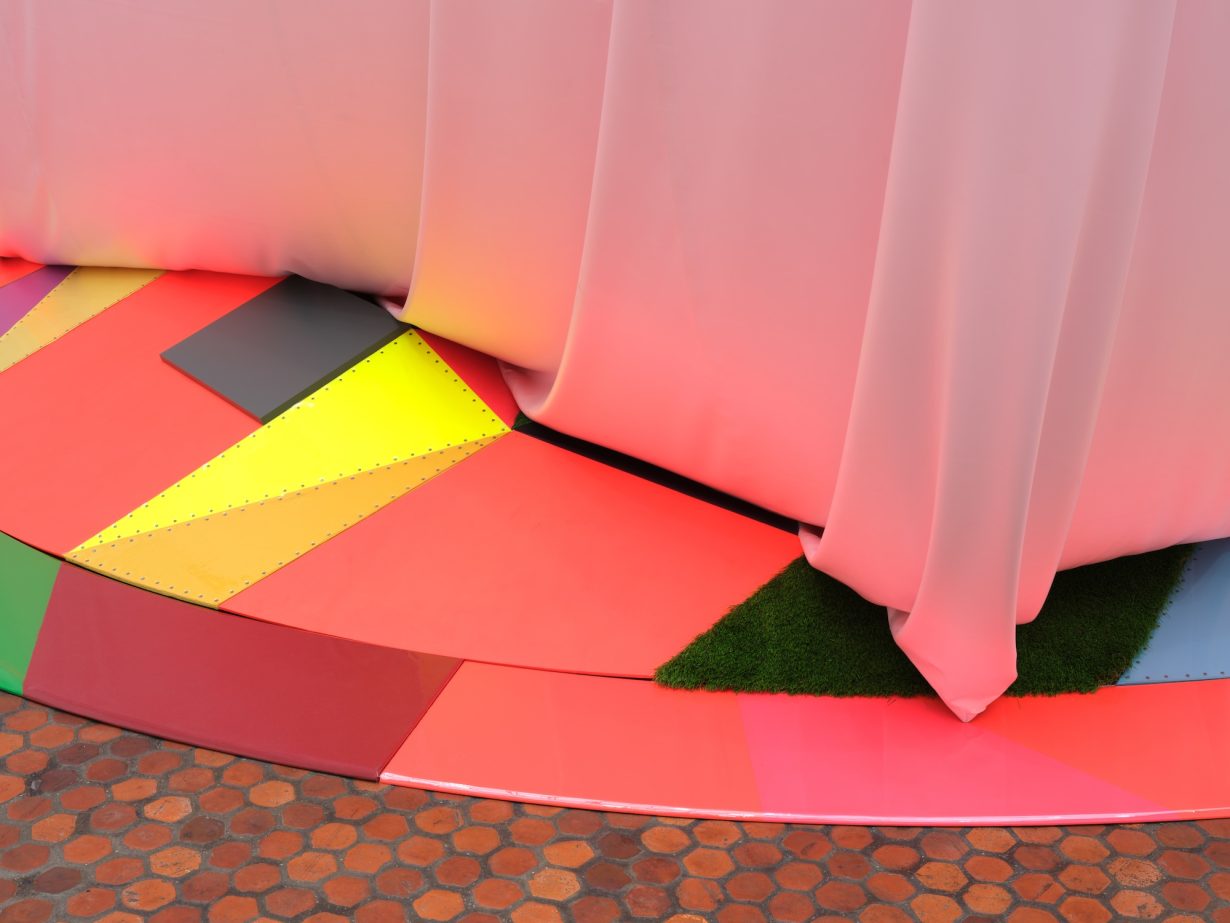
Had I gone inside before the renovations began, I can imagine that the house’s sensorial peculiarities would have boggled me the way the couple’s architectural prototype Ubiquitous Site X (1987–91/2026) did at Arts and Letters. Imagine a gigantic swim cap suspended upside-down over a platform that covers an area of about four California King beds. Once beneath it, you find the sheet of latex to be heavier than it appears. It wobbles and slaps you as you slump under its weight, onto the jagged platform (imagine crawling on a pile of Lygia Clark’s Bichos). Your body becomes something of a caryatid – or a pea under a mattress.
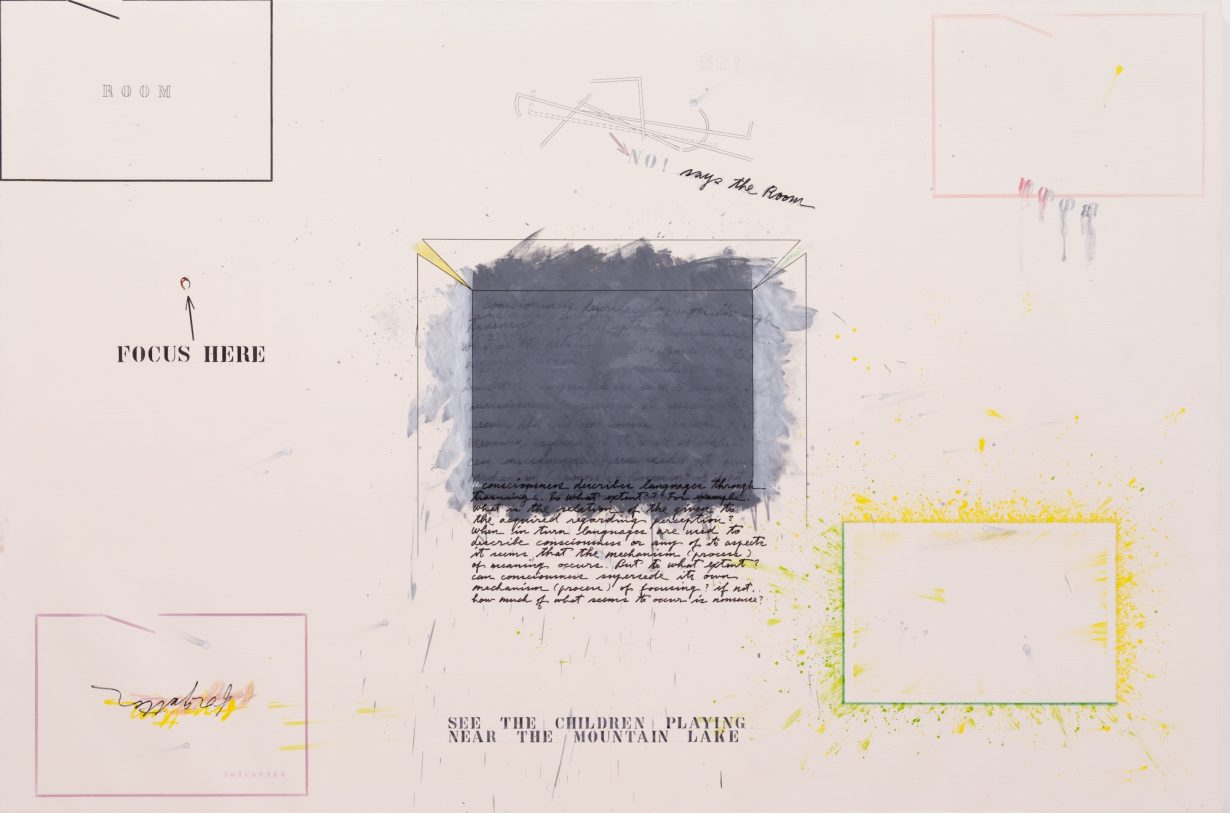
In their 2002 book Architectural Body, Arakawa and Gins introduce the neologism ‘bioscleave’ as an alternative to ‘biosphere’, which for them failed to capture the dynamism of the world as they saw it. They also describe a ‘ubiquitous site’ as ‘everywhere you have landed or could land’. By ‘land’, they mean, in a literal sense, the act of registering a point of physical contact between one’s body and environment. A ‘landing site’ – a phrase Arakawa and Gins have used to title some artworks or describe others such as Stuttering God (1988–90), an installation meant to be navigated in total darkness – is defined more abstractly on their foundation’s website as ‘a kind of destination where the self is constantly reborn’.
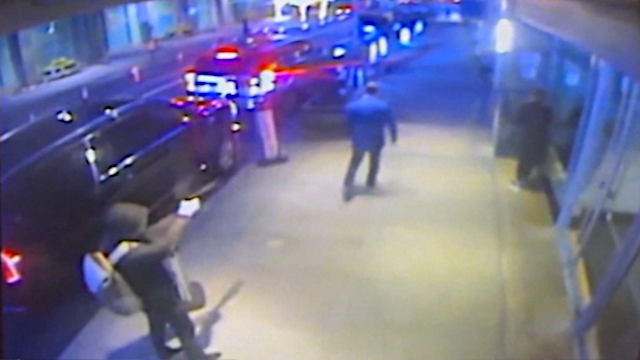
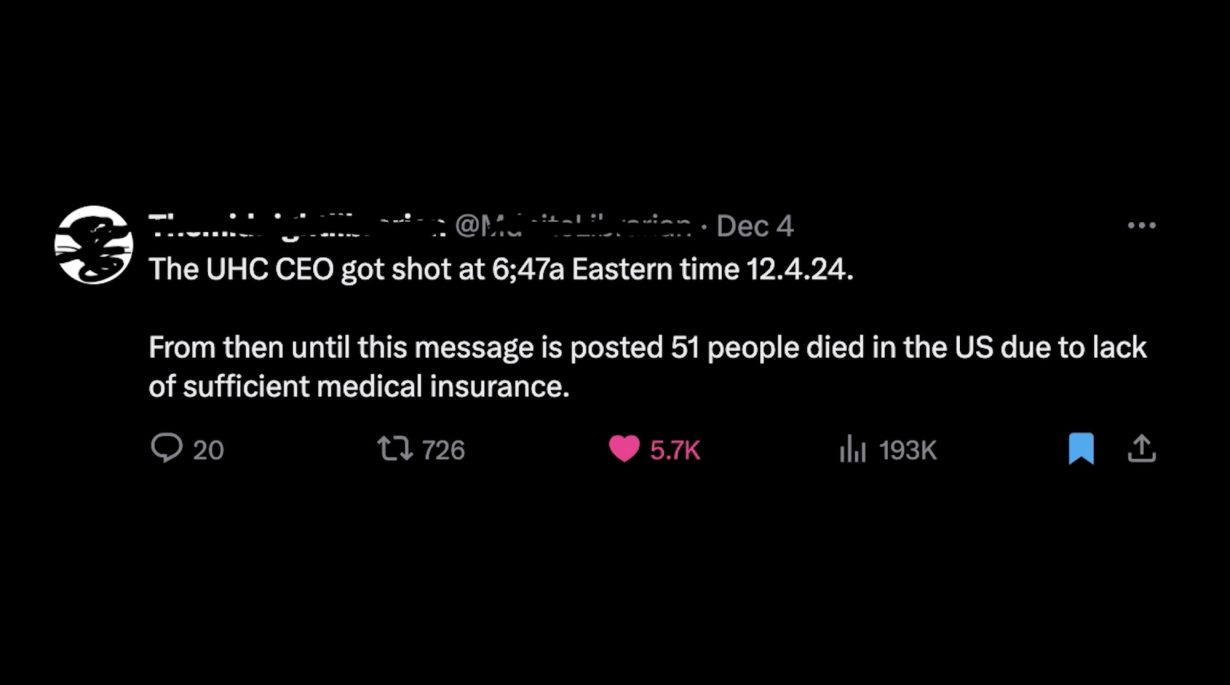
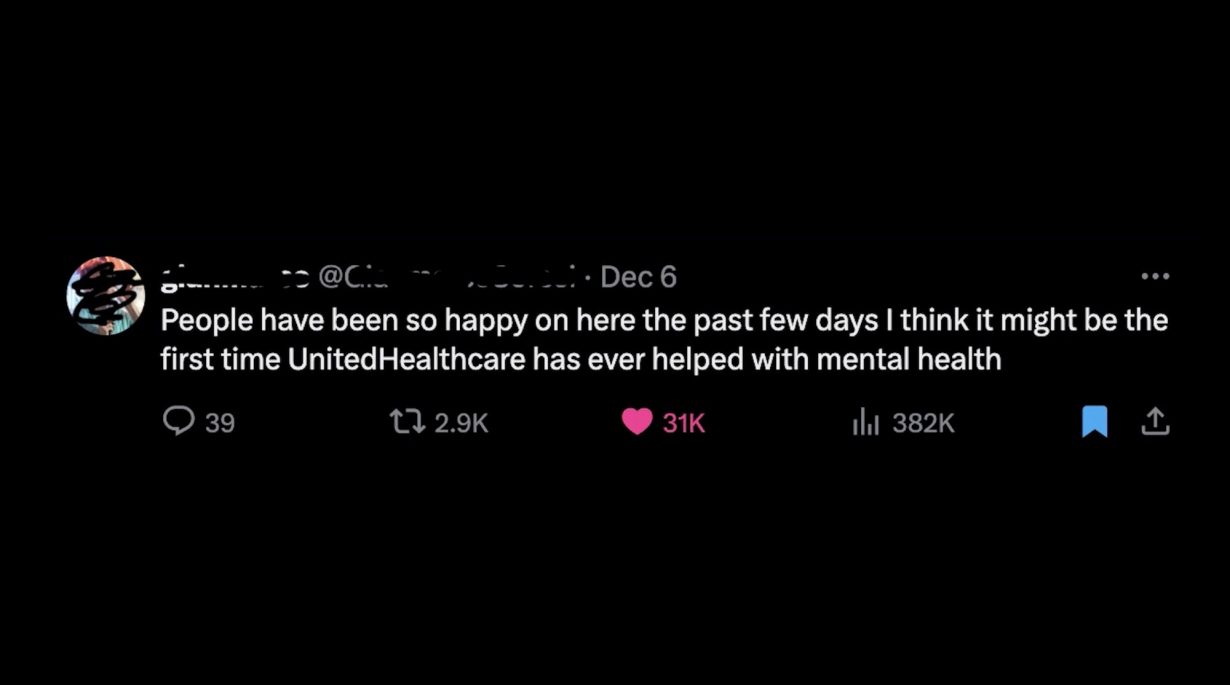
Oddly enough, I thought of landing sites during a screening of Stanya Kahn’s short film Deny, Defend, Depose (2026) at Woodbine in mid-October. The film is a montage of social media posts celebrating Luigi Mangione’s 2024 killing of UnitedHealthcare CEO Brian Thompson, shared by users spanning the political spectrum. It opens with a few seconds of security footage: Mangione opens fire, Thompson lists and stumbles, spins around, grabs a wall for balance, but swiftly collapses, landing on the sidewalk in front of a Hilton hotel in Midtown. Today, this length of concrete looks spectacularly unmonumental. There seems to be nothing out of place save for – and these could have been present before the shooting – laminated signs by the hotel’s entrances forbidding trespassing and demonstrations. But in those seconds of security footage, the flat concrete, given a urine-yellow cast by the camera, looks radioactive with foreboding.
After the screening, members of the December 4 Legal Committee, a group formed to raise funds for Mangione’s legal defence, joined Kahn on a panel to promote their new book, Depose: Luigi Mangione, the Right to Health, and the Unfinished American Revolution (2026). Expanding on a note found in a backpack recovered in Altoona, Pennsylvania, often referred to as ‘Luigi’s Manifesto’, part of which reads, ‘A reminder: the US has the most expensive healthcare system in the world, yet we rank roughly 42nd in life expectancy’, the authors of Depose open their book by writing, ‘Every single year since 2015, the number of excess deaths in the US’ – those above the level expected in a comparably wealthy country with universal healthcare – ‘has exceeded all American military deaths in both World Wars combined… Roughly 70,000 deaths in 2023 alone are attributable to the uniquely American system of healthcare,’ one that prioritises returns to shareholders over patients’ well-being. If, as the authors argue, the bipartisan celebration of Thompson’s death is sufficient evidence of a shared sense of justice that could lead to the revolutionary reconstitution of health as common property, then that nondescript sidewalk could indeed have been the birthplace of a new political consciousness. When I brought up Mangione at an opening at Subtitled NYC, a friend responded with a story about his students debating whether the vigilante was physically attractive.

How meaningful is it today to say, ‘I’ve decided not to die’, in a country where ‘excess death’ has become the fait accompli of contemporary life? Where eccentric houses are constructed to prolong the existence of some while others struggle to afford essential medications. To be sure, it was never clear if Arakawa was completely serious in his proclamation and if he and Gins believed Bioscleave House to be literally life-extending or simply life-enriching, like any artwork. Upon further inspection, it appears that the original statement in Natsume’s novel is uttered by someone trying to fend off an insurance salesman.


