The artist’s beds of rotting matter and jars of decay question how – and what – we value
‘Bed rotting’ can be understood as voluntarily retreating to bed for hours at a time while awake, engaging in activities such as doomscrolling, streaming, eating and gaming. Contemporary art appears increasingly captivated by what the phenomenon reveals about our current cultural mood: for example, it’s a concept that manifests in works like Qualeasha Wood’s Attention Economy (2025) and Aphex Redditor’s viral BedRot (2026), both durational performances examining states of digital exhaustion. Colombian Ana María Devis, meanwhile, takes the term in a more empirical sense, zooming inwards instead of out, viewing decay not as a state of decline, but as an opportunity for new lifeforms to emerge. A valid excuse for an extra hour or two under the covers, one might argue.
Raised in Bogotá and trained in scenography while living briefly in Brazil, Devis is an artist whose three-decade-long career has unfolded mostly within local contexts and regional galleries. Speaking to me from her hometown, she tells me she is “interested in working from that threshold where the intimate and the environmental meet, where the domestic ceases to be a contained space and reveals itself as a living ecosystem”, making sense of invisible networks such as bacteria. It is a bacteria-infested bed, left to decompose after a year of human absence, that forms the centrepiece of her first solo institutional exhibition – From One Life Into Another, on show at the Bogotá Museum of Modern Art (MAMBO) – informing a series of two installations, one videowork and a drawing composed of five panels, as well as several research photographs.
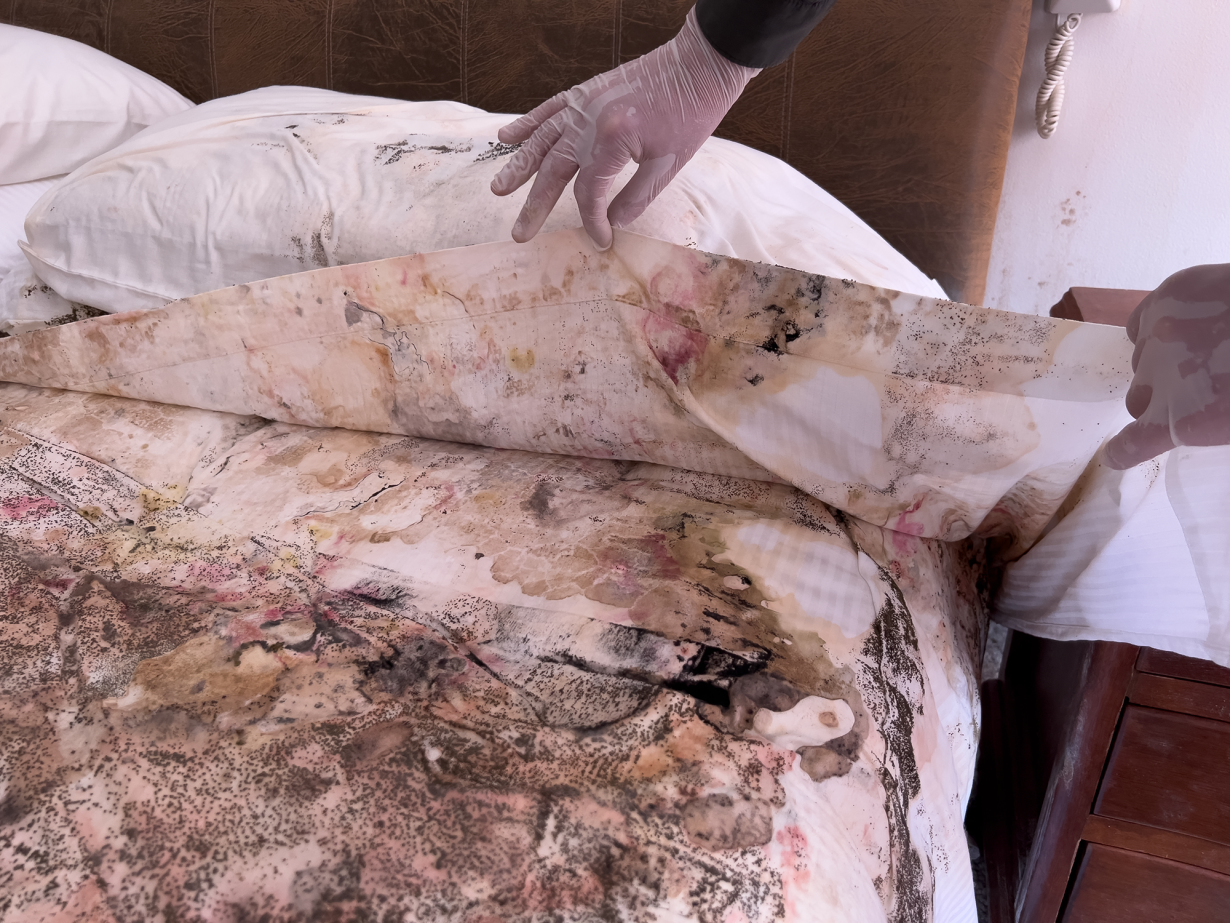
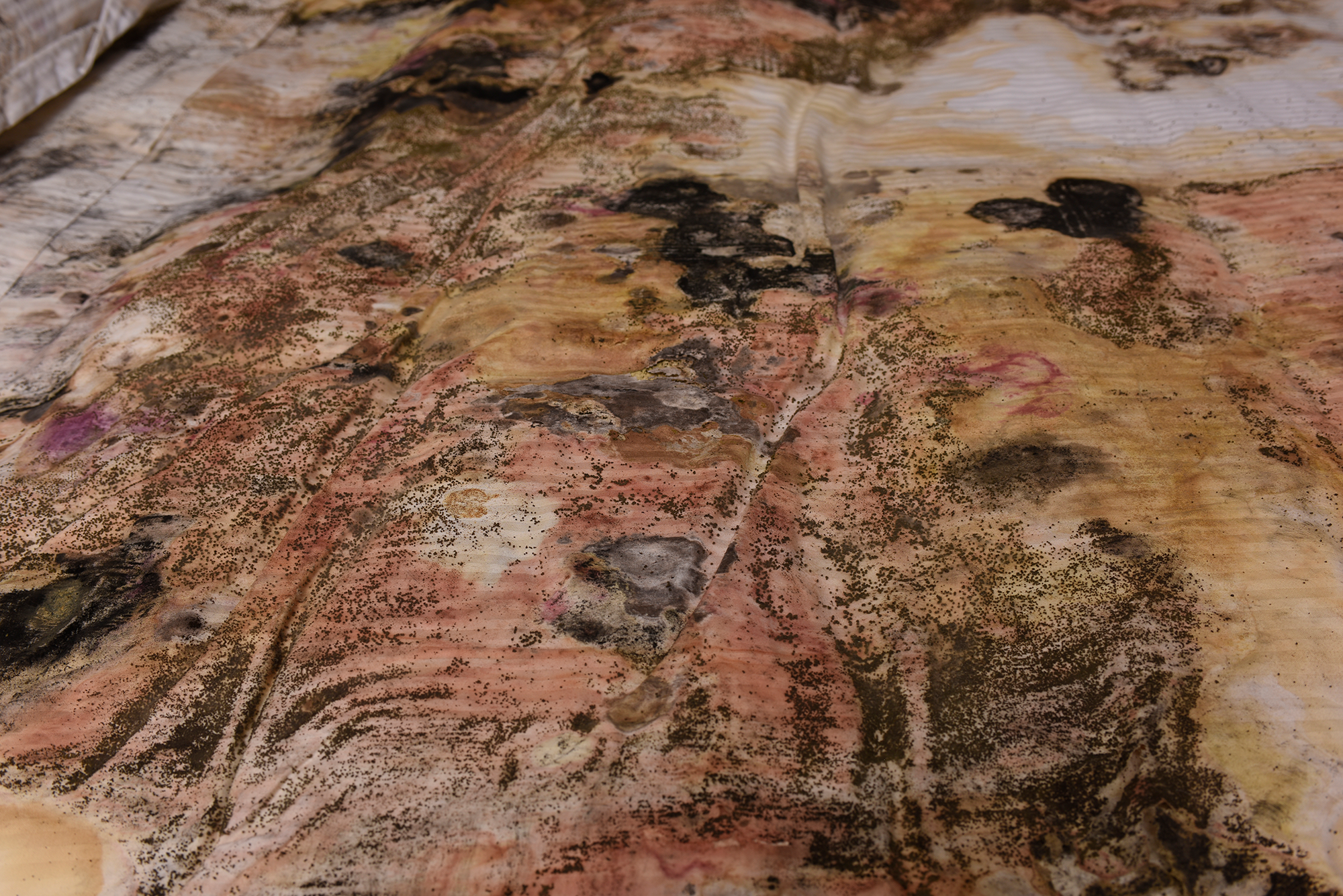
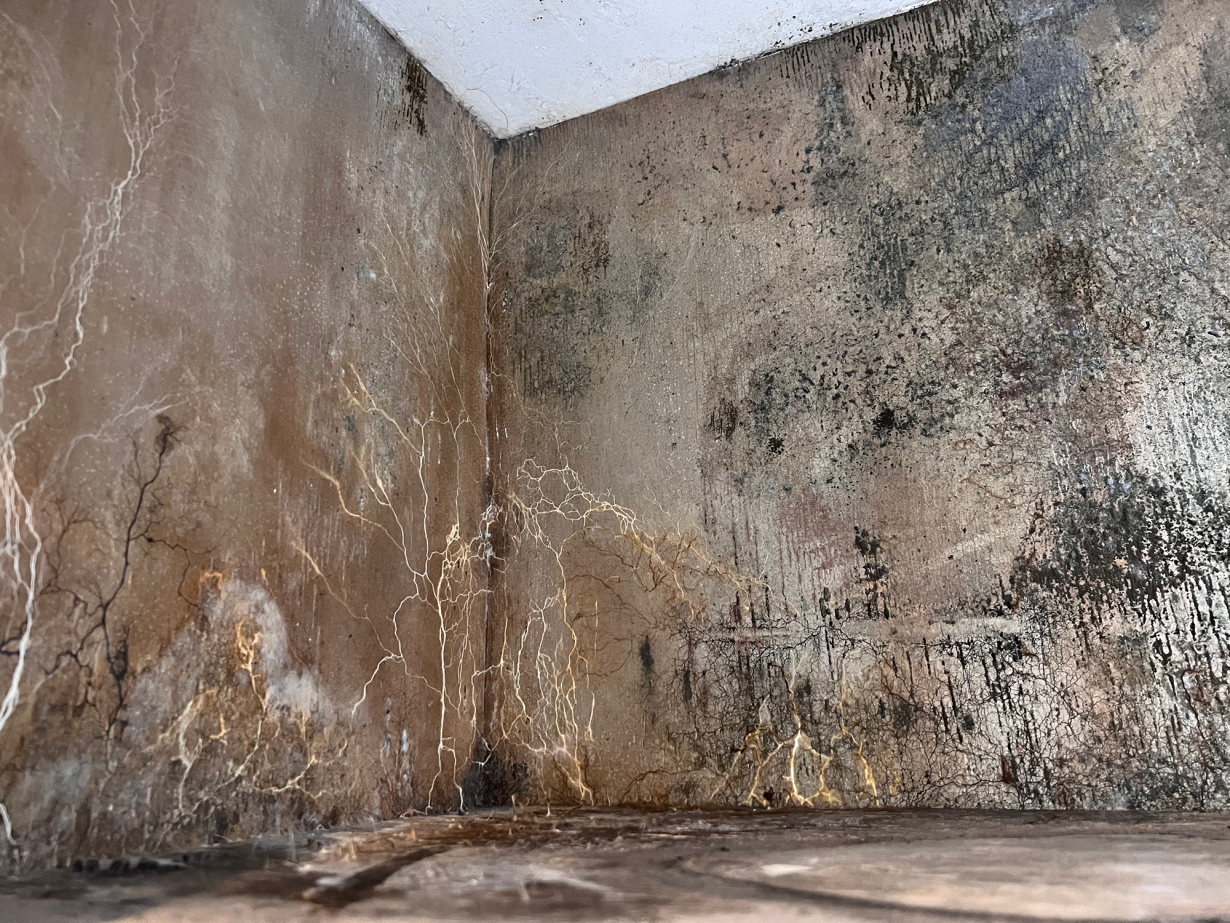
The artist describes the initial encounter with the bed as “almost unbearable”. It emerged after the death of a friend’s father, whose sixth-floor apartment remained locked and abandoned for months while exposed to a water leak, activating a slow but sure process of decay. When Devis and her friend finally entered the space after learning of the issue, decked out in masks and gloves to protect themselves from potential health risks, what they found was shocking. “The air was dense, saturated with a pungent, almost sweet and decomposing smell, something that could be felt in the body as much as seen,” she recalls. “The bed, in the main room, had become an epicentre. Its deep reds and oranges were produced by yeasts and proteins that, drawn to fat, had colonised the surface. It was impossible not to recognise the imprints of the bodies that had once inhabited it: persistent, almost spectral traces that made an absent presence visible.”
It makes one uneasy to imagine these invisible microforms alive in our homes, not least where we sleep – those warm, sacred spaces of safety and intimacy. Perhaps that kneejerk discomfort is one of the reasons why Devis chose to preserve the bed, seeing its potential in artworks, rather than disposing of it at once. She began to document the scene, photographing textures and forms up close, and worked with a mycologist, Tatiana Sanjuán, to sterilise material for further work, placing the sheets in an autoclave and applying 8.34 bar of pressure, at a temperature of 100C, before transferring them under a germicidal ultraviolet light for 24 hours. The procedure was hazardous. One research photograph, displayed in the exhibition, shows white vinyl-gloved hands pulling back a striped bedsheet to reveal a colony of spores, overlapping and fading in shades of rust. Delicate dark-brown dots gather in groups, collating into new forms that look harsh and menacing. Another image closes in on the wicker basket on the bedside table – at second glance, furry with white mould; another zooms in on a specific patch of decay and its veinlike growth; a trick of the eye.
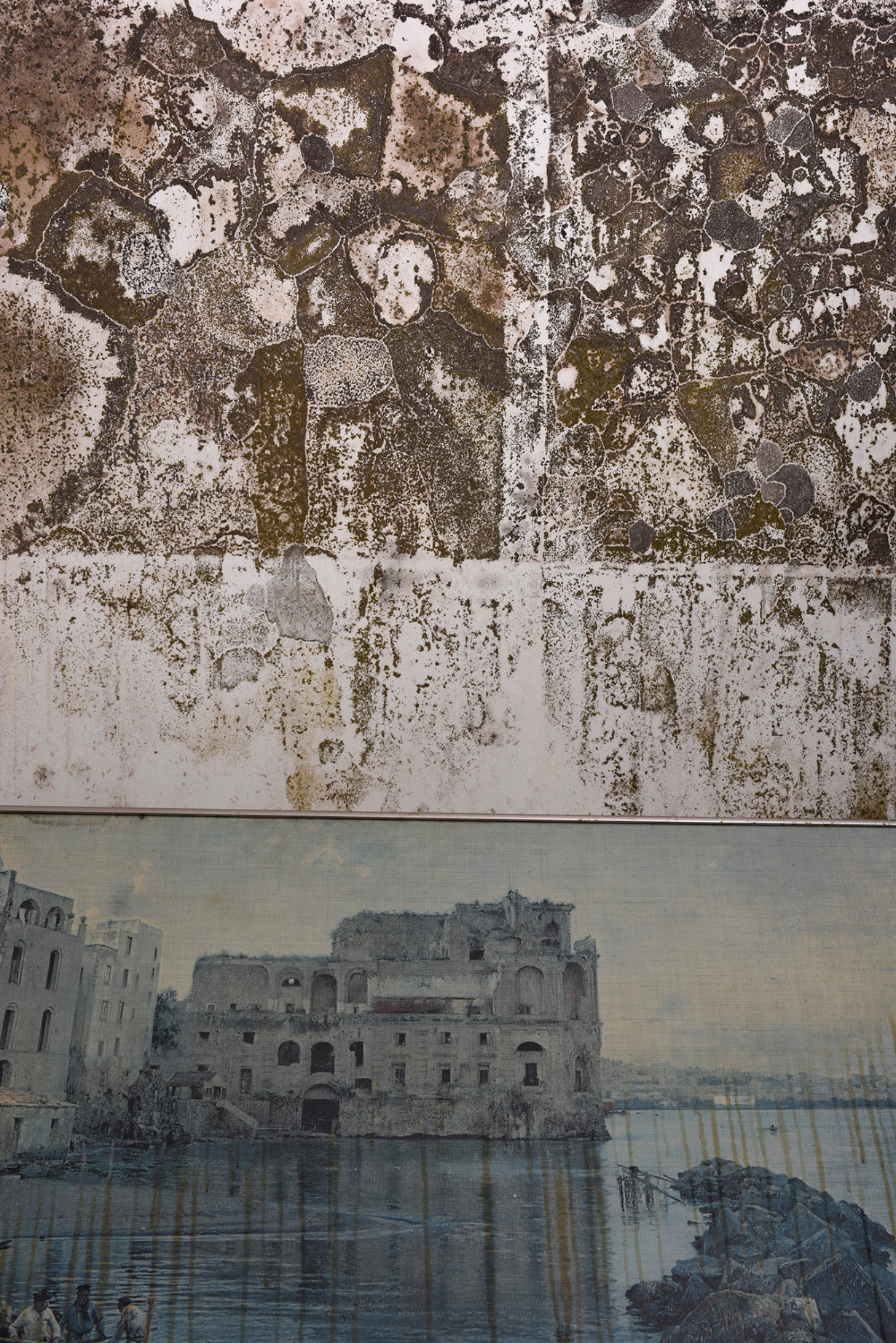
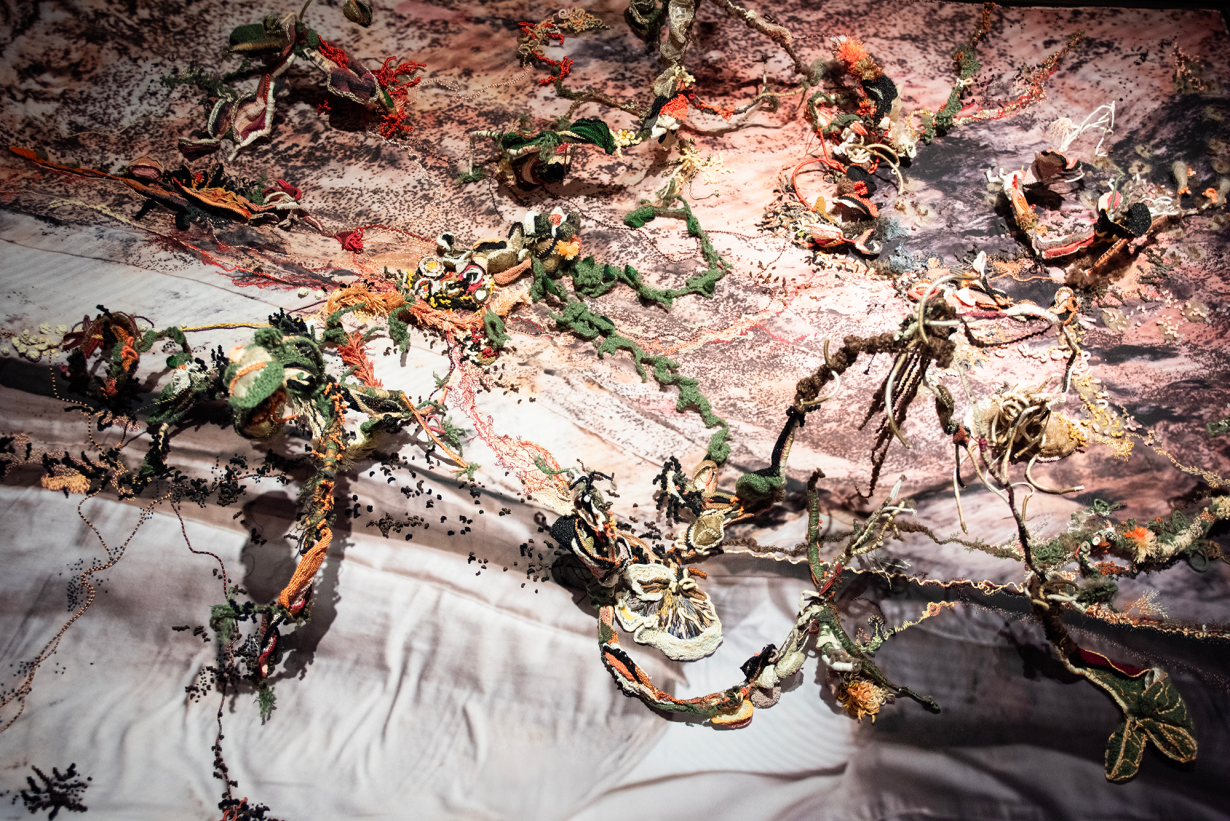
Learning how particular forms and colours signified different metabolic processes, Devis and Sanjuán retained certain cultures in the laboratory to extract pigments, later used to dye threads that Devis stitched over and into fabric transfers of the photographs. “The image ceased to be immediate and entered a manual, almost meditative process,” she says, explaining she found the reworking essential to her understanding of the protein breakdowns resulting in the dramatic visual effects at play. “Through repetition, it is possible to access forms of knowledge that are not linear or fully visible, but that manifest themselves through matter. The stitch began to operate in a way analogous to the processes of growth and expansion I had observed in the microorganisms.”
Back in the gallery, a single bedsheet hangs from the ceiling like a sail. Harsh tears in the most dense, rotting sections allow light to filter through from a window above, leaving jagged shadows on the tiled floor. Elsewhere, another sheet, this one embroidered, is displayed flat on a glass table. The threadwork is at times delicate, adorned with lines of tiny beads and knitted knots; at others dense and lurching, conjoining together from the surface to create odd, unidentified three-dimensional creatures, as if mirroring how fungal growth might have continued to proliferate had the scene been left unchecked. There’s a playfulness to this display, but, as the forms spawn seemingly at random, clutching to each other or spiralling into new shapes, also a sense that control could be lost at any moment – much like the ‘bed’ rot we engage with while on our phones, or any other rot for that matter. Under the table, a lightbox mirror reflects the patterns of decay as loose threads hang down from above, as though roots: the energy channels feeding the chaos on the surface.
You first encounter the bed at the entrance to the museum’s lower ground floor gallery, where the exhibition takes place. Here, a television screen mounted to the wall shows a video in which a white sheet, adorned with a print of the photograph of the rotted bed, hangs from the branches of a saman tree. It blows gently in the wind as nonchalant bearded iguanas graze below, waddling around and chewing on grass; a tropical landscape stretches out far behind, the heightened saturation of the landscape vivid, the grass dewy and the air presumably thick with humidity. This suggestion of moisture brings the two opposing scenes together – the bedroom, closed, stifling with damp and potentially hazardous bacteria, and the landscape, open and safe (the exhibition text revealing that it is home to the artist’s mother), and somewhere Devis has frequently integrated into her works – uniting them, ultimately, with evidence of life.
The iguanas feature elsewhere in Devis’s MAMBO show, where displays of collected human hair, used makeup wipes and residues of reptile skin – signifiers of human and nonhuman bodily waste – are presented in glass jars, almost like a pick-and-mix sweet shop or a biological specimen collection. Working with a Frankenstein-esque logic, Devis sews the objects together, reimagining them as fantasy buglike creatures, displayed on a table with magnifying glasses and entomology glassware, and a towering treelike form: peculiar at first glance, grotesque at the next. Devis attributes part of her affinity for collecting odd objects to her father, an engineer by trade, who decided to devote himself to painting at the age of thirty-five. “He was a tireless collector, an accumulator of fragments and remnants,” Devis says. “I was fascinated in seeing how everything he gathered – what for others might seem like waste – would later find another life in his painting.”
She says her father’s way of seeing and transforming matter sharpened her own practice, stemming from an interest in “what the body, both human and nonhuman, leaves behind and [that which] loses value once it is separated from it”. Further elaborating, she says: “I am interested in thinking of these materials not as waste, but as matter charged with memory, time and presence… Many come from a close environment: my mother, my daughters, friends, people who are part of my life, but also from other bodies and ecosystems. The hair, for instance, is not only mine, but that of others who, by donating it, become part of what I call a ‘collective of affects’.” In that, they become a record of shared feminine rituals: clumps of shed strands left behind in a hairbrush; dried wet-wipes smeared with what appears to be rouge lipstick and black mascara. “I am interested in the ambivalence they hold,” Devis says. “They are linked to ideals of beauty, to routines of constructing appearance; but the moment they are discarded, they become something uncomfortable, even repulsive. That transition, from the desirable to the abject, is a threshold I am interested in inhabiting.”
In MAMBO’s upstairs gallery, housing objects from the gallery’s permanent collection, Elsa Gramcko’s Broken Surface (1963) is displayed, a small painting on wood in various shades of teal, centred around a rectangle. Like Devis, Gramcko used waste and found materials in her work, often playing with the limits of material by allowing decomposition or decay, such as rust, to disrupt industrial surfaces while acknowledging the ongoing passage of time. Gramcko was one of the Venezuelan Informalists, who critiqued the rapid modernisation taking place in Venezuela during the 1950s and often used tactics of shock to make a statement (Carlos Contramaestre’s 1962 Homage to Necrophilia exhibition, for instance, incorporated animal remains and was shut down by the Ministry of Health within days). Yet, despite the reactions of repulsion provoked by From One Life Into Another, and the potential biological hazards that once accompanied it, Devis tells me that transgression was never her intention. Rather, she sees her practice as process-led: “I am interested in understanding how the transformations [of materials] operate, rather than using them as a disruptive gesture in itself,” she notes, a continuity that she believes can “unsettle our habitual ways of perceiving and understanding the world”.
When left unchecked for too long, anything alive can begin to rot. It will transform not only itself, but the spaces and atmosphere around it, recycling nutrients into that environment to fuel new growth. Decay, in other words, is essential to life.
Ana Maria Devis’s exhibition From One Life Into Another. Affective Thresholds and Astonishing Matters is on show at MAMBO, Bogotá, through 26 June
From the Summer 2026 issue of ArtReview – get your copy.