An exhibition at Square Street Gallery examines how language is an evolving marker of sociocultural relations
If language is an intimate form of embodied transmission, whereby words are spoken by individuals whose understanding of their meaning is contingent on contextual and interpersonal relations, then it is through language’s everyday use that a more complex, materialist understanding of culture emerges. The title of Faan1jik6 Zi1gaan1, a three-artist group show, is the Romanised, Cantonese transliteration of 翻譯之間 (meaning: ‘In between translations’) and pointedly reflects on that dynamic in the context of Hong Kong.
Yip Kai Chun’s installation 崖hea響槓言 voice from the root, reclaiming (2016) traces the artist’s reconnection to his father’s native language, Hakka. Spoken by an ethnic group understood to have migrated from Northern China to the South during the thirteenth century, Hakka is often considered a phonetic bridge between Mandarin, China’s official language, and Cantonese, a dialect or distinct language, depending on who you’re asking. A rag-tag group of stools is positioned in front of a television set with speakers on either side, its red screen soundtracked by Yip speaking with his father in Cantonese about colours, about how he identifies, while recalling sayings like “a home with a podocarpus always has a surplus,” and so on. Yip asks his father to translate words and phrases into Hakka throughout, with black characters appearing onscreen in traditional Chinese script (rather than the simplified system introduced to Mainland China in the mid-twentieth century) to transliterate those expressions with Cantonese words. The Hakka pronunciation for ‘Occupy Central’, or instance, referring to Hong Kong’s 2014 Umbrella Movement, phonetically approximates to Zam1 (hair pin in phonetic romanisation), Ling5 (to lead), Zung2 (swollen), Wan4 (circle).
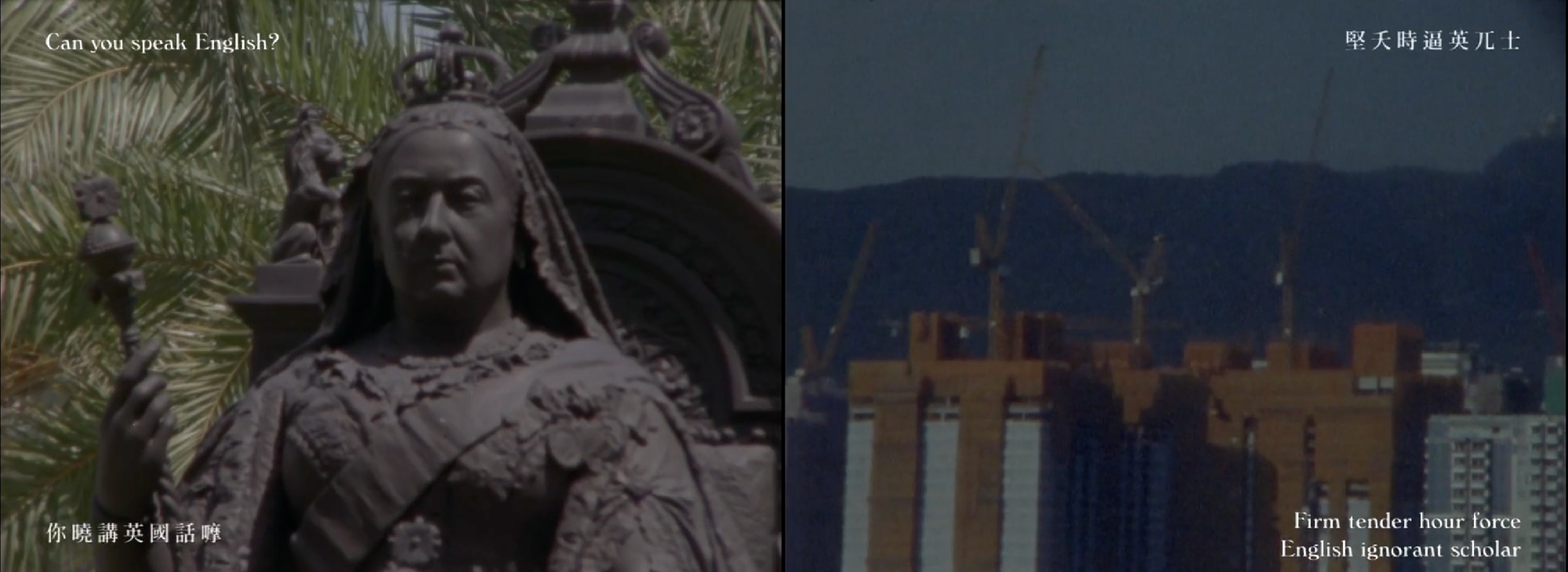
The abstract poetry of these notations mirrors those in Yan Wai Yin Winnie’s two-channel video Too Long Ago, Not Far (2024). Using a Super8 camera, Yan filmed everything around her between 2019 and 2023, while preparing to leave Hong Kong for England. These images of daily life in Hong Kong were then digitised to create the backdrop for an audiovisual dictionary drawing from a nineteenth-century publication commonly referred to as 華英通語 or Huaying Tongyu (literally: ‘interchangeable expressions between Chinese and English’), which taught English pronunciation using phonetically aligned Chinese characters. English words and their transliterations appear in white on the top and bottom corner of one screen, while their Cantonese phonetic notations and literal English translations appear on the other: so ‘cut’, for example, becomes phonetically aligned with the Cantonese for ‘cough’. Simultaneously, words and phrases are spoken aloud over parallel images, creating an expanded field of interpretation. In the case of ‘lion’, views of Hong Kong’s iconic Lion Rock mountain overlap: a landmark associated with the Lion Rock Spirit popularised during the 1970s to define a resilient Hong Kong identity.
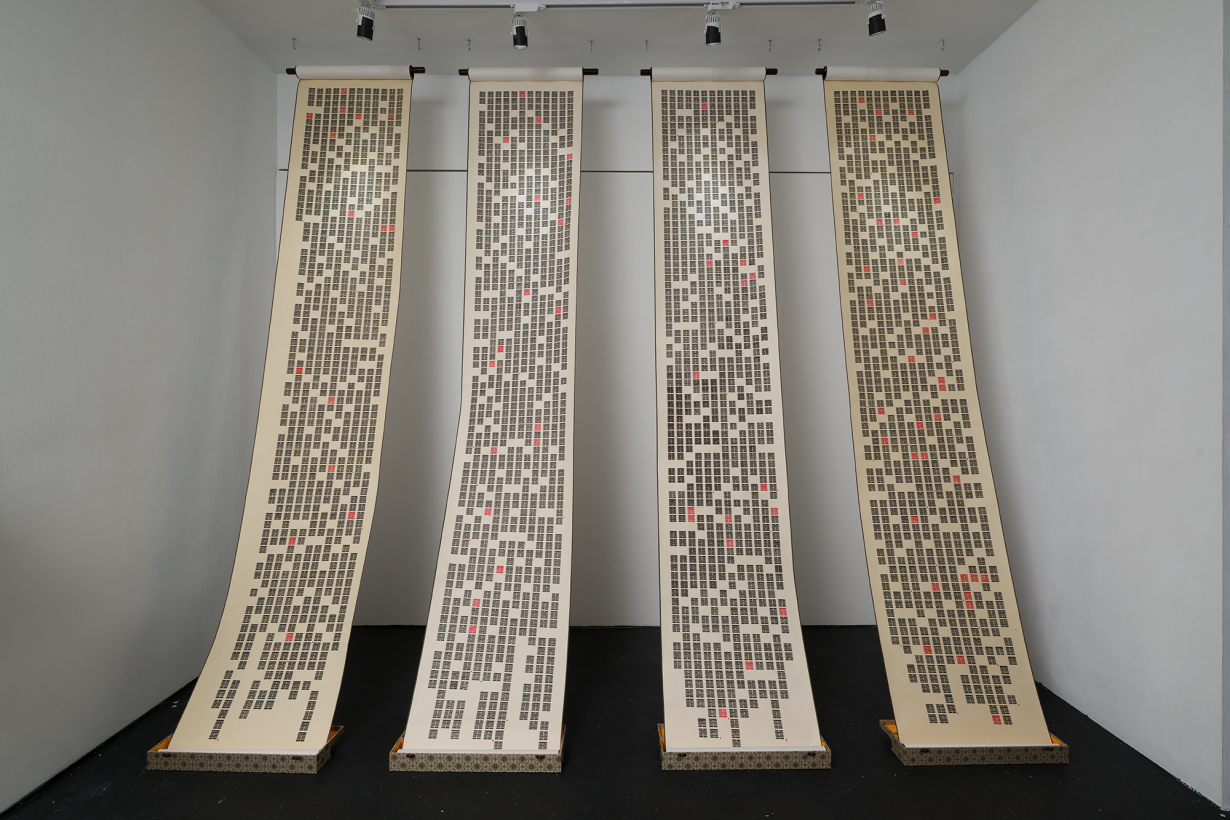
At times, the phonetic notations from Yan’s source material seem off when spoken aloud, perhaps reflecting changes in pronunciation across some two centuries – a temporal gap that Yip’s father likewise demonstrates with a dialect that forms a bridge not just between Mandarin and Cantonese, but across time and space. These fissures refute the idea that culture is immutable: a material reality that language reveals as an unruly source-code of cultural transmission, whether in the context of nation-states standardising heterogenous tongues into one official language in the name of modernisation, or through the endurance nevertheless of those who have been marginalised as a result. Melody Chan’s installation Mind Palace (2023) pays tribute to that grounded, somewhat anarchic, reality. Four long scrolls printed with I-Ching hexagrams appear like Chinese text. Drawing from binary logic, each hexagram forms part of an indecipherable encryption that Chan devised to express a mesh of her own private writings and the texts of philosopher Gottfried Wilhelm Leibniz. What emerges is a common portrait of language as an unruly field of embodied relations and transmissions across a sociocultural spectrum that never stops evolving, rather than an apparatus of static containment: something to be created, learned, concealed, recalled, even defended.
Faan1jik6 Zi1gaan1 (In Between Translations), Square Street Gallery, Hong Kong, 29 January – 7 March
From the Summer 2026 issue of ArtReview Asia – get your copy.