Wendt’s nudes should not be read solely as aestheticised confessions, says Qingyuan Deng, but as acts of defiance
At American Art Catalogues, a gallery nestled in a townhouse in Manhattan’s West Village, the first US solo presentation of photographs by Lionel Wendt, who has for the past two decades been historicised as a canonical figure of South Asian modernism in Europe and in the wider Asian region itself, gathers a group of hauntingly melancholic gelatin silver prints. Between the tonal range of the bromide surfaces, the sculptural weight of the shadow that falls across the male nudes and the eerie control Wendt exerts over solarisation and still lifes, encountering his spectral materiality at the intimate scale of bourgeois domesticity gave me a glimpse into a kind of movingly stubborn eroticism that sprang forth in an unaccommodating time and place. However, I left wanting something beyond these carefully arranged scenes of longing. I wished to see some reckoning with the radicality that made Wendt not just a photographer of concealed desire but one of the central protagonists of Sri Lankan modernism, a dimension this show, curiously, insufficiently addresses.
The show emphasises the male nude as a site of homosexual desire. The press release’s analysis of Untitled (Male Figure) (c. 1930–44) reads the subject’s withheld gaze as an index of queer interiority. This insight is not wrong, but it is overdetermined by queer theory’s recent reorientation towards opacity and refusal. Under the 1883 Penal Code, imposed by British colonial rule, which criminalised homosexuality as a violation of the natural order, male-male sexual acts in 1930s Ceylon were subject to prosecution.
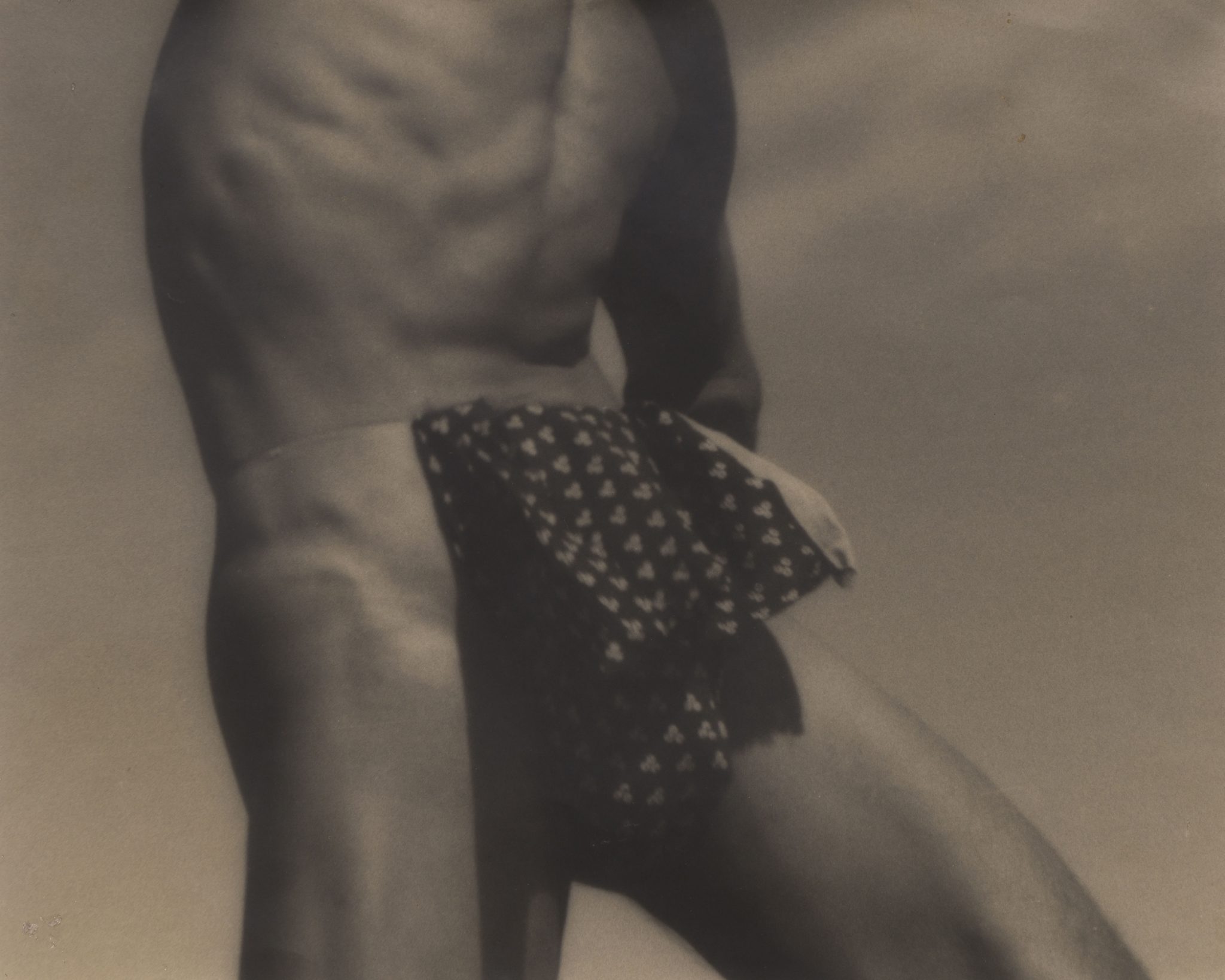
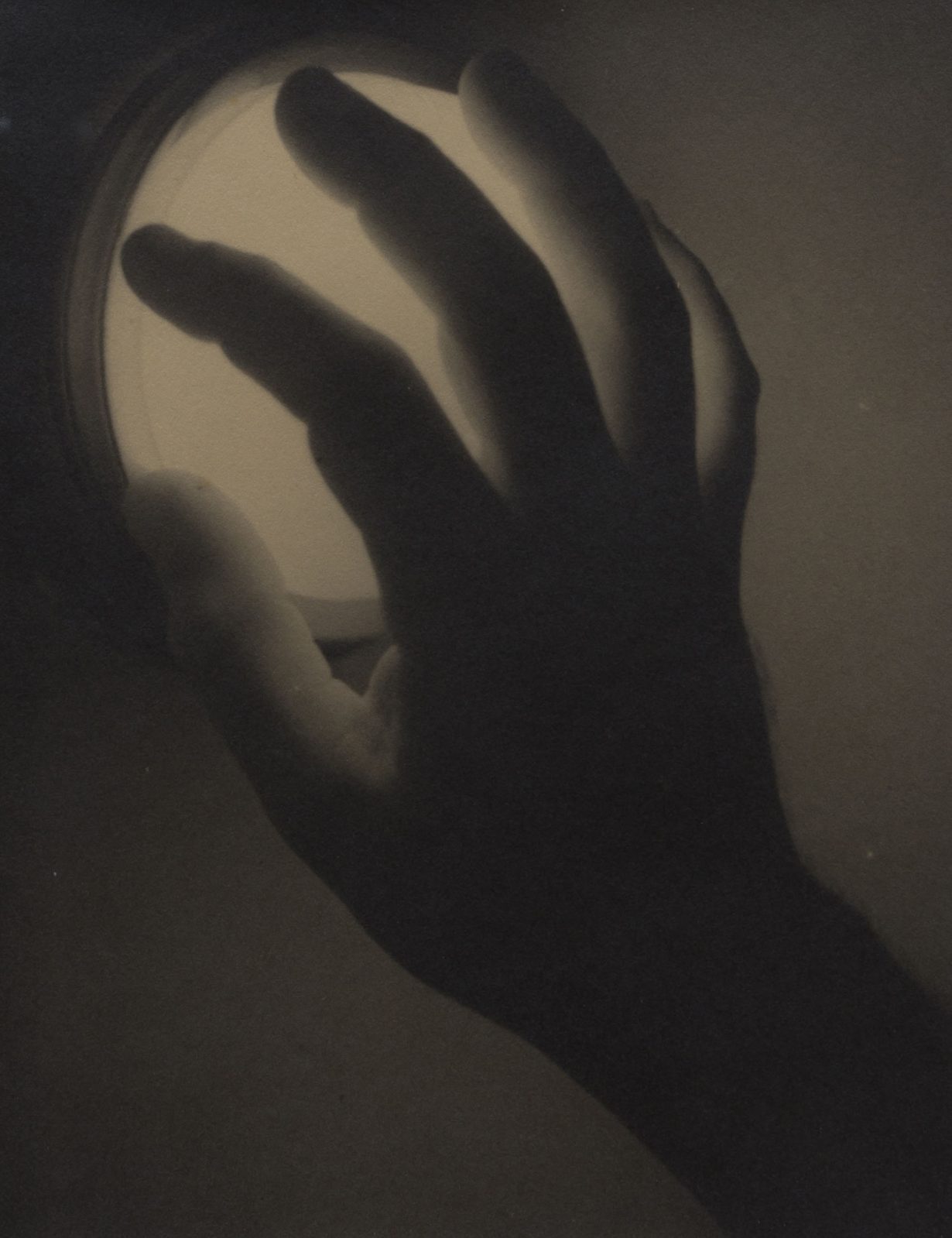
Conditions of legal and social duress, not just repression, can be felt in every formal decision Wendt made, producing something closer to strategic retreat: a practice of encoding homoerotic meaning within ethnography, studio portraiture and Surrealist experimentation, such that the images could circulate publicly while reserving their fuller charge for a knowing community. Consider Bachelor Cruising South (c. 1934–37), whose title gestures towards the sexual in the name of the nautical. The image offers only a silhouetted hand, abstracted to the point of dissembling the erotics. Or the aggressive staging, crop and contrast of Untitled (Male Torso) (c. 1930–44), which can be read as modernist attention to volumetric space rather than portraying a specific, desirable man. And the small traditional nude figurine in Untitled (Still Life with Mask and Statue) (c. 1942), which smuggles homoeroticism – long sanctioned in precolonial culture – by displacing it onto a theatrical tableau that disarms direct accusation.
Wendt’s nudes read not solely as aestheticised confessions but also as acts of defiance. And by concentrating so heavily on the bodily and the scopophilic, the presentation collapses Wendt’s queerness, entangled as it was with his mixed ancestry, his sympathy for anti-colonial politics and his participation in the construction of a national visual culture, into the narrower category of homosexual visual pleasure.
Homoeroticism need not be a dead end if it is understood as a gateway into the fuller political stakes of Wendt’s practice. The clearest evidence for this is Song of Ceylon, his 1934 collaboration with the gay filmmaker Basil Wright. Structured in four movements, the film juxtaposes rural religious ritual and agrarian rhythms with the mechanised infrastructures of colonial trade. Wendt narrated the film using passages from a seventeenth-century English captive’s account of the island, implicitly recalling a time before British rule at a moment of rising independence struggle. In the film, seminude men husk coconuts, bathe at village wells, perform subsistence labour in landscapes saturated with spiritual meaning – scenes whose homoeroticism is inseparable from ideals of indigeneity exterior to plantation capitalism. Queerness here manifests as expansive sociality, labouring bodies in proximity and solidarity, unfazed by the British conception of heterosexual decency and respectability and outside the system of colonial extraction.
At American Art Catalogues, Wendt’s photographs are received as private documents of forbidden sexuality, legible to a metropolitan audience precisely because they conform to a recognisable genre. Yet Wendt was not documenting beautiful men. He was employing photography as the democratic medium through which precolonial ideas of ecology, sexuality and sociality were disseminated towards erecting a new national consciousness. Largely glossing over how Wendt negotiates Ceylonese struggles for self-determination, fraught homosocial relations and the body as coded archive, the exhibition instead offers a Wendt whose body of work is, somewhat literally, a body.
From the April & May 2026 issue of ArtReview – get your copy.