The artist explores the limits of firsthand knowledge, research and the pursuit of historical truth
Some say photomontage was invented in 1918 by Raoul Hausmann and Hannah Höch, who were inspired when they came upon, in homes on the Baltic island of Usedom, coloured lithographs of Prussian musketeers posing in front of barracks. These were generic military mementos, but each family’s had been personalised with a cutout photograph of their son’s face pasted on top of another soldier’s. The blatant artifice suggests a kind of desire-laden mythmaking on the part of whoever was doing or paying for the cutting and pasting (accounts vary) that fulfilled a need for those wanting to see their loved ones’ contributions to world events represented in a quasi-official capacity.
A revisionist and archival impulse likewise underpins selections from Sim Chi Yin’s photomontage series The Suitcase is a Little Bit Rotten (2022/23–ongoing; all works here from 2026). On show as part of 归舟: Longings, Returns, these UV prints on glass, backlit on vintage-looking wooden stands, feature enlargements of magic-lantern slides depicting naturalistic scenes from British-colonised Malaya – present-day Malaysia and Singapore – onto which Sim collaged cutout photos of a man identified in the exhibition pamphlet as her late paternal grandfather, Shen Huansheng, a leftist newspaper editor and educator who was expelled from Malaya alongside 20,000–35,000 other, mostly ethnic Chinese communists and opponents of the colonial state. This mass displacement occurred against the backdrop of the Cold War and the 12-year Anti-British National Liberation War beginning in 1948 (named by the British as the ‘Malayan Emergency’). In May 1949, the pamphlet tells us, Shen was deported to his ancestral village in Shantou, China, where he joined a communist guerrilla group and was executed by the Chinese Nationalist Party.
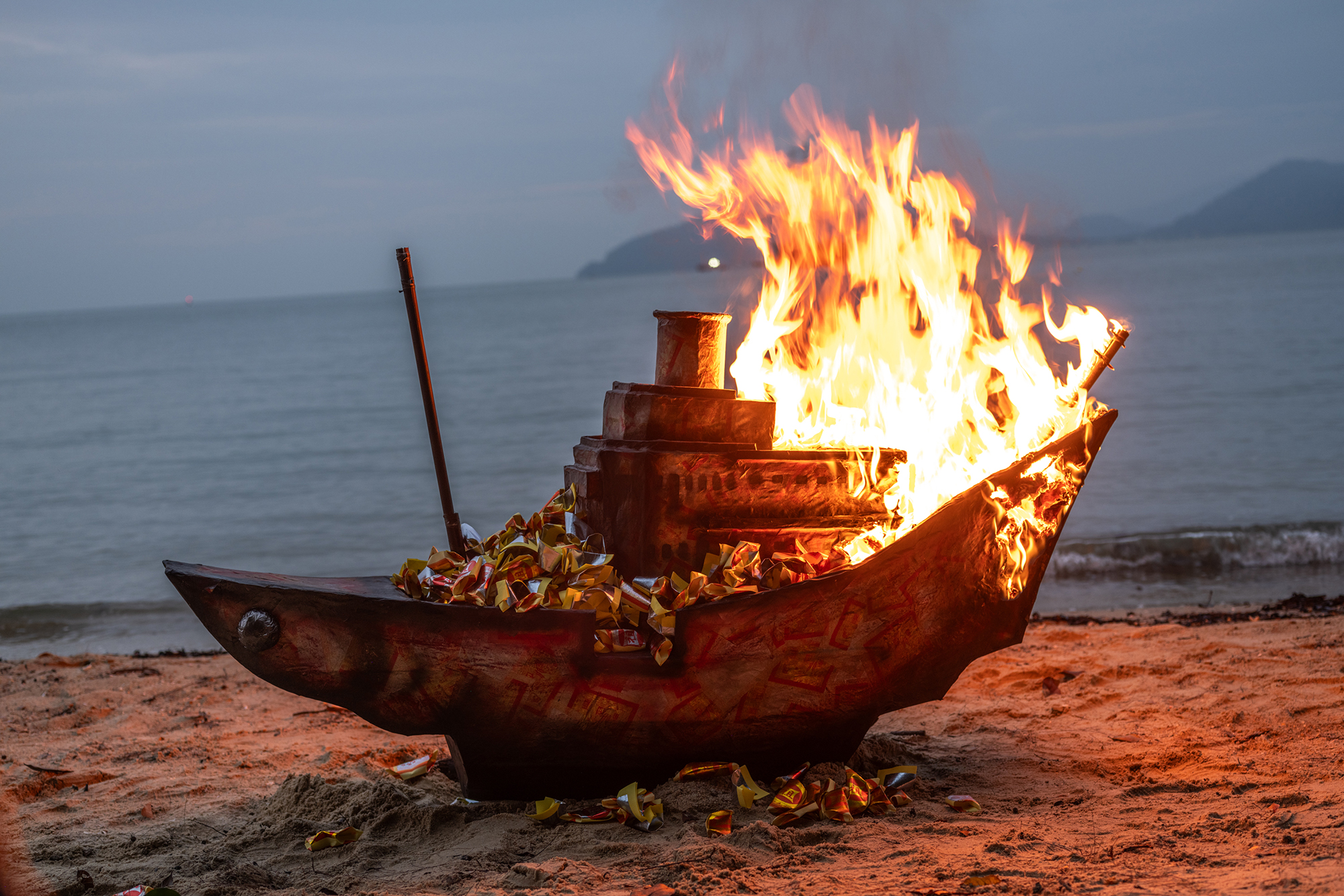
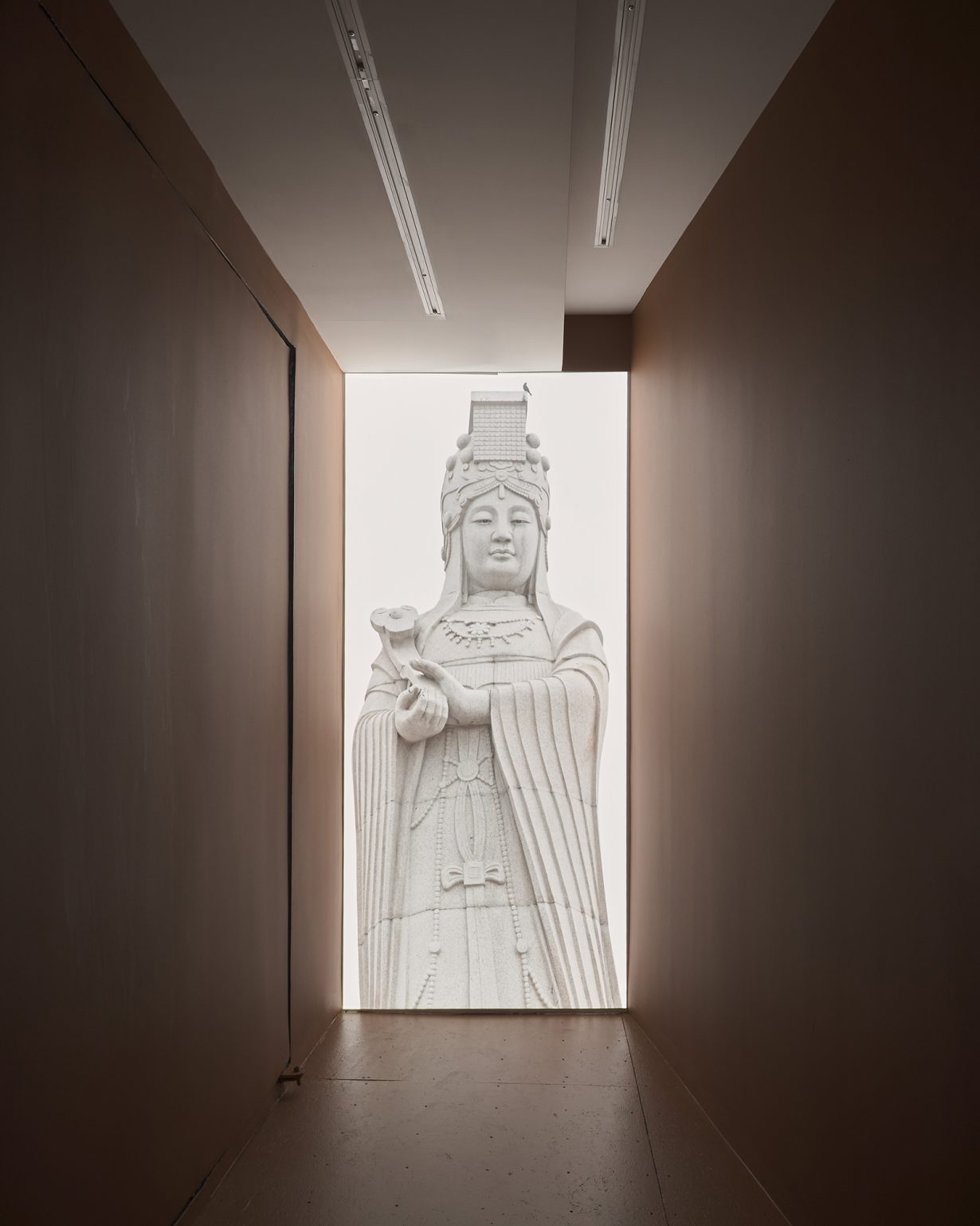
Shen appears in one of the works in the series, SS Van Riemsdyk (2026), on the deck of a careening ship, standing in profile, mastlike and spectral. In Rowboat (2026) there are three tanned men in a skiff in centre-frame; Shen observes them, his clothes and complexion as pale as the sun-bleached photograph from which they were cut. He stands in a vessel floating in the image’s top register – a paper boat, the kind often burned with spirit money and other joss-paper items as an offering to the dead during funerals in many Sinitic cultures. The boat crops up again in the exhibition as a shoe-size paper-and-bamboo sculpture, painted red, gold and silver. In the titular three-channel projection, it burns on a beach while related footage – of hands writing letters and folding origami; black-and-white archival photographs; interviews with other elderly communist deportees – advances on an adjacent wall. In the third channel, Sim’s camera gets up-close to the hands and faces of stone statues of the Buddhist divinity Guanyin and the Chinese sea-goddess Mazu.
Like the effigy of a deity, Sim’s grandfather is an image frozen in time and space, able to be installed in any scene; like the guerrilla fighter he became in China, his ghost materialises in unexpected places. The act of un-erasing his presence serves its rhetorical function, yet, short of artlessly honouring his memory, Sim’s interventions imbue his character with a twinge of uncanniness: just as a deportee may ‘return’ to a place that is not home, the lost fact or figure that the artist-as-researcher ‘returns’ to its place in history experiences an un-homelike reunion.
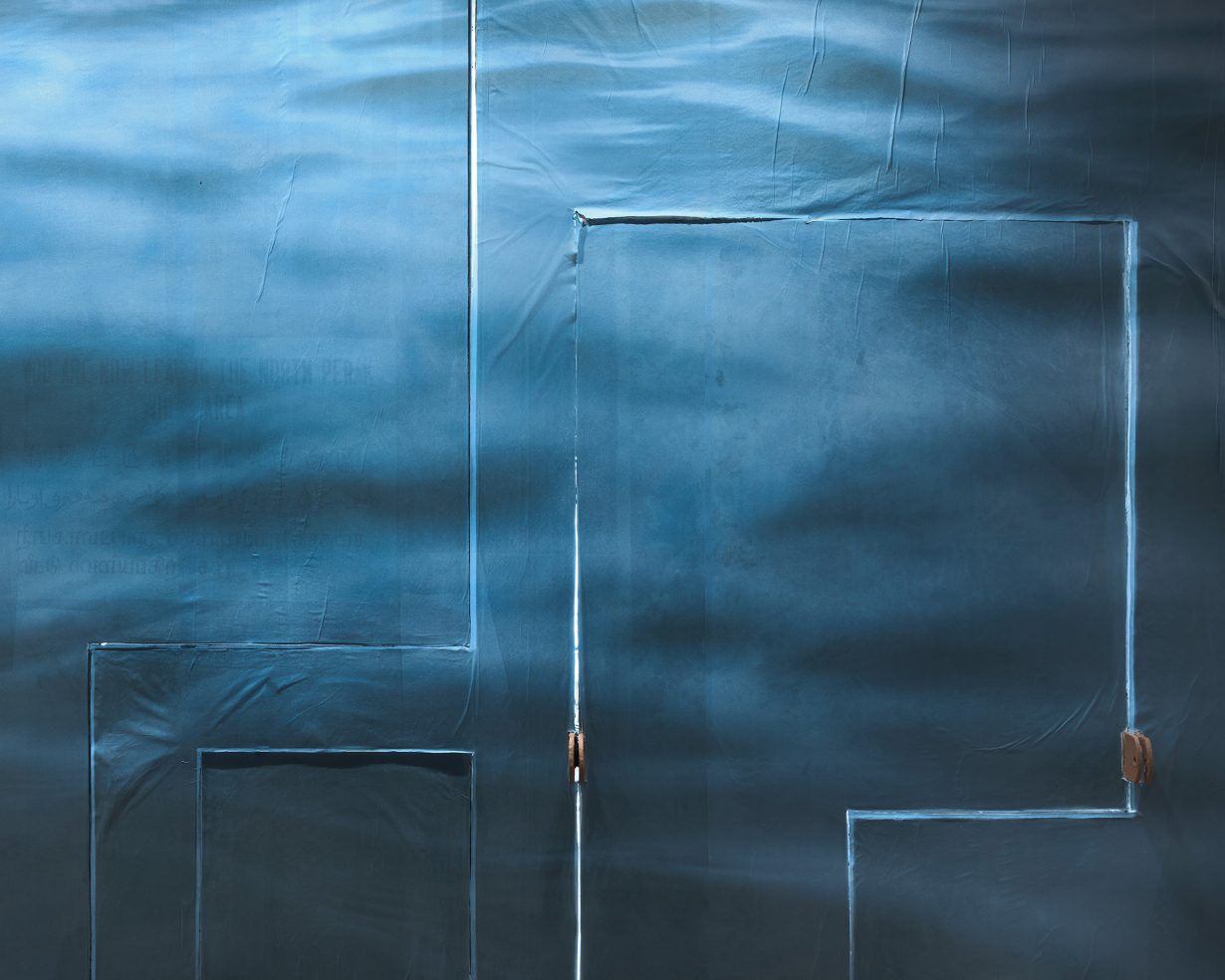
Knowing the limits of her firsthand knowledge and research, Sim eschews the pursuit of historical truth, saying, in an interview in the exhibition pamphlet, ‘I don’t think’, having spent a decade in journalism, ‘I’m even striving for any kind of objectivity anymore’. A mural in the exhibition gives form to this feeling. Here, a collage of sepia-toned vinyl prints of photographs and other archival materials hides beneath a layer of blue paper. The warren of history is visible only through a few eel-shaped slits created by the artist during a performance on the show’s opening night, first by making vertical cuts in the paper with an X-Acto knife, then by tearing lengthwise with her fingers, slowly so as to reveal as little of the collage as possible. Those sifting through current news and crosstalk regarding ongoing colonial conflicts in places like Palestine, Lebanon and Iran ought to know that what she calls ‘capital H history’ is a construct. It may also be dawning on them that history in lowercase – the fragmented, suppressed, elliptical annals of everyday people – has also been constructed, its truths deferred, and that the aesthetic dimension of memory itself perpetuates the artifice.
Sim Chi Yin 归舟: Longings, Returns at Storefront for Art and Architecture, New York, 8–29 August
From the September 2026 issue of ArtReview – get your copy.