“Violence exceeds the physical, operating structurally and pervasively, to the point that it is naturalised as the very air we breathe”
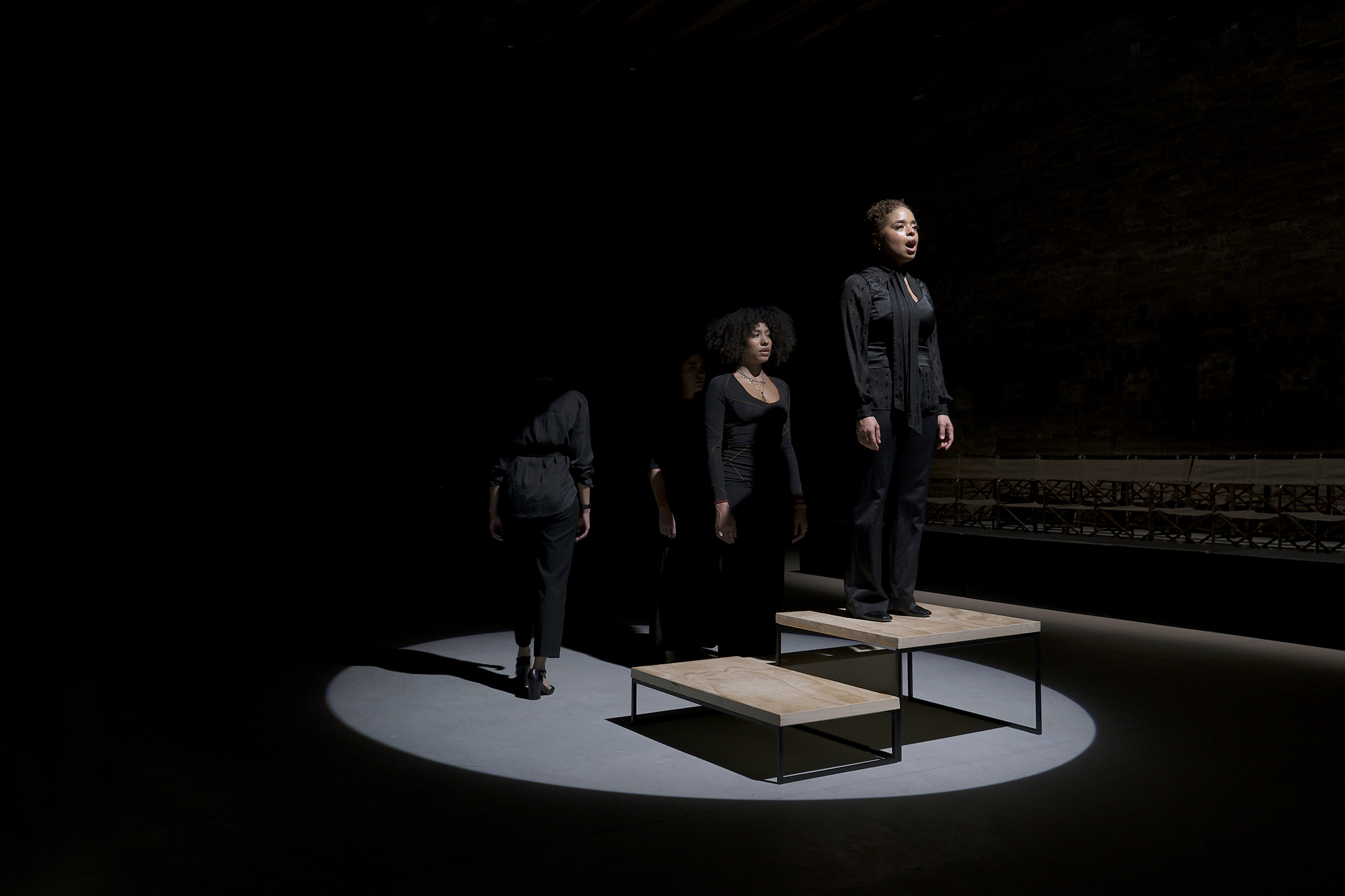
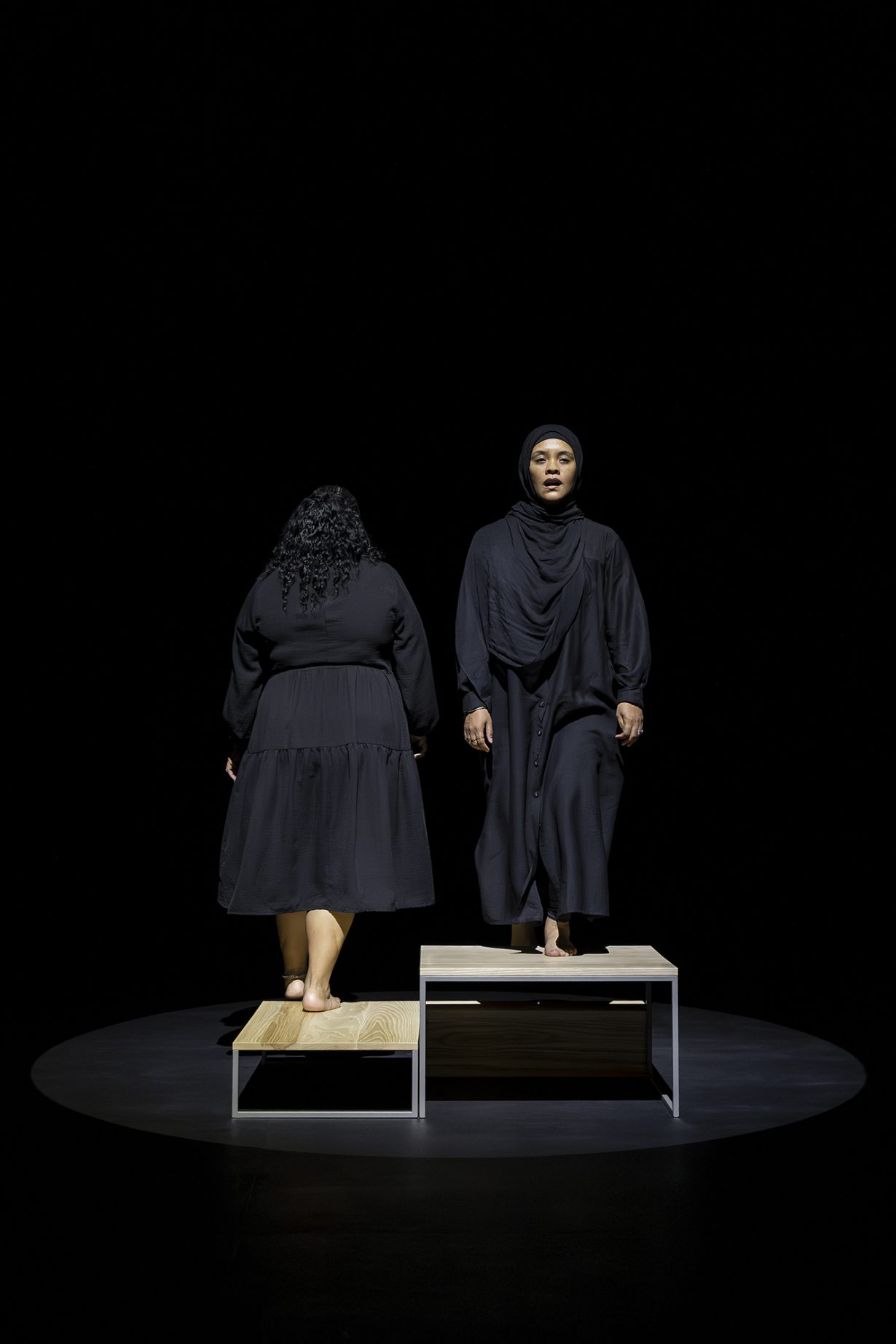
In 2015 Gabrielle Goliath was listening to a father lament the loss of his daughter on a Cape Town radio station: Ipeleng Christine Moholane, a nineteen-year-old journalism student, had been found raped and murdered in an open veld in Tembisa. Goliath listened on as Ipeleng’s father spoke openly about recognising his daughter’s damaged body and she understood that this moment necessitated a careful examination of the customs surrounding grief. Which became the original iteration of Elegy, a performance work first developed in 2015. In a darkened space, seven women with operatic training came together, each holding a single note in relay for an hour, one picking up the note as another’s voice began to tire. The work would go on to develop into a series of iterations as Goliath repeatedly returned to it.
In the years since, Elegy has evolved into something of a life practice, rather than merely a project, for Goliath. Each iteration unfolds as an open-ended process rather than a fixed form, adapting to new contexts through shifts in duration, configuration and participation, while maintaining its core gesture: the sustained voicing of grief as a means of holding space for lives rendered anonymous by systemic violence. In each version it became essential for Goliath to establish connections with families, communities, survivors and performers; the effort of this contact intertwined with that of the work itself. As a Lebanese artist reflecting on a reality influenced by ongoing cycles of political crises and unresolved sorrow, and from within a culture seldom allowed to grieve authentically, I found in Elegy a depth that reveals how certain lives cannot be relegated to the edges of mourning.
It is this proposal that brought Goliath into direct confrontation with the South African state. Her latest version of Elegy, conceived for the 61st Venice Biennale, expands the work’s grieving over three regions: South Africa, Namibia and Gaza, featuring a tribute to the journalist Hiba Abu Nada, who was killed in an Israeli airstrike in October 2023. In January 2026 South Africa’s minister of Sport, Arts and Culture, Gayton McKenzie, cancelled Goliath’s presentation at the national pavilion. The artist, who refused to alter the work in order that it be reinstated, took legal action. She will now show Elegy independently at the Chiesa di Sant’Antonin in Venice. Nearby, the official South African Pavilion will stand empty for the first time since 2011. I spoke with Goliath over Zoom earlier this month.
ArtReview Elegy began in 2015, and the work has since been staged in Johannesburg, São Paulo, Paris, Basel and Amsterdam. At what point did you understand that this was a project with no fixed endpoint and instead, as you’ve called it, a ‘life work of mourning’? I am interested in the ways you speak about your practice as a labour of forming relations that necessitate participation.
Gabrielle Goliath I think it is important to acknowledge that, in that moment of cancellation, what happened was not only that a singular, authorial artist was cancelled. What was cancelled was also a work of community and a set of relations that had developed over ten years. That, to me, is something really profound to consider in the wake of the minister’s nefarious actions.
And of course, one must also think of those who make the work possible: the many magnificent opera singers who embody the absent presence of the one we are coming towards, the one we are mourning. But also, and above all, those whom we mourn. The significance of calling Elegy a lifework lies in the fact that I cannot imagine how we are to consider a world hospitable to all without carrying those losses with us. So to speak of it as lifework is also to think about the manner in which the minister canceled spirit work, and those to whom this work is directed.
As for when I first realised that the work would need to be ongoing: I come from a context in which we are, in a very terrifyingly ordinary way, contending with rape culture and femicide in South Africa. That is the context I was grappling with when I came to this particular work, when I came to the loss of Ipeleng, and to her father speaking in the deepest throes of sorrow about his loss.
For me, the question was: how do I conceive of a work that is not going to peddle in certain grammars, or return us to that scene of subjection, but instead do a different kind of work, an honouring work? And I think this applies to violence in all its forms. Violence exceeds the physical, operating structurally and pervasively, to the point that it is naturalised as the very air we breathe.
The imperative for a work like Elegy to remain ongoing is to counter this absolutely normative and permissible context in which we live: a context in which we all contend with violence, even if in different ways, because life itself is differentially valued. Nonetheless, Elegy is a work that seeks to counter the ways in which violence desubjectifies, rendering those lost to it faceless, nameless, reduced to numerics. Elegy actively refuses that. It insists on recalling by name. And it is so powerful to enunciate someone’s name. That act of naming is part of what the work continually seeks to preserve.
AR The formal structure of Elegy is severe in its economy: seven voices, a single sustained note, one hour. There is no narrative, no image, no named body onstage. This restraint could itself be seen as an ethical position, a refusal to aestheticise pain or produce the kind of spectacular image of suffering that gets consumed and then forgotten. Can you speak about how you arrived at that formal choice, and what it protects against?
GG What you’re picking up on there is really bedrock to the way I work materially, conceptually and formally. It is, fundamentally, a counter-mimetic approach.
I love your phrasing of a “severe economy”, because Elegy absolutely has one. It is stripped down, pared back and nonnarrative. That formal choice is there not only, as you say, to resist the spectacularisation of suffering or the ways art can aestheticise pain, but also to attend to a certain kind of irresolution. That irresolution matters because the work does not allow its audience to remain at a safe distance, simply observing. You come into it and participate in it. It is, in that sense, a demanding conceptual artwork. It is not easy to sit with. It has a durée to it, and that hour makes a demand on you.
I am always thinking carefully about what it means to encounter a work. When you walk into an exhibition of mine, you do not walk headlong into a cut lip or a bruised eye. You walk into light, and you walk into voice and sound. That matters to me. It is part of thinking carefully about representation, because no frame is ever watertight. And when I say ‘frame’, I do not only mean the static image. I mean the moving image, sculpture, scent, whatever form the work takes. One always has to ask: who is coming to it? What are they coming to? What is being represented to them? Are they able to apprehend or recognise life? This is precisely what Elegy grapples with. The very idea of directing a performance toward Heba Abunada, for example – a Palestinian mother, a woman, a life – was rendered impossible, even heretical. And so one is forced to think carefully about the slippage that occurs when we come to scenes of devastation, to bodies torn apart under rubble. Who comes to such scenes? Do they apprehend those lives as lives worth loving, worth grieving?
That, for me, is the difficult question at the centre of Elegy. And that was also the absolute line in this case: unless you violently excise that aspect of the work, you cannot proceed. So I am attending carefully, and politically, to the question of form. Do I want to return you to a scene of rubble? Not necessarily. That is not how my practice unfolds. But do I want to bring you into a form of relation that is not easy?
None of us can ever fully know or understand what Heba Abunada, what Ipeleng Christine Moholane and what so many women and ancestors went through. And I think this is the ethics of my practice: it is subject-centred. The subject calls to you, and, in that impossibility, demands that you respond.
You respond across differences, and without necessarily ever fully knowing. That is also why, as you said, the work is not overly prescriptive. Part of the ethics of the work is to retain a degree of opacity for those to whom the work is directed, because they are not fully transparent to me either. So, the form of the work has to be conceived in relation to that difficulty, and attended to as tenderly as possible.
AR The South African minister of Sports, Arts and Culture, Gayton McKenzie described the Gaza suite as ‘highly divisive’ and ‘polarising’. You have described Elegy, from its very beginning, as a work of mourning. But Elegy has always mourned people whose deaths were also political, women killed by femicide, victims of colonial genocide. McKenzie is not alone in his position. We have seen institutions across the artworld, from biennials to museums to commercial galleries, apply the same logic, treating Palestinian grief as a category of speech that requires special consideration, in ways that destabilise rather than cohere. What is it about the Palestinian dead specifically that becomes, in his framing and in the artworld’s, too political to grieve?
GG When I first applied for the pavilion, I did so with deep hope, heart and faith. It was also in alignment with the stance my country has taken at the International Court of Justice, continuing to pursue this difficult juridical work. I had already written about this in the proposal itself, so there was no attempt to sidestep anything: the framework and intentions were very clear from the outset. This also sits within a longer history of pro-Palestinian support, shaped by South Africa’s own experience of apartheid.
When the pavilion was cancelled, it revealed something that often only becomes visible in moments like these: that the minister was pursuing a party-specific agenda rooted in a pro-Israeli stance. He has been very vocal about this position, and ultimately it was his personal beliefs that led to the cancellation.
What this moment has exposed are deeper fault lines and fissures across the artworld. I hope these continue to surface, because they reveal underlying structures that often remain obscured. At the same time, I do not take for granted the support we have received.
But it is equally important to acknowledge that many others have not had that support. Many have been violently – or often silently – censored and disregarded. At its core, this is a question of power. What is being revealed is the extent to which the artworld itself is complicit in determining whose lives are framed as grievable, and whose are not. It may sound provocative, but it is undeniably true.
The very act of considering a Palestinian life as fully apprehensible, as a life that can be publicly grieved, becomes a kind of forbidden threshold, a line that cannot be crossed. And this is precisely what exposes where power resides, and what sustains these divisions. Why does this become the ultimate litmus test – the thing that cannot be named, cannot be spoken aloud?
I experienced this quite starkly in the United States. Coming from South Africa, where one can at least say ‘Gaza’ or ‘Palestine’ openly, it was striking to encounter a context where these names are often whispered, avoided, not spoken aloud. And when you think of that phrase ‘Gaza broke the artworld’, the contradiction is laid bare. You can grieve certain lives, but not others. In my case, the message was explicit: you cannot grieve these lives.
AR During the court proceedings, McKenzie’s counsel struggled to produce any contractual evidence that the minister held a veto over the artistic content of the pavilion. His team eventually argued he had been ‘deceived’ by Art Periodic, the pavilion’s commissioner and organising partner company, about the nature of your proposal – which is a remarkable claim given that Elegy is a well-documented, decade-old body of work. What do you make of the legal and institutional condition that was supposed to protect artistic autonomy in this process, and where it failed?
GG The South African Pavilion has long been a site of contention and is frequently mired in controversy. Within that context, I think Art Periodic was attempting to address a deeper structural issue: a lack of arts infrastructure and support. This is something we can compare to other contexts – for example, Australia – where the arts community was able to rally collectively and successfully reinstate its pavilion. In contrast, Art Periodic’s proposal was an attempt to fill a void in South Africa: not only a lack of funding, but a lack of ethical and transparent institutional support. They had envisioned a long-term partnership with the government, over a period of about ten years to build infrastructure, strengthen the pavilion and support the broader arts community. But the speed at which this effort collapsed reveals a more fundamental fracture within the South African art sector itself. That fracture is exacerbated by the role of the minister, who has caused significant damage while pulling funding and further destabilising a sector already weakened by years of slow, steady infrastructural erosion.
So while there was a strong public response – letters of support, petitions, artists writing to the president – there remains a lack of cohesion within the sector. And this is unfolding within a broader political moment in South Africa, where the arts are often the first to be affected: the first to have funding cut, the first to be deemed nonessential. That is what makes this situation so devastating. Many have described it as a betrayal, particularly because it violates principles that are held as fundamental, such as the constitution and the right to freedom of expression. The minister’s actions represent a clear transgression of those values.
In that sense, the moment also underscores the urgency of strengthening the arts ecology, especially the independent sector, so that it can better safeguard artistic autonomy and freedom of expression. Because these are values that are incredibly precious, and yet, as we are seeing, they are also remarkably fragile.
AR You’re showing independently at Chiesa di Sant’Antonin in Venice, not far from where the pavilion would have been. I want to ask about the word ‘independent’ here. There’s a long tradition of artists working outside or against the structures that were supposed to host them, and sometimes that outside position grants a kind of freedom that the other space forecloses. Do you find anything generative in where you’ve ended up, or does it remain, at its core, a loss?
GG In many respects, as you say, working within an independent space untethers the work from a nationalistic platform, with all the complexities that entails. There is something quite significant in that shift. It is also especially meaningful that the work will be sounding out in a church, in a sacred space. It is not simply a black cube but rather a sacral environment, and that changes the conditions of encounter.
I met with the Patriarchate of Venice, with Don Caputo, and had a very careful conversation with him about the work. I was quite apprehensive going into that meeting, but it turned out to be an incredibly warm exchange. He spoke very generously about the work and made it clear that there was no intention on the part of the church to censor it. At the same time, he emphasised the seriousness with which they hold the space, and the importance of understanding what would take place within it. That encounter was both thoughtful and affirming.
So there is something quite special in the fact that, in the wake of the minister’s violent cancellation, others have stepped forward to make space for the work and to insist that these lives will be grieved, and to actively create the conditions in which that can happen. The independence of the space has also allowed us to think differently about how the work is encountered. The doors will simply open on May 5th, without adherence to the Biennale’s protocols. I have always felt that Elegy cannot be opened in a conventional way. It cannot be reduced to a social event of canapés and Aperol spritz. It presents a different kind of encounter. In that spirit, we have been developing what we are calling the Elegy Reader. This idea emerged in conversation with [Tunisian art critic and curator] Lina Lazaar, and brings together poets from multiple sites of rupture: Lebanon, Yemen, Iran, Namibia, South Africa, Haiti, Sudan, among others. We will host a public reading on May 7th in the evening, inviting participants to read from this collective text. What feels important here is that it is not only an extension of the work, but a form of community practice. It gathers voices, creates a shared space and draws people into a particular kind of relation, one that resonates with the ethos of Elegy itself.
Gabrielle Goliath’s Elegy is on view at Chiesa di Sant’Antonin in Castello, Venice, 5 May–31 July