In the desert, Jenny Wu finds an example of art’s tunnel vision
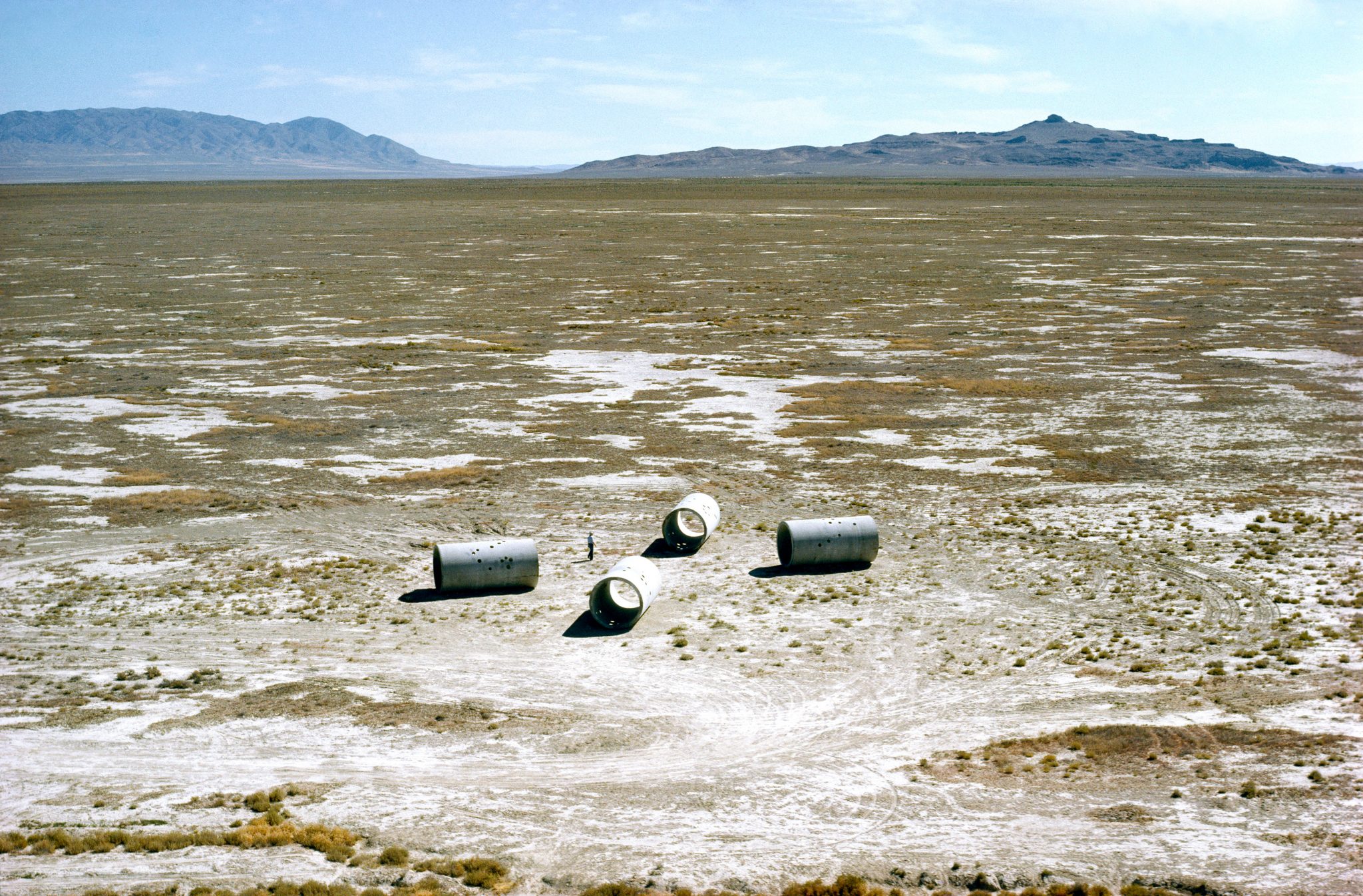
Driving from Salt Lake City to Nancy Holt’s Sun Tunnels (1973–76), one notices the Cowboy Bar & Cafe on the side of a narrow road that branches off the highway, winding its way up towards the ghost town of Lucin. As of late, the bar has been sporting a Trump 2024 banner on its marquee, and a sticker by the door reads, ‘I support my local police’. Inside, amid American flags sticking out of water pitchers and advertisements for Pabst Blue Ribbon, one finds a pool table, slot machines and possibly a handful of day drinkers clustered around a table. Fifty years ago, Holt used to drop in on her way from the Las Vegas airport to the 40 acres she purchased in the Great Basin Desert, where she oversaw the construction of her best-known work of Land art: four 22-ton concrete culverts, each measuring 2.8 metres in diameter and 5.5 metres in length, arranged in an open x on the flat, arid ground.
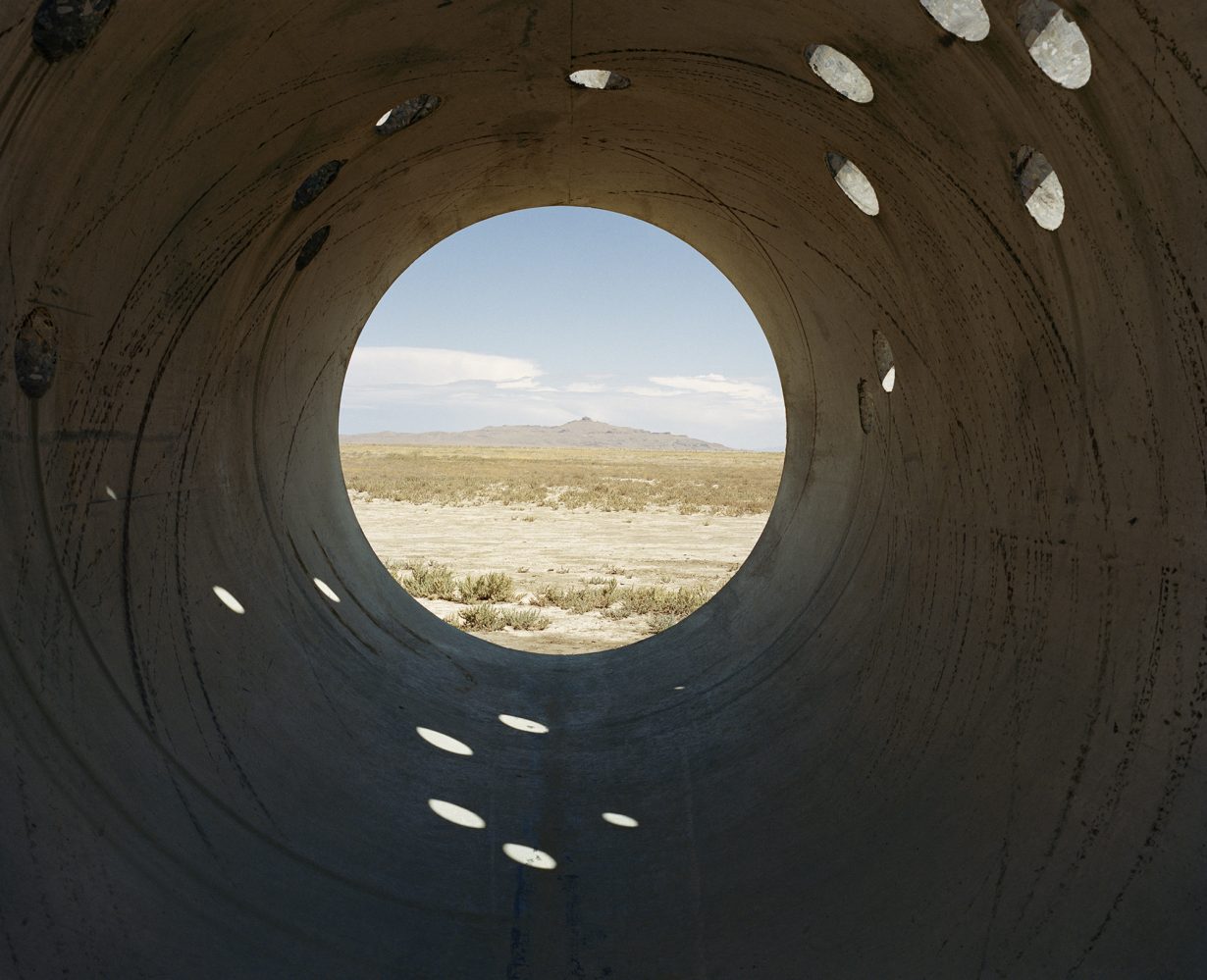
Writing in 1977, the late New York artist expressed a desire for Sun Tunnels to bring sections of a blurry and ‘overwhelming’ landscape into focus. Accordingly, entering the tunnels allows one to tune out a great deal of sensory input from the environment. Bound within a circular aperture, the low-lying Pilot mountains, the clouds and the desert grasses congeal into a framed picture not unlike the establishing shot of a silent Western, while the shaded interiors of the cylinders form something akin to a ‘black box’ viewing room. Put another way, the tunnels cut off peripheral vision, turning visitors into frogs peering out from the shafts of dark wells.
If visitors arrive at the Great Basin Desert with mental images of towns, ranches, roads and rest stops encountered en route, the spectacle of Sun Tunnels bleaches away these prior impressions. The sculpture does not pretend to care for ethnography. Nevertheless, when sunlight streams through the face-size holes cut from the sides of the concrete drums – in configurations that mimic the constellations Capricorn, Columba, Draco and Perseus – one notices that the tunnels’ interiors are streaked with crisscrossing brown lines, which appear in neither archival photographs of the work nor Holt’s 1978 film memorialising its construction process. According to news reports, the lines were made by locals firing bullets into the tunnels for sport. How the work is used when curators and art historians aren’t looking reveals a tension between what lies inside and outside Holt’s apertures. Beyond what experience can be neatly framed for a viewer lies the disorder, violence and ad hoc thrills of a wider society.
Holt seemed drawn to framing devices from the start: Views through a Sand Dune (1972) involved the insertion of a cement-asbestos pipe into a sand dune on Narragansett Beach, Rhode Island. But far from caring only about the view, Holt was also aware of what frames exclude: unpictured people haunt the edges of her short film Pine Barrens (1975). Shot in southern New Jersey Pine Barrens consists of footage of what Holt, who grew up in that state, called ‘the forgotten land of the northeastern urban belt’. Here we see evergreens and white sand filmed from a moving vehicle. In voiceover, residents of the plains – who call themselves ‘Pineys’ – comment on the scenery. Although we do not see them, we learn how they self-identify: as solitary, grounded and hardworking individuals, unlike city folk who earn “big money for little work”. “The good ol’ Pineys don’t ask any help from anyone,” one woman says, her spectrality adding a touch of mystery to the cliché.
The voices of the southern New Jerseyites are at once integral and accessory to Pine Barrens. As is the psychology of the American West to Sun Tunnels. ‘I want to set up always the tension between the outside, or the periphery, and the centre’, Holt once said regarding a different sculpture (Annual Ring, 1981). ‘There should always be that edge when you’re in you think about being out. [W]hen you’re out you think about being in.’ She was speaking literally about how people interact with her work, but the same logic applies to the friction between what sits in art’s frame and the Wild West, as it were, exterior to it. Perhaps the point is that when one is outside a work like Sun Tunnels, one yearns for the pristinely framed view that the apertures afford. And when one is cradled in the concrete cylinders, secluded and dislocated, one should instinctively want out.
Nancy Holt: MoonSunStarEarthSkyWater is on view at Goodwood Art Foundation, Chichester, through 1 November
From the April & May 2026 issue of ArtReview – get your copy.