The artist’s latest presentation at the Cisternerne ascends to new heights of affecting, if slightly excessive, melodrama
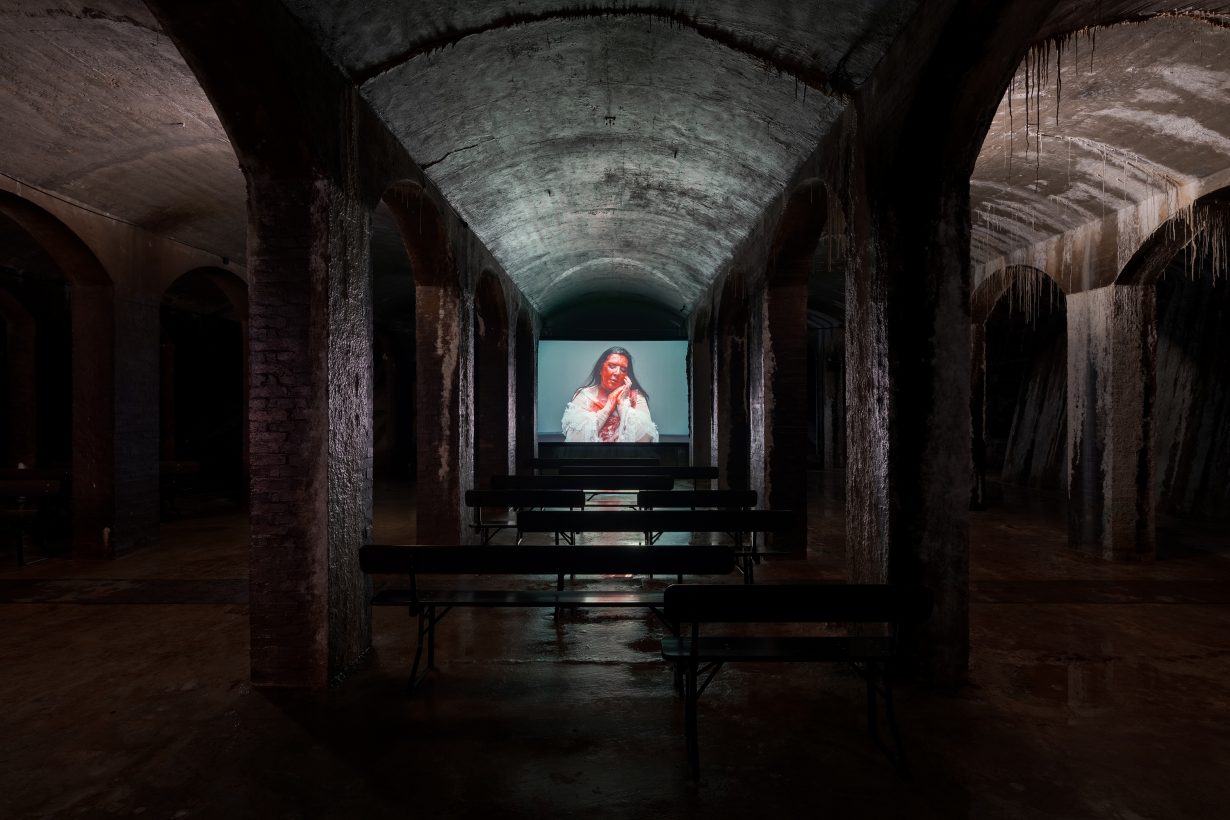
How many times do we need to see Marina Abramović die? Since the 1970s, the storied performance artist has submitted her body to all manners of punishment. In Copenhagen’s Cisternerne – the cavernous former cistern complex beneath Søndermarken park that now serves as an exhibition space – Abramović dies seven times, in seven lavishly cinematic films. Each of these is displayed on a towering screen that visitors must discover by exploring the subterranean gloom, stepping through puddles along the way.
Each film interprets a famous female death scene from an opera, soundtracked by an aria sung by the late American-Greek soprano Maria Callas; the audio reverberates through the caves. Aficionados will enjoy unpacking Abramović’s imaginings, novices will still feel the soaring emotion of her performances. Abramović has long been fascinated by Callas, whose voice she remembers hearing in her grandmother’s kitchen. There are eerie similarities between the two women as well, not least in their physical likeness. They both also experienced misfortune in love – Callas in her tumultuous relationship with Aristotle Onassis, Abramović in hers with Ulay. But while Abramović survived heartbreak, Callas died alone in her Paris apartment.
The films, starring herself and actor Willem Dafoe, were first shown at Lisson Gallery, London, in 2021 and as the backdrop for the 7 Deaths of Maria Callas opera that toured Europe between 2020 and 2023. This is the first time the films can be experienced as an installation, where visitors have to move between screens to see the deaths played one after another. This movement facilitates a new communal encounter with said demises, with the dramatic surroundings of the Cisterns undoubtedly adding a sensorial layer to their emotional intensity.
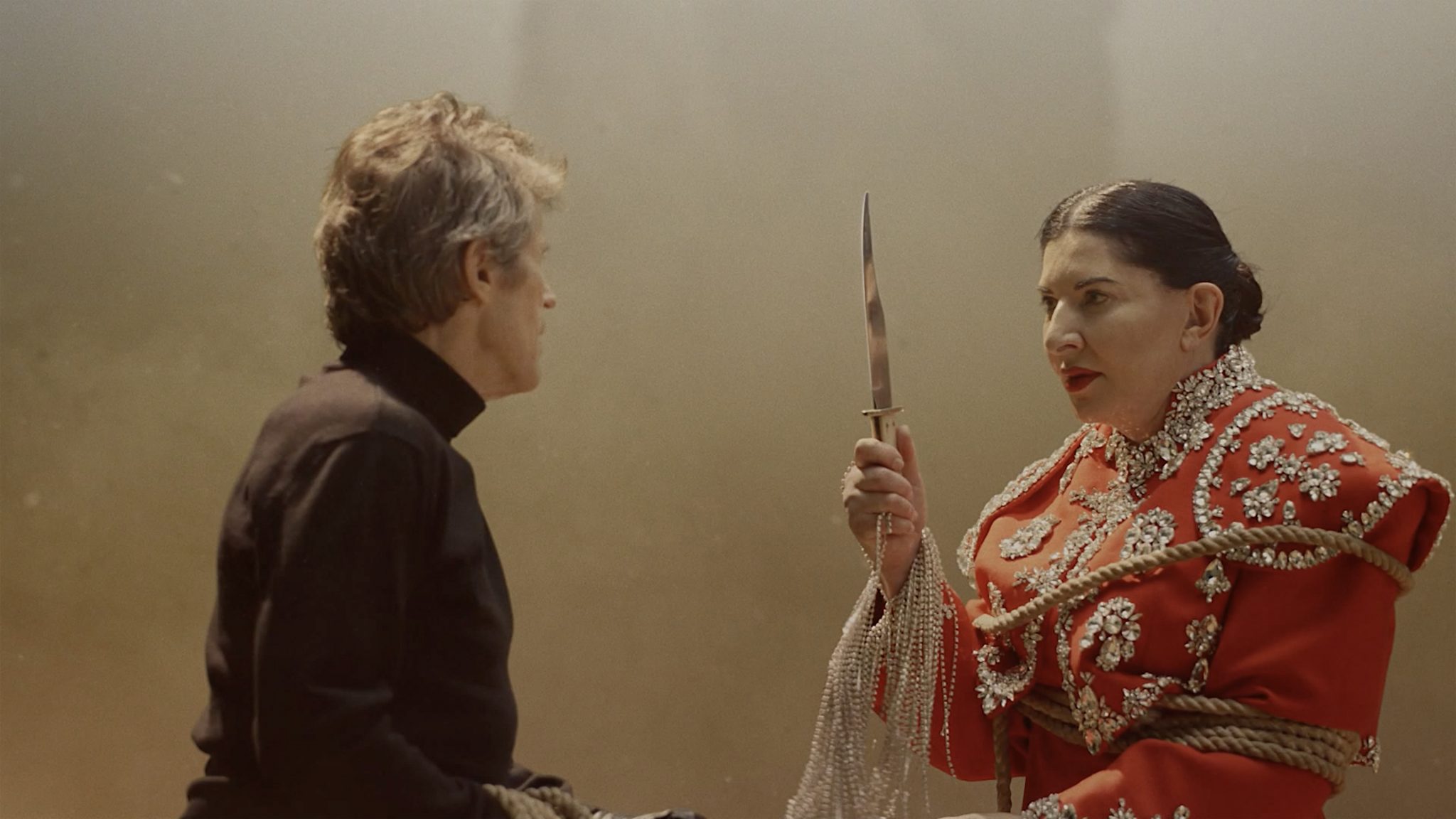
The films’ resonance, in turn, depends on which is running when you descend into the Cisterns. One might imagine there to be a happy (yet tragic) ending for Dafoe and Abramović in their homage to Norma (1831), when the duo walk into burning flames. The first death in the sequence was initially conceived as Violetta’s from La traviata (1853), succumbing to tuberculosis, Abramović dying as a gust of wind extinguishes a candle at her bedside. Abramović kills herself three times: jumping from a skyscraper as the title character in Tosca (1900); surrendering to madness as the protagonist in Lucia di Lammermoor (1835); and breathing the poisoned air of a postapocalyptic world (these are not all period-faithful renderings) as Cio-Cio-San in Madama Butterfly (1904). Dafoe, meanwhile, is responsible for two deaths: looping snakes around Abramović as Desdemona from Otello (1887) and stabbing her as Carmen (1875).
As a feminist commentary on the female embodiment of heartbreak, Abramović and Callas’s shared performance is substantial enough: Dafoe feels like an addendum, though both artist and actor possess an electric presence and clearly delight in the highs and lows of operatic extravagance. Where the films point towards a more interesting conversation are the moments where Abramović toys with gender. In the Carmen film, the heroine is now a bullfighter, rather than the lover of one. In Norma, Dafoe appears in an elaborate gown, face painted, while Abramović is in full tuxedo, offering a welcome twist on the operatic female role as a vessel for tragedy and the typical power dynamics of male-female relationships. Though Abramović still perishes, of course.
As with much of her work, Abramović draws attention to the link between life and death, selfsacrifice and salvation, the films newly amplified by the environment of the Cisterns. Her reincarnation reflects our willingness to begin the cycle over and over again. Where there might have once been redemption, though, in the caves there is no clear beginning or end. Instead, Seven Deaths ascends to new heights of affecting, if slightly excessive, melodrama and locks us into the cycle.
Marina Abramović: Seven Deaths is on view at Cisternerne, Copenhagen, through 30 November
From the Summer 2026 issue of ArtReview – get your copy.
Read next What Keeps Marina Abramović Going?