It’s time the artist received the credit she is due
Should Hung Hsien’s name be new to you, blame the long-lasting invisibility of women artists, of Taiwanese artists and of many ink artists, too: her work may have been perceived as niche in three different ways, but it would be surprising if this state of affairs were to last much longer. To make matters worse, Hung Hsien (born in Yangzhou, China, in 1933) has also been talked about with three different names: her own; Margaret Chang, when she was using her English name and her husband’s (architect T.C. Chang) surname; and Hong Xian, the Mandarin pinyin version of Hung Hsien. A retrospective at Asia Society Hong Kong shows just what a master she is, and how well she controls her chosen medium, Chinese ink, to produce cell-like, dreamlike, water-and-cloudlike shapes that linger in front of one’s eyes long after having seen them.
Hung started her formal education in Taiwan, after she had moved there with her family in 1948 (just before the end of the Chinese Civil War) and started to paint under the supervision of Puru, a Qing dynasty prince and acclaimed painter, and at the National Taiwan Normal University. In 1958 she moved to the United States, where she continued her studies, and began to merge her classical Chinese ink education with Abstract Expressionism, developing a unique visual language. Liu Kuo-sung (born in 1932), one of Taiwan’s best-known ink painters and founder of the Fifth Moon Group, reconnected with her during a trip to the US in the mid-1960s, and she became one of Fifth Moon’s few female members. The group’s production is not very uniform, but what links them is a deep knowledge of ink painting, and a desire to move its aesthetics and techniques into more international and modern visual rhythms.
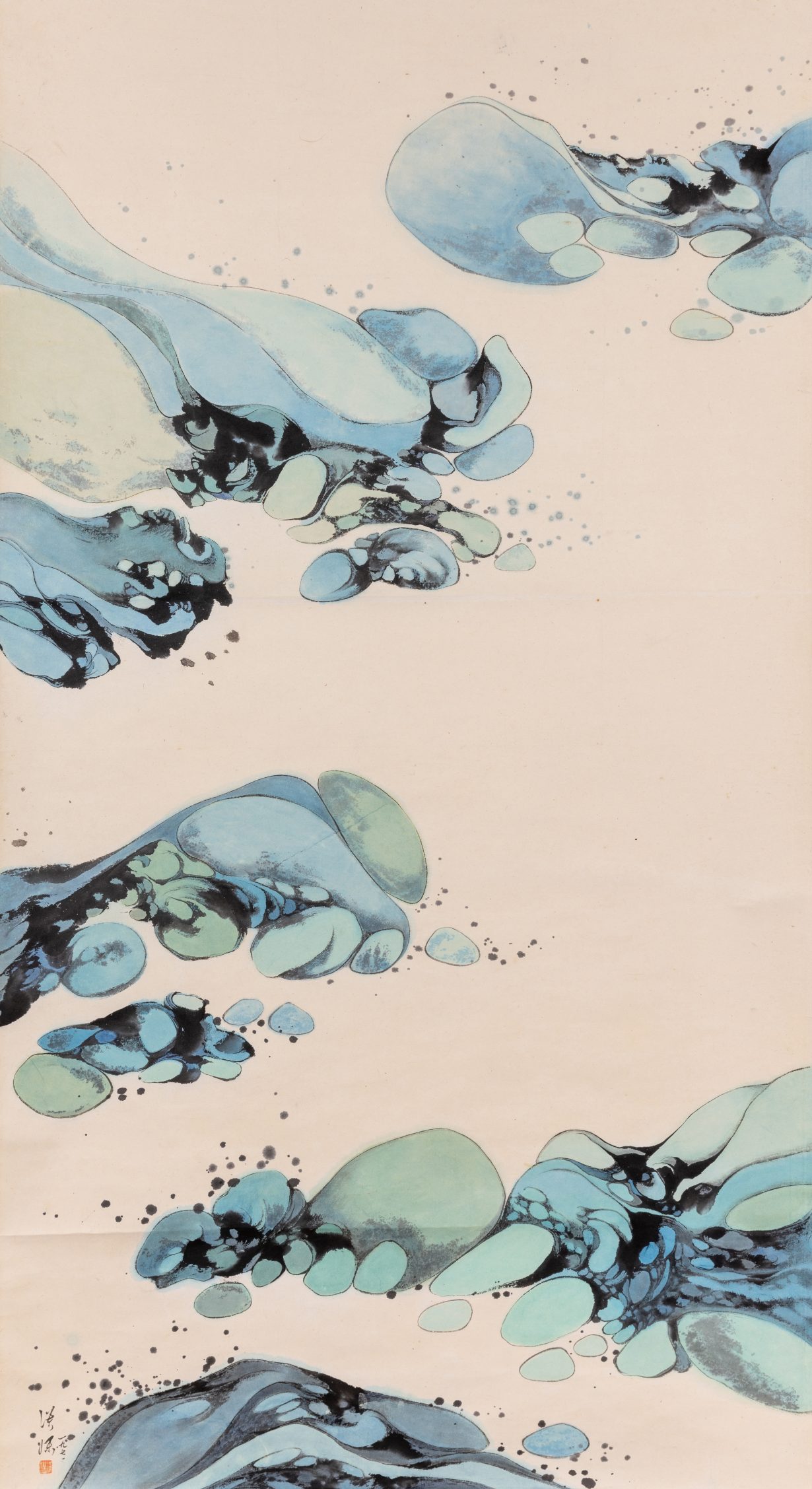
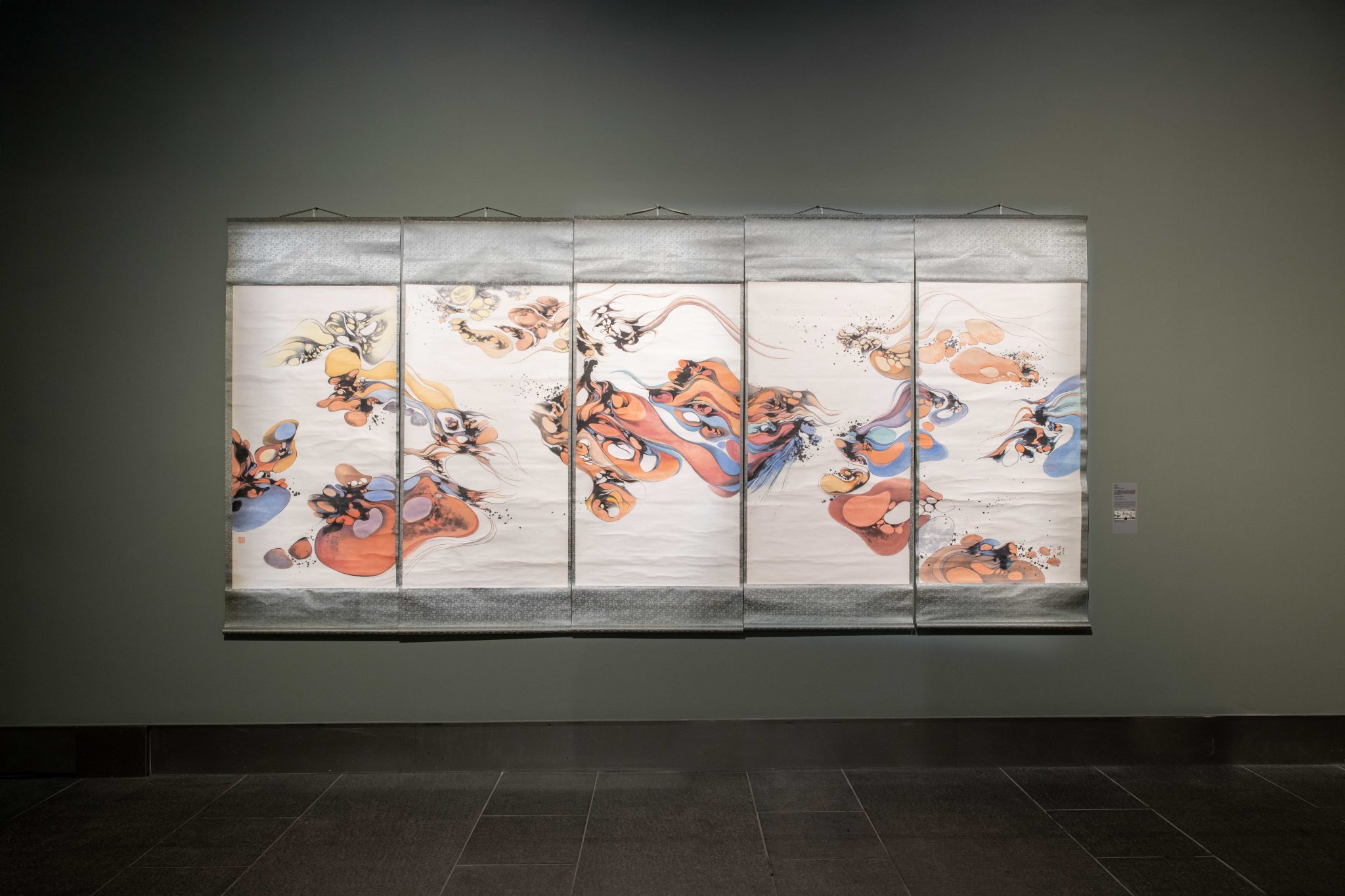
The show in Hong Kong offers the chance to see a wide arc of Hung’s production, from her diligent student days to her signature organic, floating forms that take the shape of water and pebbles and boulders and clouds. Early works such as Sea of Clouds, a black-and-white ink painting from 1955, echo beautifully with more mature pieces like Pond of Heaven (1971) and Emerald Island (1971): her brush is skilled, immersed in nature, both in its naturalistic version and in its fantastical transposition. In such works, we can appreciate how a more abundant use of colour changed Hung’s perspective. The pale blues and watery greens together with the black ink flow organically against a background of white space, like floating bubbles in an expansive dream. Also on show is the large Heaven and Earth (1971), five continuous vertical scrolls where orange, pink, yellow, blue and grey are entangled together in forms that could be emerging from the thick, white mist of a classical Chinese landscape, as they twirl around an empty space that emphasises their amoebalike presence. It’s a reminder that a certain form of abstraction has been intrinsic in much of Chinese painting – with its calligraphic influences, where words morph into the emotion with which they are written, and its consciousness of space and distance, that morphs clouds, woods and waterways into their own memory. Hung pushes this into her own modernity through the vivid palette she has selected, giving negative, white spaces a magnificent role. It’s time she received the credit she is due.
Hung Hsien: Between Worlds at Asia Society, Hong Kong, 25 March – 21 June
From the Summer 2026 issue of ArtReview Asia – get your copy.